overheating HONDA RIDGELINE 2017 2.G Owners Manual
[x] Cancel search | Manufacturer: HONDA, Model Year: 2017, Model line: RIDGELINE, Model: HONDA RIDGELINE 2017 2.GPages: 606, PDF Size: 13.21 MB
Page 3 of 606
Contents
This owner’s manual should be considered a permanent part of the
vehicle and should remain with the vehicle when it is sold.
This owner’s manual covers all models of your vehicle. You may find
descriptions of equipment and features that are not on your
particular model.
Images throughout this owner’s manual (including the front cover)
represent features and equipment that are available on some, but
not all, models. Your particular mo del may not have some of these
features.
This owner’s manual is for vehicles sold in the United States and
Canada.
The information and specifications in cluded in this publication were
in effect at the time of approval for printing. Honda Motor Co., Ltd.
reserves the right, however, to discontinue or change specifications
or design at any time without notice and without incurring any
obligation.2 Safe Driving P. 27
For Safe Driving P. 28 Seat Belts P. 33 Airbags P. 40
2Instrument Panel P. 71
Indicators P. 72 Gauges and Multi-Information Display P. 101
2Controls P. 107
Clock P. 108 Locking and Unlocking the Doors P. 109
Security System P. 131 Opening and Closing the Windows P. 134
Adjusting the Mirrors P. 159 Adjusting the Seats P. 161
Heating and Cooling System
* P. 193
2 Features P. 197
Audio System P. 198
General Information on the Audio System P. 296
HomeLink ® Universal Transceiver
* P. 334 Bluetooth ® HandsFreeLink ® P. 337, 362
2 Driving P. 395
Before Driving P. 396 Towing a Trailer P. 404
Parking Your Vehicle P. 487Multi-View Rear Camera P. 496
2Maintenance P. 503
Before Performing Maintenance P. 504 Maintenance MinderTM P. 507
Checking and Maintaining Wiper Blades P. 529
Heating and Cooling System
*/Climate Control System* Maintenance P. 542
2 Handling the Unexpected P. 551
Tools P. 552 If a Tire Goes Flat P. 553
Overheating P. 569 Indicator, Coming On/Blinking P. 571
When You Cannot Unlock the Fuel Fill Door P. 581
2 Information P. 585
Specifications P. 586 Identification Numbers P. 588
Emissions Testing P. 591 Warranty Coverages P. 593
Page 24 of 606
Quick Reference Guide
23
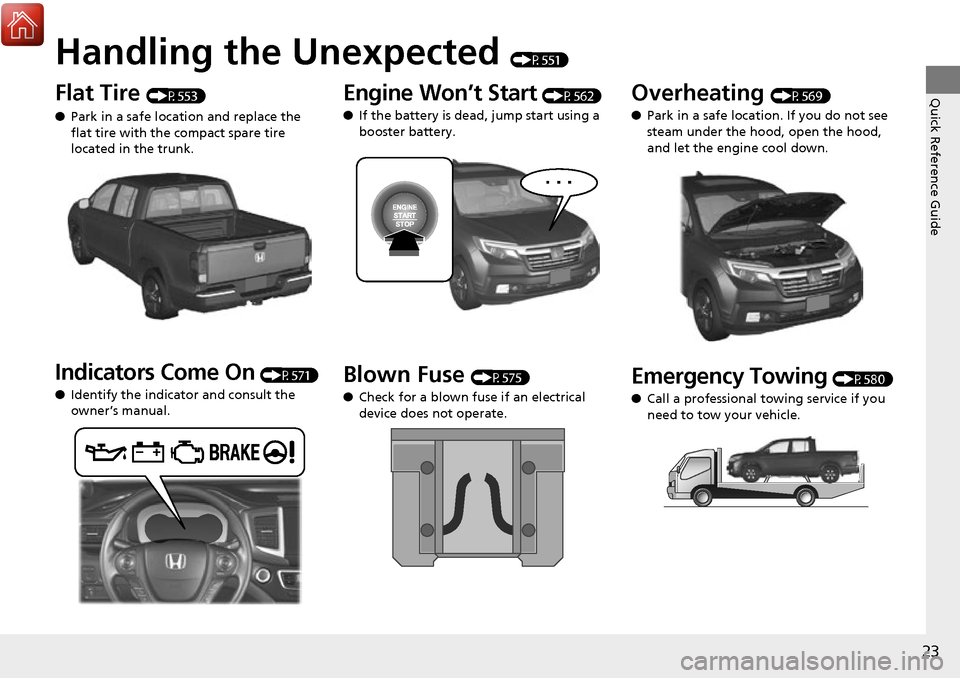
Handling the Unexpected (P551)
Flat Tire (P553)
● Park in a safe location and replace the
flat tire with the compact spare tire
located in the trunk.
Indicators Come On (P571)
● Identify the indica tor and consult the
owner’s manual.
Engine Won’t Start (P562)
● If the battery is dead, jump start using a
booster battery.
Blown Fuse (P575)
● Check for a blown fuse if an electrical
device does not operate.
Overheating (P569)
● Park in a safe location. If you do not see
steam under the hood, open the hood,
and let the engine cool down.
Emergency Towing (P580)
● Call a professional towing service if you
need to tow your vehicle.
Page 91 of 606
90
uuIndicators uMulti-Information Display Warn ing and Information Messages
Instrument Panel
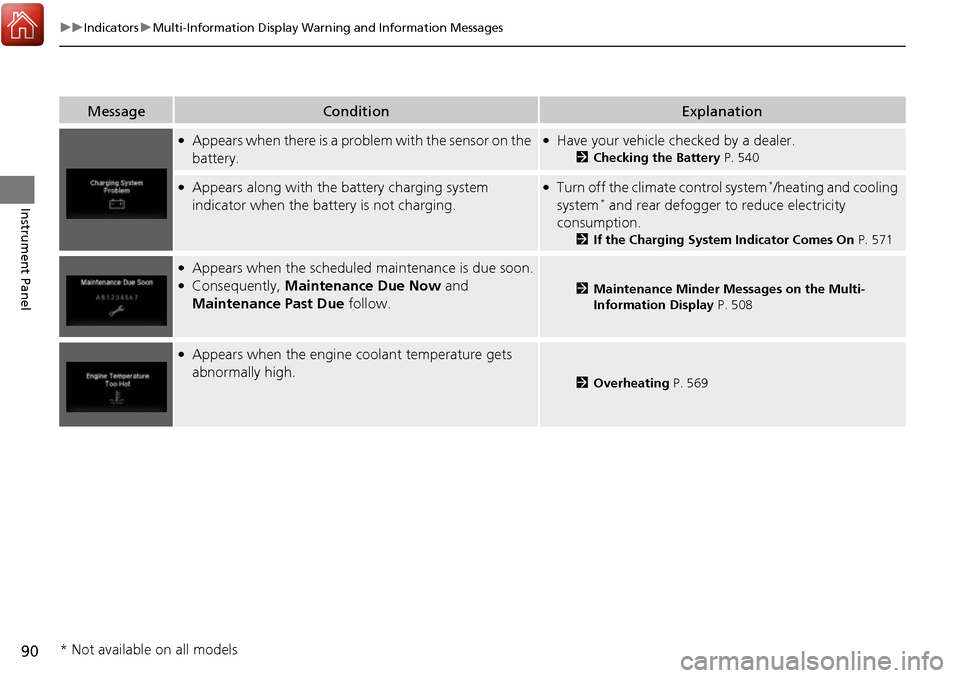
MessageConditionExplanation
●Appears when there is a problem with the sensor on the
battery.●Have your vehicle checked by a dealer.
2Checking the Battery P. 540
●Appears along with the battery charging system
indicator when the battery is not charging.●Turn off the climate control system*/heating and cooling
system* and rear defogger to reduce electricity
consumption.
2 If the Charging System Indicator Comes On P. 571
●Appears when the scheduled maintenance is due soon.●Consequently, Maintenance Due Now and
Maintenance Past Due follow.2Maintenance Minder Messages on the Multi-
Information Display P. 508
●Appears when the engine coolant temperature gets
abnormally high.
2Overheating P. 569
* Not available on all models
Page 94 of 606
93
uuIndicators uMulti-Information Display Warning and Information Messages
Continued
Instrument Panel
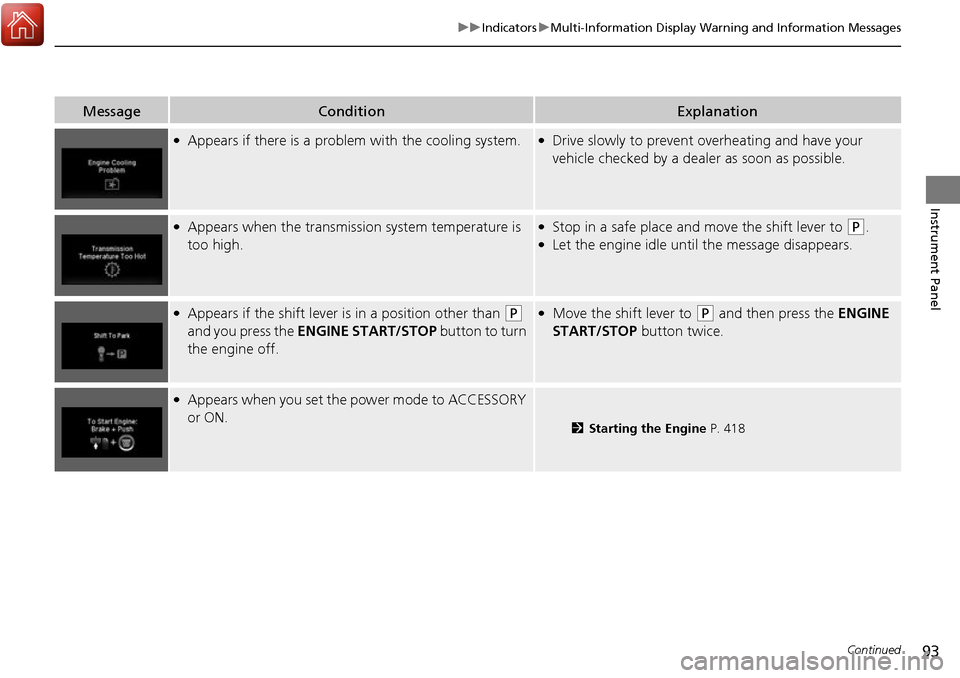
MessageConditionExplanation
●Appears if there is a problem with the cooling system.●Drive slowly to prevent overheating and have your
vehicle checked by a dealer as soon as possible.
●Appears when the transmission system temperature is
too high.●Stop in a safe place and move the shift lever to (P.●Let the engine idle until the message disappears.
●Appears if the shift lever is in a position other than (P
and you press the ENGINE START/STOP button to turn
the engine off. ●Move the shift lever to (P and then press the ENGINE
START/STOP button twice.
●Appears when you set the power mode to ACCESSORY
or ON.
2 Starting the Engine P. 418
Page 102 of 606
101
Instrument Panel
Gauges and Multi-Information Display
Gauges
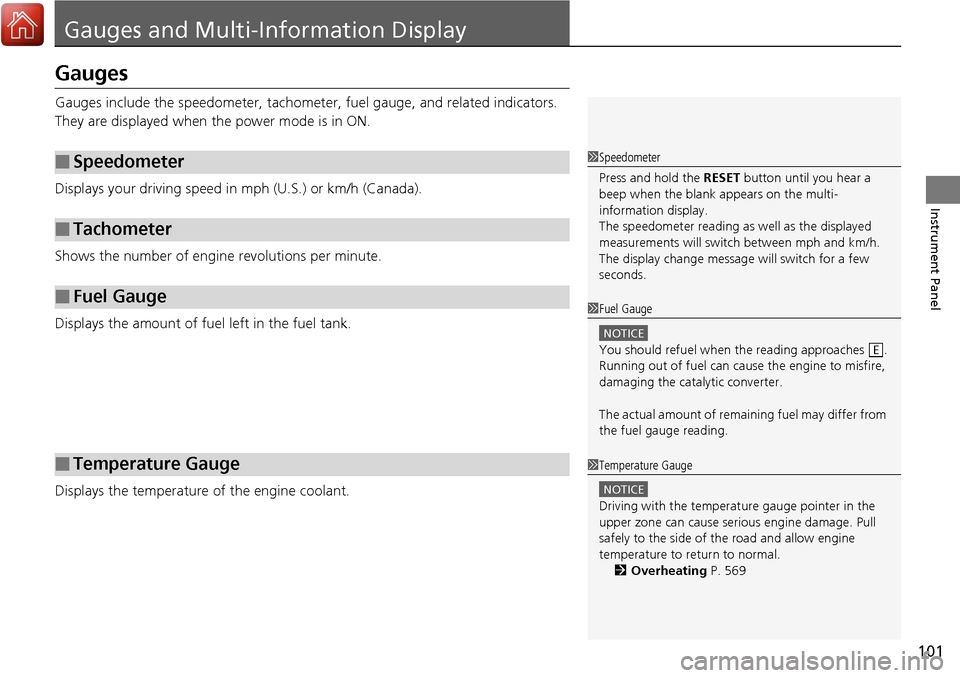
Gauges include the speedometer, tachometer, fuel gauge, and related indicators.
They are displayed when the power mode is in ON.
Displays your driving speed in mph (U.S.) or km/h (Canada).
Shows the number of engine revolutions per minute.
Displays the amount of fuel left in the fuel tank.
Displays the temperature of the engine coolant.
■Speedometer
■Tachometer
■Fuel Gauge
■Temperature Gauge
1Speedometer
Press and hold the RESET button until you hear a
beep when the blank appears on the multi-
information display.
The speedometer reading as well as the displayed
measurements will switch between mph and km/h.
The display change message will switch for a few
seconds.
1 Fuel Gauge
NOTICE
You should refuel when the reading approaches .
Running out of fuel can cause the engine to misfire,
damaging the cata lytic converter.
The actual amount of remain ing fuel may differ from
the fuel gauge reading.E
1 Temperature Gauge
NOTICE
Driving with the temperat ure gauge pointer in the
upper zone can cause serious engine damage. Pull
safely to the side of th e road and allow engine
temperature to return to normal. 2 Overheating P. 569
Page 532 of 606
531
Maintenance
Checking and Maintaining Tires
Checking Tires
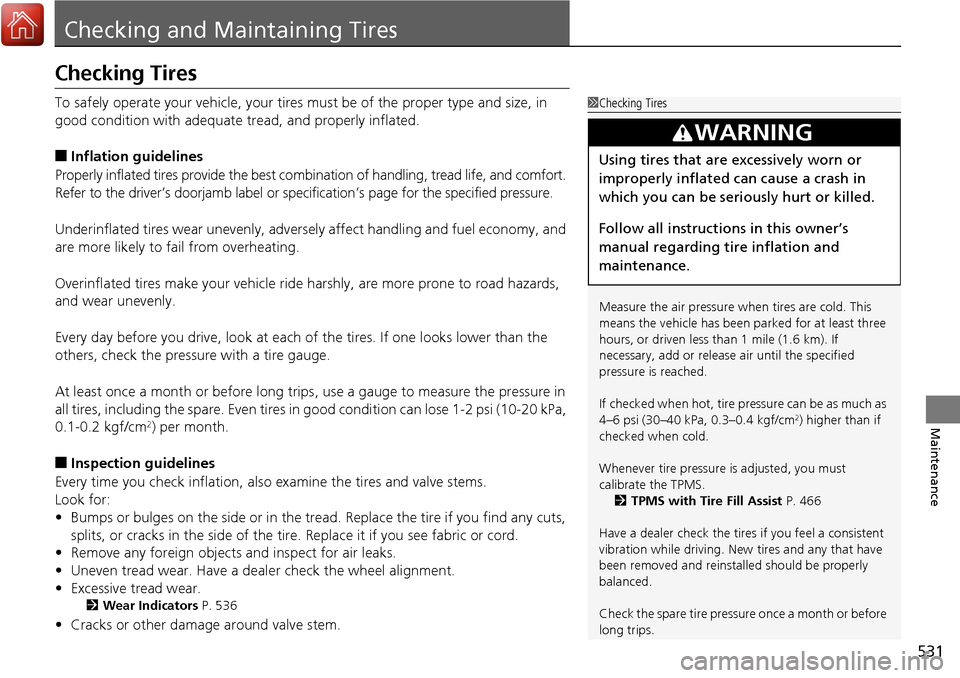
To safely operate your vehicle, your tires must be of the proper type and size, in
good condition with adequate tread, and properly inflated.
■Inflation guidelines
Properly inflated tires provid e the best combination of handling, tread life, and comfort.
Refer to the driver’s doorjamb label or spec ification’s page for the specified pressure.
Underinflated tires wear unev enly, adversely affect handling and fuel economy, and
are more likely to fail from overheating.
Overinflated tires make your vehicle ride ha rshly, are more prone to road hazards,
and wear unevenly.
Every day before you drive, look at each of the tires. If one looks lower than the
others, check the pressure with a tire gauge.
At least once a month or before long trips , use a gauge to measure the pressure in
all tires, including the spare. Even tires in good condition can lose 1-2 psi (10-20 kPa,
0.1-0.2 kgf/cm
2) per month.
■Inspection guidelines
Every time you check inflation, also examine the tires and valve stems.
Look for:
• Bumps or bulges on the side or in the tr ead. Replace the tire if you find any cuts,
splits, or cracks in the side of the tire . Replace it if you see fabric or cord.
• Remove any foreign objects and inspect for air leaks.
• Uneven tread wear. Have a deal er check the wheel alignment.
• Excessive tread wear.
2 Wear Indicators P. 536
•Cracks or other damage around valve stem.
1Checking Tires
Measure the air pressure when tires are cold. This
means the vehicle has been parked for at least three
hours, or driven less than 1 mile (1.6 km). If
necessary, add or releas e air until the specified
pressure is reached.
If checked when hot, tire pressure can be as much as
4–6 psi (30–40 kPa, 0.3–0.4 kgf/cm
2) higher than if
checked when cold.
Whenever tire pressure is adjusted, you must
calibrate the TPMS. 2 TPMS with Tire Fill Assist P. 466
Have a dealer check the tires if you feel a consistent
vibration while driving. Ne w tires and any that have
been removed and reinst alled should be properly
balanced.
Check the spare tire pressu re once a month or before
long trips.
3WARNING
Using tires that are excessively worn or
improperly inflated can cause a crash in
which you can be seriously hurt or killed.
Follow all instruction s in this owner’s
manual regarding ti re inflation and
maintenance.
Page 552 of 606
551
Handling the Unexpected
This chapter explains how to handle unexpected troubles.
ToolsTypes of Tools .................................. 552
If a Tire Goes Flat Changing a Flat Tire ......................... 553
Engine Does Not Start Checking the Engine ........................ 562
If the Smart Entry Remote Battery is Weak .......................................... 563
Emergency Engine Stop ................... 564
Jump Starting .................................... 565
Shift Lever Does Not Move .............. 568Overheating
How to Handle Overheating............. 569
Indicator, Coming On/Blinking
If the Low Oil Pressure Indicator Comes On ............................................. 571
If the Charging System Indicator Comes
On ................................................. 571
If the Malfunction Indicator Lamp Comes On or Blinks ................................... 572
If the Brake System Indicator (Red) Comes On .................................................... 573
If the Electric Power Steering (EPS) System
Indicator Comes On ........................... 573 If the Low Tire Pressure/Tire Pressure
Monitoring System (TPMS) Indicator Comes
On or Blinks........................................ 574
Fuses
Fuse Locations ................................. 575
Inspecting and Changing Fuses ........ 579
Emergency Towing ........................... 580
When You Cannot Unlock the Fuel Fill Door ................................................. 581
Refueling
Refueling From a Portable Fuel Container ................................... 582
Page 570 of 606
569Continued
Handling the Unexpected
Overheating
How to Handle Overheating
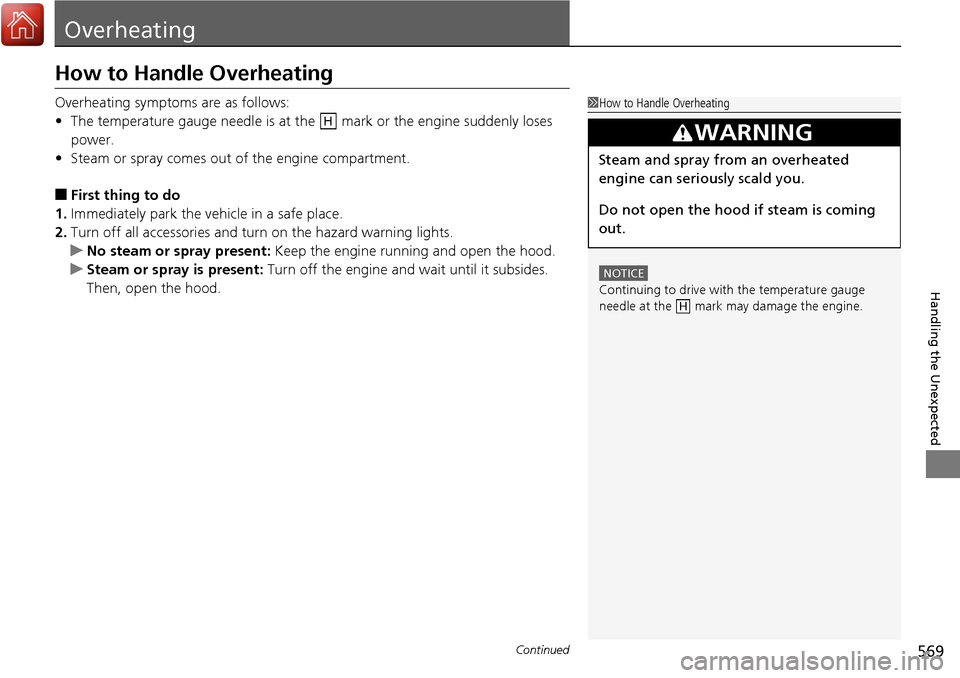
Overheating symptoms are as follows:
•The temperature gauge needle is at the mark or the engine suddenly loses
power.
• Steam or spray comes out of the engine compartment.
■First thing to do
1. Immediately park the vehicle in a safe place.
2. Turn off all accessories and turn on the hazard warning lights.
u No steam or spray present: Keep the engine running and open the hood.
u Steam or spray is present: Turn off the engine and wait until it subsides.
Then, open the hood.
1 How to Handle Overheating
NOTICE
Continuing to drive with the temperature gauge
needle at the mark may damage the engine.
3WARNING
Steam and spray from an overheated
engine can seriously scald you.
Do not open the hood if steam is coming
out.
H
H
Page 571 of 606
uuOverheating uHow to Handle Overheating
570
Handling the Unexpected
■Next thing to do
1.Check that the cooling fan is operating and
stop the engine once the temperature
gauge needle goes down.
u If the cooling fan is not operating,
immediately stop the engine.
2. Once the engine has cooled down, inspect
the coolant level an d check the cooling
system components for leaks.
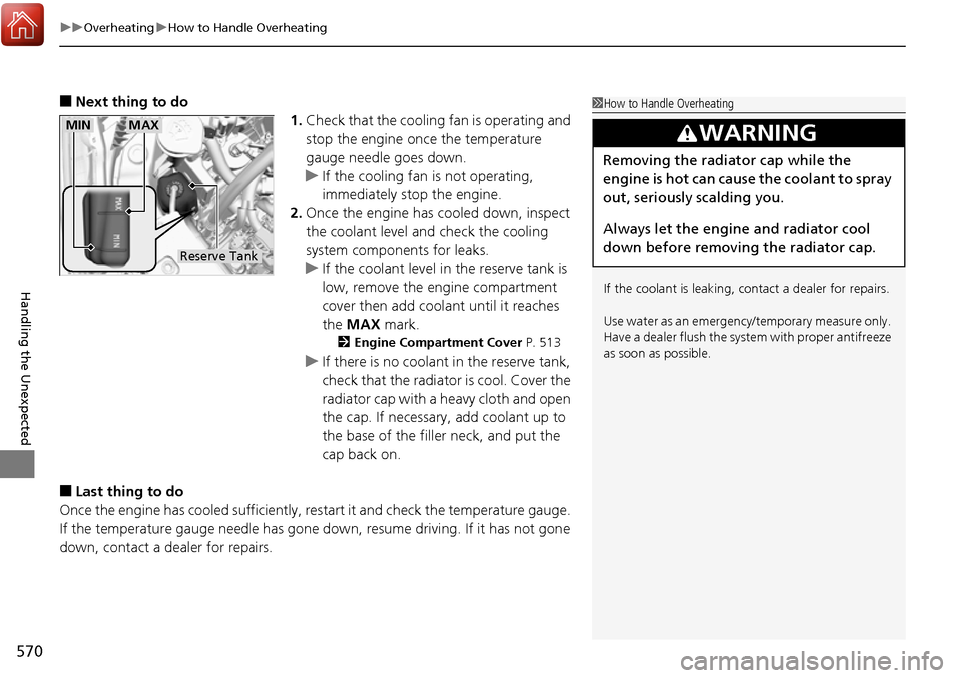
u If the coolant level in the reserve tank is
low, remove the engine compartment
cover then add coolant until it reaches
the MAX mark.
2Engine Compartment Cover P. 513
uIf there is no coolan t in the reserve tank,
check that the radiator is cool. Cover the
radiator cap with a heavy cloth and open
the cap. If necessary, add coolant up to
the base of the filler neck, and put the
cap back on.
■Last thing to do
Once the engine has cooled sufficiently, re start it and check the temperature gauge.
If the temperature gauge needle has gone do wn, resume driving. If it has not gone
down, contact a dealer for repairs.
1 How to Handle Overheating
If the coolant is leaking, contact a dealer for repairs.
Use water as an emergency/temporary measure only.
Have a dealer flush the system with proper antifreeze
as soon as possible.
3WARNING
Removing the radiator cap while the
engine is hot can cause the coolant to spray
out, seriously scalding you.
Always let the engine and radiator cool
down before removing the radiator cap.
Reserve Tank
MAXMIN
Page 600 of 606
599
Index
Collision Mitigation Braking SystemTM
(CMBSTM) ................................................. 478
Indicator ............................................. 86, 87
Compact Spare Tire .......................... 553, 587
Console Compartment ............................. 172
Controls .................................................... 107
Conversation Mirror ................................ 177
Coolant (Engine) ...................................... 519
Adding to the Radiator ........................... 520
Adding to the Reserve Tank .................... 519
Overheating ............................................ 569
Creeping (Automatic Transmission) ........ 425
Cross Traffic Monitor ............................... 492
Cruise Control .......................................... 431
Indicator ................................................... 80
Cup Holders .............................................. 173
Customer Service Information ................ 596
Customized Features ............................... 303
D
Daytime Running Lights .......................... 148
Dead Battery ............................................ 565
Defaulting All the Settings ...................... 333
Defogger/Heated Door Mirror ................ 154
Defrosting the Windshield and Windows ......................................... 187, 196
Devices that Emit Radio Waves ............... 589
Dimming Headlights .............................................. 144
Rearview Mirror ...................................... 159 Dipstick (Engine Oil)
................................. 515
Directional Signals (Turn Signal) ............. 143
Display Button .......................................... 223
Door Mirrors ............................................. 160
Doors ......................................................... 109
Auto Door Locking .................................. 122
Auto Door Unlocking ............................... 122
Door Open Message ............................ 32, 89
Keys ........................................................ 109
Locking/Unlocking the Doors from the Inside ................................ 14, 119
Locking/Unlocking the Doors from the Outside ................................... 112
Lockout Prevention System ...................... 118
DOT Tire Quality Grading ........................ 534
Driving ....................................................... 395
Adaptive Cruise Control (ACC) ................ 441
Automatic Transmission ........................... 425
Braking .................................................... 474
Cruise Control ......................................... 431
Off-Highway Driving Guidelines ............... 416
Starting the Engine .................................. 418
Driving Guidelines for Your Utility Vehicle ..................................................... 424
Driving Position Memory System ............. 156
Dust and Pollen Filter ............................... 542
E
ECON Button............................................. 428
ECON Mode Indicator ................................ 85 Electric Power Steering (EPS) System
Indicator............................................ 78, 573
Electronic Stability Control (ESC) ............. 462
Emergency ................................................ 580
Emergency Trunk Opener ........................ 130
Emissions Testing (Readiness Codes) ....... 591
Engine ....................................................... 588
Coolant ................................................... 519
Jump Starting .......................................... 565
Oil ........................................................... 514
Remote Engine Start................................ 420
Starting ................................................... 418
Engine Compartment Cover .................... 513
Engine Coolant ......................................... 519
Adding to the Radiator ............................ 520
Adding to the Reserve Tank..................... 519
Overheating ............................................ 569
Temperature Gauge ................................ 101
Engine Oil ................................................. 514
Adding .................................................... 516
Checking................................................. 515
Displaying Oil Life .................................... 507
Low Oil Pressure Indicator ................. 73, 571
Recommended Engine Oil ....................... 514
ENGINE START/STOP Button .................... 140
EPS (Electric Power Steering) System ............................................... 78, 573
Exhaust Gas Hazard
(Carbon Monoxide) .................................. 68
Exterior Care (Cleaning) ........................... 545
Exterior Mirrors ........................................ 160