engine HONDA S2000 2002 1.G Owner's Manual
[x] Cancel search | Manufacturer: HONDA, Model Year: 2002, Model line: S2000, Model: HONDA S2000 2002 1.GPages: 277, PDF Size: 4.81 MB
Page 124 of 277
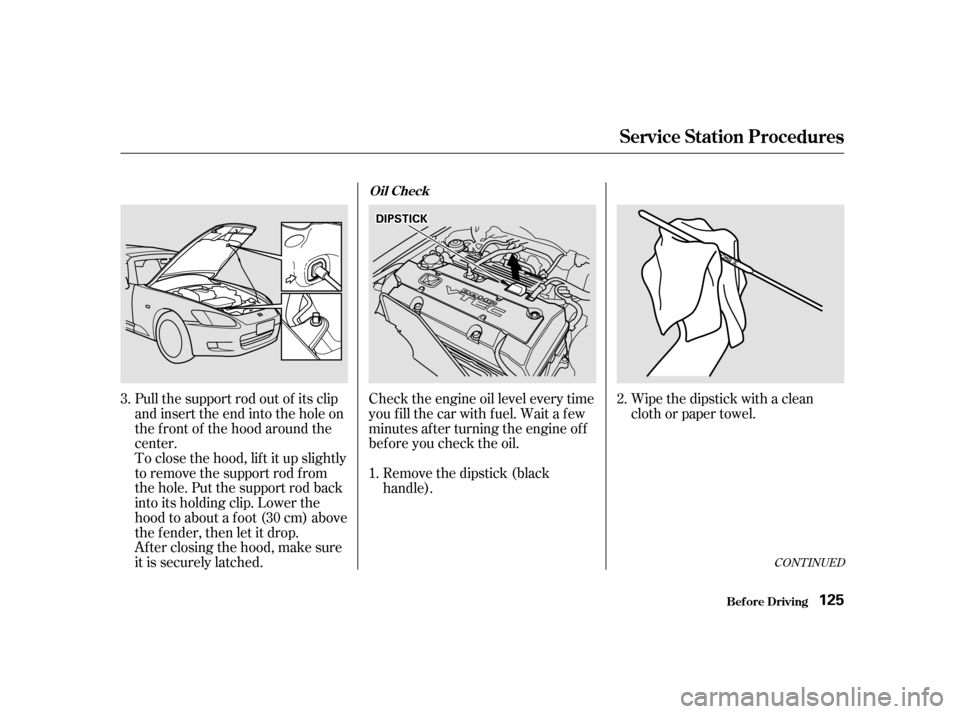
Pull the support rod out of its clip
and insert the end into the hole on
the f ront of the hood around the
center.
To close the hood, lif t it up slightly
to remove the support rod f rom
the hole. Put the support rod back
into its holding clip. Lower the
hood to about a f oot (30 cm) above
the fender, then let it drop.
After closing the hood, make sure
it is securely latched.Check the engine oil level every time
you f ill the car with f uel. Wait a f ew
minutes af ter turning the engine of f
bef ore you check the oil.
Remove the dipstick (black
handle). Wipe the dipstick with a clean
cloth or paper towel.
1.
3.
2.
CONT INUED
Oil Check
Service Station Procedures
Bef ore Driving125
DDIIPPSSTTIICCKK
Page 125 of 277
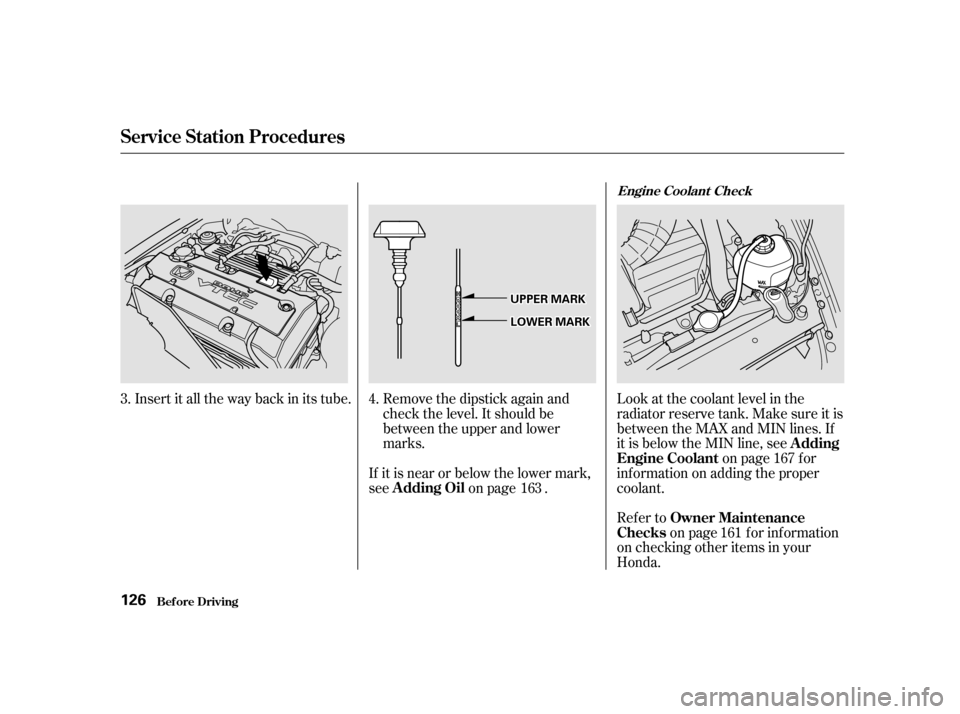
Insert it all the way back in its tube. Remove the dipstick again andcheck the level. It should be
between the upper and lower
marks.
If it is near or below the lower mark,
see on page . Look at the coolant level in the
radiator reserve tank. Make sure it is
between the MAX and MIN lines. If
it is below the MIN line, see
on page f or
informationonaddingtheproper
coolant.
Refer to on page f or inf ormation
on checking other items in your
Honda.
3.
4.
163 167
161
Service Station Procedures
Bef ore Driving A dding Oil
A dding
Engine Coolant
Owner Maintenance
Checks
Engine Coolant Check
126
UUPPPPEERRMMAARRKK
LLOOWWEERRMMAARRKK
Page 126 of 277

You can improve f uel economy by
driving moderately. Rapid acceler-
ation, abrupt cornering, and hard
braking use more f uel.
Always drive in the highest gear that
allows the engine to run and acceler-
ate smoothly.
A cold engine uses more f uel than a
warm engine. It is not necessary to
‘‘warm-up’’ a cold engine by letting it
idle f or a long time. You can drive
away in about a minute, no matter
how cold it is outside. The engine
will warm up f aster, and you get
better f uel economy. To cut down on
the number of ‘‘cold starts,’’ try tocombine several short trips into one.
The condition of your car and your
driving habits are the two most
important things that affect the fuel
mileage you get.
Always maintain your car according
to the maintenance schedule. This
will keep it in top operating condition.
Depending on traf f ic conditions, try
to maintain a constant speed. Every
time you slow down and speed up,
your car uses extra f uel. Use the
cruise control, when appropriate, to
increase f uel economy.The air conditioning puts an extra
load on the engine which makes it
usemorefuel.Turnoff theA/Cto
cutdownonairconditioninguse.
Use the f low-through ventilation
when the outside air temperature is
moderate.
In winter, the build-up of snow on
your car’s underside adds weight and
rolling resistance. Frequent cleaning
helps your f uel mileage and reduces
thechanceof corrosion.
An important part of that mainte-
nance is the
(see page ). For
example, an underinf lated tire
causes more ‘‘rolling resistance,’’
which uses f uel. It also wears out
f aster, so check the tire pressure at
least monthly. 161 Driving Habits
Car Condition
Owner Maintenance
Checks
Bef ore Driving
Fuel Economy
127
Page 134 of 277

This section gives you tips on
starting the engine under various
conditions, and how to operate the
manual transmission. It also includes
important inf ormation on parking
your car, and the braking system.........................
Preparing to Drive . 136
.......................
Starting the Engine . 137
Starting in Cold Weather ....................
at High Altitude . 138
....
6-speed Manual Transmission . 139
.....
Recommended Shif t Points . 140
..............
Engine Speed Limiter . 140
.......................
Reverse Lockout . 140
...........................................
Parking . 141
.....................
The Braking System . 142
.............
Brake Wear Indicators . 142
...............
Brake System Design . 143
.......................
Anti-lock Brakes . 143
Important Saf ety .........................
Reminders . 144
........................
ABS Indicator . 145
...............
Driving in Bad Weather . 146
...........................
Towing a Trailer . 147
Driving
Driving 135
Page 135 of 277

Make sure all windows, mirrors,
and outside lights are clean and
unobstructed. Remove f rost, snow,
or ice.Check that any items you may be
carrying with you inside are stored
properly or f astened down
securely.
Check the adjustment of the seat
(see page ).
Check the adjustment of the
inside and outside mirrors (see
page ).Fasten your seat belt. Check that
your passenger has f astened his or
her seat belt (see page ).
Turn the ignition switch ON (II).
Check the indicator lights in the
instrument panel.
Start the engine (see page ).
Check the gauges and indicator
lights in the instrument panel (see
page ).
Visually check the tires. If a tire
looks low, use a gauge to check its
pressure.
Youshoulddothefollowingchecks
and adjustments every day bef ore
you drive your car.
Check that the hood and trunk are
f ully closed. Make sure the doors are securely
closed and locked.
1. 2. 3. 4. 5. 6. 7.8.9.
10. 11. 43
67
78 137
15
Driving
Preparing to Drive
136
Page 136 of 277
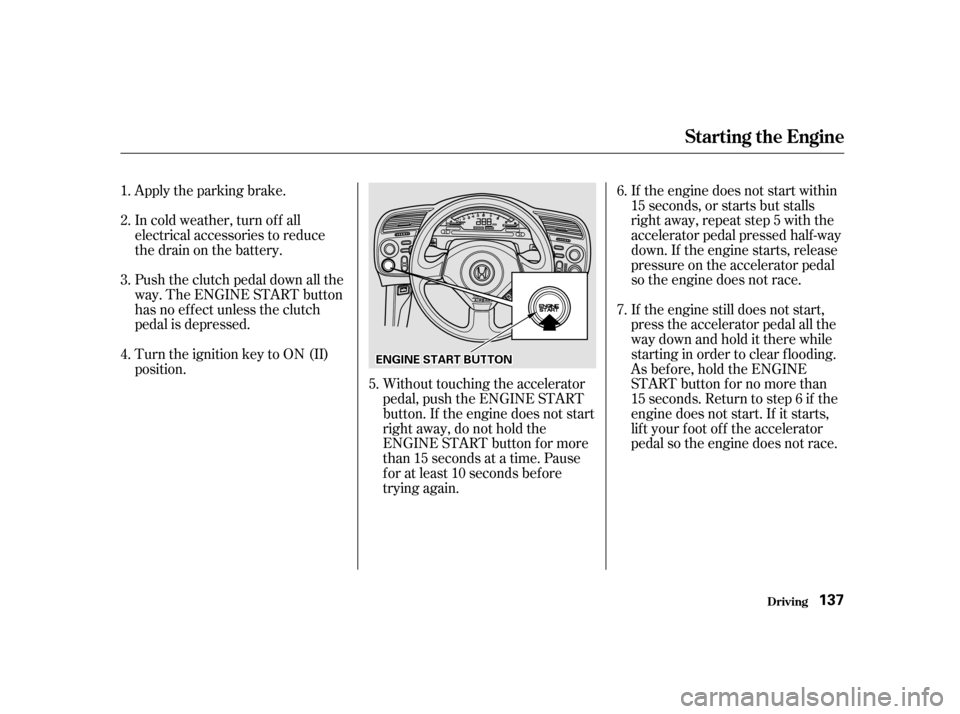
Apply the parking brake.
In cold weather, turn of f all
electrical accessories to reduce
the drain on the battery.
Push the clutch pedal down all the
way. The ENGINE START button
has no ef f ect unless the clutch
pedal is depressed.
Turn the ignition key to ON (II)
position.Without touching the accelerator
pedal, push the ENGINE START
button. If the engine does not start
right away, do not hold the
ENGINE START button f or more
than 15 seconds at a time. Pause
f or at least 10 seconds bef ore
trying again.If the engine still does not start,
press the accelerator pedal all the
way down and hold it there while
starting in order to clear f looding.
As before, hold the ENGINE
START button f or no more than
15 seconds. Return to step 6 if the
engine does not start. If it starts,
lif t your f oot of f the accelerator
pedal so the engine does not race.
If theenginedoesnotstartwithin
15 seconds, or starts but stalls
right away, repeat step 5 with the
accelerator pedal pressed half-way
down. If the engine starts, release
pressure on the accelerator pedal
so the engine does not race.
1. 2. 3. 4.
5.6. 7.
Driving
Starting the Engine
137
EENNGGIINNEESSTTAARRTTBBUUTTTTOONN
Page 137 of 277

An engine is harder to start in cold
weather. The thinner air f ound at
high altitude above 8,000 f eet (2,400
meters) adds to the problem.Use the f ollowing procedure:
Turn of f all electrical accessories
to reduce the drain on the battery.
Push the accelerator pedal half-
way to the f loor and hold it there
while starting the engine. Do not
hold the ENGINE START button
formorethan15seconds.When
the engine starts, release the
accelerator pedal gradually as the
engine speeds up and smooths out.
If the engine fails to start in step 2,
push the accelerator pedal to the
f loor and hold it there while you
try to start the engine for no more
than 15 seconds. If the engine
does not start, return to step 2.
1. 2. 3.
Starting the Engine
Driving
Starting in Cold Weather at High
A ltitude (A bove 8,000 f eet/
2,400 meters) 138
Page 138 of 277
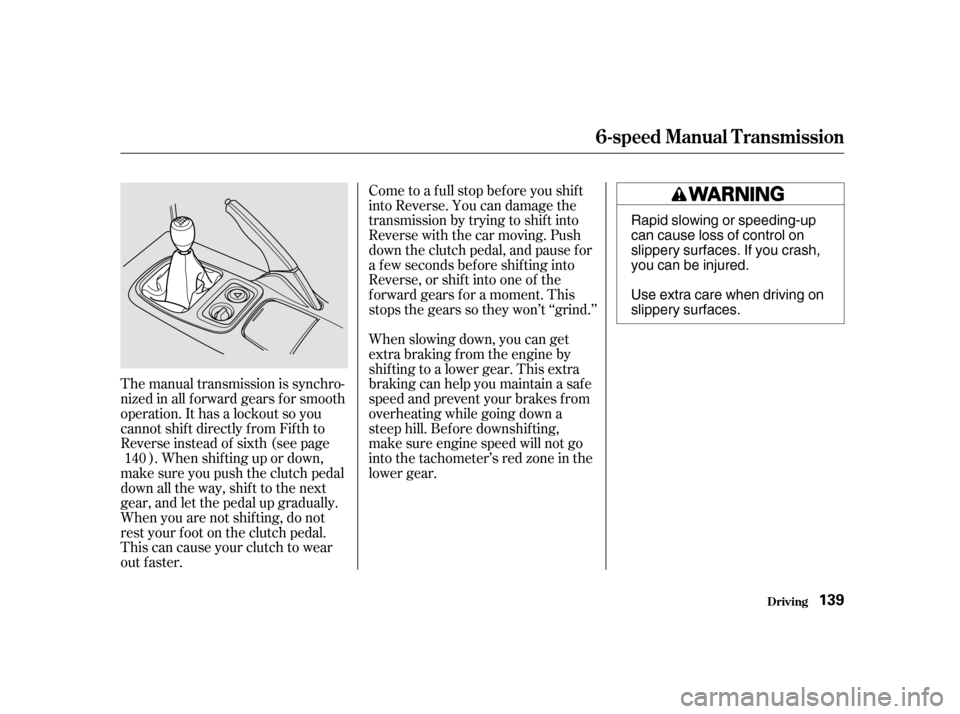
The manual transmission is synchro-
nizedinallforwardgearsforsmooth
operation. It has a lockout so you
cannot shift directly from Fifth to
Reverse instead of sixth (see page). When shif ting up or down,
make sure you push the clutch pedal
down all the way, shift to the next
gear, and let the pedal up gradually.
When you are not shif ting, do not
rest your f oot on the clutch pedal.
This can cause your clutch to wear
out f aster. Come to a full stop before you shift
into Reverse. You can damage the
transmission by trying to shift into
Reverse with the car moving. Push
down the clutch pedal, and pause f or
a f ew seconds bef ore shif ting into
Reverse, or shif t into one of the
f orward gears f or a moment. This
stops the gears so they won’t ‘‘grind.’’
When slowing down, you can get
extra braking f rom the engine by
shifting to a lower gear. This extra
braking can help you maintain a safe
speed and prevent your brakes f rom
overheating while going down a
steep hill. Bef ore downshif ting,
make sure engine speed will not go
into the tachometer’s red zone in the
lower gear.
140
Driving
6-speed Manual T ransmission
139
Rapid slowing or speeding-up
can cause loss of control on
slippery surfaces. If you crash,
you can be injured.
Use extra care when driving on
slippery surfaces.
Page 139 of 277
Drive in the highest gear that lets
the engine run and accelerate
smoothly. This will give you the best
f uel economy and ef f ective emis-
sions control. The f ollowing shif t
points are recommended:Shif t Up
1st to 2nd
2nd to 3rd 3rd to 4th4th to 5th
5th to 6th Normal Acceleration
15 mph (24 km/h)
25 mph (40 km/h)
40 mph (64 km/h)
47 mph (75 km/h)
52 mph (83 km/h) If you exceed the maximum speed
f or the gear you are in, the engine
speed will enter into the tachometer’s
red zone. If this occurs, you may f eel
the engine cut in and out. This is
caused by a limiter in the engine’s
computer controls. The engine will
run normally when you reduce the
RPM below the red zone.
Bef ore downshif ting, make sure the
engine will not go into the
tachometer’s red zone.
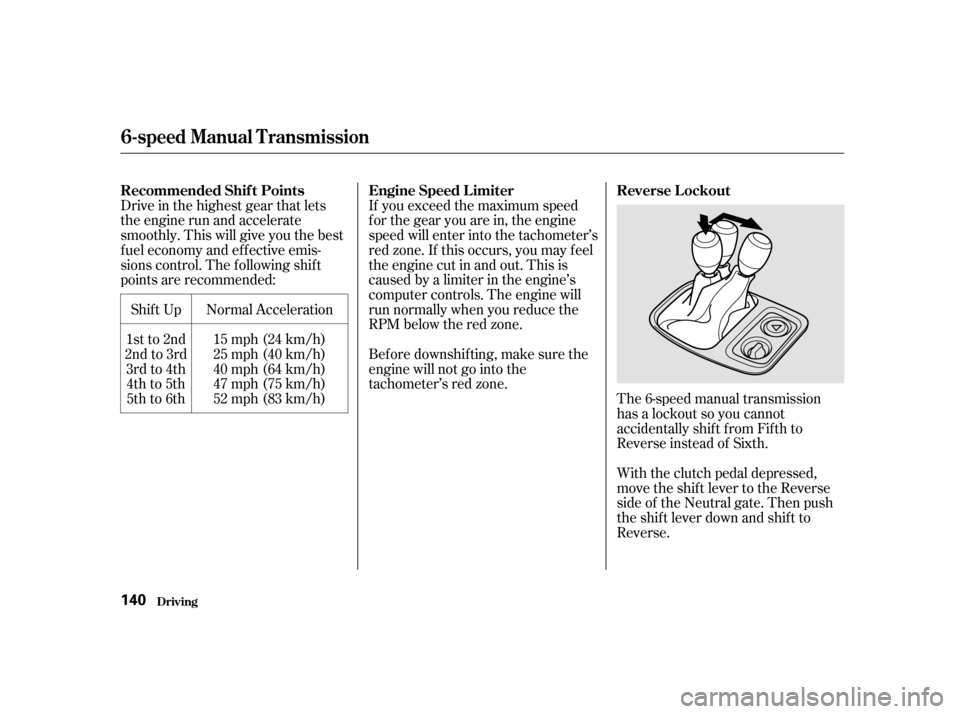
With the clutch pedal depressed,
move the shift lever to the Reverse
side of the Neutral gate. Then push
the shif t lever down and shif t to
Reverse.
The 6-speed manual transmission
has a lockout so you cannot
accidentally shif t f rom Fif th to
Reverse instead of Sixth.
Recommended Shif t Points Engine Speed L imiter Reverse L ockout
6-speed Manual T ransmission
Driving
140
Page 141 of 277

All f our brakes have audible brake
wear indicators.
Check your brakes af ter driving
through deep water. Apply the
brakes moderately to see if they f eel
normal. If not, apply them gently and
f requently until they do. Since a
longer distance is needed to stop
with wet brakes, be extra cautious
and alert in your driving.
Constant application of the brakes
when going down a long hill builds
up heat and reduces their ef f ective-
ness. Use the engine to assist the
brakes by downshif ting to a lower
gear and taking your f oot of f the
accelerator pedal.
Put your f oot on the brake pedal only
when you intend to brake. Resting
your f oot on the pedal keeps the
brakes applied lightly, causing them
to build up heat. Heat build-up can
reduce how well your brakes work. It
also keeps your brake lights on all
the time, conf using drivers behind
you. When the brake pads need replacing,
you will hear a distinctive metallic
‘‘screeching’’ sound when you apply
the brakes. If you do not have the
brake pads replaced, they will begin
screeching all the time.
Your brakes may sometimes squeal
or squeak when you apply them
lightly. Do not conf use this with the
brake wear indicators. They make a
very audible ‘‘screeching.’’
Your Honda is equipped with disc
brakes at all f our wheels. A power
assist helps reduce the ef f ort needed
on the brake pedal. The ABS helps
you retain steering control when
braking very hard.
Brake Wear Indicators
The Braking System
Driving
142