cooling HONDA S2000 2003 1.G User Guide
[x] Cancel search | Manufacturer: HONDA, Model Year: 2003, Model line: S2000, Model: HONDA S2000 2003 1.GPages: 280, PDF Size: 3.9 MB
Page 96 of 280

These settings direct all the air f low
to the defroster vents at the base of
the windshield and the side window
def roster vents. The air f low will get
warmer and clear the windows faster
as the engine warms up. You can
close the side vents with the dial
beside each vent. This will send
more warm air to the windshield
defroster vents.
For saf ety, make sure you have a
clear view through all the windows
bef ore driving away.You should shut the system
completely of f only f or the f irst f ew
minutes of driving in cold weather,
until the engine coolant warms up
enough to operate the heater. Keep
the fan on at all other times so stale
air does not build up in the interior. To shut of f the system temporarily,
turn of f the f an (no lights
illuminated).
Heating and Cooling
Comf ort and Convenience Feat ures
To Turn Everything Of f
93
Page 150 of 280
This section also includes
Maintenance Schedules f or normal
driving and severe driving conditions,
a Maintenance Record, and instruc-
tions f or simple maintenance tasks
you may want to take care of
yourself . This section explains why it is
important to keep your car well
maintained and how to f ollow basic
maintenance saf ety precautions.
If you have the skills and tools to per-
f orm more complex maintenance
tasks on your Honda, you may want
to purchase the Service Manual. See
page f or inf ormation on how to
obtain a copy, or see your Honda
dealer.......................
Maintenance Saf ety .148
.
Important Safety Precautions . 149
.................
Maintenance Schedule . 150
...
Required Maintenance Record . 157
.......
Owner Maintenance Checks . 159
..............................
Fluid Locations .160
......................................
Engine Oil .161
..................................
Adding Oil .161
....................
Recommended Oil .161
..............................
Synthetic Oil .162
....................................
Additives .162
.....
Changing the Oil and Filter . 163
.............................
Cooling System .165
............
Adding Engine Coolant . 165
.......
Replacing Engine Coolant . 167
....................
Windshield Washers .171
6-speed Manual Transmission ...........................................
Fluid .172
..........................
Dif f erential Fluid .173
................
Brake and Clutch Fluid . 174
............................
Brake System .174
...........................
Clutch System .175
.....................
Air Cleaner Element .176
....................................
Hood Latch .178 ....................................
Spark Plugs .178
..............................
Replacement .178
............................
Specif ications .180
...........................................
Battery .181
.................................
Wiper Blades .184
..............
Air Conditioning System . 186
..................
Dust and Pollen Filter . 187
.......................................
Drive Belt .188
...............................................
Tires .189
......................................
Inf lation .189
..................................
Inspection .191
..............................
Maintenance .192
.............................
Tire Rotation .192
...................................
Tire Wear .192
...
Replacing Tires and Wheels . 193
......................
Wheels and Tires .194
..........................
Winter Driving .194
.............................
Snow Tires .195
............................
Tire Chains .195
.............................................
Lights .196
.....................
Headlight Aiming .198
........................
Replacing Bulbs .198
...........................
Storing Your Car .206
267
Maintenance
Maint enance147
Page 168 of 280
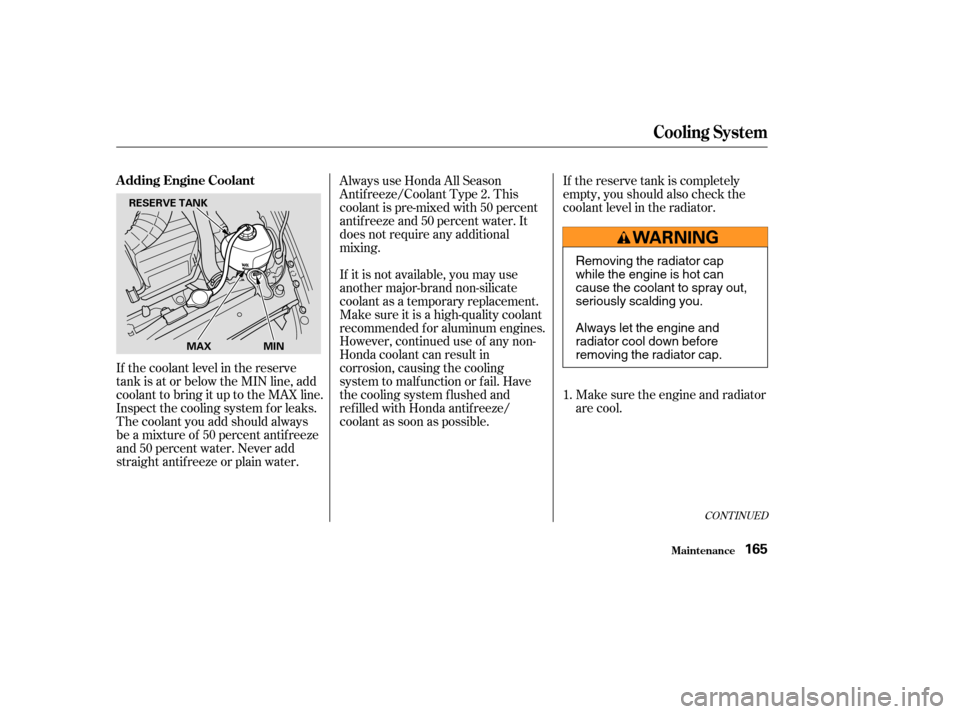
If the coolant level in the reserve
tank is at or below the MIN line, add
coolant to bring it up to the MAX line.
Inspect the cooling system f or leaks.
The coolant you add should always
be a mixture of 50 percent antif reeze
and 50 percent water. Never add
straight antif reeze or plain water.If the reserve tank is completely
empty, you should also check the
coolant level in the radiator.
Make sure the engine and radiator
are cool.
Always use Honda All Season
Antif reeze/Coolant Type 2. This
coolant is pre-mixed with 50 percent
antif reeze and 50 percent water. It
does not require any additional
mixing.
If it is not available, you may use
another major-brand non-silicate
coolant as a temporary replacement.
Make sure it is a high-quality coolant
recommended f or aluminum engines.
However, continued use of any non-
Honda coolant can result in
corrosion, causing the cooling
system to malf unction or f ail. Have
the cooling system f lushed and
ref illed with Honda antif reeze/
coolant as soon as possible.
1.
CONT INUED
A dding Engine Coolant
Cooling Syst em
Maint enance165
RESERVE TANK
MAX MIN
Removing the radiator cap
while the engine is hot can
cause the coolant to spray out,
seriously scalding you.
Always let the engine and
radiator cool down before
removing the radiator cap.
Page 169 of 280
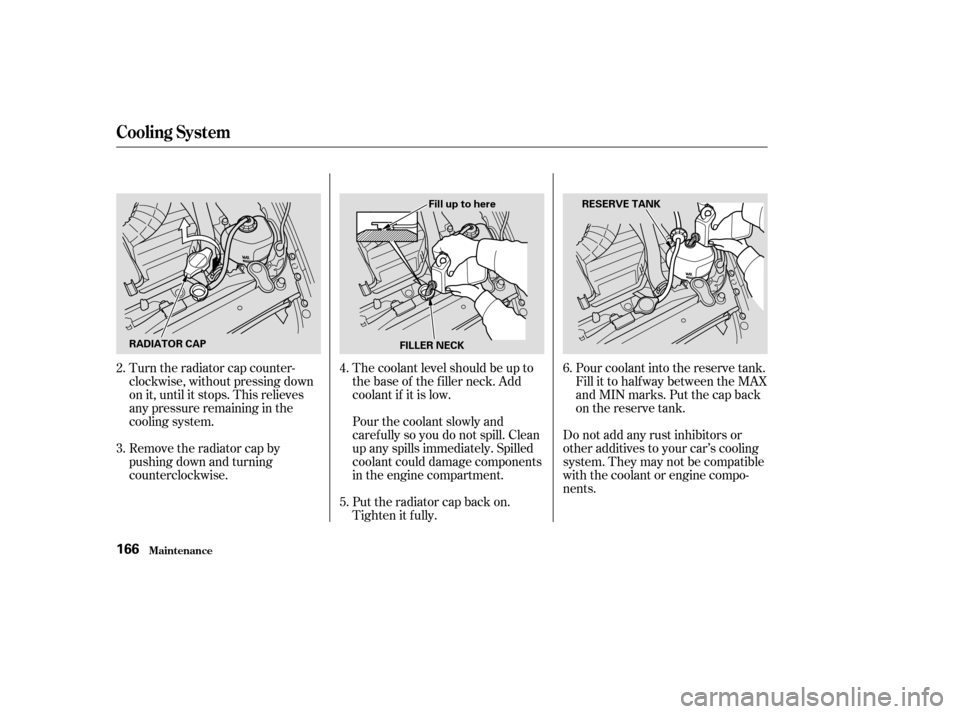
The coolant level should be up to
the base of the f iller neck. Add
coolant if it is low.
Turn the radiator cap counter-
clockwise, without pressing down
on it, until it stops. This relieves
any pressure remaining in the
cooling system.
Remove the radiator cap by
pushing down and turning
counterclockwise. Pour coolant into the reserve tank.
Fill it to half way between the MAX
and MIN marks. Put the cap back
on the reserve tank.
Put the radiator cap back on.
Tighten it f ully. Pourthecoolantslowlyand
caref ully so you do not spill. Clean
up any spills immediately. Spilled
coolant could damage components
in the engine compartment. Do not add any rust inhibitors or
other additives to your car’s cooling
system. They may not be compatible
with the coolant or engine compo-
nents.
2.
3.
4.
5.6.
Cooling Syst em
Maint enance166
RADIATOR CAP RESERVE TANK
Fill up to here
FILLER NECK
Page 170 of 280
Turn the ignition ON (II). Turn
the heater temperature control
dial f ully clockwise. Turn the
ignition of f .
Openthehood.Makesurethe
engine and radiator are cool to the
touch.
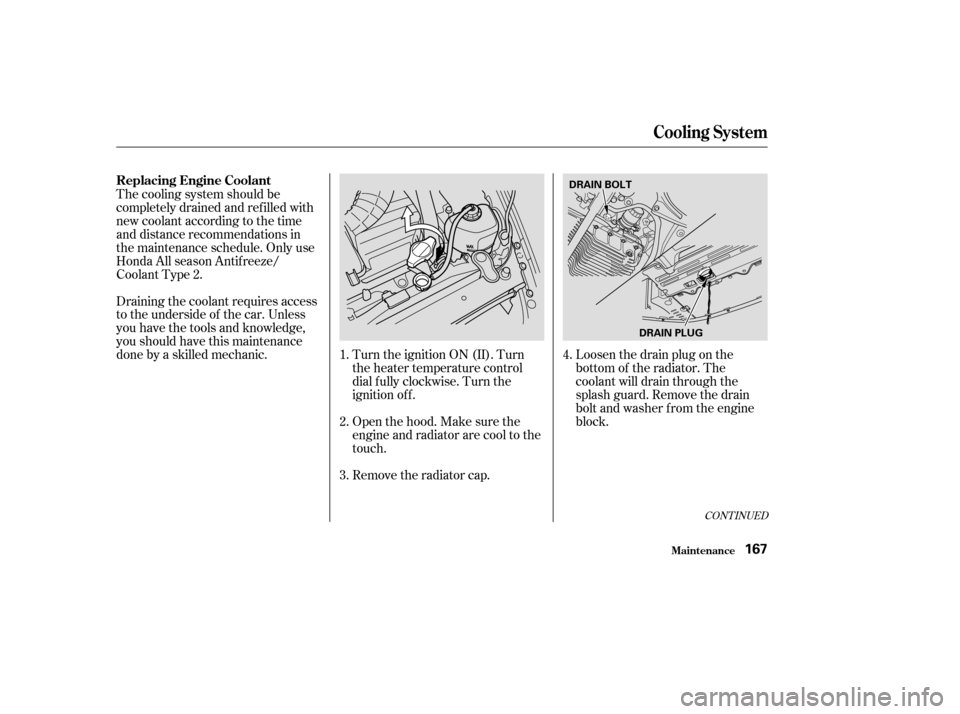
Remove the radiator cap.Loosen the drain plug on the
bottom of the radiator. The
coolant will drain through the
splash guard. Remove the drain
bolt and washer f rom the engine
block.
Thecoolingsystemshouldbe
completely drained and ref illed with
new coolant according to the time
and distance recommendations in
the maintenance schedule. Only use
Honda All season Antif reeze/
Coolant Type 2.
Draining the coolant requires access
to the underside of the car. Unless
you have the tools and knowledge,
you should have this maintenance
done by a skilled mechanic.
1.
2.
3. 4.
CONT INUED
Replacing Engine Coolant
Cooling Syst em
Maint enance167
DRAIN BOLT
DRAIN PLUG
Page 171 of 280
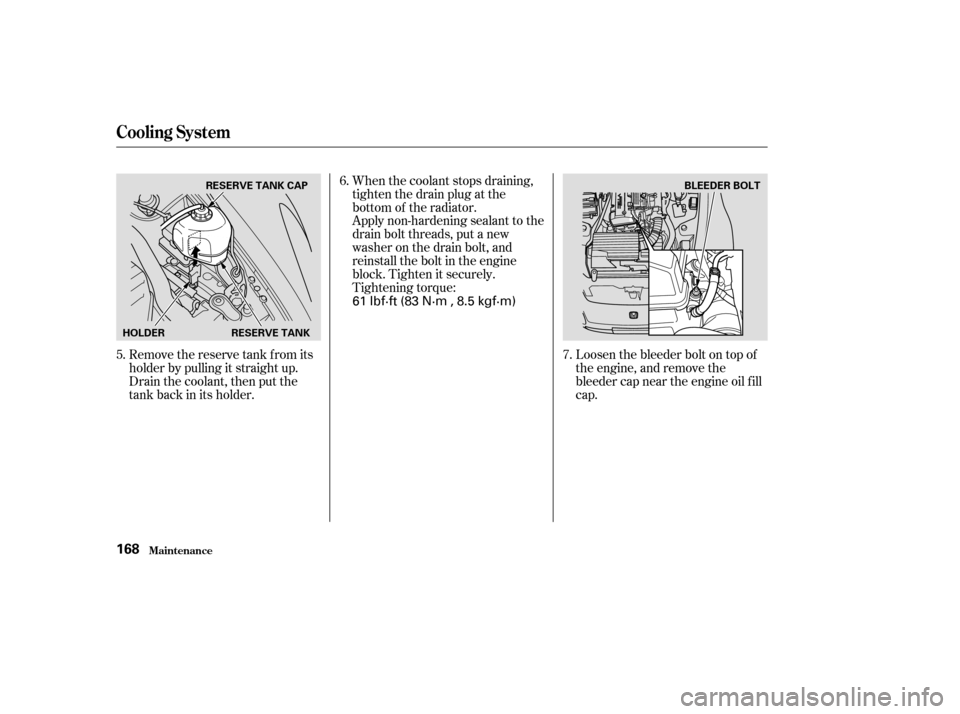
Remove the reserve tank f rom its
holder by pulling it straight up.
Drain the coolant, then put the
tank back in its holder.When the coolant stops draining,
tightenthedrainplugatthe
bottom of the radiator.
Apply non-hardening sealant to the
drain bolt threads, put a new
washer on the drain bolt, and
reinstall the bolt in the engine
block. Tighten it securely.
Tightening torque:
Loosen the bleeder bolt on top of
the engine, and remove the
bleeder cap near the engine oil f ill
cap.
5. 6.
7.
Cooling Syst em
Maint enance168
RESERVE TANK CAP
HOLDER RESERVE TANK BLEEDER BOLT
61 lbf·ft (83 N·m , 8.5 kgf·m)
Page 172 of 280
CONT INUED
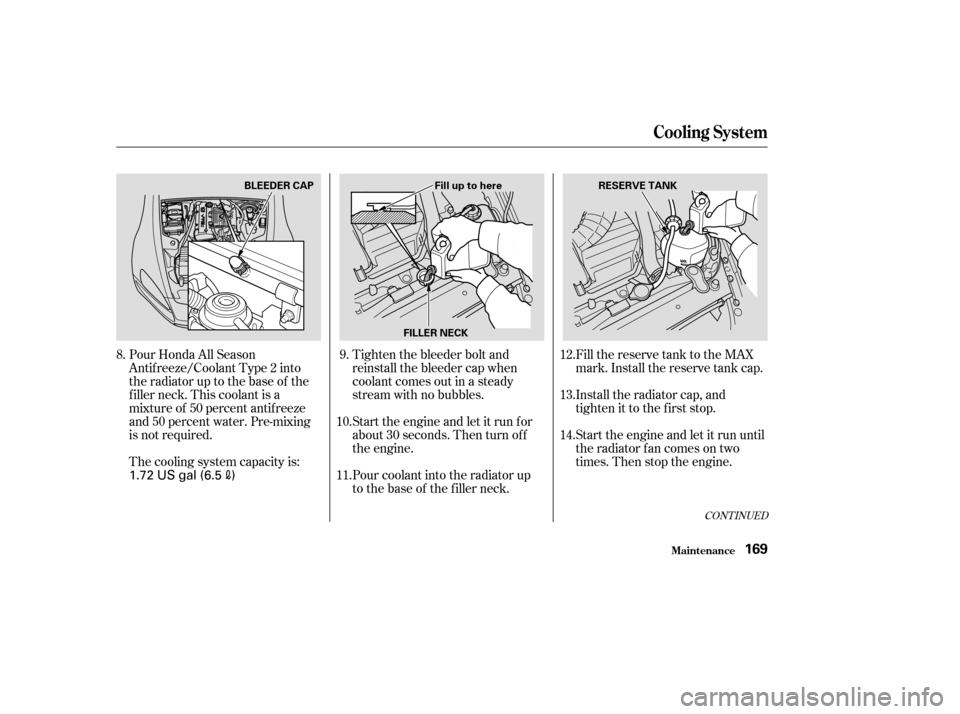
Fill the reserve tank to the MAX
mark. Install the reserve tank cap.
Install the radiator cap, and
tighten it to the first stop.
Start the engine and let it run until
the radiator fan comes on two
times. Then stop the engine.
Pour Honda All Season
Antif reeze/Coolant Type 2 into
the radiator up to the base of the
f iller neck. This coolant is a
mixture of 50 percent antif reeze
and 50 percent water. Pre-mixing
is not required.
Pour coolant into the radiator up
to the base of the f iller neck. Start the engine and let it run f or
about 30 seconds. Then turn of f
the engine. Tighten the bleeder bolt and
reinstall the bleeder cap when
coolant comes out in a steady
stream with no bubbles.
The cooling system capacity is: 9.
10.
11. 12.
13.
14.
8.
Cooling Syst em
Maint enance169
BLEEDER CAP
Fill up to here
FILLER NECK RESERVE TANK
1.72 US gal (6.5)
Page 173 of 280

Remove the radiator cap.
Pour coolant into the radiator up
to the base of the f iller neck and
into the reserve tank up to the
MAX mark.
Start the engine and hold it at
1,500 rpm until the radiator f an
comes on. Turn of f the engine.
Check the coolant level in the
radiator and add coolant if needed.
Install the radiator cap, and
tighten it fully.
If necessary, f ill the reserve tank
to the MAX mark. Install the
reserve tank cap.
15.
16.
17.
18.
19.
Cooling Syst em
Maint enance170
Page 189 of 280
Run the air conditioning at least once
a week during the cold weather
months. Run it f or at least ten
minutes while you are driving at a
steady speed with the engine at
normal operating temperature. This
circulates the lubricating oil con-
tained in the ref rigerant.If the air conditioning does not get as
cold as before, have your dealer
check the system. Recharge the
system with Ref rigerant HFC-134a
(R-134a). (See Specif ications on page
.)
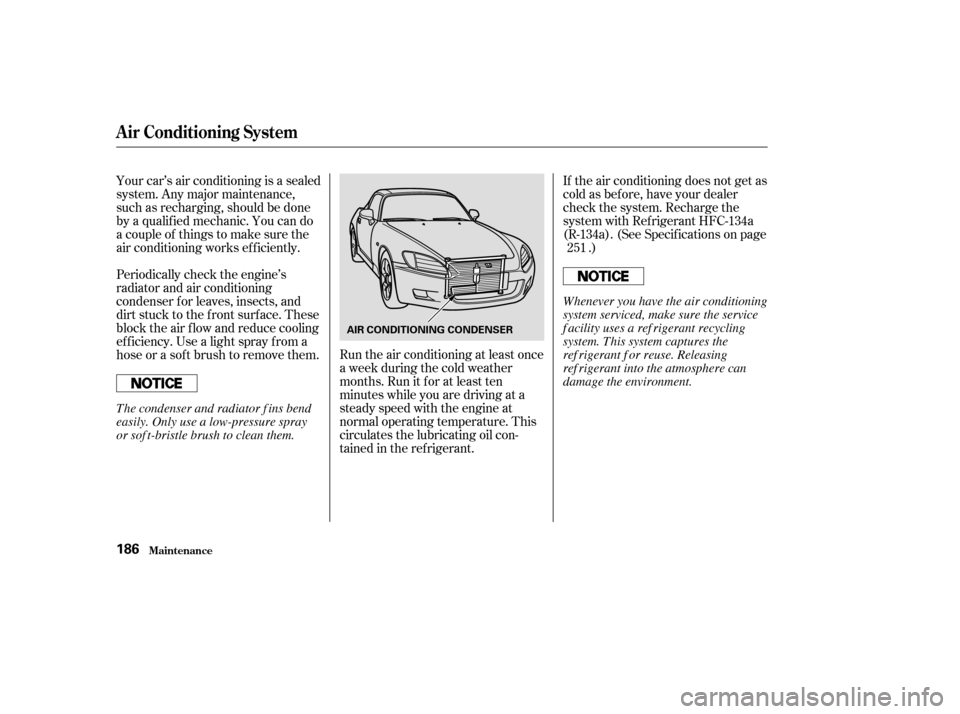
Your car’s air conditioning is a sealed
system. Any major maintenance,
such as recharging, should be done
by a qualif ied mechanic. You can do
a couple of things to make sure the
air conditioning works ef f iciently.
Periodically check the engine’s
radiator and air conditioning
condenser f or leaves, insects, and
dirt stuck to the f ront surf ace. These
block the air f low and reduce cooling
ef f iciency. Use a light spray f rom a
hose or a sof t brush to remove them. 251
A ir Condit ioning Syst em
Maint enance186
AIR CONDITIONING CONDENSER
Whenever you have the air conditioning
system serviced, make sure the service
f acility uses a ref rigerant recycling
system. This system captures the
ref rigerant f or reuse. Releasing
ref rigerant into the atmosphere can
damage the environment.
The condenser and radiator f ins bend
easily. Only use a low-pressure spray
or sof t-bristle brush to clean them.
Page 190 of 280
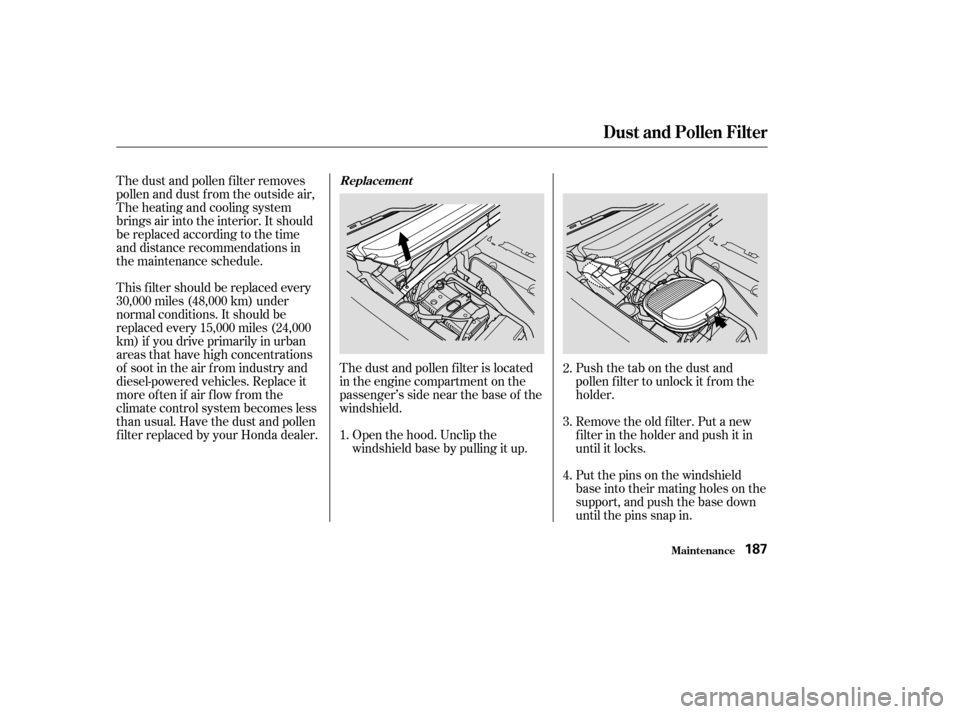
Open the hood. Unclip the
windshield base by pulling it up.Put the pins on the windshield
base into their mating holes on the
support, and push the base down
until the pins snap in. Remove the old f ilter. Put a new
f ilter in the holder and push it in
until it locks.
The dust and pollen f ilter is located
in the engine compartment on the
passenger’s side near the base of the
windshield.
Push the tab on the dust and
pollen f ilter to unlock it f rom the
holder.
This f ilter should be replaced every
30,000 miles (48,000 km) under
normal conditions. It should be
replaced every 15,000 miles (24,000
km) if you drive primarily in urban
areas that have high concentrations
of soot in the air f rom industry and
diesel-powered vehicles. Replace it
more of ten if air f low f rom the
climate control system becomes less
than usual. Have the dust and pollen
f ilter replaced by your Honda dealer. The dust and pollen f ilter removes
pollen and dust f rom the outside air,
The heating and cooling system
brings air into the interior. It should
be replaced according to the time
and distance recommendations in
the maintenance schedule.
1.2.
3.
4.
Maint enance
Replacement
Dust and Pollen Filter
187