seats HONDA S2000 2003 1.G Owners Manual
[x] Cancel search | Manufacturer: HONDA, Model Year: 2003, Model line: S2000, Model: HONDA S2000 2003 1.GPages: 280, PDF Size: 3.9 MB
Page 8 of 280
This section gives you important
inf ormation about how to protect
yourself and your passenger. It
shows you how to use seat belts
properly. It explains your Supple-
mental Restraint System. And it tells
you how to properly restrain children
in your car..........
Important Safety Precautions . 6
.............
Your Car’s Saf ety Features . 7
.......................................
Seat Belts .8
...........................................
Airbags .9
.....................
Seats & Seat-Backs .10
..........................
Head Restraints .10
..................................
Door Locks .10
........
Pre-Drive Saf ety Checklist . 11
............................
Protecting Adults .12
.....
1. Close and Lock the Doors . 12
...........
2. Adjust the Front Seats . 12
............
3. Adjust the Seat-Backs . 13
4. Fasten and Position the Seat .....................................
Belts .15
5. Maintain a Proper Sitting ................................
Position .16
.....
Advice f or Pregnant Women . 17
...
Additional Safety Precautions . 18
........................
Protecting Children .18
All Children Must Be ...............................
Restrained .19
Your Car is Not Recommended ..............
f or Child Passengers . 19
The Passenger’s Airbag Poses ......
Serious Risks to Children . 20
...
Additional Safety Precautions . 22General Guidelines f or Using
...............................
Child Seats .22
.........
Protecting Small Children . 26
.......
Protecting Larger Children . 29
Additional Inf ormation About Your .................................
Seat Belts .33
..
Seat Belt System Components . 33
......................
Lap/Shoulder Belt .33
Automatic Seat Belt ...............................
Tensioners .34
...............
Seat Belt Maintenance . 34
Additional Inf ormation About Your ...........................................
SRS .36
........................
SRS Components .36
...........
How Your Airbags Work . 36
How the SRS Indicator Light .......................................
Works .38
..................................
SRS Service .39
...
Additional Safety Precautions . 39
.............
Carbon Monoxide Hazard . 40
...................................
Saf ety Labels .41
Driver and Passenger Saf ety
Driver and Passenger Saf ety
5
Page 10 of 280
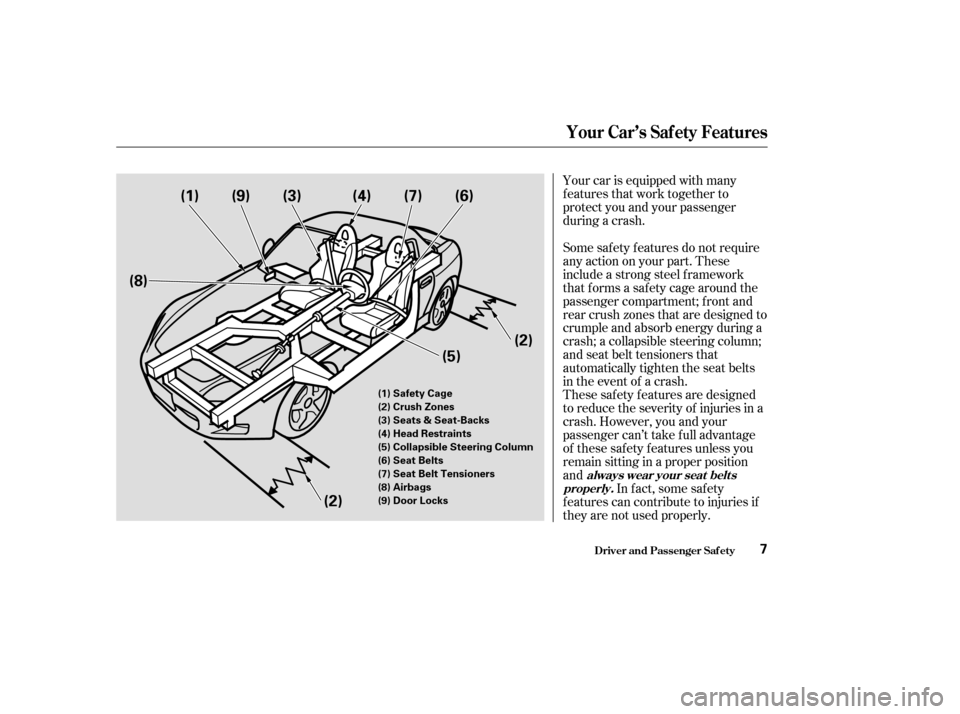
Your car is equipped with many
features that work together to
protect you and your passenger
during a crash.
These saf ety f eatures are designed
to reduce the severity of injuries in a
crash. However, you and your
passenger can’t take full advantage
of these saf ety f eatures unless you
remain sitting in a proper position
andIn f act, some saf ety
f eatures can contribute to injuries if
they are not used properly. Some saf ety f eatures do not require
anyactiononyourpart.These
include a strong steel f ramework
that forms a safety cage around the
passenger compartment; f ront and
rear crush zones that are designed to
crumple and absorb energy during a
crash; a collapsible steering column;
and seat belt tensioners that
automatically tighten the seat belts
in the event of a crash.
Driver and Passenger Saf ety
Your Car’s Saf ety Features
always wear your seat belts
properly.
7
(8) (1) (9) (3) (4) (7) (6)
(2)
(5)
(2)
(1) Safety Cage
(2) Crush Zones
(3) Seats & Seat-Backs
(4) Head Restraints
(5) Collapsible Steering Column
(6) Seat Belts
(7) Seat Belt Tensioners
(8) Airbags
(9) Door Locks
Page 13 of 280

Head restraints can help protect you
f rom whiplash and other injuries.Keeping your doors locked reduces
thechanceof beingthrownoutof
the car during a crash. It also helps
prevent occupants f rom accidentally
opening a door and f alling out, and
outsiders f rom unexpectedly opening
your doors.
Move the seats
as far back as possible, and keep
adjustable seat-backs in an upright
position whenever the car is moving.
Your car’s seats are designed to keep
you in a comf ortable, upright
position so you can take f ull
advantage of the protection offered
by seat belts and the energy
absorbing materials in the seats.
How you adjust your seats and seat-
backs can also affect your safety. For
example, sitting too close to the
steering wheel or dashboard
increases the risk of you or your
passenger being injured by striking
theinsideof thecar,orbyan
inf lating airbag.
Reclining a seat-back too f ar reduces
the seat belt’s ef f ectiveness and
increases the chance that the seat’s
occupant will slide under the seat
belt in a crash and be seriously
injured. Seats & Seat-Backs
Door L ocks
Head Restraints
Driver and Passenger Saf ety
Your Car’s Saf ety Features
What you should do:
10
Page 14 of 280

Seat-backs are upright (see page).
To make sure you and your
passenger get the maximum
protection f rom your car’s saf ety
f eatures, check the f ollowing each
time before you drive away:
A small child riding in a f orward-
f acing child seat is properly
restrained (see page ). Both doors are closed and locked
(see page ).
All cargo is properly stored or
secured (see page ).
Remember, however, that no saf ety
system can prevent all injuries or
deaths that can occur in severe
crashes, even when seat belts are
properly worn and the airbags deploy.
Occupants are sitting upright and
as far back as possible from the
steering wheel and dashboard
(see page ). You and any adult passenger, or a
larger child who has outgrown
child seats, are wearing your seat
belts and wearing them properly
(see page ). The rest of this section gives more
detailed inf ormation about how you
can maximize your saf ety.
15
26
13 12
12 128
Driver and Passenger Saf ety
Your Car’s Saf ety Features
Pre-Drive Saf ety Checklist
11
Page 15 of 280
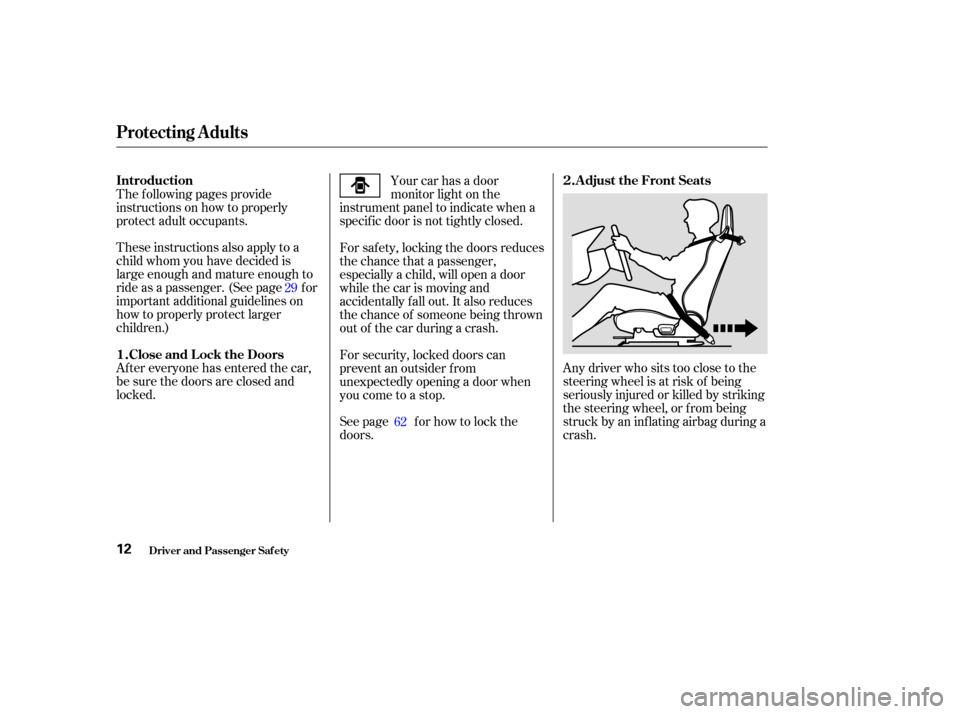
Any driver who sits too close to the
steering wheel is at risk of being
seriously injured or killed by striking
the steering wheel, or f rom being
struck by an inf lating airbag during a
crash.
Af ter everyone has entered the car,
be sure the doors are closed and
locked. The f ollowing pages provide
instructions on how to properly
protect adult occupants.
These instructions also apply to a
child whom you have decided is
large enough and mature enough to
ride as a passenger. (See page f or
important additional guidelines on
how to properly protect larger
children.) Your car has a door
monitor light on the
instrument panel to indicate when a
specif ic door is not tightly closed.
For saf ety, locking the doors reduces
the chance that a passenger,
especially a child, will open a door
while the car is moving and
accidentally f all out. It also reduces
the chance of someone being thrown
out of the car during a crash.
For security, locked doors can
prevent an outsider f rom
unexpectedly opening a door when
you come to a stop.
See page f or how to lock the
doors.
29
62
Driver and Passenger Saf ety
Protecting Adults
Introduction A djust the Front Seats
Close and L ock the Doors
1. 2.
12
Page 16 of 280
CONT INUED
To reduce the chance of injury, wear
your seat belt properly, sit upright
with your back against the seat, and
movetheseatawayfromthe
steering wheel to the f arthest
distance that allows you to maintain
f ull control of the car.Once your seat is adjusted correctly,
rock it back and f orth to make sure
the seat is locked in position.
See page f or how to adjust the
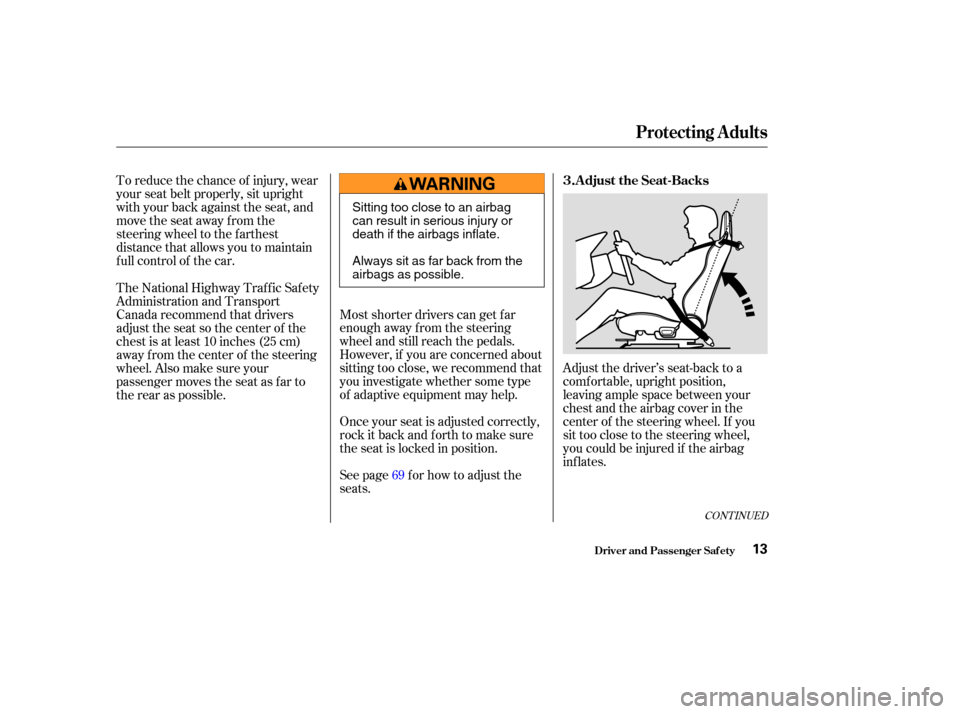
seats.Adjust the driver’s seat-back to a
comf ortable, upright position,
leaving ample space between your
chest and the airbag cover in the
center of the steering wheel. If you
sit too close to the steering wheel,
you could be injured if the airbag
inf lates.
Most shorter drivers can get f ar
enough away f rom the steering
wheel and still reach the pedals.
However, if you are concerned about
sitting too close, we recommend that
you investigate whether some type
of adaptive equipment may help.
The National Highway Traffic Safety
Administration and Transport
Canada recommend that drivers
adjust the seat so the center of the
chest is at least 10 inches (25 cm)
away f rom the center of the steering
wheel.Alsomakesureyour
passenger moves the seat as f ar to
the rear as possible.
69
Driver and Passenger Saf ety
Protecting Adults
Adjust the Seat-Backs
3.
13
Sitting too close to an airbag
can result in serious injury or
death if the airbags inflate.
Always sit as far back from the
airbags as possible.
Page 19 of 280
See page f or additional
inf ormation about your seat belt
system and how to take care of your
belts. If a seat belt does not seem to work
as it should, it may not protect the
occupant in a crash.Anyone using a seat belt that is
not working properly can be
seriously injured or killed. Have your
Honda dealer check the belt as soon
as possible. After occupants have adjusted their
seats and put on seat belts, it is very
important that they continue to sit
upright, well back in their seats, with
their feet on the floor, until the car is
parked and the engine is of f .
Sitting improperly can increase the
chance of injury during a crash. For
example, if an occupant slouches,
lies down, turns sideways, sits
forward, leans forward or sideways,
or puts one or both f eet up, the
chance of injury during a crash is
greatly increased.
In addition, an occupant who is out of
position can be seriously or f atally
injured by striking interior parts of
thecar,orbybeingstruckbyan
inf lating airbag.Remember, to get the best
protection f rom your car’s airbags
and other safety features, you must
sit properly and wear your seat belt
properly.
33
Driver and Passenger Saf ety
Protecting Adults
No one should
sit in a seat wit h an inoperat ive seat belt.
Maintain a Proper Sitting
Position
5.
16
Sitting improperly or out of
position can result in serious
injury or death in a crash.
Always sit upright, well back in
the seat, with your feet on the
floor.
Page 25 of 280

Leaving a child without adult
supervision is illegal in most states
and Canadian provinces and can
be very hazardous. For example, a
small child lef t in a car on a hot
day can die f rom heatstroke. A
child lef t alone with the key in the
ignition can accidentally set the
car in motion, possibly injuring
themselves or others. As discussed on page , because
your car does not have a back seat,
and because of the passenger’s
airbag hazard, we strongly
recommend that you do not carry a
small child as a passenger in this car.
However, if you must carry a small
child in this car, the child must be
properly restrained in a child seat.
The f ollowing pages give general
guidelines f or selecting and installing
a child seat. See page f or
additional information.
Even very young
children learn how to unlock
vehicle doors, turn on the ignition,
and open the trunk, which can
lead to accidental injury or death.
Children who play in cars can
accidentally get trapped inside the
trunk. Teach your children not to
play in or around cars. Know how
to operate the emergency trunk
opener and decide if your children
should be shown how to use this
f eature (See page ). 26
67 19
Protecting Children
Driver and Passenger Saf ety
Do not leave a child alone in your
car. K eep car keys and remot e
transmitters out of the reach ofchildren.
Lock both doors and the trunk when your car is not in use.
General Guidelines f or Using
Child Seats
Additional Saf ety Precautions
22
Page 26 of 280
CONT INUED
To provide proper protection, a child
seat should meet three
requirements:The child seat should
meet Federal Motor Vehicle
Saf ety Standard 213 (FMVSS 213)
or Canadian Motor Vehicle Saf ety
Standard 213 (CMVSS 213). Look
for the manufacturer’s statement
of compliance on the box and seat. Due to variations in the design of
child seats, vehicle seats, and seat
belts, all child seats will not f it all
seating positions in all cars.
However, Honda is conf ident that
one or more child seat models can f it
andbeproperlyinstalledinall
recommended seating positions in
your car.
Bef ore purchasing a child seat, we
recommend that parents test the
child seat to make sure it f its
properly in the passenger’s seat. If a
previously purchased child seat does
not f it, you will need to buy a
dif f erent one that will f it.
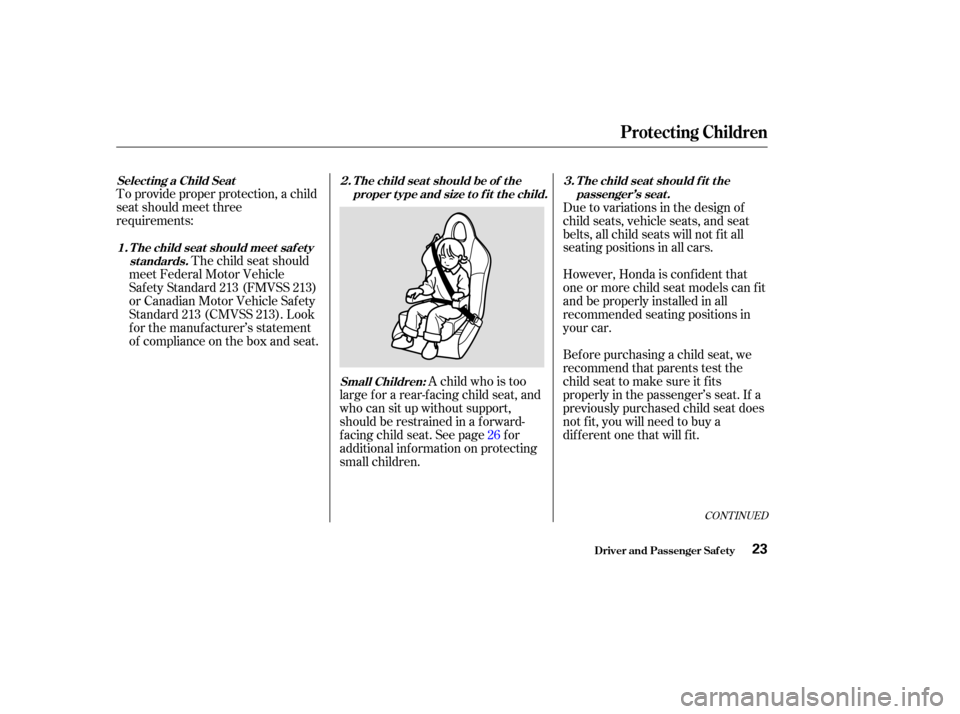
A child who is too
large f or a rear-f acing child seat, and
who can sit up without support,
should be restrained in a f orward-
f acing child seat. See page f or
additional inf ormation on protecting
small children. 26
Protecting Children
Driver and Passenger Saf ety
T he child seat should f it the
passenger’s seat .
T he child seat should be of the
proper t ype and size t o f it t he child.
T he child seat should meet saf et y st andards.
Select ing a Child Seat
Small Children:
2.
3.
1.
23
Page 28 of 280

Af ter selecting a proper child seat,
there are three main steps in
installing the seat:Af ter installing a child
seat, push and pull the seat
f orward and f rom side to side to
verif y that it is secure. To provide security during normal
driving maneuvers as well as during
a collision, we recommend that
parents secure a child seat as f irmly
as possible.
Make sure the child is properly
strappedinthechildseat
according to the child seat maker’s
instructions. A child who is not
properly secured in a child seat
canbethrownoutof theseatina
crash and be seriously injured.
When you are not using a child seat,
either remove it and store it in a saf e
place, or make sure it is properly
secured. An unsecured child seat can
be thrown around the car during a
crash or sudden stop and injure
someone.
However, a child seat does not need
to be ‘‘rock solid.’’ It may be dif f icult
to install a child seat so that it does
not move at all. Some side-to-side or
back-and-f orth movement can be
expected and should not reduce the
child seat’s ef f ectiveness.
All child
seats must be secured to the car
with the lap part of a lap/shoulder
belt. A child whose seat is not
properly secured to the car can be
endangered in a crash. See page for instructions on how to
secure a f orward-f acing child seat
in this car. 27
Protecting Children
Driver and Passenger Saf ety
Make sure t he child seat is f irmly
secured. Secure the child in the child seat.
Storing a Child Seat
Inst alling a Child Seat
Properly secure t he child seat t othe car with a seat belt.
1.
2. 3.
25