brake HONDA S2000 2004 2.G User Guide
[x] Cancel search | Manufacturer: HONDA, Model Year: 2004, Model line: S2000, Model: HONDA S2000 2004 2.GPages: 208, PDF Size: 2.91 MB
Page 99 of 208

Thecruisecontrolmaynothold
the set speed when you are going
up and down hills. If your speed
increases going down a hill, use
the brakes to slow down. This will
cancelthecruisecontrol.To
resume the set speed, press the
RESUME/accel button. The
CRUISE CONTROL indicator on
the instrument panel will come
back on.You can increase the set cruising
speed in any of these ways:
Press and hold the RESUME/
accel button. When you reach the
desired cruising speed, release the
button.
Push on the accelerator pedal.
Accelerate to the desired cruising
speed, and press the SET/decel
button.
To increase your speed in very
small amounts, tap the RESUME/
accel button. Each time you do
this, your vehicle will speed up
about 1 mph (1.6 km/h). You can decrease the set cruising
speed in any of these ways:
Press and hold the SET/decel
button. Release the button when
you reach the desired speed.
To slow down in very small
amounts, tap the SET/decel
button. Each time you do this,
your vehicle will slow down about
1 mph (1.6 km/h).
Tap the brake or clutch pedal
lightly with your f oot. The
CRUISE CONTROL indicator on
the instrument panel will go out.
When the vehicle slows to the
desired speed, press the SET/
decel button.
Cruise Control
Comf ort and Convenience Feat ures
Changing the Set Speed
96
Page 100 of 208

Even with the cruise control turned
on, you can still use the accelerator
pedal to speed up f or passing. Af ter
completing the pass, take your foot
of f the accelerator pedal. The vehicle
will return to the set cruising speed.
Resting your f oot on the brake or
clutch pedal will cause the cruise
control to cancel.Youcancancelthecruisecontrolin
any of these ways:
Tap the brake or clutch pedal.
Push the CANCEL button on the
steering wheel. When you push the CANCEL button,
or tap the brake or clutch pedal, the
system remembers the previously-
set cruising speed. To return to that
speed, accelerate to above 25 mph
(40 km/h) and then press and
release the RESUME/accel button.
The CRUISE CONTROL indicator
comes on. The vehicle will accelerate
to the same cruising speed as before.
Pressing the Cruise Control Master
Switch turns the system completely
of f and erases the previous cruising
speed.
Press the Cruise Control Master
Switch.
Cruise Control
Comf ort and Convenience Feat ures
Cancelling the Cruise Control
97
Page 103 of 208

Help assure your vehicle’s f uture
reliability and perf ormance by paying
extra attention to how you drive
during the f irst 600 miles (1,000 km).
During this period:Avoid full-throttle starts and rapid
acceleration. Do not exceed 5,500
rpm f or the f irst 600 miles (1,000
km) of operation. Your Honda is designed to operate
on unleaded gasoline with a pump
octane number of 91 or higher. Use
of a lower octane gasoline can cause
occasional metallic knocking noises
in the engine and will result in
decreased engine perf ormance.
In addition, in order to maintain good
perf ormance, f uel economy, and
emissions control, we strongly
recommend, in areas where it is
available, the use of gasoline that
does NOT contain manganese-based
f uel additives such as MMT. Use of
gasoline with these additives may
adversely affect performance, and
cause the Malf unction Indicator
Lamp on your instrument panel to
come on. If this happens, contact
your authorized Honda dealer f or
service. For f urther important f uel-
related information, please refer to
your Quick Start Guide. Some gasoline today is blended with
oxygenates such as ethanol or
MTBE. Your vehicle is designed to
operate on oxygenated gasoline
containing up to 10 percent ethanol
by volume and up to 15 percent
MTBE by volume. Do not use
gasoline containing methanol.
If you notice any undesirable
operating symptoms, try another
service station or switch to another
brand of gasoline.
Avoidhardbrakingforthefirst
200 miles (300 km).
Do not change the oil until the
scheduled maintenance time.
You should also f ollow these re-
commendations with an overhauled
or exchanged engine, or when the
brakes are replaced.
Break-in Period, Gasoline T ype
Break-in Period Gasoline Type
Bef ore Driving100
Page 105 of 208
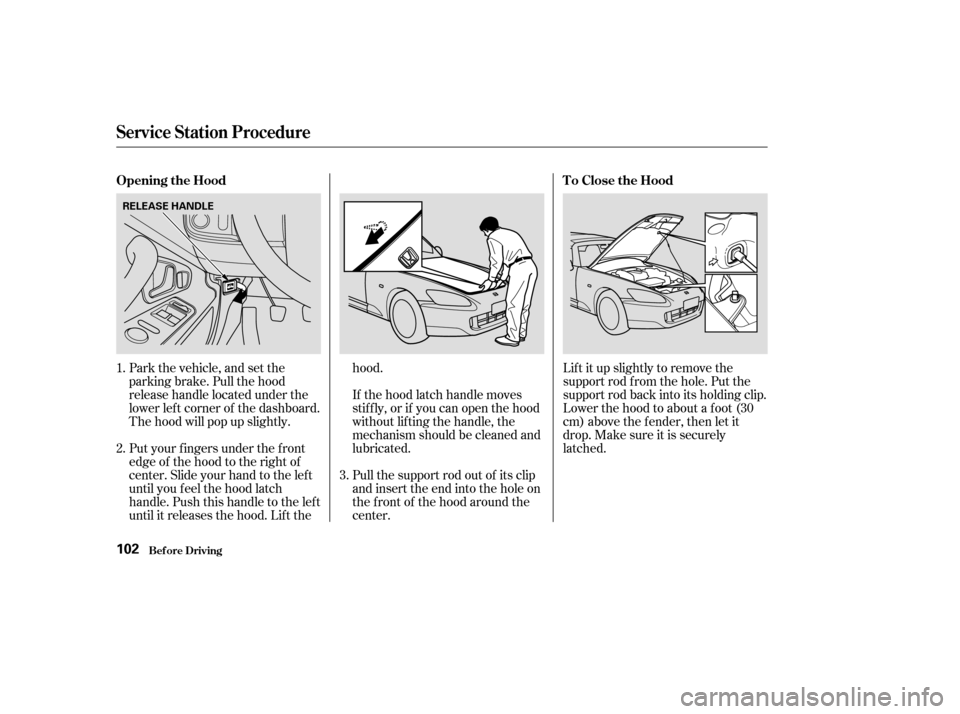
Park the vehicle, and set the
parking brake. Pull the hood
release handle located under the
lower lef t corner of the dashboard.
The hood will pop up slightly.Lif t it up slightly to remove the
support rod f rom the hole. Put the
support rod back into its holding clip.
Lower the hood to about a f oot (30
cm) above the f ender, then let it
drop. Make sure it is securely
latched.
Put your f ingers under the f ront
edge of the hood to the right of
center. Slide your hand to the lef t
until you f eel the hood latch
handle. Push this handle to the lef t
until it releases the hood. Lif t the hood.
If the hood latch handle moves
stif f ly, or if you can open the hood
without lifting the handle, the
mechanism should be cleaned and
lubricated.
Pull the support rod out of its clip
and insert the end into the hole on
the f ront of the hood around the
center.
1.
2.
3.
Service Station Procedure
Opening the Hood T o Close the Hood
Bef ore Driving102
RELEASE HANDLE
Page 108 of 208
Modif ying your vehicle, or installing
some non-Honda accessories, can
make your vehicle unsaf e. Bef ore
you make any modif ications or add
anyaccessories,besuretoreadthe
f ollowing inf ormation.
Your dealer has Honda accessories
that allow you to personalize your
vehicle. These accessories have
been designed and approved f or your
vehicle, and are covered by warranty.When properly installed, cellular
phones, alarms, two-way radios, and
low-powered audio systems should
not interf ere with your vehicle’s
computer controlled systems, such
as the SRS and anti-lock brake
system.Bef ore installing any accessory:
Make sure the accessory does not
obscure any lights, or interf ere
with proper vehicle operation or
perf ormance.
Be sure electronic accessories do
not overload electrical circuits
(see page ) or interf ere with
proper operation.
Have the installer contact your
Honda dealer f or assistance bef ore
installing any electronic accessory.
Although aftermarket accessories
may f it on your vehicle, they may not
meet f actory specif ications, and
could adversely af f ect your vehicle’s
handling and stability. (See
‘‘Modif ying Your Vehicle’’ on page f or additional inf ormation.) 170
106
Bef ore Driving
A ccessories
A ccessories and Modif ications
105
Improper accessories or
modifications can affect your
vehicle’s handling, stability, and
performance, and cause a
crash in which you can be hurt
or killed.
Follow all instructions in this
owner’s manual regarding
accessories and modifications.
Page 109 of 208

Removing parts f rom your vehicle,
or replacing components with non-
Honda (af termarket) components
could seriously af f ect your vehicle’s
handling, stability, and reliability.
Some examples are:Lowering the vehicle with an
aftermarket suspension kit that
signif icantly reduces ground
clearance can allow the
undercarriage to hit speed bumps
or other raised objects, which
could cause the airbags to deploy. Larger or smaller wheels and tires
can interf ere with the operation of
your vehicle’s anti-lock brakes and
other systems.
Do not modif y your steering wheel
or any other part of your
Supplemental Restraint System.
Modif ications could make the
system inef f ective. See the saf ety
precautions on page .
If you plan to modif y your vehicle,
consult your Honda dealer.
Af termarket wheels, because they
are a universal design, can cause
excessive stress on suspension
components. Raising your vehicle with an
af termarket suspension kit can
af f ect handling and stability. 15
Bef ore Driving
Modif ying Your Vehicle
A ccessories and Modif ications
106
Page 114 of 208

This section gives you tips on
starting the engine under various
conditions, and how to operate the
manual transmission. It also includes
important inf ormation on parking
your vehicle, and the braking system.........................
Preparing to Drive .112
.......................
Starting the Engine .113
....
6-speed Manual Transmission . 114
...........................................
Parking .116
.............................
Braking System .116
...............
Anti-lock Brakes (ABS) . 117
...........................
Towing a Trailer .118
Driving
Driving111
Page 116 of 208
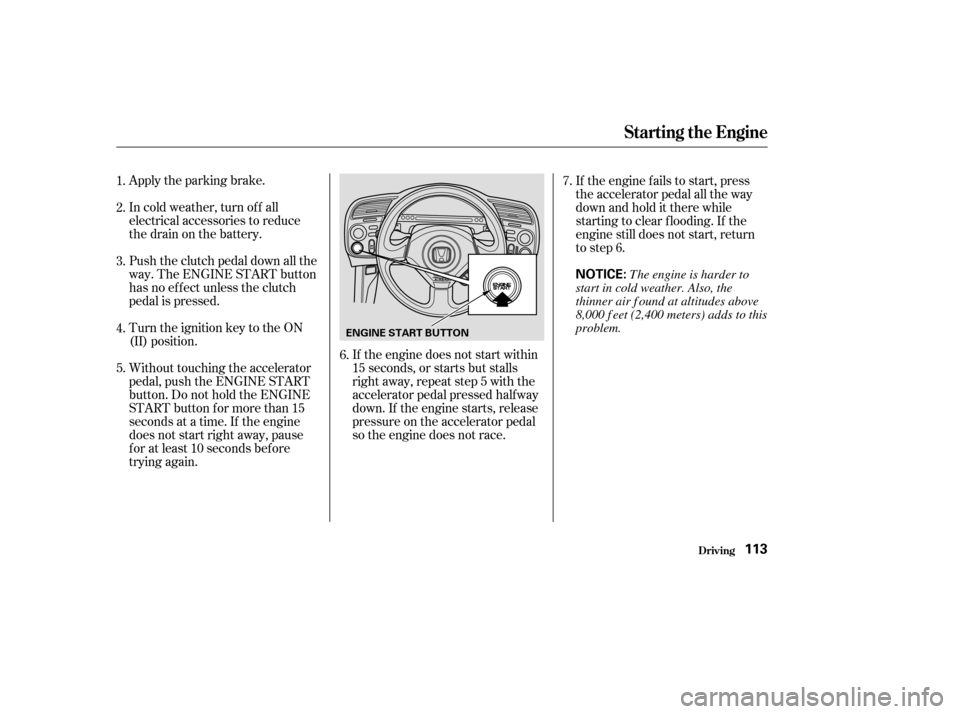
Apply the parking brake.
In cold weather, turn of f all
electrical accessories to reduce
the drain on the battery.
Push the clutch pedal down all the
way. The ENGINE START button
has no ef f ect unless the clutch
pedal is pressed.
Turn the ignition key to the ON
(II) position.
Without touching the accelerator
pedal, push the ENGINE START
button. Do not hold the ENGINE
START button for more than 15
seconds at a time. If the engine
does not start right away, pause
f or at least 10 seconds bef ore
trying again.If the engine does not start within
15 seconds, or starts but stalls
right away, repeat step 5 with the
accelerator pedal pressed halfway
down. If the engine starts, release
pressure on the accelerator pedal
so the engine does not race.If the engine fails to start, press
the accelerator pedal all the way
downandholdittherewhile
starting to clear flooding. If the
engine still does not start, return
to step 6.
1.
2.
3.
4.
5.
6.7.
Starting the Engine
Driving113
NOTICE:
ENGINE START BUTTON
The engine is harder to
start in cold weather. Also, the
thinner air f ound at altitudes above
8,000 f eet (2,400 meters) adds to this
problem.
Page 117 of 208
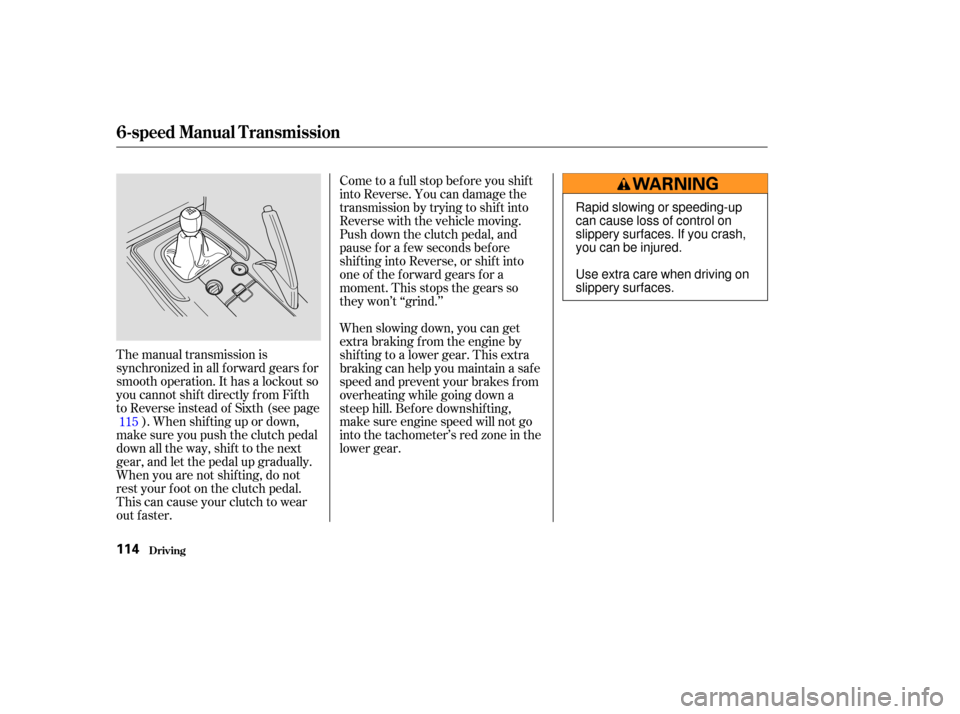
The manual transmission is
synchronized in all f orward gears f or
smooth operation. It has a lockout so
you cannot shift directly from Fifth
to Reverse instead of Sixth (see page). When shif ting up or down,
make sure you push the clutch pedal
down all the way, shift to the next
gear, and let the pedal up gradually.
When you are not shif ting, do not
rest your f oot on the clutch pedal.
This can cause your clutch to wear
out f aster. Come to a full stop before you shift
into Reverse. You can damage the
transmission by trying to shif t into
Reverse with the vehicle moving.
Push down the clutch pedal, and
pause f or a f ew seconds bef ore
shif ting into Reverse, or shif t into
one of the f orward gears f or a
moment. This stops the gears so
they won’t ‘‘grind.’’
When slowing down, you can get
extra braking f rom the engine by
shifting to a lower gear. This extra
braking can help you maintain a safe
speed and prevent your brakes f rom
overheating while going down a
steep hill. Bef ore downshif ting,
make sure engine speed will not go
into the tachometer’s red zone in the
lower gear.
115
6-speed Manual T ransmission
Driving114
Rapid slowing or speeding-up
can cause loss of control on
slippery surfaces. If you crash,
you can be injured.
Use extra care when driving on
slippery surfaces.
Page 119 of 208

Make sure the convertible top and
windows are closed.
Turn of f the lights.
Place any packages, valuables, etc.,
in the trunk or take them with you.
Lock the doors.
Never park over dry leaves, tall
grass, or other f lammable
materials. The hot three way
catalytic converter could cause
these materials to catch on fire.If the vehicle is f acing uphill, turn
the f ront wheels away f rom the
curb, and put the transmission in
f irst gear.
If the vehicle is f acing downhill,
turn the front wheels toward the
curb, and put the transmission in
reverse gear.
Make sure the parking brake is
f ully released bef ore driving away.
Driving with the parking brake
partially set can overheat or
damage the rear brakes.
Your Honda is equipped with disc
brakes at all f our wheels. A power
assist helps reduce the ef f ort needed
on the brake pedal. The ABS helps
you retain steering control when
braking very hard.
Resting your f oot on the pedal keeps
the brakes applied lightly, builds up
heat, and reduces their ef f ectiveness.
It also keeps your brake lights on all
the time, conf using drivers behind
you.
Constant application of the brakes
when going down a long hill builds
up heat and reduces their ef f ective-
ness. Use the engine to assist the
brakes by taking your f oot of f the
accelerator and downshif ting to a
lower gear.
Always use the parking brake when
you park your vehicle. Make sure
the parking brake is set f irmly or
your vehicle may roll if it is on an
incline.
Parking, Braking System
Parking
Parking T ips
Braking System
Driving116