heating HONDA S2000 2004 2.G Owners Manual
[x] Cancel search | Manufacturer: HONDA, Model Year: 2004, Model line: S2000, Model: HONDA S2000 2004 2.GPages: 208, PDF Size: 2.91 MB
Page 5 of 208
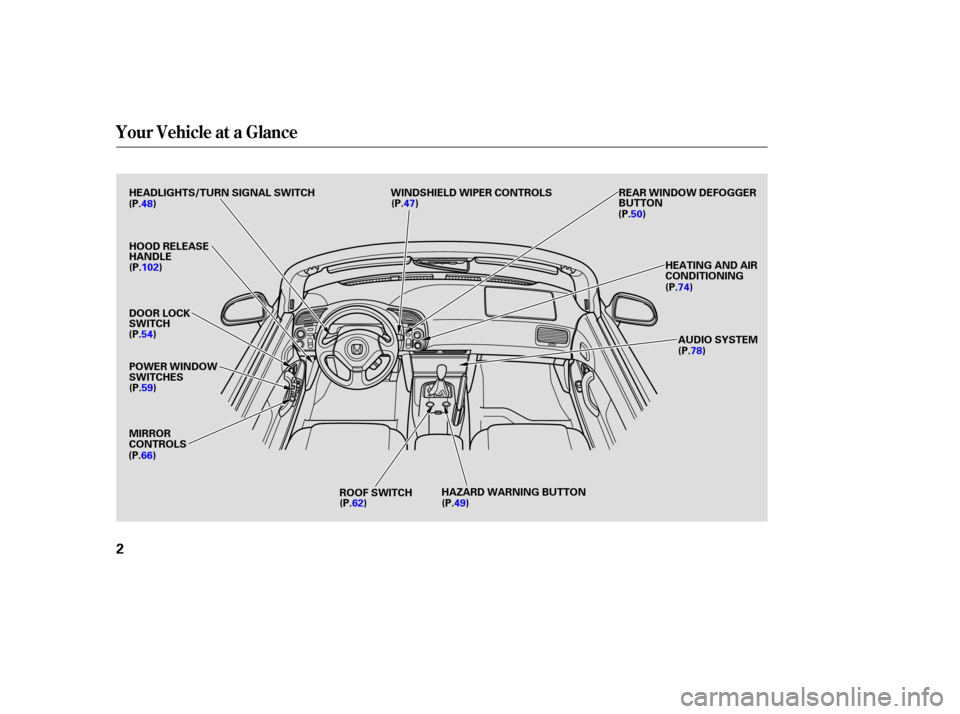
Your Vehicle at a Glance
2
HEADLIGHTS/TURN SIGNAL SWITCH
HOOD RELEASE
HANDLE
DOOR LOCK
SWITCH
POWER WINDOW
SWITCHES
MIRROR
CONTROLSROOF SWITCH AUDIO SYSTEM
HEATING AND AIR
CONDITIONING
REAR WINDOW DEFOGGER
BUTTON
WINDSHIELD WIPER CONTROLS
HAZARD WARNING BUTTON
(P.48)
(P.102)
(P.54) (P.59)
(P.66) (P.47)
(P.50)
(P.74)
(P.78)
(P.49)
(P.62)
Page 37 of 208

Your vehicle’s exhaust contains
carbon monoxide gas. You should
have no problem with carbon
monoxide entering the vehicle in
normal driving if you maintain your
vehicle properly.
Have the exhaust system inspected
f or leaks whenever:The vehicle is raised f or an oil
change.
You notice a change in the sound
of the exhaust.
The vehicle was in an accident
that may have damaged the under-
side. High levels of carbon monoxide can
collect rapidly in enclosed areas,
such as a garage. Do not run the
engine with the garage door closed.
Even with the door open, run the
engine only long enough to move the
vehicle out of the garage. With the trunk lid open, air f low can
pull exhaust gas into your vehicle’s
interior and create a hazardous
condition. If you must drive with the
trunk lid open, open all the windows,
and set the heating and cooling
system as shown below.
If you must sit in your parked vehicle,
even in an unconf ined area, with the
engine running, adjust the heating
and cooling system as f ollows:
Push the button.
Select the mode.
Turn the f an on high speed.
Set the temperature control to a
comfortable setting.
1.
2.
3.
4.
Carbon Monoxide Hazard
Driver and Passenger Saf ety34
Carbon monoxide gas is toxic.
Breathing it can cause
unconsciousness and even kill
you.
Avoid any enclosed areas or
activities that expose you to
carbon monoxide.
Page 41 of 208
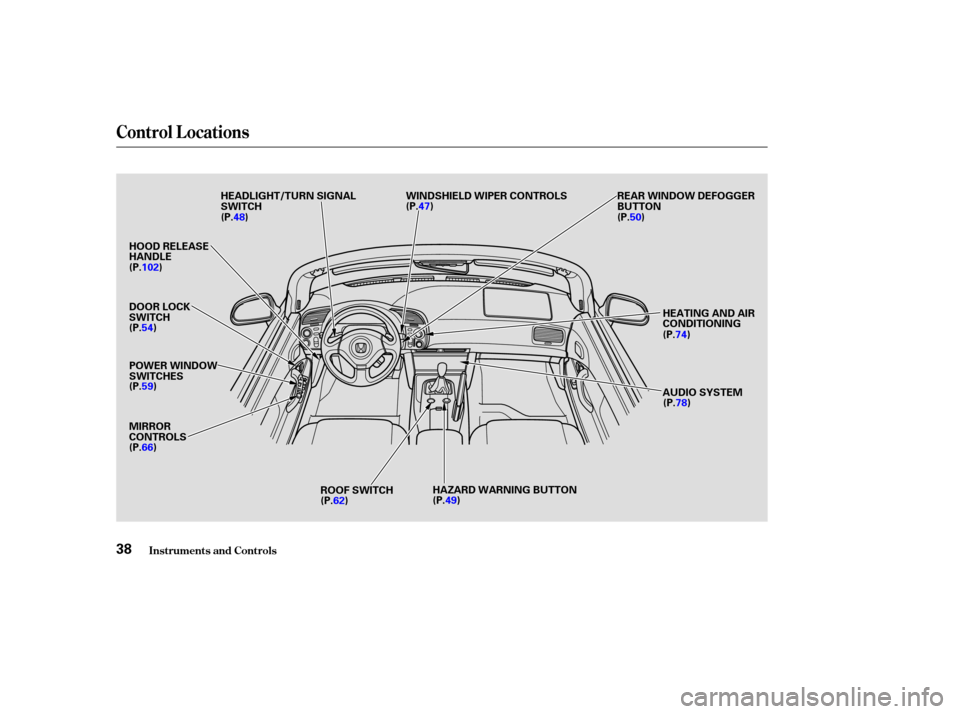
Control L ocations
Inst rument s and Cont rols38
HEADLIGHT/TURN SIGNAL
SWITCH
HOOD RELEASE
HANDLE
DOOR LOCK
SWITCH
POWER WINDOW
SWITCHES
MIRROR
CONTROLS
ROOF SWITCH AUDIO SYSTEM
HEATING AND AIR
CONDITIONING
REAR WINDOW DEFOGGER
BUTTON
WINDSHIELD WIPER CONTROLS
HAZARD WARNING BUTTON
(P.48)
(P.102)
(P.54)
(P.59)
(P.66) (P.47)
(P.50)
(P.74)
(P. 78)
(P.49)
(P.62)
Page 76 of 208

The heating and air conditioning
systems in your Honda provide a
comf ortable driving environment in
all weather conditions.
The standard audio system has
many f eatures. This section de-
scribes those f eatures and how to
use them. (If you selected an
optional audio system, ref er to the
operating instructions that came
with it.)...............
Vents, Heating, and A/C . 74
...............................
Airflow Buttons .75
............................
Playing the Radio .78
..............................
Radio Reception .81
....................................
Playing a CD .83
.....................................
CD Changer .84
......................
Protecting Your CDs .85
...........
CD Player Error Messages . 86
.......
CD Changer Error Messages . 87
...
Playing the XM
Satellite Radio . 88
..................
Remote Audio Controls . 93
...................
Radio Thef t Protection . 94
.................................
Cruise Control .95
Comf ort and Convenience Features
Comf ort and Convenience Feat ures73
Page 77 of 208
Vents, Heating, and A/C
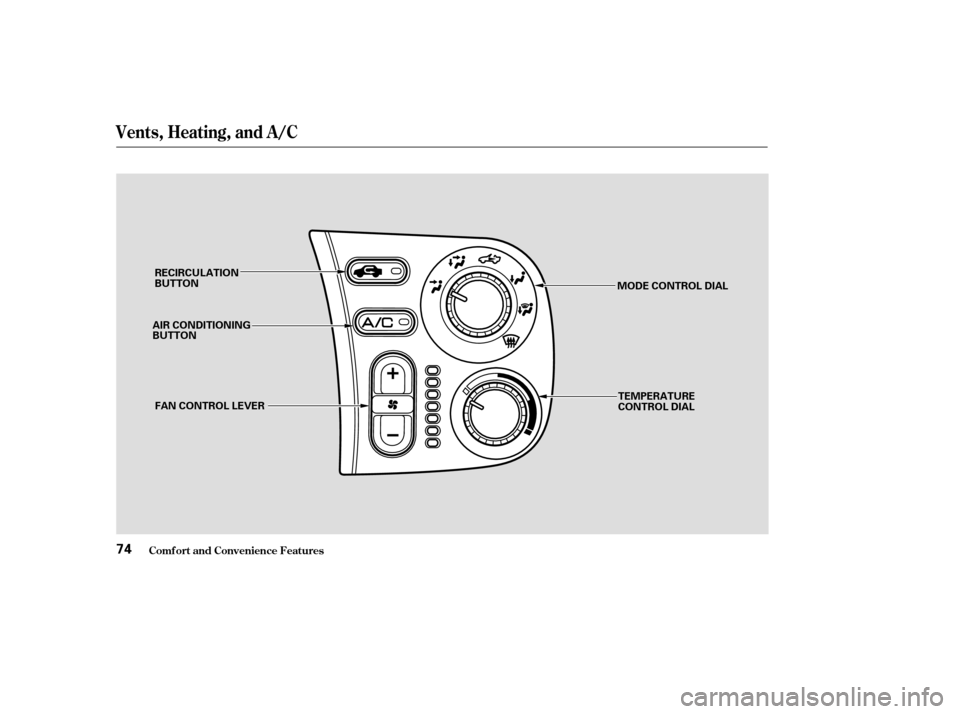
Comf ort and Convenience Feat ures74
RECIRCULATION
BUTTON
AIR CONDITIONING
BUTTON
FAN CONTROL LEVER MODE CONTROL DIAL
TEMPERATURE
CONTROL DIAL
Page 78 of 208

Push this lever up and down to
increase and decrease the f an speed.
The indicators next to the lever show
you the speed selected.
Turning this dial clockwise increases
the temperature of the airflow.
This button turns the air
conditioning on and of f . The
indicator in the button comes on
when the A/C is on.
This button controls the source of
the air going into the system. When
the indicator in this button is on, air
f rom the vehicle’s interior is sent
through the system again
(Recirculation mode). When the
indicator is of f , air is brought in f rom
outside the vehicle (Fresh Air mode).The outside air intakes f or the
heating and cooling system are at
the base of the windshield. Keep this
area clear of leaves and other debris.
ThesystemshouldbeleftinFresh
Air mode under almost all conditions.
Keeping the system in Recirculation
mode, particularly with the A/C of f ,
can cause the windows to fog up.
Switch to Recirculation mode when
driving through dusty or smoky
conditions, then return to Fresh Air
mode.
This button turns the rear window
def ogger of f and on (see page ).
Use the mode control dial to select
the vents the air flows from. Some
air will f low f rom the dashboard
vents in all modes. Air flows from the vents on
both sides of the instrument panel,
andfromthedashboardventinfront
of the passenger.
Airf low is divided between
the vents in the dashboard and the
f loor vents.
Air flows from the center
vents in the dashboard above the
audio system, the vents on both
sides of the instrument panel, and
f rom the f loor vents. Select this
position when you drive with the
convertible top f olded.
Air f lows f rom the f loor
vents and the vents on both sides of
the instrument panel.
Airf low is divided between
the f loor vents and the def roster
vents at the base of the windshield,
and the vents on both sides of the
instrument panel.
50
Comf ort and Convenience Feat ures
Fan Control L ever
T emperature Control Dial
Air Conditioning (A/C) Button
Recirculation Button
Rear Window Def ogger Button
Mode Control Dial
Airf low Buttons
75
Page 79 of 208

The f low-through ventilation system
draws in outside air, circulates it
through the interior, then exhausts it
through vents behind the seat-backs.Turn the temperature control dial
all the way to the lef t.
Make sure the A/C is of f .
Select and Fresh Air mode.
Set the f an to the desired speed.
The heater uses engine coolant to
warm the air. If the engine is cold, it
will be several minutes bef ore you
f eel warm air coming f rom the
system. Select and Fresh Air mode.
Set the f an to the desired speed.
Adjust the warmth of the air with
the temperature control dial. Air conditioning places an extra load
on the engine. Watch the engine
coolant temperature gauge (see page
). If it moves near the red zone,
turn of f the A/C until the gauge
reads normally.
Turn on the A/C by pressing the
button. The indicator in the button
comesonwhenafanspeedis
selected.
Make sure the temperature
control dial is all the way to the left.
Select .
If the outside air is humid, select
Recirculation mode. If the outside
air is dry, select Fresh Air mode.
Set the f an to the desired speed. you can
cool it down more rapidly by partially
opening the windows, turning on the
A/C, and setting the fan to
maximum speed in Fresh Air mode.
Air f lows f rom the def roster
vents at the base of the windshield
and the vents on both sides of the
instrument panel.
When you select , the system
automatically switches to Fresh Air
mode and turns on the A/C. 1.
2.
3.
4.
1.
2.
3.1.
2.
3.
4.
5.45
If the interior is very warm,
Ventilation
Using the Heater
Using the A /C
Comf ort and Convenience Feat ures
Vents, Heating, and A/C
76
Page 80 of 208

To remove f og f rom the inside of the
windows:
When you switch to another mode
f rom , the A/C stays on.
Press the A/C button to turn it of f .Select . The system
automatically switches to Fresh
Air mode and turns on the A/C.
Select .
Set the f an and temperature
controls to the maximum level.
Air conditioning, as it cools, removes
moisture from the air. When used in
combination with the heater, it
makes the interior warm and dry.
Switch the f an on.
Turn on the air conditioning.
Select and Fresh Air mode.
Adjust the temperature control
dial to your pref erence.
This setting is suitable f or all driving
conditions whenever the outside
temperature is above 32°F (0°C). Set the f an to the desired speed.
Select . When you select
, the system automatically
switches to Fresh Air mode and
turns on the A/C.
Adjust the temperature control
dial so the airflow feels warm.
Select to help clear the
rear window. To clear the windows f aster, you can
close the dashboard corner vents
and the vents on both sides of the
instrument panel by rotating the
wheel below the vent. This will send
more warm air to the windshield
def roster vents. Once the windshield
is clear, select the Fresh Air mode to
avoid f ogging the windows.
For your saf ety, make sure you have
a clear view through all the windows
bef ore driving.
1.
2.
3.
4.
1.
2.
3.
4.1.
2.
3.
Vents, Heating, and A/C
Comf ort and Convenience Feat ures
T o Def og and Def rost
T o Remove Exterior Frost or Ice
From the Windows
To Dehumidif y the Interior
77
Page 117 of 208
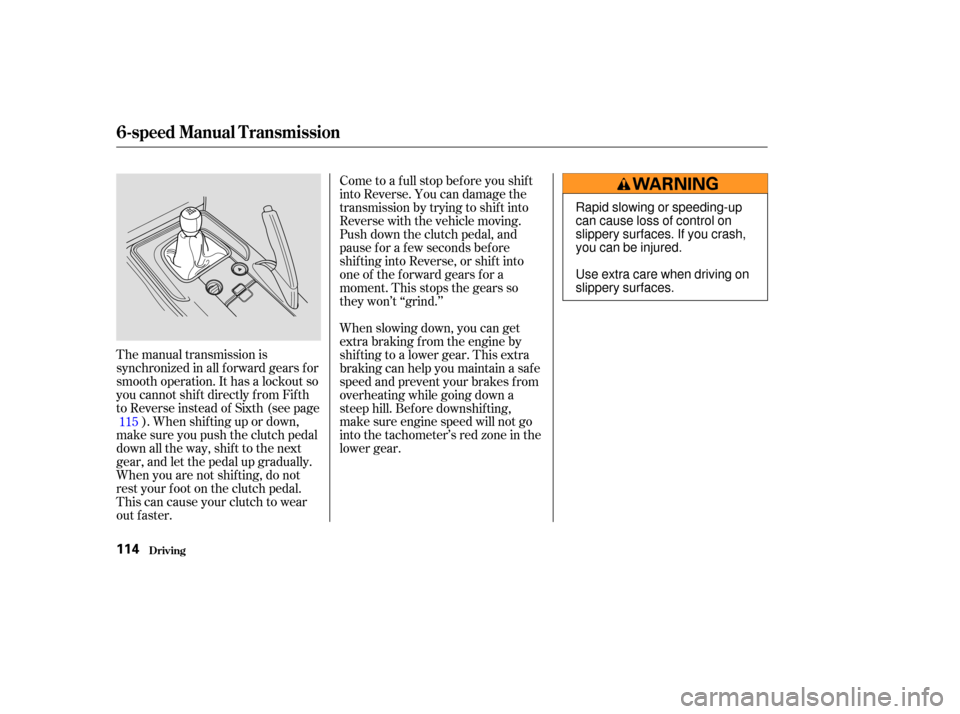
The manual transmission is
synchronized in all f orward gears f or
smooth operation. It has a lockout so
you cannot shift directly from Fifth
to Reverse instead of Sixth (see page). When shif ting up or down,
make sure you push the clutch pedal
down all the way, shift to the next
gear, and let the pedal up gradually.
When you are not shif ting, do not
rest your f oot on the clutch pedal.
This can cause your clutch to wear
out f aster. Come to a full stop before you shift
into Reverse. You can damage the
transmission by trying to shif t into
Reverse with the vehicle moving.
Push down the clutch pedal, and
pause f or a f ew seconds bef ore
shif ting into Reverse, or shif t into
one of the f orward gears f or a
moment. This stops the gears so
they won’t ‘‘grind.’’
When slowing down, you can get
extra braking f rom the engine by
shifting to a lower gear. This extra
braking can help you maintain a safe
speed and prevent your brakes f rom
overheating while going down a
steep hill. Bef ore downshif ting,
make sure engine speed will not go
into the tachometer’s red zone in the
lower gear.
115
6-speed Manual T ransmission
Driving114
Rapid slowing or speeding-up
can cause loss of control on
slippery surfaces. If you crash,
you can be injured.
Use extra care when driving on
slippery surfaces.
Page 146 of 208
If your seat belts get dirty, use a sof t
brush with a mixture of mild soap
and warm water to clean them. Do
not use bleach, dye, or cleaning
solvents. Let the belts air-dry bef ore
you use the vehicle.
Dirt build-up in the loops of the seat
belt anchors can cause the belts to
retract slowly. Wipe the insides of
the loops with a clean cloth
dampened in mild soap and warm
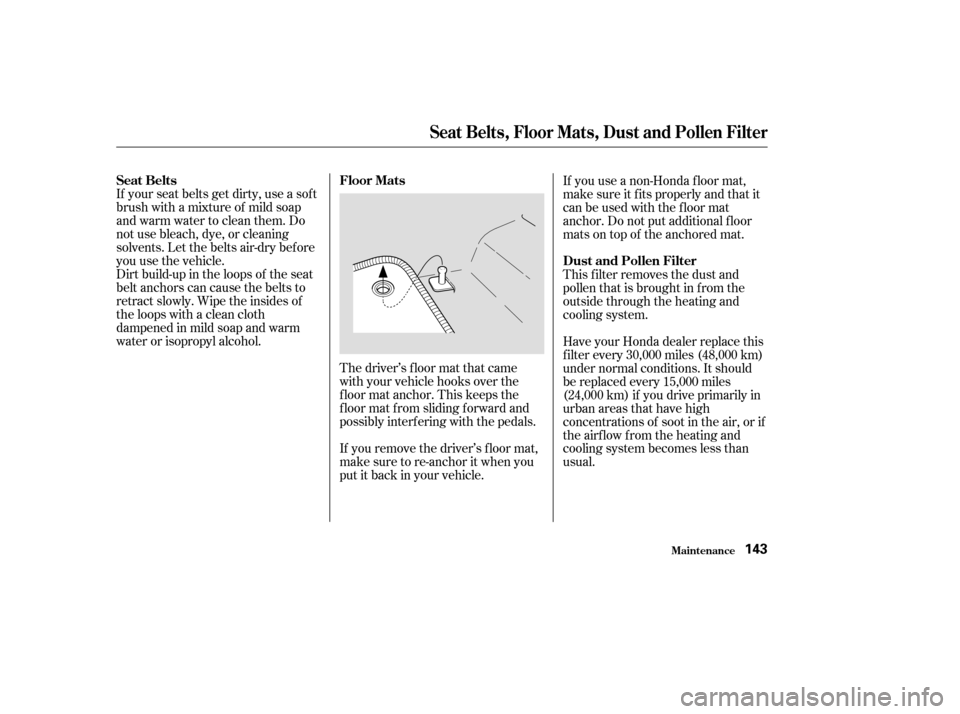
water or isopropyl alcohol.The driver’s f loor mat that came
with your vehicle hooks over the
f loor mat anchor. This keeps the
f loor mat f rom sliding f orward and
possibly interf ering with the pedals.
If you remove the driver’s f loor mat,
make sure to re-anchor it when you
putitbackinyourvehicle.If you use a non-Honda f loor mat,
make sure it f its properly and that it
canbeusedwiththefloormat
anchor. Do not put additional f loor
mats on top of the anchored mat.
This f ilter removes the dust and
pollenthatisbroughtinfromthe
outside through the heating and
cooling system.
Have your Honda dealer replace this
f ilter every 30,000 miles (48,000 km)
under normal conditions. It should
be replaced every 15,000 miles
(24,000 km) if you drive primarily in
urban areas that have high
concentrations of soot in the air, or if
the airflow from the heating and
cooling system becomes less than
usual.
Seat Belts, Floor Mats, Dust and Pollen Filter
Maint enance
Seat Belts
Floor Mats
Dust and Pollen Filter
143