instrument panel HONDA S2000 2005 2.G Owner's Manual
[x] Cancel search | Manufacturer: HONDA, Model Year: 2005, Model line: S2000, Model: HONDA S2000 2005 2.GPages: 209, PDF Size: 2.78 MB
Page 95 of 209
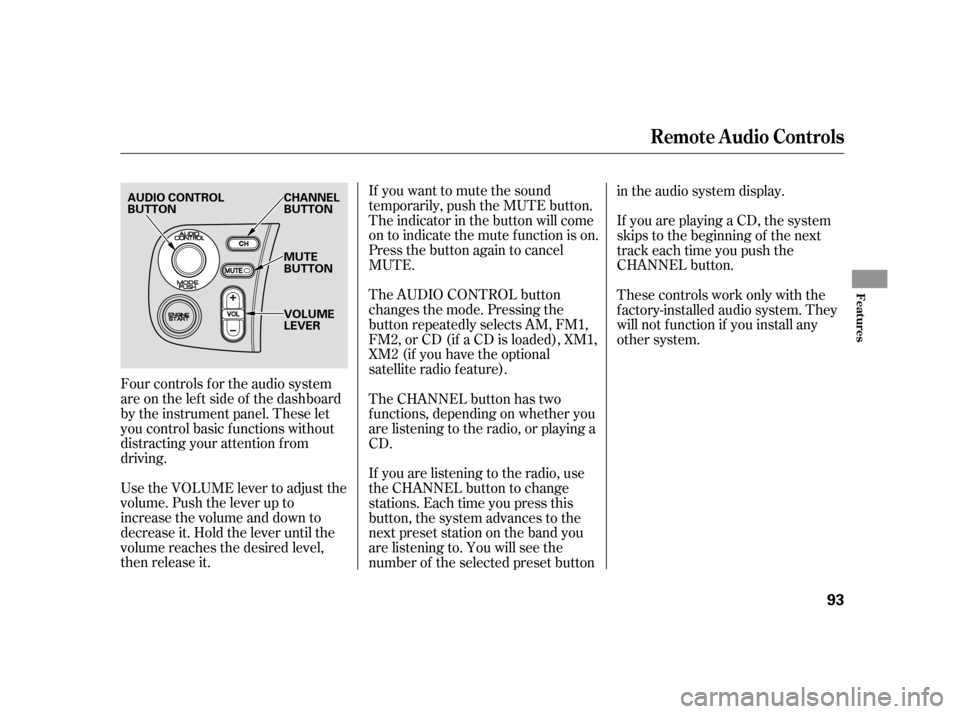
Four controls f or the audio system
areontheleftsideof thedashboard
by the instrument panel. These let
you control basic f unctions without
distracting your attention f rom
driving.
Use the VOLUME lever to adjust the
volume. Push the lever up to
increase the volume and down to
decrease it. Hold the lever until the
volume reaches the desired level,
then release it.If you want to mute the sound
temporarily, push the MUTE button.
The indicator in the button will come
on to indicate the mute f unction is on.
Press the button again to cancel
MUTE.
The AUDIO CONTROL button
changes the mode. Pressing the
button repeatedly selects AM, FM1,
FM2, or CD (if a CD is loaded), XM1,
XM2 (if you have the optional
satellite radio f eature).
The CHANNEL button has two
f unctions, depending on whether you
are listening to the radio, or playing a
CD.
If you are listening to the radio, use
the CHANNEL button to change
stations. Each time you press this
button, the system advances to the
next preset station on the band you
are listening to. You will see the
number of the selected preset buttonin the audio system display.
If youareplayingaCD,thesystem
skips to the beginning of the next
track each time you push the
CHANNEL button.
These controls work only with the
f actory-installed audio system. They
will not f unction if you install any
other system.
Remote Audio Controls
Features
93
AUDIO CONTROL
BUTTON
CHANNEL
BUTTON
MUTE
BUTTON
VOLUME
LEVER
Page 97 of 209
Cruise control allows you to maintain
asetspeedabove25mph(40km/h)
without keeping your f oot on the
accelerator pedal. It should be used
f or cruising on straight, open
highways. It is not recommended f or
city driving, winding roads, slippery
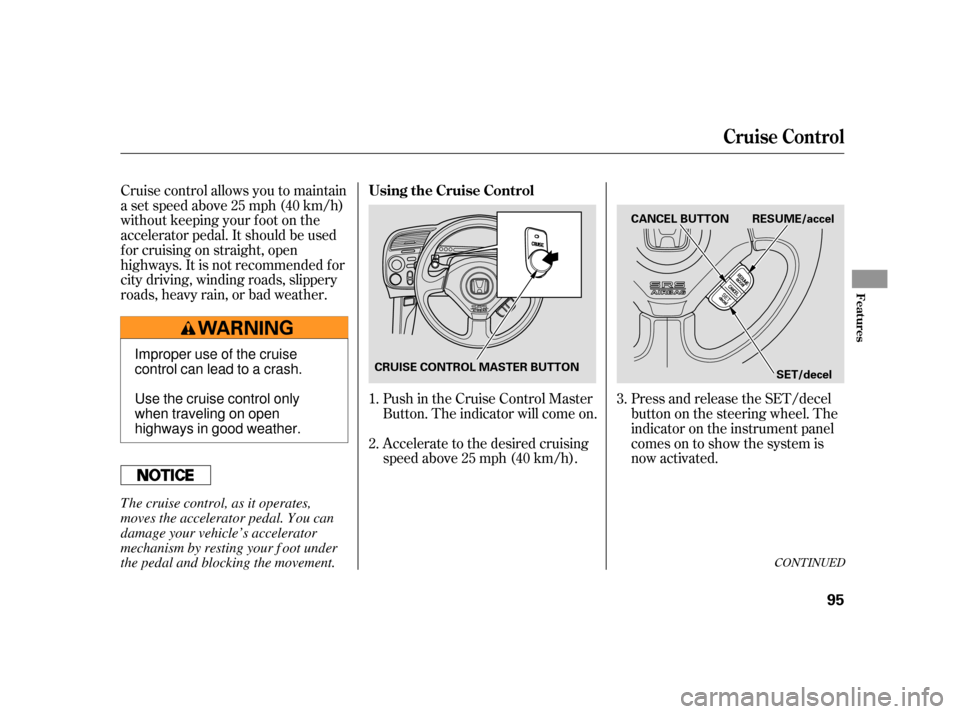
roads, heavy rain, or bad weather.Push in the Cruise Control Master
Button. The indicator will come on.Press and release the SET/decel
buttononthesteeringwheel.The
indicator on the instrument panel
comes on to show the system is
now activated.
Accelerate to the desired cruising
speedabove25mph(40km/h).
1.
2.
3.
CONT INUED
Cruise Control
Using the Cruise Control
Features
95
CANCEL BUTTON
SET/decel
RESUME/accel
CRUISE CONTROL MASTER BUTTON
Improper use of the cruise
control can lead to a crash.
Use the cruise control only
when traveling on open
highways in good weather.
The cruise control, as it operates,
moves the accelerator pedal. Y ou can
damage your vehicle’s accelerator
mechanism by resting your f oot under
the pedal and blocking the movement.
Page 98 of 209

You can increase the set cruising
speed in any of these ways:Press and hold the RESUME/
accel button. When you reach the
desired cruising speed, release the
button.
Push on the accelerator pedal.
Accelerate to the desired cruising
speed, and press the SET/decel
button. You can decrease the set cruising
speed in any of these ways:
Press and hold the SET/decel
button. Release the button when
you reach the desired speed.
To slow down in very small
amounts, tap the SET/decel
button. Each time you do this,
your vehicle will slow down about
1 mph (1.6 km/h).
Tap the brake or clutch pedal
lightly with your f oot. The
CRUISE CONTROL indicator on
the instrument panel goes out.
When the vehicle slows to the
desired speed, press the SET/
decel button.
Cruise control may not hold the
set speed when you are going up
and down hills. If your speed
increases going down a hill, use
the brakes to slow down. This will
cancelthecruisecontrol.To
resume the set speed, press the
RESUME/accel button. The
indicator on the instrument panel
will come back on.
To increase the speed in very
small amounts, tap the RESUME/
accel button. Each time you do
this, your vehicle speeds up about
1 mph (1.6 km/h).
Cruise Control
Changing the Set Speed
96
Page 102 of 209

Help assure your vehicle’s f uture
reliability and perf ormance by paying
extra attention to how you drive
during the f irst 600 miles (1,000 km).
During this period:Avoid full-throttle starts and rapid
acceleration. Do not exceed 5,500
rpm f or the f irst 600 miles (1,000
km) of operation.
You should also f ollow these
recommendations with an
overhauled or exchanged engine, or
when the brakes are replaced. Avoidhardbrakingforthefirst
200 miles (300 km). Do not change the oil until the
scheduled maintenance time. Your vehicle is designed to operate
on premium unleaded gasoline with a
pump octane of 91 or higher. Use of
a lower octane gasoline can cause
occasional metallic knocking noises
in the engine and will result in
decreased engine perf ormance. Use
of a gasoline with a pump octane less
than 86 can lead to engine damage.
We recommend quality gasoline
containing detergent additives that
help prevent f uel system and engine
deposits.
In addition, in order to maintain good
perf ormance, f uel economy, and
emissions control, we strongly
recommend, in areas where it is
available, the use of gasoline that
does NOT contain manganese-based
f uel additives such as MMT.
Use of gasoline with these additives
may adversely af f ect perf ormance, and cause the Malfunction Indicator
Lamp on your instrument panel to
come on. If this happens, contact
your authorized dealer f or service.
Some gasoline today is blended with
oxygenates such as ethanol or
MTBE. Your vehicle is designed to
operate on oxygenated gasoline
containing up to 10 percent ethanol
by volume and up to 15 percent
MTBE by volume. Do not use
gasoline containing methanol.
If you notice any undesirable
operating symptoms, try another
service station or switch to another
brand of gasoline.
For f urther important f uel-related
inf ormation, please ref er to your
.
Break-in Period
Fuel Recommendation
Quick Start Guide
Break-in Period, Fuel Recommendation
100
Page 115 of 209

Youshoulddothefollowingchecks
and adjustments bef ore you drive
your vehicle.Make sure all windows, mirrors,
and outside lights are clean and
unobstructed. Remove f rost, snow,
or ice. Check that any items you may be
carrying are stored properly or
f astened down securely.
Fasten your seat belt. Check that
your passenger has f astened his or
her seat belt (see page ).
When you start the engine, check
the gauges and indicators in the
instrument panel (see page ).
Check the seat adjustment (see
page ).
Check the adjustment of the
inside and outside mirrors (see
page ).
Make sure the doors are securely
closed and locked.
Check that the hood is f ully closed.
Check that the trunk is f ully
closed.
Visually check the tires. If a tire
looks low, use a gauge to check its
pressure.
1.
2.
58
66 12
39
3.
4. 5.
6.
7.
8.
9.
10.
Preparing to Drive
Driving
113
Page 167 of 209
If the headlights dim noticeably or
go out when you try to start the
engine, either the battery is
discharged or the connections are
corroded. Check the condition of the
battery and terminal connections
(see page ). You can then try
jump starting the vehicle from a
booster battery (see page ).In this case, the starter motor’s
speed sounds normal, or even f aster
than normal, when you press the
ENGINE START button, but the
engine does not run.
If you f ind nothing wrong, you will
need a qualif ied technician to f ind
the problem. See on page .
There may be an electrical
problem, such as no power to the
f uel pump. Check all the f uses
(see page ).
Are you using a properly coded
key? An improperly coded key will
cause the immobilizer system
indicator in the instrument panel
to blink rapidly (see page ).
Are you using the proper starting
procedure? Ref er to on page .
Do you have f uel? Check the f uel
gauge; the low f uel indicator may
not be working. 52
114
154
166 174
179
T he Starter Operates Normally
Emergency
Towing
Starting the
Engine
If theEngineWon’tStart
T aking Care of t he Unexpect ed
165
Page 201 of 209
CONT INUED
....................................
Accessories .105
ACCESSORY (Ignition Key .......................................
Position) .53
...............
Accessory Power Socket . 69
....................
Additives, Engine Oil . 132
...............................
Airbag (SRS) .9, 19
................
Air Conditioning System . 74
............................................
Usage .76
.......................
Air Pressure, Tires .150
.......................
Alcohol in Gasoline .100
......................................
Antif reeze .134
Anti-lock Brakes (ABS) ...............................
Indicator .41, 119
...................................
Operation .118
.
Anti-thef t Steering Column Lock . 53
............................
Anti-thef t System .94
......................................
Audio Panel .70
..................................
Audio System .78
...
Automatic Seat Belt Tensioners . 17
...............
Automatic Speed Control . 95
........
Back-up Light Replacement . 144Battery
Charging System ...........................
Indicator .40, 170
............................
Jump Starting .166
..............................
Maintenance .154
............................
Specif ications .185
................................
Bef ore Driving .99
....................................
Belts,Seat .8,16
.............................
Beverage Holder .69
..................................
Booster Seats .32
............................................
Brakes .117
...........
Anti-lock System (ABS) . 118
.............
Break-in, New Linings . 100
...........................................
Fluid .139
.........................................
Parking .67
..........................
System Design .118
.................
System Indicator . 40,172
........................
Wear Indicators .118
.............................
Braking System .117
.................
Break-in, New Vehicle . 100
..
Brightness Control, Instruments . 49
........................
Brights, Headlights .48
.........................
Bulb Replacement .140
..........................
Back-up Lights .144
.................................
Headlights .140
...........
Side Turn Signal Lights . 143............................
Specif ications .185
............
Turn Signal Lights . 142,144
..............................
Bulbs, Halogen .140
............................
Capacities Chart .184
.............
Carbon Monoxide Hazard . 35
....................
Cargo, How to Carry .107
..............
CAUTION, Explanation of . ii
...........................................
CD Care .90
.....................................
CD Changer .90
.......
CD Changer Error Messages . 92
........................
CD Error Messages .91
.........................................
CD Player .88
........................
Certif ication Label .182
.................................
Chains, Tires .153
....................
Changing a Flat Tire .159
Changing Oil ........................................
How to .132
......................................
When to .125
...
Charging System Indicator . 40,170
............
Checklist, Bef ore Driving . 113
Index
B A
C
INDEX
I
Page 204 of 209
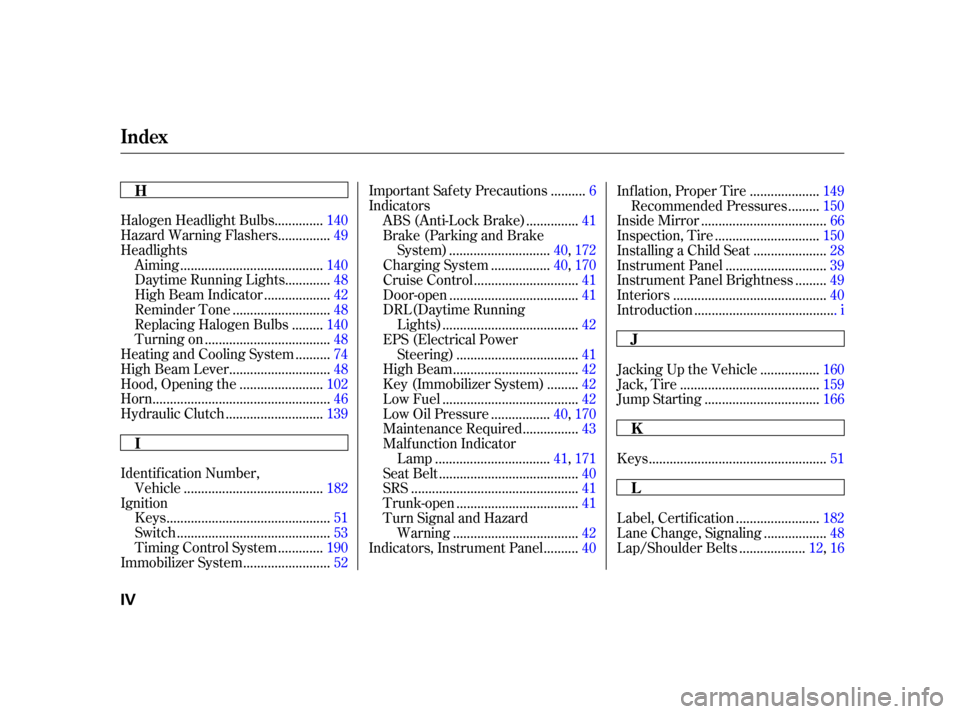
.............
Halogen Headlight Bulbs . 140
..............
Hazard Warning Flashers . 49
Headlights ........................................
Aiming .140
............
Daytime Running Lights . 48
..................
High Beam Indicator . 42
...........................
Reminder Tone .48
........
Replacing Halogen Bulbs . 140
...................................
Turning on .48
.........
Heating and Cooling System . 74
............................
High Beam Lever .48
.......................
Hood, Opening the .102
..................................................
Horn .46
...........................
Hydraulic Clutch .139
Identif ication Number, .......................................
Vehicle .182
Ignition ..............................................
Keys .51
...........................................
Switch .53
............
Timing Control System . 190
........................
Immobilizer System .52 .........
Important Safety Precautions . 6
Indicators ..............
ABS (Anti-Lock Brake) . 41
Brake (Parking and Brake ............................
System) .40, 172
................
Charging System . 40,170
.............................
Cruise Control .41
....................................
Door-open .41
DRL(Daytime Running ......................................
Lights) .42
EPS (Electrical Power ..................................
Steering) .41
...................................
High Beam .42
........
Key (Immobilizer System) . 42
......................................
Low Fuel .42
................
Low Oil Pressure . 40,170
...............
Maintenance Required . 43
Malf unction Indicator ................................
Lamp .41, 171
.......................................
Seat Belt .40
...............................................
SRS .41
..................................
Trunk-open .41
Turn Signal and Hazard ...................................
Warning .42
.........
Indicators, Instrument Panel . 40...................
Inf lation, Proper Tire . 149
........
Recommended Pressures . 150
...................................
Inside Mirror .66
.............................
Inspection, Tire .150
....................
Installing a Child Seat .28
............................
Instrument Panel .39
........
Instrument Panel Brightness . 49
...........................................
Interiors .40
........................................
Introduction . i
.......................
Label, Certif ication .182
.................
Lane Change, Signaling . 48
..................
Lap/Shoulder Belts . 12,16
..................................................
Keys .51
................
Jacking Up the Vehicle . 160
.......................................
Jack, Tire .159
................................
Jump Starting .166
Index
I J
K
L
H
IV