lock HONDA S2000 2007 2.G Workshop Manual
[x] Cancel search | Manufacturer: HONDA, Model Year: 2007, Model line: S2000, Model: HONDA S2000 2007 2.GPages: 228, PDF Size: 3.81 MB
Page 166 of 228
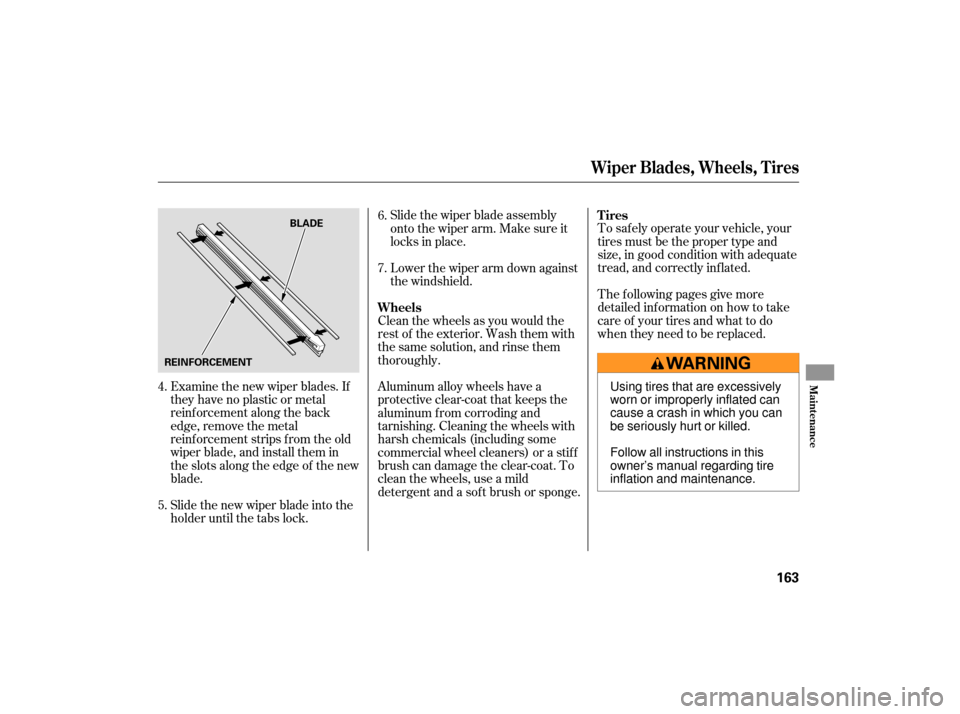
Examine the new wiper blades. If
they have no plastic or metal
reinf orcement along the back
edge, remove the metal
reinf orcement strips f rom the old
wiper blade, and install them in
the slots along the edge of the new
blade.To saf ely operate your vehicle, your
tires must be the proper type and
size, in good condition with adequate
tread, and correctly inf lated.
The f ollowing pages give more
detailed inf ormation on how to take
care of your tires and what to do
when they need to be replaced.
Slide the new wiper blade into the
holder until the tabs lock. Slide the wiper blade assembly
onto the wiper arm. Make sure it
locks in place.
Lower the wiper arm down against
the windshield.
Clean the wheels as you would the
rest of the exterior. Wash them with
thesamesolution,andrinsethem
thoroughly.
Aluminum alloy wheels have a
protective clear-coat that keeps the
aluminum f rom corroding and
tarnishing. Cleaning the wheels with
harsh chemicals (including some
commercial wheel cleaners) or a stif f
brush can damage the clear-coat. To
clean the wheels, use a mild
detergent and a sof t brush or sponge.
4.
5. 6.
7.
Tires
Wheels
Wiper Blades, Wheels, Tires
Maint enance
163
REINFORCEMENT BLADE
Using tires that are excessively
worn or improperly inflated can
cause a crash in which you can
be seriously hurt or killed.
Follow all instructions in this
owner’s manual regarding tire
inflation and maintenance.
Page 170 of 228

Wheels:
Tires:
See page for info rmation about
DOT Tire Quality Grading, and page
f or tire size and labeling
inf ormation.
Replacement wheels are available at
your dealer. If you ever replace a wheel, make
sure that the wheel’s specif ications
match those of the original wheels. TheABSworksbycomparingthe
speed of the wheels. When replacing
tires, use the same size originally
supplied with the vehicle. Tire size
and construction can affect wheel
speed and may cause the system to
activate.
Replace your tires with radial tires of
the same size, load range, speed
rating, and maximum cold tire
pressure rating (as shown on the
tire’s side wall).
Mixing radial and bias-ply tires on
your vehicle can reduce braking
ability, traction, and steering
accuracy. Using tires of a dif f erent
size or construction can cause the
anti-lock brake and the vehicle
stability assist systems to work
inconsistently.
It is best to replace all f our tires at
thesametime.If thatisnotpossible
or necessary, replace the two f ront
tires or two rear tires as a pair.
Replacing just one tire can seriously
af f ect your vehicle’s handling. 204
206
Wheel and T ire Specif ications
Replacing T ires and Wheels
Tires
Maint enance
167
Front:
17x7J
Rear: 17x81/2J
Front: 215/45R17 87W
Rear: 245/40R17 91W
Installing improper tires on your
vehicle can affect handling and
stability. This can cause a crash
in which you can be seriously
hurt or killed.
Always use the size and type of
tires recommended in this
owner’s manual.
Page 172 of 228
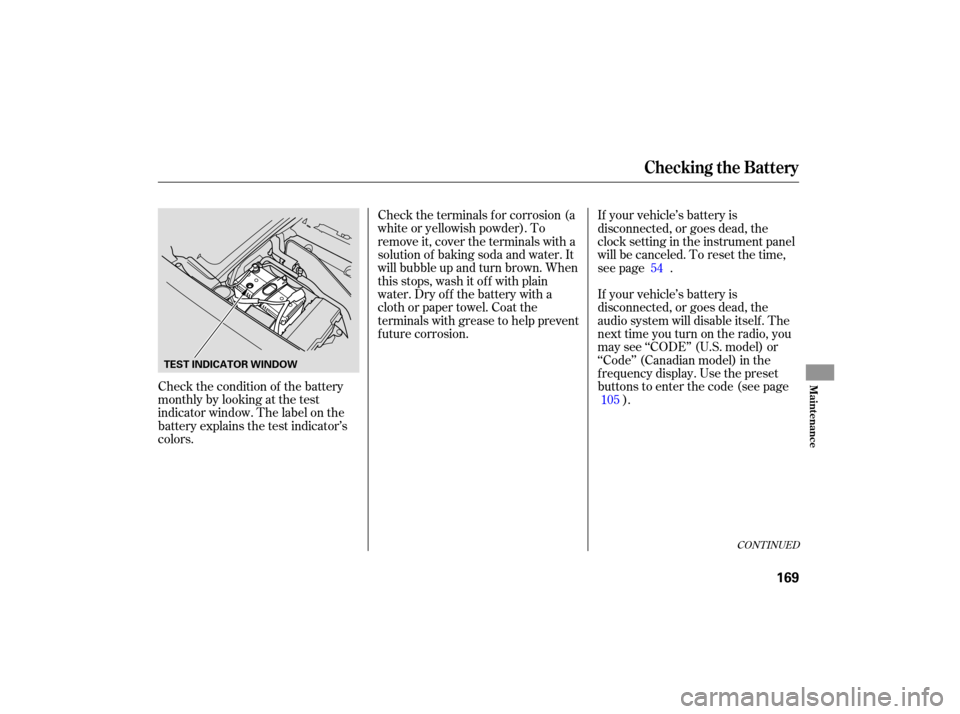
Check the condition of the battery
monthlybylookingatthetest
indicator window. The label on the
battery explains the test indicato r’s
colors. Check
the terminals for corrosion (a
white or yellowish powder). To
remove it, cover the terminals with a
solution of baking soda and water. It
will bubble up and turn brown. When
this stops, wash it off with plain
water. Dry off the battery with a
cloth or paper towel. Coat the
terminals with grease to help prevent
future corrosion. If
your vehicle’s battery is
disconnected, or goes dead, the
clock setting in the instrument panel
will be canceled. To reset the time,
see page .
If your vehicle’s battery is
disconnected, or goes dead, the
audio system will disable itsel f. The
nexttimeyouturnontheradio,you
may see ‘‘CODE’’ (U.S. model) or
‘‘Code’’ (Canadian model) in the
f requency display. Use the preset
buttons to enter the code (see page ). 54
105
CONT INUED
Checking the Battery
Maint enance
169
TEST INDICATOR WINDOW
Page 174 of 228

If you need to park your vehicle f or
an extended period (more than 1
month), there are several things you
should do to prepare it f or storage.
Proper preparation helps prevent
deterioration and makes it easier to
get your vehicle back on the road. If
possible, store your vehicle indoors.Fill the f uel tank.
Change the engine oil and f ilter.
Wash and dry the exterior
completely.
Cleantheinterior.Makesurethe
carpeting, floor mats, etc., are
completely dry.
Raise the convertible top cover.
Leave the parking brake off. Put
the transmission in reverse. Block the rear wheels.
If the vehicle is to be stored f or a
longer period, it should be
supported on jackstands so the
tires are of f the ground.
Leave one window open slightly (if
the vehicle is being stored
indoors).
Disconnect the battery.
Cover the vehicle with a
‘‘breathable’’ cover, one made
f rom a porous material such as
cotton. Non-porous materials, such
as plastic sheeting, trap moisture,
which can damage the paint.
Support the f ront wiper blade
arms with a f olded towel or rag so
they do not touch the windshield.
To minimize sticking, apply a
silicone spray lubricant to all door
and trunk seals. Also, apply a
vehiclebodywaxtothepainted
surfaces that mate with the door
and trunk seals. If possible, periodically run the
engine until it reaches f ull
operating temperature (the
cooling f an cycles on and of f
twice). Pref erably, do this once a
month.
Vehicle Storage
Maint enance
171
Page 178 of 228
Thesizedifferencemayalsocause
damage to the rear dif f erential, so do
not mount the compact spare on the
rear. If either rear tire goes f lat,
remove the f ront tire on that same
side, mount the compact spare tire
on the f ront, then mount the f ront
tire on the rear.Park the vehicle on f irm, level, and
non-slippery ground. Put the
transmission in reverse. Apply the
parking brake.
Turn on the hazard warning lights,
and turn the ignition switch to the
LOCK (0) position. Have your
passenger get out of the vehicle
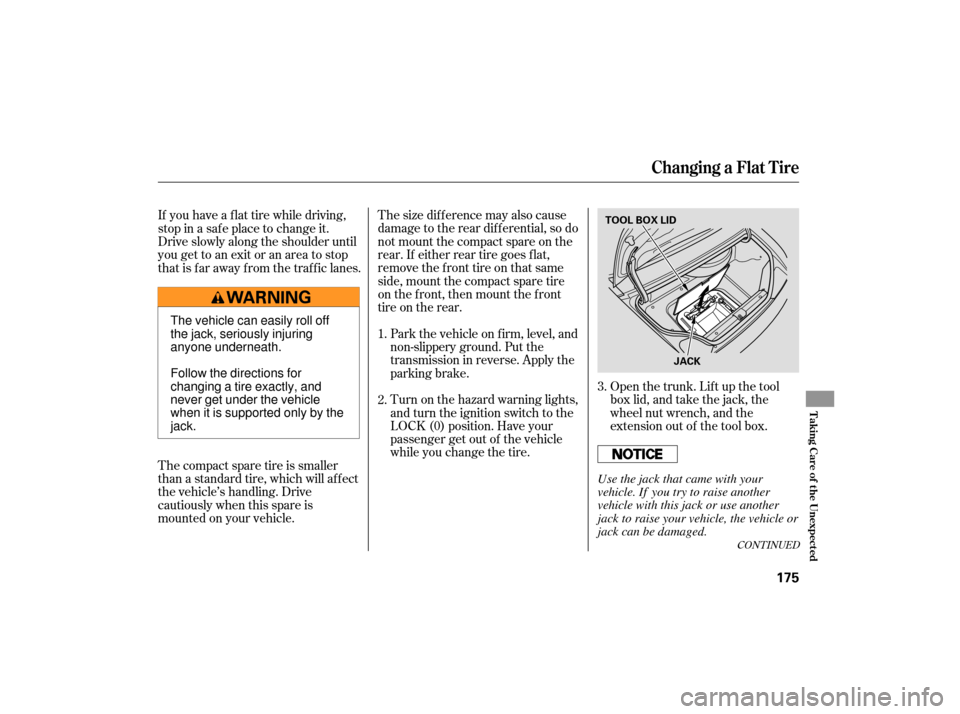
while you change the tire. Open the trunk. Lift up the tool
box lid, and take the jack, the
wheel nut wrench, and the
extension out of the tool box.
Thecompactsparetireissmaller
than a standard tire, which will affect
the vehicle’s handling. Drive
cautiously when this spare is
mounted on your vehicle. If you have a f lat tire while driving,
stop in a saf e place to change it.
Drive slowly along the shoulder until
you get to an exit or an area to stop
that is far away from the traffic lanes.
3.
1.
2.
CONT INUED
Changing a Flat Tire
T aking Care of t he Unexpect ed
175
TOOL BOX LID
JACK
The vehicle can easily roll off
the jack, seriously injuring
anyone underneath.
Follow the directions for
changing a tire exactly, and
never get under the vehicle
when it is supported only by the
jack. Use the jack that came with your
vehicle. If you try to raise another
vehicle with this jack or use another
jack to raise your vehicle, the vehicle or
jack can be damaged.
Page 179 of 228
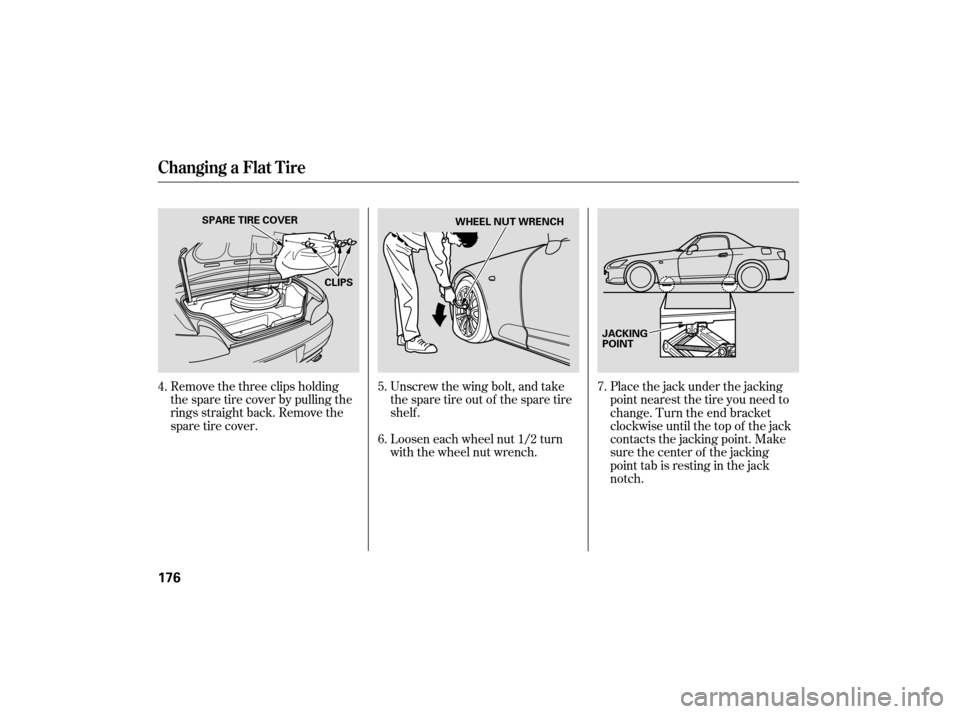
Unscrew the wing bolt, and take
the spare tire out of the spare tire
shelf .
Remove the three clips holding
the spare tire cover by pulling the
rings straight back. Remove the
sparetirecover.
Loosen each wheel nut 1/2 turn
with the wheel nut wrench.Place the jack under the jacking
point nearest the tire you need to
change. Turn the end bracket
clockwise until the top of the jack
contacts the jacking point. Make
sure the center of the jacking
point tab is resting in the jack
notch.
4.
5.
6. 7.
Changing a Flat Tire
176
SPARETIRECOVER
WHEEL NUT WRENCH
JACKING
POINT
CLIPS
Page 183 of 228

Diagnosing why the engine won’t
start falls into two areas, depending
on what you hear when you press
the ENGINE START button.
You hear nothing, or almost
nothing. The engine’s starter
motor does not operate at all, or
operates very slowly.
You can hear the starter motor
operating normally, or the starter
motor sounds like it is spinning
faster than normal, but the engine
does not start up and run. When
you press the ENGINE
START button, you do not hear the
norm al noise of the engine trying to
start. You may hear a clicking sound
or series of clicks, or nothing at all.
Check these things:
Check the transmission interlock.
The clutch pedal must be pushed
all the way to the floor or the
starter will not operate.
Turn the ignition switch to the ON
(II) position. Turn on the
headlights, and check their
brightness. If the headlights are
very dim or do not come on at all,
the battery is discharged. See
on page . Press
the ENGI NE START button,
then release it. If the headlights do
not dim, check the condition of the
fuses.IfthefusesareOK,thereis
probably something wrong with
the electrical circuit for the
ignition switch or starter motor.
You will need a qualified mechanic
to determine the problem. (See
on page .)
182 196
Nothing Happens or the Starter
Motor Operates Very Slowly
Jump Starting Emergency T owing
If theEngineWon’tStart
180
Page 188 of 228

If there was no coolant in the
reserve tank, you may need to add
coolant to the radiator. Let the
engine cool down until the reading
reaches the middle of the
temperature gauge or lower
befo re checking the radiato r. Using
gloves or a large heavy
cloth, turn the radiator cap
counterclockwise, without pushing
down, to the first stop. After the
pressure releases, push down on
the cap, and turn it until it comes
off. Put
the radiator cap back on
tightl y. Run the engine, and check
the temperatu re gauge. If it goes
back to the red mark, the engine
needs repair (see on page ).
If the temperature stays normal,
check the coolant level in the
radiator reserve tank. If it has
gone down, add coolant to the
MAX mark. Put the cap back on
tightly.
Start the engine, and set the
temperature control dial to
maximum heat. Add coolant to the
radiator up to the base of the f iller
neck. If you do not have the
proper coolant mixture available,
you can add plain water.
Remember to have the cooling
system drained and ref illed with
the proper mixture as soon as you
can.
9. 8.
7. 10.
11.196
Emergency
Towing
If theEngineOverheats
T aking Care of t he Unexpect ed
185
Removing the radiator cap
while the engine is hot can
cause the coolant to spray out,
seriously scalding you.
Always let the engine and
radiator cool down before
removing the radiator cap.
Page 194 of 228
CONTINUED
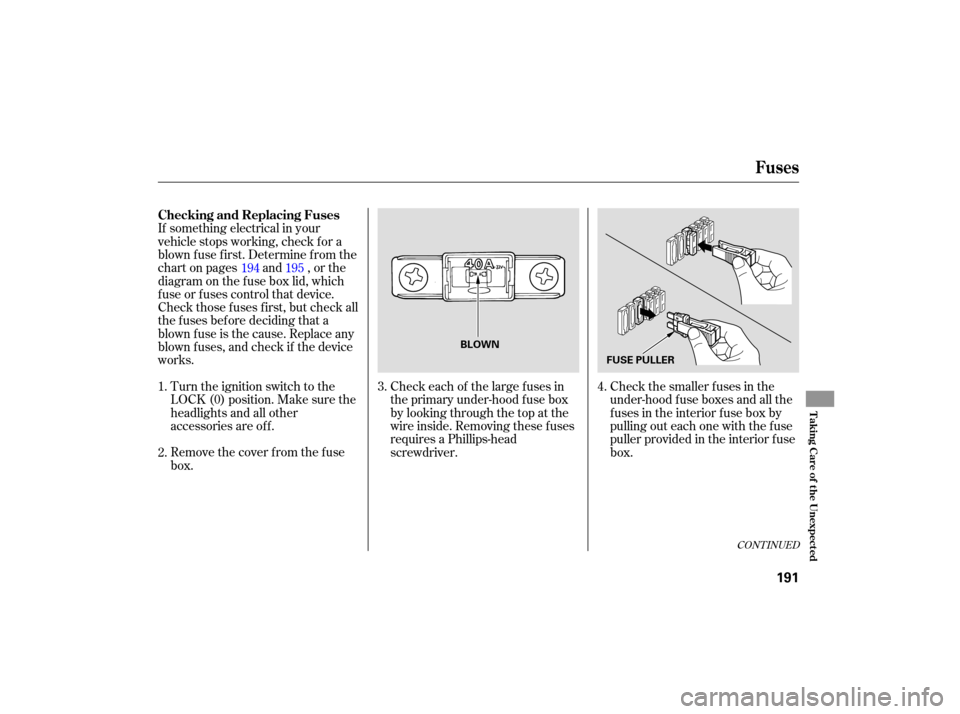
If something electrical in your
vehicle stops working, check for a
blown fuse first. Determine from the
chart on pages and , or the
diagram on the f use box lid, which
f use or f uses control that device.
Check those f uses f irst, but check all
the f uses bef ore deciding that a
blown f use is the cause. Replace any
blown f uses, and check if the device
works.
Turn the ignition switch to the
LOCK (0) position. Make sure the
headlights and all other
accessories are of f .
Remove the cover f rom the f use
box. Check each of the large f uses in
the primary under-hood f use box
by looking through the top at the
wire inside. Removing these f uses
requires a Phillips-head
screwdriver.
Check the smaller f uses in the
under-hood f use boxes and all the
fuses in the interior fuse box by
pulling out each one with the f use
puller provided in the interior f use
box.
1.
2. 3.
4.
194 195
Fuses
Checking and Replacing Fuses
T aking Care of t he Unexpect ed
191
BLOWN
FUSE PULLER
Page 196 of 228

If the radio fuse is removed, the
audio system will disable itsel f. The
nexttimeyouturnontheradioyou
will see ‘‘CODE’’ (U.S. model) or
‘‘Code’’ (Canadian model) in the
frequency display. Use the preset
buttons to enter the five-digit code
(see page ).
If the instrument panel fuse is
removed, the clock setting in the
instrument panel will be cancel ed. To
reset the time, see page .
105
54
Fuses
T aking Care of t he Unexpect ed
193