heating HONDA S2000 2009 2.G User Guide
[x] Cancel search | Manufacturer: HONDA, Model Year: 2009, Model line: S2000, Model: HONDA S2000 2009 2.GPages: 268, PDF Size: 5.11 MB
Page 101 of 268

Air conditioning places an extra load
on the engine. Watch the engine
coolant temperature gauge (see page). If it moves near the red zone,
turn of f the A/C until the gauge
reading returns to normal.
The f low-through ventilation system
draws in outside air, circulates it
through the interior, then exhausts it
through vents behind the seat-backs.
Set the temperature to the lower
limit.
Make sure the A/C is of f .
Select and fresh air mode.
Set the f an to the desired speed.
The heater uses engine coolant to
warm the air. If the engine is cold, it
will be several minutes bef ore you
f eel warm air coming f rom the
system. Select and fresh air mode.
Set the f an to the desired speed.
Adjust the warmth of the air with
the temperature control dial. Set the f an to the desired speed.
Turn on the A/C by pressing the
button. The indicator in the button
comes on.
Make sure the temperature is set
to maximum cool.
Select .
If the outside air is humid, select
recirculation mode. If the outside
air is dry, select f resh air mode.
Air f lows f rom the f loor
vents and the vents on both sides of
the instrument panel.
When you select , the system
automatically switches to f resh air
mode.
Airf low is divided between
the f loor vents and the def roster
vents at the base of the windshield,
and the vents on both sides of the
instrument panel.
Air f lows f rom the def roster
vents at the base of the windshield
and the vents on both sides of the
instrument panel.
When you select or ,
the system automatically switches to
f resh air mode and turns on the A/C. you can
cool it down more rapidly by partially
opening the windows, turning on the
A/C, and setting the fan to
maximum speed in f resh air mode.
1.
2.
3.
4.
1.
2.
3.
1.
2.
3.
4.
5.
55
If the interior is very warm,
Vents, Heating, and A/C
Using the A/C
Ventilation
Using the Heater
98
2009 S2000
Page 102 of 268
Air conditioning, as it cools, removes
moisture from the air. When used in
combination with the heater, it
makes the interior warm and dry and
can prevent the windows f rom
f ogging up.Turn the fan on.
Turn on the air conditioning.
Select and fresh air mode.
Adjust the temperature to your
pref erence.
This setting is suitable f or all driving
conditions whenever the outside
temperature is above 32°F (0°C).
To remove f og f rom the inside of the
windows: Set the f an to the desired speed, or
high f or f aster def rosting.
Select . The system
automatically switches to f resh air mode and turns on the A/C.
Adjust the temperature so the
airflow feels warm.
Select to help clear the
rear window.
To increase airf low to the
windshield, close the corner vents.
When you select or ,
the system automatically turns on
the A/C. This helps to dehumidif y
the air and to def og the windshield.
In either mode, you cannot turn of f
the A/C.
When you switch to another mode
f rom or , the A/C
stayson.PresstheA/Cbuttonto
turn it off. Push the f an control level down until
the indicator goes off. A lack of
airf low can cause the windows to f og
up. You should keep the f an on at all
times so stale air and moisture do
not build up in the interior and cause
f ogging.
For your saf ety, make sure you have
a clear view through all the windows
bef ore driving.
To clear the windows f aster, you can
close the dashboard corner vents
and the vents on both sides of the
instrument panel by rotating the
wheel below the vent. This will send
more warm air to the windshield
def roster vents. Once the windshield
is clear, select f resh air mode to
avoid f ogging the windows.
Select . The system
automatically switches to f resh air
mode and turns on the A/C. Select .
Set the f an and temperature
controls to the maximum level.
1.
2.
3.
4.
1.
2. 3.
4.
5.
1.2.
3.
Vents, Heating, and A/C
Dehumidif y the Interior
To Defog and Defrost To Turn Everything Off
T o Remove Exterior Frost or Ice
From the Windows
Features
99
2009 S2000
Page 103 of 268
Vents and Heating
100
FAN CONTROL LEVERMODE CONTROL DIAL
TEMPERATURE
CONTROL DIAL
REAR WINDOW
DEFOGGER BUTTON
RECIRCULATION BUTTON
S2000 CR model
2009 S2000
Page 104 of 268

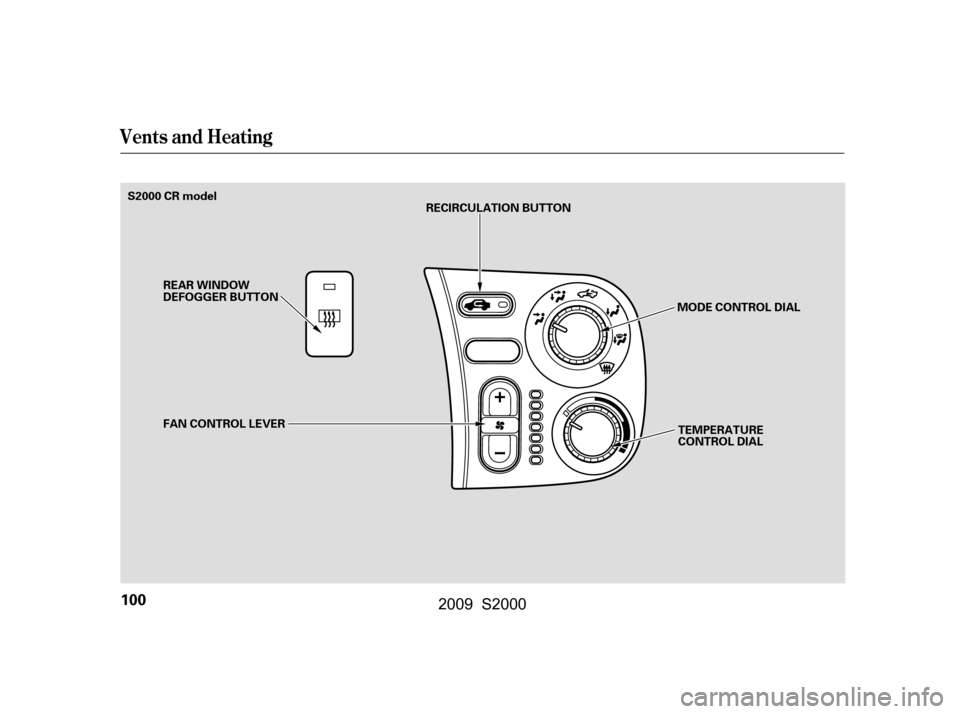
Push this lever up and down to
increase or decrease the f an speed
and airf low. The indicators next to
the lever show you the speed and
airf low selected.
Turning this dial clockwise increases
the temperature of the airflow.This button turns the rear window
def ogger of f and on (see page ).
When the recirculation indicator is
on, air f rom the vehicle’s interior is
sent through the system again
(recirculation mode). When the
indicator is of f , air is brought in f rom
the outside of the vehicle (f resh air
mode).
Switch to recirculation mode when
driving through dusty or smoky
conditions, then return to fresh air
mode.
The outside air intakes f or the
heating system are at the base of the
windshield. Keep this area clear of
leaves and other debris.
Thesystemshouldbeleftinfresh
air mode under almost all conditions.
Keeping the system in recirculation
mode, can cause the windows to f og
up. Do not push the def ogger button
when the removable hardtop is
removed.
Airf low is divided between
the vents in the dashboard and the
f loor vents. Air flows from the vents on
both sides of the instrument panel,
andfromthedashboardventinfront
of the passenger.
Use the mode control dial to select
the vents the air flows from. Some
air will f low f rom the dashboard
vents in all modes. 61
CONT INUED
Fan Control L ever
T emperature Control Dial
Rear Window Def ogger Button
Recirculation Button
A irf low Controls
Mode Control Dial
Vents and Heating
Features
101
2009 S2000
Page 105 of 268

The f low-through ventilation system
draws in outside air, circulates it
through the interior, then exhausts it
through vents behind the seat-backs.
Air flows from the center
vents in the dashboard, the vents on
both sides of the instrument panel,
and from the floor vents. Select this
position when you drive with the
removable hardtop removed. Set the temperature to the lower
limit.
Select and fresh air mode.
Set the f an to the desired speed.
Air f lows f rom the f loor
vents and the vents on both sides of
the instrument panel.
Airf low is divided between
the f loor vents and the def roster
vents at the base of the windshield,
and the vents on both sides of the
instrument panel.
Air f lows f rom the def roster
vents at the base of the windshield
and the vents on both sides of the
instrument panel. The heater uses engine coolant to
warm the air. If the engine is cold, it
will be several minutes bef ore you
f eel warm air coming f rom the
system.
Select and fresh air mode.
Set the f an to the desired speed.
Adjust the warmth of the air with
the temperature control dial.
When you select or ,
the system automatically switches to
Fresh Air mode. To remove f og f rom the inside of the
windows:
Set the f an to the desired speed, or
high f or f aster def rosting.
Select . The system
automatically switches to fresh air
mode.
Adjust the temperature so the
airflow feels warm.
Select to help clear the
rear window.
To increase airf low to the
windshield, close the corner vents.
When you select or ,
the system automatically turns on
the f resh air mode. This helps to
def og the windshield.
1.
2.
3.
1.
2.
3. 1.
2.
3.
4.
5.
Ventilation
Using the Heater
To Def og and Def rost
Vents and Heating
102
2009 S2000
Page 106 of 268

Push the f an control level down until
the indicator goes off. A lack of
airf low can cause the windows to f og
up. You should keep the f an on at all
times so stale air and moisture do
not build up in the interior and cause
f ogging.
Select . The system
automatically switches to f resh air
mode.
Select .
Set the f an and temperature
controls to the maximum level. To clear the windows f aster, you can
close the dashboard corner vents
and the vents on both sides of the
instrument panel by rotating the
wheel below the vent. This will send
more warm air to the windshield
def roster vents. Once the windshield
is clear, select f resh air mode to
avoid f ogging the windows.
For your saf ety, make sure you have
a clear view through all the windows
bef ore driving.
3.
1.
2. To Turn Everything Off
T o Remove Exterior Frost or Ice
From the Windows
Vents and Heating
Features
103
2009 S2000
Page 150 of 268
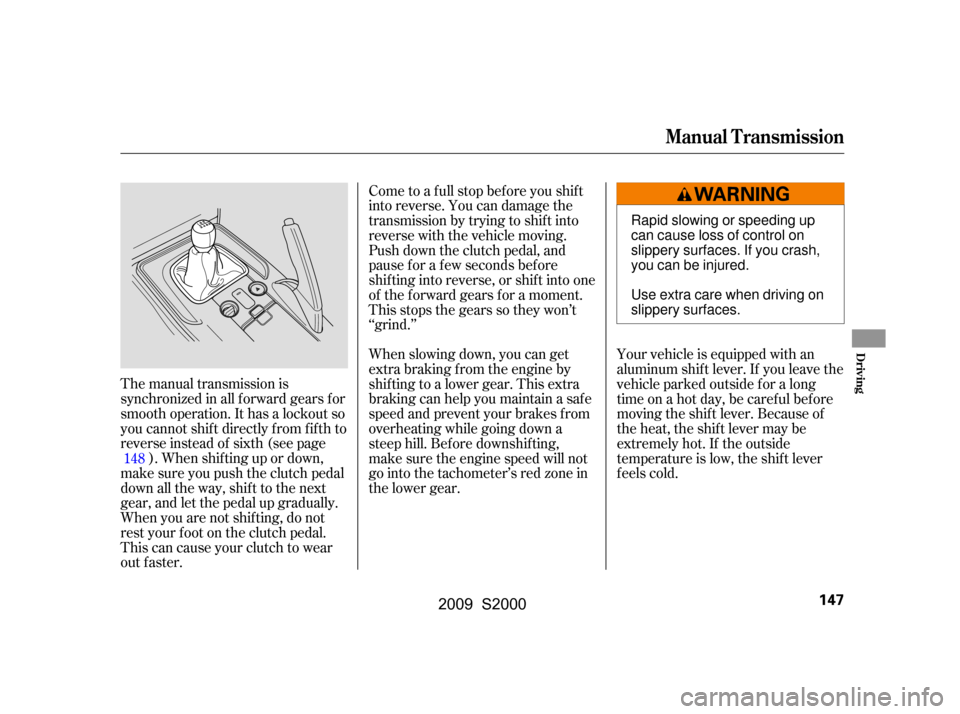
The manual transmission is
synchronized in all f orward gears f or
smooth operation. It has a lockout so
you cannot shift directly from fifth to
reverse instead of sixth (see page). When shif ting up or down,
make sure you push the clutch pedal
down all the way, shift to the next
gear, and let the pedal up gradually.
When you are not shif ting, do not
rest your f oot on the clutch pedal.
This can cause your clutch to wear
out f aster. When slowing down, you can get
extra braking f rom the engine by
shifting to a lower gear. This extra
braking can help you maintain a safe
speed and prevent your brakes f rom
overheating while going down a
steep hill. Bef ore downshif ting,
make sure the engine speed will not
go into the tachometer’s red zone in
the lower gear.
Your vehicle is equipped with an
aluminum shif t lever. If you leave the
vehicle parked outside f or a long
time on a hot day, be caref ul bef ore
moving the shift lever. Because of
the heat, the shift lever may be
extremely hot. If the outside
temperature is low, the shif t lever
f eels cold.
Come to a full stop before you shift
into reverse. You can damage the
transmission by trying to shift into
reverse with the vehicle moving.
Push down the clutch pedal, and
pause f or a f ew seconds bef ore
shif ting into reverse, or shif t into one
of the f orward gears f or a moment.
This stops the gears so they won’t
‘‘grind.’’
148
Manual T ransmission
Driving
147
Rapid slowing or speeding up
can cause loss of control on
slippery surfaces. If you crash,
you can be injured.
Use extra care when driving on
slippery surfaces.
2009 S2000
Page 188 of 268
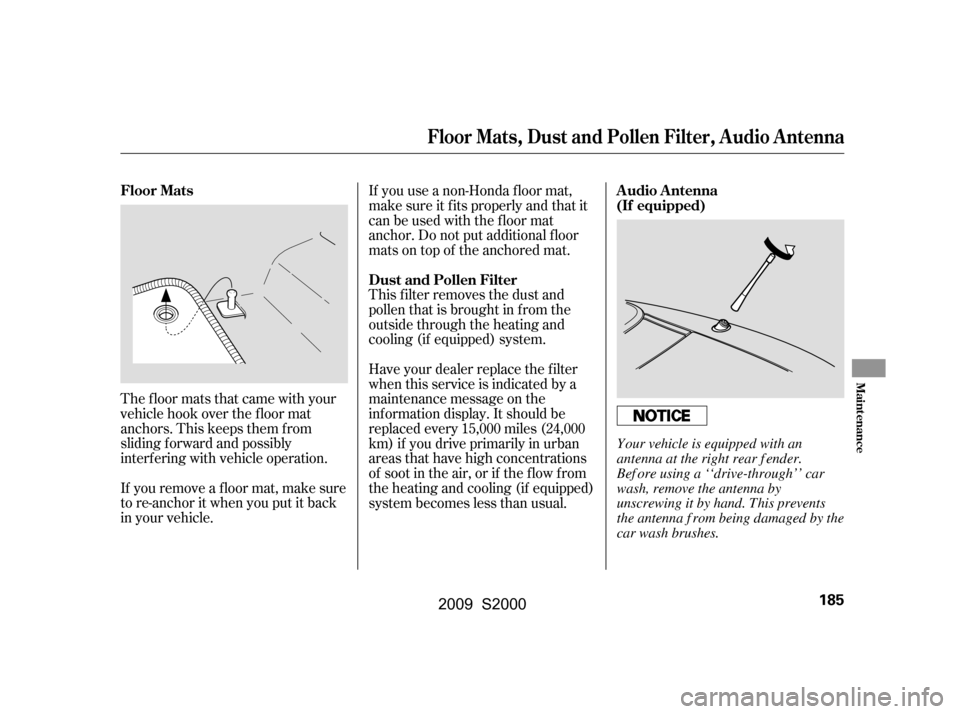
The floor mats that came with your
vehicle hook over the f loor mat
anchors. This keeps them f rom
sliding f orward and possibly
interf ering with vehicle operation.
If you remove a f loor mat, make sure
tore-anchoritwhenyouputitback
in your vehicle.If you use a non-Honda f loor mat,
make sure it f its properly and that it
canbeusedwiththefloormat
anchor. Do not put additional f loor
mats on top of the anchored mat.
This f ilter removes the dust and
pollenthatisbroughtinfromthe
outside through the heating and
cooling (if equipped) system.
Have your dealer replace the filter
when this service is indicated by a
maintenance message on the
inf ormation display. It should be
replaced every 15,000 miles (24,000
km) if you drive primarily in urban
areas that have high concentrations
of soot in the air, or if the f low f rom
the heating and cooling (if equipped)
system becomes less than usual.
Floor Mats
Dust and Pollen FilterA udio A ntenna
(If equipped)
Floor Mats, Dust and Pollen Filter, A udio A ntenna
Maint enance
185
Your vehicle is equipped with an
antenna at the right rear f ender.
Bef ore using a ‘‘drive-through’’ car
wash, remove the antenna by
unscrewing it by hand. This prevents
the antenna f rom being damaged by the
car wash brushes.
2009 S2000
Page 258 of 268
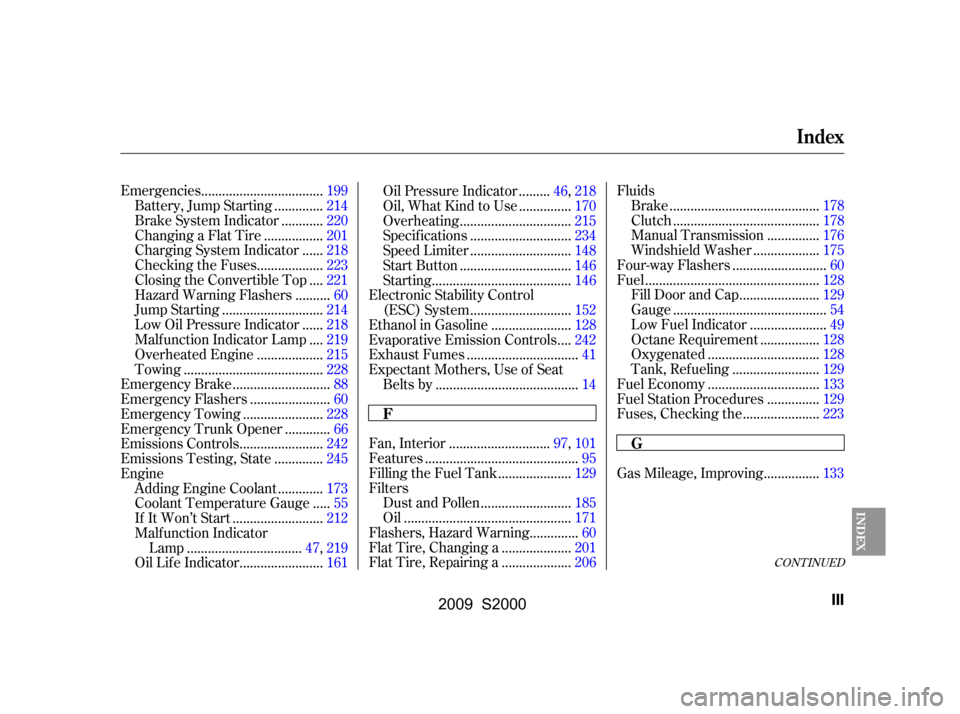
CONT INUED
............................
Fan, Interior .97,101
...........................................
Features .95
....................
Filling the Fuel Tank .129
Filters
.........................
Dust and Pollen .185
...............................................
Oil .171
.............
Flashers, Hazard Warning .60
...................
Flat Tire, Changing a .201
...................
Flat Tire, Repairing a .206 Fluids
..........................................
Brake .178
.........................................
Clutch .178
..............
Manual Transmission .176
..................
Windshield Washer .175
..........................
Four-way Flashers .60
.................................................
Fuel .128
......................
Fill Door and Cap .129
...........................................
Gauge .54
.....................
Low Fuel Indicator .49
................
Octane Requirement .128
...............................
Oxygenated .128
........................
Tank, Ref ueling .129
...............................
Fuel Economy .133
..............
Fuel Station Procedures .129
.....................
Fuses, Checking the .223
...............
Gas Mileage, Improving .133
..................................
Emergencies .199
.............
Battery, Jump Starting .214
...........
Brake System Indicator .220
................
Changing a Flat Tire .201
.....
Charging System Indicator .218
..................
Checking the Fuses .223
...
Closing the Convertible Top .221
.........
Hazard Warning Flashers .60
............................
Jump Starting .214
.....
Low Oil Pressure Indicator .218
...
Malf unction Indicator Lamp .219
..................
Overheated Engine .215
.......................................
Towing .228
...........................
Emergency Brake .88
......................
Emergency Flashers .60
......................
Emergency Towing .228
............
Emergency Trunk Opener .66
.......................
Emissions Controls .242
.............
Emissions Testing, State .245
Engine
............
Adding Engine Coolant .173
....
Coolant Temperature Gauge .55
.........................
If It Won’t Start .212
Malf unction Indicator ................................
Lamp .47,219
.......................
Oil Lif e Indicator .161 ........
Oil Pressure Indicator .46,218
..............
Oil, What Kind to Use .170
...............................
Overheating .215
............................
Specif ications .234
............................
Speed Limiter .148
...............................
Start Button .146
.......................................
Starting .146
Electronic Stability Control ............................
(ESC) System .152
......................
Ethanol in Gasoline .128
...
Evaporative Emission Controls .242
...............................
Exhaust Fumes .41
Expectant Mothers, Use of Seat ........................................
Belts by .14
Index
F
G
INDEX
III
2009 S2000
Page 259 of 268
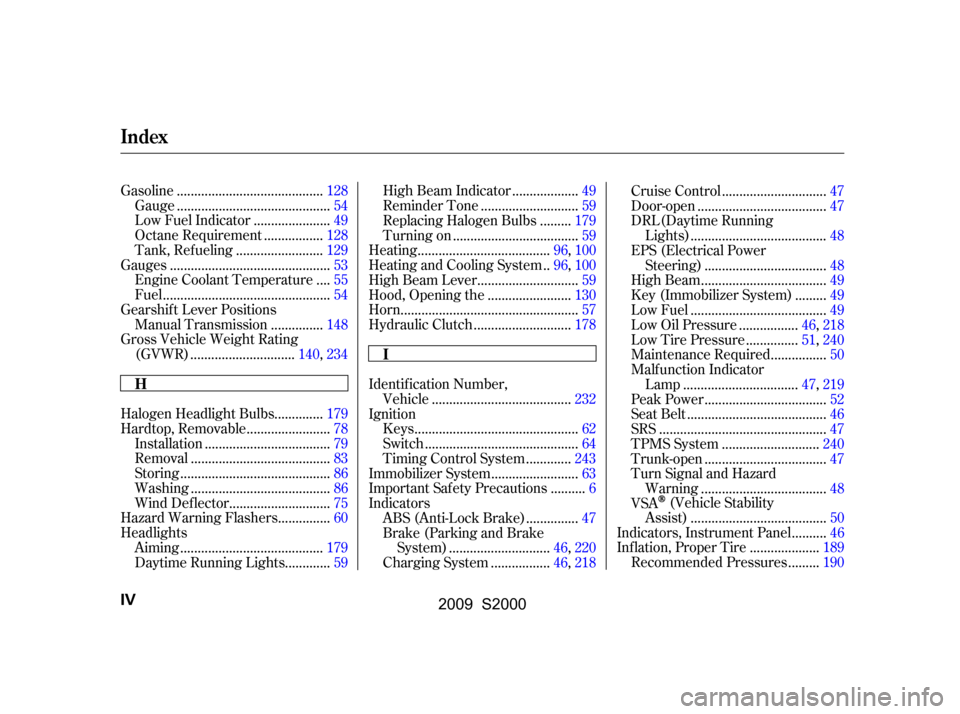
.........................................
Gasoline .128
...........................................
Gauge .54
.....................
Low Fuel Indicator .49
................
Octane Requirement .128
........................
Tank, Ref ueling .129
.............................................
Gauges .53
...
Engine Coolant Temperature .55
...............................................
Fuel .54
Gearshif t Lever Positions ..............
Manual Transmission .148
Gross Vehicle Weight Rating .............................
(GVWR) .140,234
.............
Halogen Headlight Bulbs .179
.......................
Hardtop, Removable .78
...................................
Installation .79
.......................................
Removal .83
..........................................
Storing .86
.......................................
Washing .86
............................
Wind Def lector .75
..............
Hazard Warning Flashers .60
Headlights
........................................
Aiming .179
............
Daytime Running Lights .59 ..................
High Beam Indicator .49
...........................
Reminder Tone .59
........
Replacing Halogen Bulbs .179
...................................
Turning on .59
.....................................
Heating .96,100
.
Heating and Cooling System .96,100
............................
High Beam Lever .59
.......................
Hood, Opening the .130
..................................................
Horn .57
...........................
Hydraulic Clutch .178
Identif ication Number, .......................................
Vehicle .232
Ignition ..............................................
Keys .62
...........................................
Switch .64
............
Timing Control System .243
........................
Immobilizer System .63
.........
Important Safety Precautions .6
Indicators
..............
ABS (Anti-Lock Brake) .47
Brake (Parking and Brake
............................
System) .46,220
................
Charging System .46,218 .............................
Cruise Control .47
....................................
Door-open .47
DRL(Daytime Running ......................................
Lights) .48
EPS (Electrical Power ..................................
Steering) .48
...................................
High Beam .49
........
Key (Immobilizer System) .49
......................................
Low Fuel .49
................
Low Oil Pressure .46,218
..............
Low Tire Pressure .51,240
...............
Maintenance Required .50
Malf unction Indicator
................................
Lamp .47,219
..................................
Peak Power .52
.......................................
Seat Belt .46
...............................................
SRS .47
...........................
TPMS System .240
..................................
Trunk-open .47
Turn Signal and Hazard ...................................
Warning .48
VSA
(Vehicle Stability ......................................
Assist) .50
.........
Indicators, Instrument Panel .46
...................
Inf lation, Proper Tire .189
........
Recommended Pressures .190
Index
I
H
IV
2009 S2000