fuel HUMMER H2 2004 Service Manual
[x] Cancel search | Manufacturer: HUMMER, Model Year: 2004, Model line: H2, Model: HUMMER H2 2004Pages: 472, PDF Size: 5.01 MB
Page 429 of 472

Using Your Maintenance Schedule
We at General Motors want to help you keep your
vehicle in good working condition. But we do not know
exactly how you will drive it. You may drive very
short distances only a few times a week. Or you may
drive long distances all the time in very hot, dusty
weather. You may use your vehicle in making deliveries.
Or you may drive it to work, to do errands or in many
other ways.
Because of all the different ways people use their
vehicles, maintenance needs vary. You may need more
frequent checks and replacements. So please read
the following and note how you drive. If you have any
questions on how to keep your vehicle in good condition,
see your GM Goodwrench dealer.
This schedule is for vehicles that:
carry passengers and cargo within recommended
limits. You will nd these limits on the tire and
loading information label. SeeLoading Your Vehicle
on page 4-67.
are driven on reasonable road surfaces within legal
driving limits.
are driven off-road in the recommended manner.
SeeOff-Road Driving on page 4-17.
use the recommended fuel. SeeGasoline Octane
on page 5-5.
The services inScheduled Maintenance on page 6-4
should be performed when indicated. SeeAdditional
Required Services on page 6-6andMaintenance
Footnotes on page 6-8for further information.
{CAUTION:
Performing maintenance work on a vehicle can
be dangerous. In trying to do some jobs, you
can be seriously injured. Do your own
maintenance work only if you have the
required know-how and the proper tools and
equipment for the job. If you have any doubt,
see your GM Goodwrench dealer to have a
qualied technician do the work.
6-3
Page 432 of 472

Scheduled Maintenance (cont’d)
Service MaintenanceIMaintenanceII
Inspect suspension and steering components.See footnote (b).•
Inspect engine cooling system.See footnote (c).•
Inspect wiper blades.See footnote (d).•
Inspect restraint system components.See footnote (e).•
Lubricate body components.See footnote (f).•
Check transmission uid level and add uid as needed.•
Additional Required Services
The following services should be performed at the rst maintenance service (IorII) after the indicated miles
(kilometers) shown for each item.
Additional Required Services
Service and Miles (Kilometers)25,000
(41 500)50,000
(83 000)75,000
(125 000)100,000
(166 000)125,000
(207 500)150,000
(240 000)
Inspect fuel system for damage or
leaks.••••••
Inspect exhaust system for loose or
damaged components.••••••
Change automatic transmission uid
and lter (severe service).
See footnote (h).•••
6-6
Page 434 of 472
Maintenance Footnotes
†The U.S. Environmental Protection Agency or the
California Air Resources Board has determined that the
failure to perform this maintenance item will not nullify
the emission warranty or limit recall liability prior to
the completion of the vehicle’s useful life. We, however,
urge that all recommended maintenance services be
performed at the indicated intervals and the
maintenance be recorded.
#Lubricate the front suspension, ball joints, steering
linkage, transmission shift linkage and parking
brake cable guides. Ball joints should not be lubricated
unless their temperature is 10°F (-12°C) or higher,
or they could be damaged.
(a)Visually inspect brake lines and hoses for proper
hook-up, binding, leaks, cracks, chang, etc. Inspect
disc brake pads for wear and rotors for surface
condition. Inspect other brake parts, including calipers,
parking brake, etc.
(b)Visually inspect front and rear suspension and
steering system for damaged, loose or missing parts,
signs of wear or lack of lubrication. Inspect power
steering lines and hoses for proper hook-up, binding,
leaks, cracks, chang, etc. Visually check constant
velocity joints, rubber boots and axle seals for leaks.(c)Visually inspect hoses and have them replaced if they
are cracked, swollen or deteriorated. Inspect all pipes,
ttings and clamps; replace with genuine GM parts as
needed. To help ensure proper operation, a pressure test
of the cooling system and pressure cap and cleaning the
outside of the radiator and air conditioning condenser is
recommended at least once a year.
(d)Visually inspect wiper blades for wear or cracking.
Replace blade inserts that appear worn or damaged
or that streak or miss areas of the windshield.
(e)Make sure the safety belt reminder light and all your
belts, buckles, latch plates, retractors and anchorages
are working properly. Look for any other loose or
damaged safety belt system parts. If you see anything
that might keep a safety belt system from doing its
job, have it repaired. Have any torn or frayed safety belts
replaced. Also look for any opened or broken air bag
coverings, and have them repaired or replaced. (The air
bag system does not need regular maintenance.)
(f)Lubricate all key lock cylinders, hood latch assembly,
secondary latch, pivots, spring anchor, release pawl,
rear compartment hinges, outer liftgate handle pivot
points, rear door detent link, roller mechanism, liftgate
handle pivot points, latch bolt, fuel door hinge, cargo
door hinge, locks and folding seat hardware. More
frequent lubrication may be required when exposed to a
corrosive environment. Applying silicone grease on
weatherstrips with a clean cloth will make them
last longer, seal better and not stick or squeak.
6-8
Page 435 of 472

(g)Add uid as needed. (A uid loss could indicate a
problem; repair as needed.) Check vent hose at transfer
case for kinks and proper installation.
(h)Change automatic transmission uid and lter if the
vehicle is mainly driven under one or more of these
conditions:
In heavy city traffic where the outside temperature
regularly reaches 90°F (32°C) or higher.
In hilly or mountainous terrain.
When doing frequent trailer towing.
Uses such as found in taxi, police or delivery
service.
(i)Drain, ush and rell cooling system. See Engine
Coolant on page 5-24for what to use. Inspect hoses.
Clean radiator, condenser, pressure cap and ller neck.
Pressure test the cooling system and pressure cap.
(j)A uid loss in any vehicle system could indicate a
problem. Have the system inspected and repaired and
the uid level checked. Add uid if needed.Owner Checks and Services
These owner checks and services should be performed
at the intervals specied to help ensure the safety,
dependability and emission control performance of your
vehicle. Your GM Goodwrench dealer can assist you
with these checks and services.
Be sure any necessary repairs are completed at once.
Whenever any uids or lubricants are added to your
vehicle, make sure they are the proper ones, as shown
inRecommended Fluids and Lubricants on page 6-12.
At Each Fuel Fill
It is important to perform these underhood checks at
each fuel ll.
Engine Oil Level Check
Check the engine oil level and add the proper oil if
necessary. SeeEngine Oil on page 5-14for further
details.
Notice:It is important to check your oil regularly
and keep it at the proper level. Failure to keep your
engine oil at the proper level can cause damage
to your engine not covered by your warranty.
6-9
Page 440 of 472
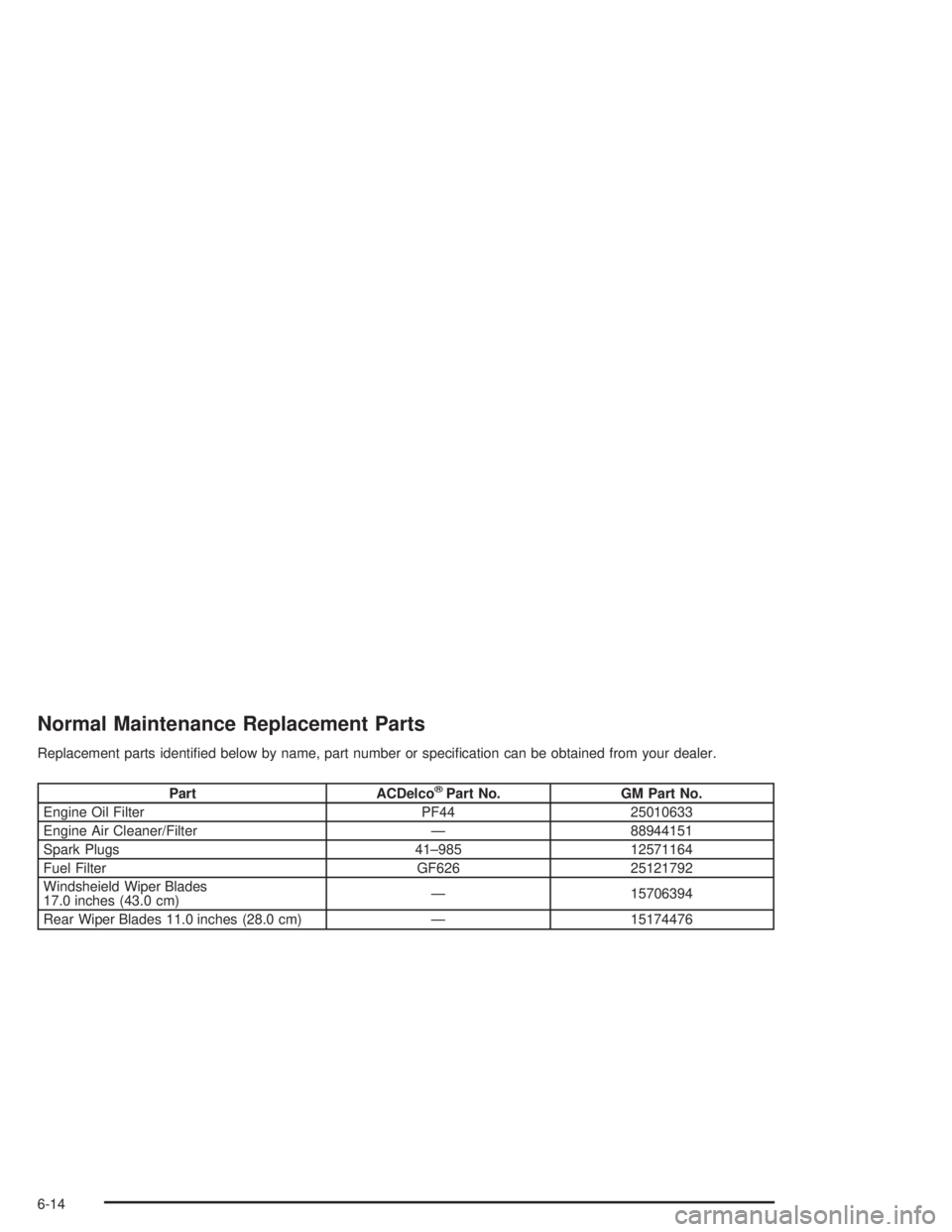
Normal Maintenance Replacement Parts
Replacement parts identied below by name, part number or specication can be obtained from your dealer.
Part ACDelco®Part No. GM Part No.
Engine Oil Filter PF44 25010633
Engine Air Cleaner/Filter — 88944151
Spark Plugs 41–985 12571164
Fuel Filter GF626 25121792
Windsheield Wiper Blades
17.0 inches (43.0 cm)— 15706394
Rear Wiper Blades 11.0 inches (28.0 cm) — 15174476
6-14
Page 449 of 472

GM Mobility Program for Persons
with Disabilities
This program, available to
qualied applicants, can
reimburse you up to
$1,000 toward eligible
aftermarket driver or
passenger adaptive
equipment you may require
for your vehicle (hand
controls, wheelchair/
scooter lifts, etc.).
This program can also provide you with free resource
information, such as area driver assessment centers and
mobility equipment installers. The offer is available for
a limited period of time from the date of vehicle
purchase/lease. For more details, or to determine your
vehicle’s eligibility, see your GM dealer or call the
GM Mobility Assistance Center at 1-800-323-9935. Text
telephone (TTY) users, call 1-800-833-9935.
GM of Canada also has a Mobility Program. Call
1-800-GM-DRIVE (463-7483) for details. All TTY users
call 1-800-263-3830.
Roadside Assistance Program
Security While You Travel
1-866-HUMMER6 (486-6376)
As the proud owner of a new HUMMER vehicle, you are
automatically enrolled in the HUMMER Roadside
Assistance program. This value-added service is
intended to provide you with peace of mind as you drive
in the city or travel the open road. HUMMER’s
Roadside Assistance toll-free number is staffed by
courteous and capable Roadside Assistance
Representatives who are available 24 hours a day,
365 days a year.
We will provide the following services during the
Bumper-to-Bumper warranty period, at no expense
to you:
Fuel Delivery:Delivery of enough fuel
($5 maximum) for the customer to get to the
nearest service station.
Lock-out Service (identication required):
Replacement keys or locksmith service will
be covered at no charge if you are unable to gain
entry into your vehicle. Delivery of the replacement
key will be covered within 10 miles.
7-5
Page 452 of 472

Public Transportation or Fuel
Reimbursement
If your vehicle requires overnight warranty repairs,
reimbursement (ve days maximum) may be available
for the use of public transportation such as taxi or
bus. In addition, should you arrange transportation
through a friend or relative, reimbursement for
reasonable fuel expenses (ve day maximum) may be
available. Claim amounts should reect actual costs and
be supported by original receipts.
Courtesy Rental Vehicle
Your dealer may arrange to provide you with a courtesy
rental vehicle or reimburse you for a rental vehicle
you obtained if your vehicle is kept for a warranty repair.
Reimbursement will be limited to a maximum of $40 a
day and must be supported by receipts. This requires
that you sign and complete a rental agreement and meet
state, local and rental vehicle provider requirements.
Requirements vary and may include minimum age
requirements, insurance coverage, credit card, etc. You
are responsible for fuel usage charges and may also
be responsible for taxes, levies, usage fees, excessive
mileage or rental usage beyond the completion of
the repair.
Generally it is not possible to provide a like-vehicle as a
courtesy rental.
Additional Program Information
Courtesy Transportation is available during the
Bumper-to-Bumper warranty coverage period, but itis
notpart of the New Vehicle Limited Warranty. A
separate booklet entitledWarranty and Owner
Assistance Informationfurnished with each new vehicle
provides detailed warranty coverage information.
Courtesy Transportation is available only at participating
dealers and all program options, such as shuttle
service, may not be available at every dealer. Please
contact your dealer for specic information about
availability. All Courtesy Transportation arrangements
will be administered by appropriate dealer personnel.
Canadian Vehicles:For warranty repairs during
the Complete Vehicle Coverage period of the General
Motors of Canada New Vehicle Limited Warranty,
alternative transportation may be available under the
Courtesy Transportation Program. Please consult
your dealer for details.
General Motors reserves the right to unilaterally modify,
change or discontinue Courtesy Transportation at
any time and to resolve all questions of claim eligibility
pursuant to the terms and conditions described
herein at its sole discretion.
7-8
Page 453 of 472

Vehicle Data Collection and Event
Data Records
Your vehicle, like other modern motor vehicles, has a
number of sophisticated computer systems that monitor
and control several aspects of the vehicle’s
performance. Your vehicle uses on-board vehicle
computers to monitor emission control components to
optimize fuel economy, to monitor conditions for air bag
deployment and, if so equipped, to provide anti-lock
braking and to help the driver control the vehicle
in difficult driving situations. Some information may be
stored during regular operations to facilitate repair
of detected malfunctions; other information is stored only
in a crash or near crash event by computer systems
commonly called event data recorders (EDR).
In a crash or near crash event, computer systems, such
as the Air Bag Sensing and Diagnostic Module (SDM)
in your vehicle may record information about the
condition of the vehicle and how it was operated, such
as engine speed, brake applications, throttle position,
vehicle speed, safety belt usage, air bag readiness, air
bag performance data, and the severity of a collision.
This information has been used to improve vehicle crash
performance and may be used to improve crash
performance of future vehicles and driving safety. Unlike
the data recorders on many airplanes, these on-board
systems do not record sounds, such as conversation of
vehicle occupants.To read this information, special equipment is needed
and access to the vehicle or the SDM is required.
GM will not access information about a crash event or
share it with others other thanwith the consent of the vehicle owner or, if the
vehicle is leased, with the consent of the lessee,
in response to an official request of police or similar
government office,
as part of GM’s defense of litigation through the
discovery process, or
as required by law.
In addition, once GM collects or receives data, GM may
use the data for GM research needs,
make it available for research where appropriate
condentiality is to be maintained and need is
shown, or
share summary data which is not tied to a specic
vehicle with non-GM organizations for research
purposes.
Others, such as law enforcement, may have access to
the special equipment that can read the information
if they have access to the vehicle or SDM.
If your vehicle is equipped with OnStar
®, please check
the OnStar®subscription service agreement or
manual for information on its operations and data
collection.
7-9
Page 457 of 472
A
Accessory Inator...........................................5-76
Accessory Power Outlets.................................3-18
Adding Equipment to Your Air Bag-Equipped
Vehicle.......................................................1-73
Adding Washer Fluid.......................................5-37
Additional Program Information........................... 7-8
Additives, Fuel................................................. 5-6
Add-On Electrical Equipment...........................5-101
Add-On Equipment..........................................4-72
Adjusting the Speakers (Balance/Fade)......3-65, 3-77
After Off-Road Driving.....................................4-41
Air Bag
Off Light.....................................................3-30
Readiness Light..........................................3-28
Air Bag System..............................................1-61
Adding Equipment to Your Air Bag-Equipped
Vehicle...................................................1-73
Air Bag Off Switch.......................................1-68
How Does an Air Bag Restrain?....................1-65
Servicing Your Air Bag-Equipped Vehicle.........1-72
What Makes an Air Bag Inate?....................1-65
What Will You See After an Air Bag Inates?......1-66
When Should an Air Bag Inate?...................1-65
Where Are the Air Bags?..............................1-63
Air Cleaner/Filter, Engine.................................5-19
Air Conditioning..............................................3-23
Air Suspension...............................................4-74
Airbag Sensing and Diagnostic Module (SDM)...... 7-9All-Wheel Drive...............................................5-48
All-Wheel Drive (AWD) System.........................2-25
AM ...............................................................3-90
Antenna, Fixed Mast.......................................3-92
Anti-lock Brake System (ABS)............................ 4-7
Anti-Lock Brake, System Warning Light..............3-34
Appearance Care............................................5-92
Care of Safety Belts....................................5-95
Chemical Paint Spotting...............................5-99
Cleaning the Inside of Your Vehicle................5-93
Cleaning the Outside of Your Vehicle..............5-95
Finish Damage............................................5-99
Sheet Metal Damage...................................5-98
Underbody Maintenance...............................5-99
Vehicle Care/Appearance Materials...............5-100
Weatherstrips..............................................5-95
Approaching a Hill..........................................4-32
Ashtrays........................................................3-18
Audio System(s).............................................3-62
Audio Steering Wheel Controls......................3-89
Care of Your Cassette Tape Player................3-90
Care of Your CD Player...............................3-92
Care of Your CDs........................................3-92
Chime Level Adjustment...............................3-92
Fixed Mast Antenna.....................................3-92
Navigation/Radio System..............................3-86
Radio with Cassette and CD.........................3-63
Radio with Six-Disc CD................................3-74
Rear Seat Audio (RSA)................................3-87
Setting the Time..........................................3-62
1
Page 458 of 472

Audio System(s) (cont.)
Theft-Deterrent Feature................................3-88
Understanding Radio Reception.....................3-90
Automatic Climate Control System.....................3-19
Automatic Dimming Mirror Operation..................2-35
Automatic Headlamp System............................3-14
Automatic Transmission
Fluid..........................................................5-21
Operation...................................................2-22
B
Backing Up....................................................4-82
Battery..........................................................5-42
BATTERY NOT CHARGING.............................3-57
Battery Replacement......................................... 2-5
Battery Run-Down Protection............................3-17
Before Leaving on a Long Trip.........................4-48
Before You Go Off-Roading..............................4-17
Bench Seat, Split (60/40)................................... 1-8
Brake
Parking......................................................2-29
System Warning Light..................................3-33
Brake Adjustment............................................5-42
Brake and Throttle Operation Techniques for
Off-Road Driving..........................................4-27
Brake Fluid....................................................5-38
Brake Pedal Travel.........................................5-42Brake Wear...................................................5-41
Brakes..........................................................5-38
Braking........................................................... 4-6
Braking in Emergencies..................................... 4-9
Break-In, New Vehicle.....................................2-18
Bulb Replacement...........................................5-52
Center High-Mounted Stoplamp (CHMSL)........5-57
Daytime Running Lamps...............................5-54
Front Turn Signal and Parking Lamps.............5-53
Halogen Bulbs............................................5-52
Headlamps.................................................5-52
Replacement Bulbs......................................5-58
Roof Marker Lamps.....................................5-55
Sidemarker Lamps.......................................5-54
Taillamps....................................................5-57
Buying New Tires...........................................5-71
C
California Fuel.................................................. 5-6
Canada – Customer Assistance.......................... 7-4
Canadian Owners................................................ ii
Canadian Roadside Assistance........................... 7-7
Capacities and Specications..........................5-111
Carbon Monoxide...................4-52, 4-75, 2-13, 2-33
Care of
Safety Belts................................................5-95
Your Cassette Tape Player............................3-90
2