seats HUMMER H2 2005 User Guide
[x] Cancel search | Manufacturer: HUMMER, Model Year: 2005, Model line: H2, Model: HUMMER H2 2005Pages: 468, PDF Size: 3.21 MB
Page 28 of 468
How to Wear Safety Belts Properly
This part is only for people of adult size.
Be aware that there are special things to know about
safety belts and children. And there are different
rules for smaller children and babies. If a child will be
riding in your vehicle, seeOlder Children on page 1-36
orInfants and Young Children on page 1-39. Follow
those rules for everyone’s protection.
First, you will want to know which restraint systems your
vehicle has.
We will start with the driver position.
Driver Position
Lap-Shoulder Belt
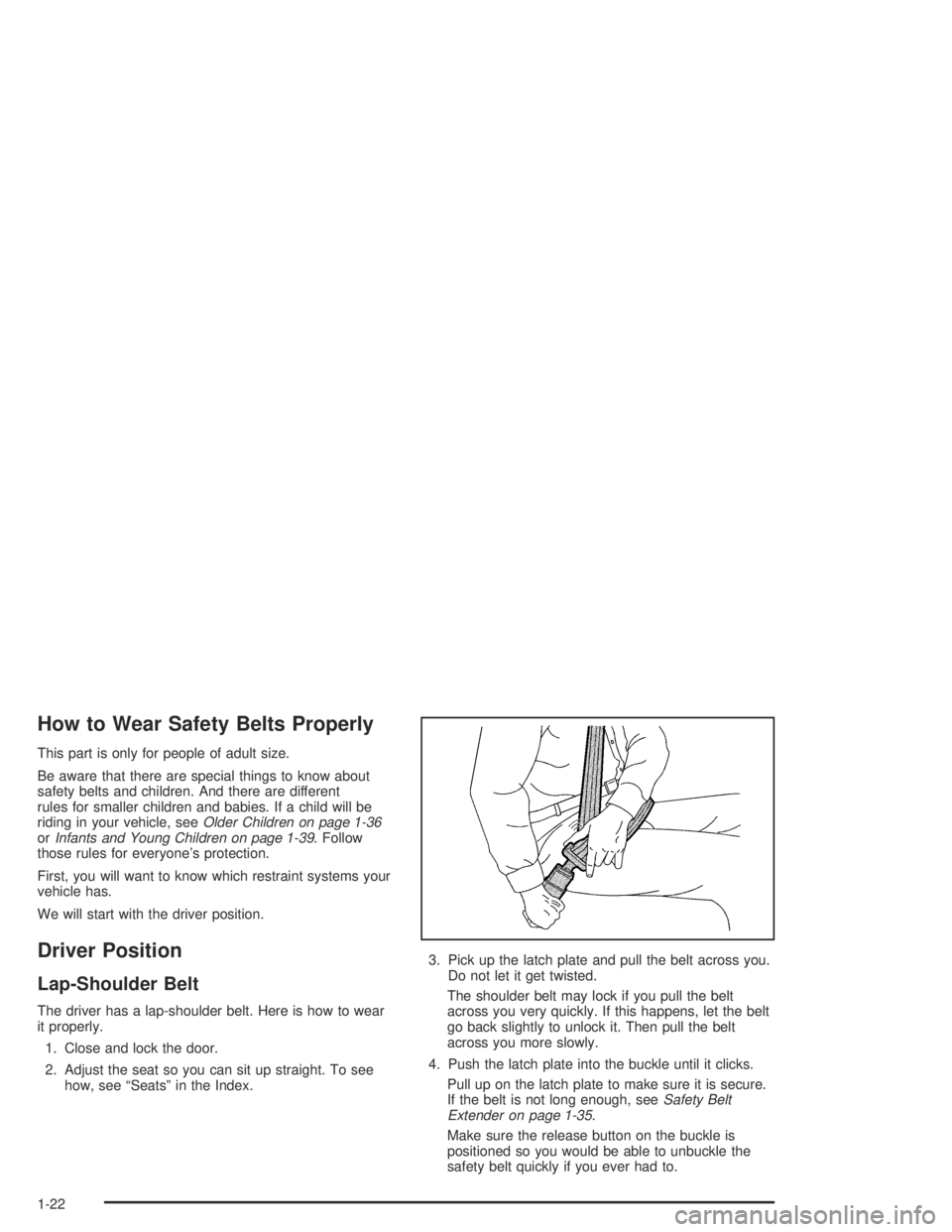
The driver has a lap-shoulder belt. Here is how to wear
it properly.
1. Close and lock the door.
2. Adjust the seat so you can sit up straight. To see
how, see “Seats” in the Index.3. Pick up the latch plate and pull the belt across you.
Do not let it get twisted.
The shoulder belt may lock if you pull the belt
across you very quickly. If this happens, let the belt
go back slightly to unlock it. Then pull the belt
across you more slowly.
4. Push the latch plate into the buckle until it clicks.
Pull up on the latch plate to make sure it is secure.
If the belt is not long enough, seeSafety Belt
Extender on page 1-35.
Make sure the release button on the buckle is
positioned so you would be able to unbuckle the
safety belt quickly if you ever had to.
1-22
Page 39 of 468
Rear Safety Belt Comfort Guides for
Children and Small Adults
Rear shoulder belt comfort guides will provide added
safety belt comfort for older children who have outgrown
booster seats and for small adults. When installed on
a shoulder belt, the comfort guide better positions
the belt away from the neck and head.
Comfort guides are provided for each passenger in the
second row seat and one guide for the single third
row seat. To provide added safety belt comfort
for children who have outgrown child restraints and
booster seats and for smaller adults, the comfort guides
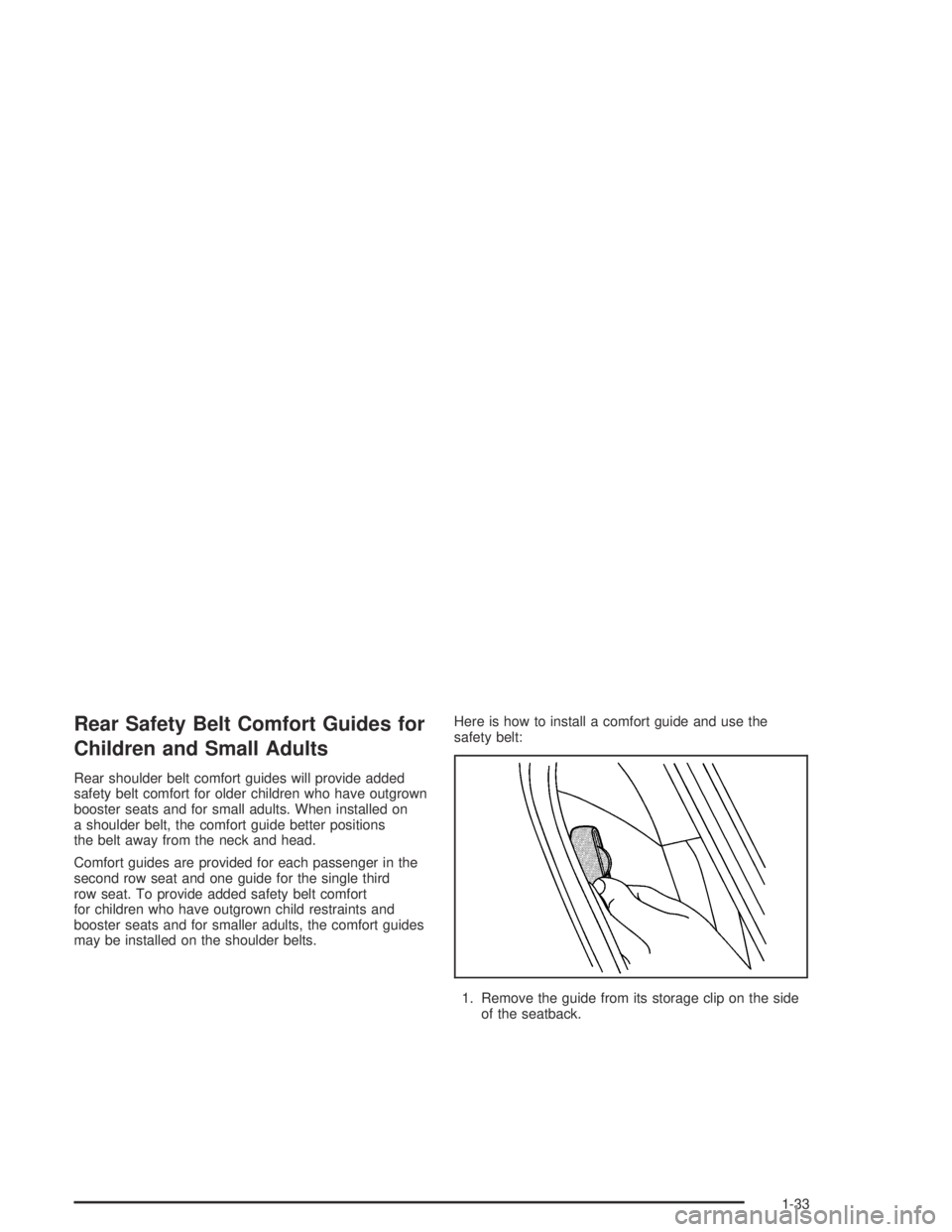
may be installed on the shoulder belts.Here is how to install a comfort guide and use the
safety belt:
1. Remove the guide from its storage clip on the side
of the seatback.
1-33
Page 41 of 468

4. Buckle, position and release the safety belt as
described inRear Seat Passengers on page 1-30.
Make sure that the shoulder belt crosses
the shoulder.
To remove and store the comfort guides, squeeze the
belt edges together so that you can take them out of the
guides. For the second row, slide the guide onto its
storage clip on the trim panel near the side of the
seatback. For the third row, slide the guide onto its
storage clip on the side of the seatback. Make sure you
remove the comfort guide from the belt before you
fold a rear seat down.
Safety Belt Extender
If the vehicle’s safety belt will fasten around you, you
should use it.
But if a safety belt is not long enough, your dealer will
order you an extender. It is free. When you go in to
order it, take the heaviest coat you will wear, so
the extender will be long enough for you. To help avoid
personal injury, do not let someone else use it, and
use it only for the seat it is made to t. The extender has
been designed for adults. Never use it for securing
child seats. To wear it, just attach it to the regular safety
belt. For more information see the instruction sheet
that comes with the extender.
1-35
Page 42 of 468
Child Restraints
Older Children
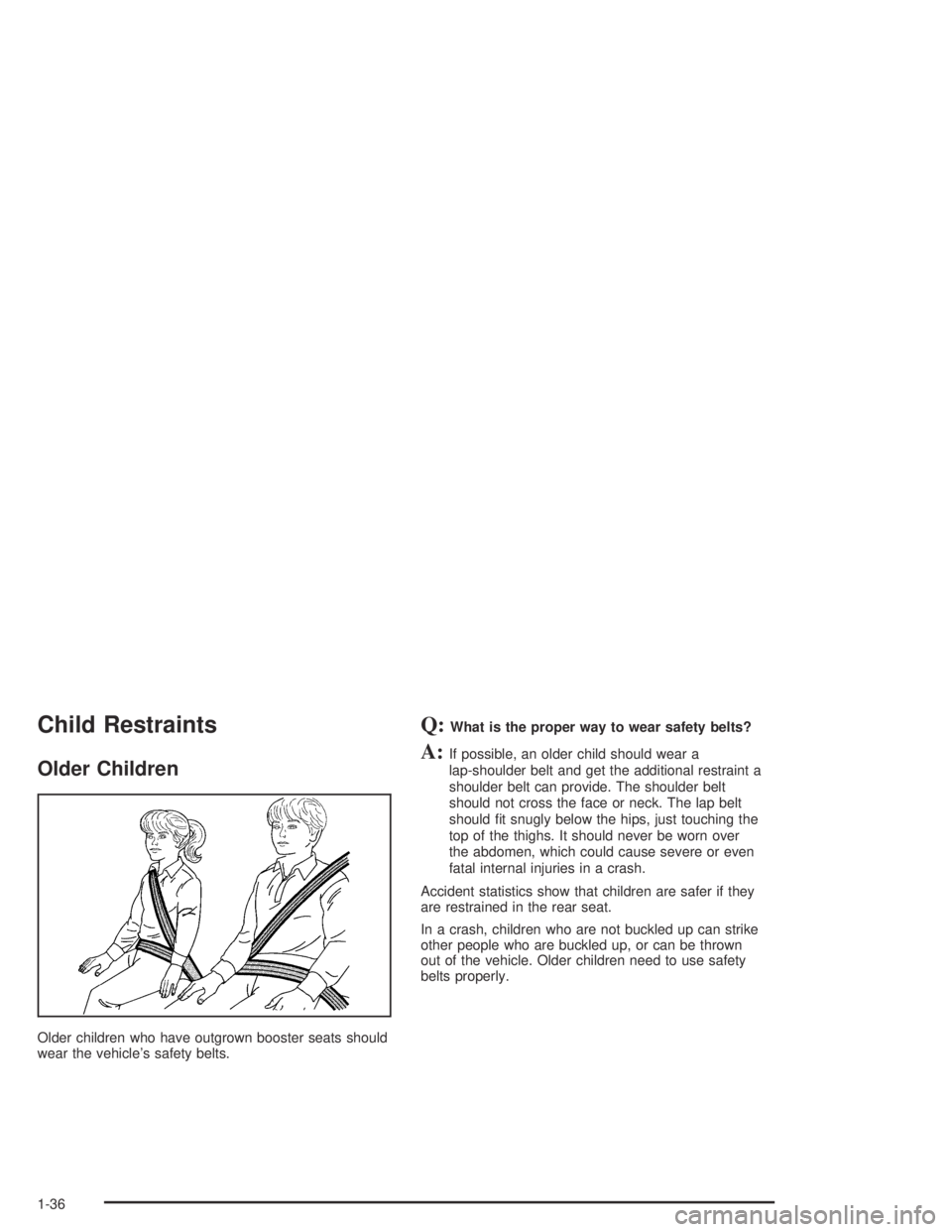
Older children who have outgrown booster seats should
wear the vehicle’s safety belts.
Q:What is the proper way to wear safety belts?
A:If possible, an older child should wear a
lap-shoulder belt and get the additional restraint a
shoulder belt can provide. The shoulder belt
should not cross the face or neck. The lap belt
should t snugly below the hips, just touching the
top of the thighs. It should never be worn over
the abdomen, which could cause severe or even
fatal internal injuries in a crash.
Accident statistics show that children are safer if they
are restrained in the rear seat.
In a crash, children who are not buckled up can strike
other people who are buckled up, or can be thrown
out of the vehicle. Older children need to use safety
belts properly.
1-36
Page 49 of 468
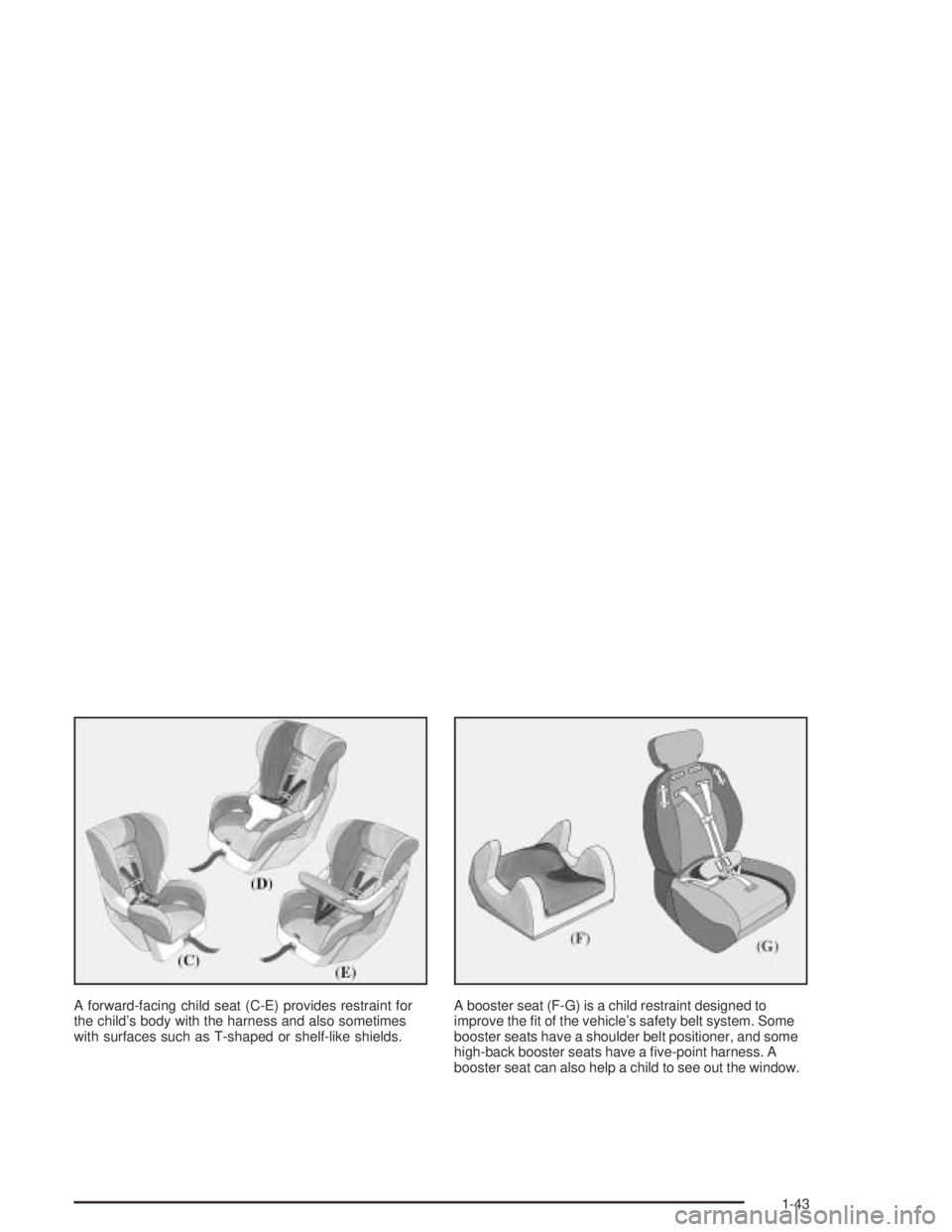
A forward-facing child seat (C-E) provides restraint for
the child’s body with the harness and also sometimes
with surfaces such as T-shaped or shelf-like shields.A booster seat (F-G) is a child restraint designed to
improve the t of the vehicle’s safety belt system. Some
booster seats have a shoulder belt positioner, and some
high-back booster seats have a ve-point harness. A
booster seat can also help a child to see out the window.
1-43
Page 54 of 468
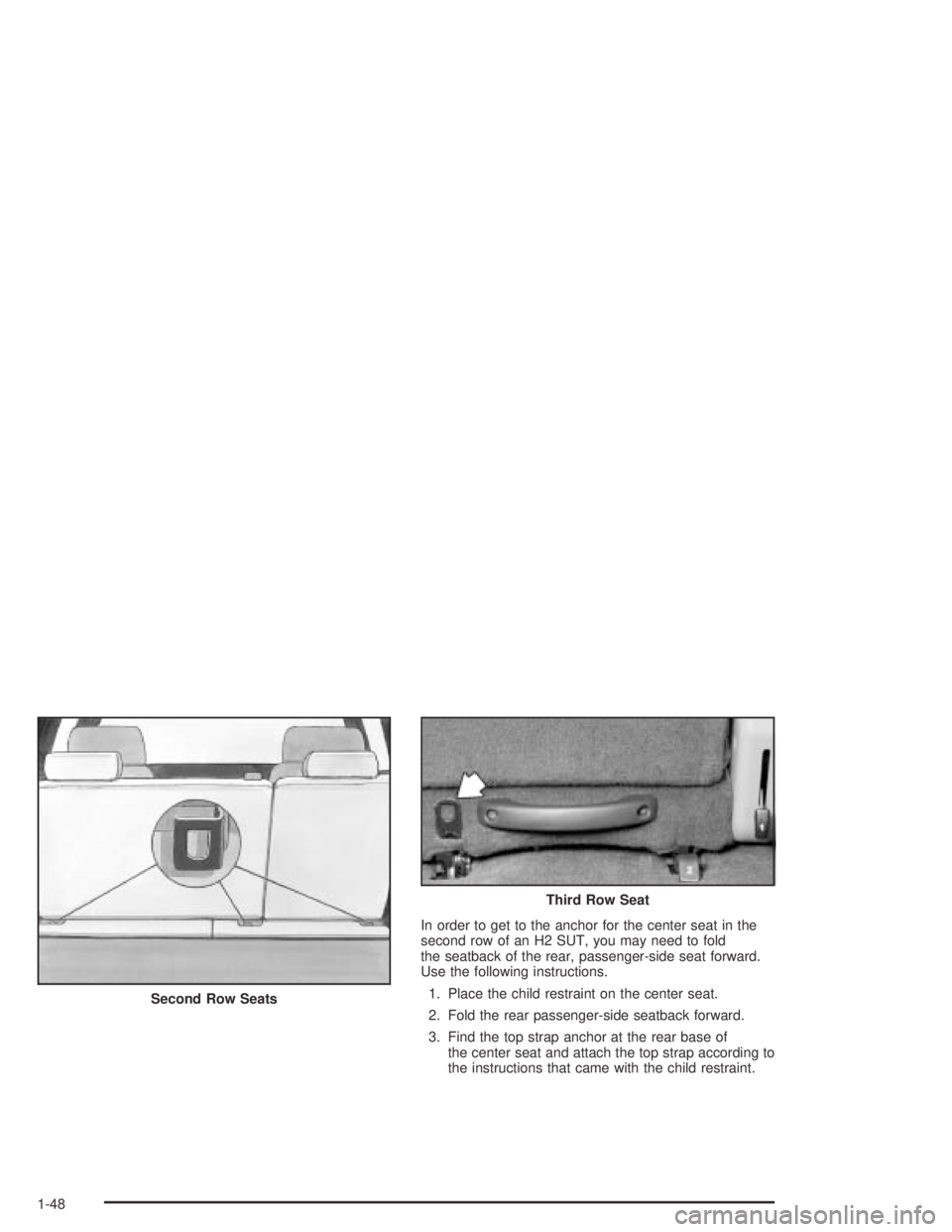
In order to get to the anchor for the center seat in the
second row of an H2 SUT, you may need to fold
the seatback of the rear, passenger-side seat forward.
Use the following instructions.
1. Place the child restraint on the center seat.
2. Fold the rear passenger-side seatback forward.
3. Find the top strap anchor at the rear base of
the center seat and attach the top strap according to
the instructions that came with the child restraint. Second Row Seats
Third Row Seat
1-48
Page 62 of 468
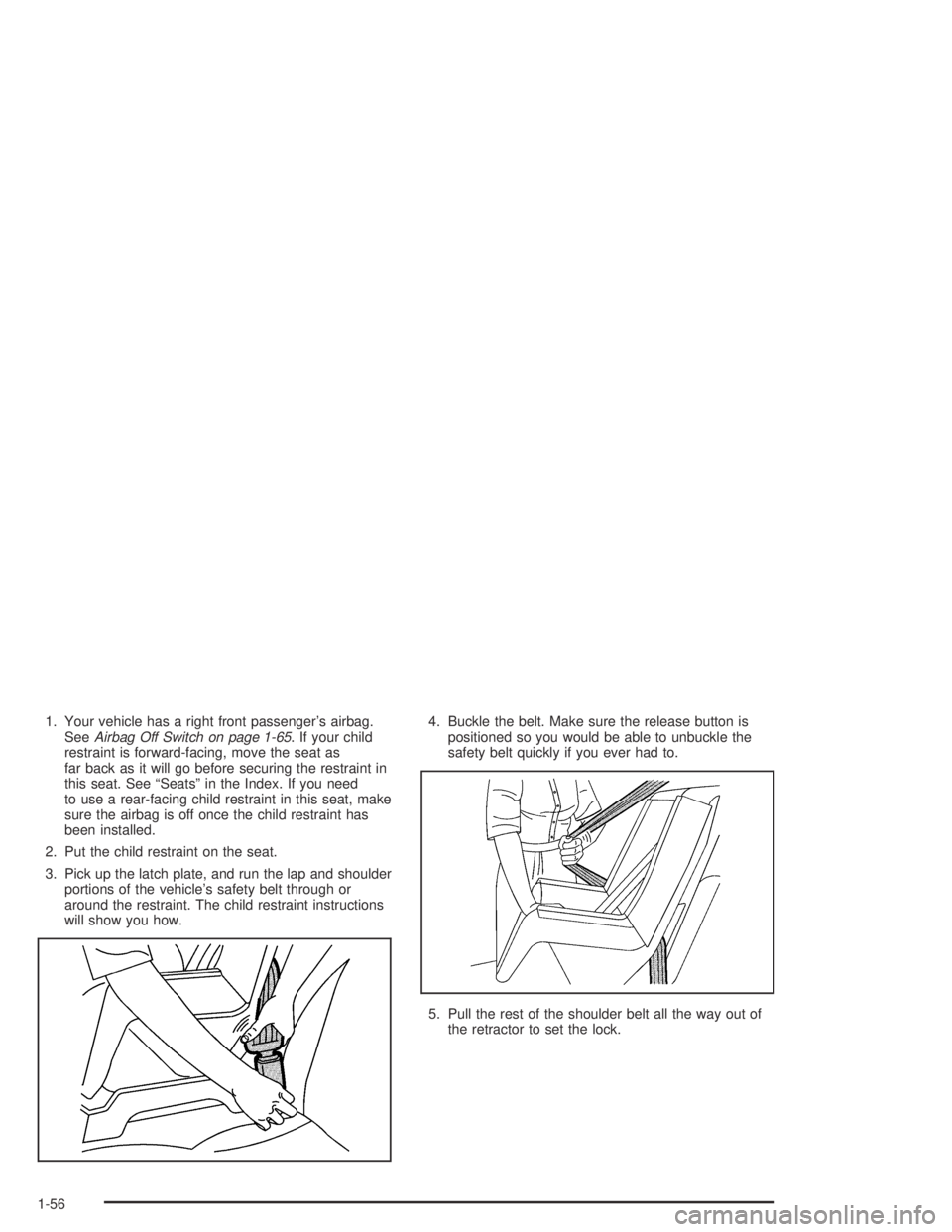
1. Your vehicle has a right front passenger’s airbag.
SeeAirbag Off Switch on page 1-65. If your child
restraint is forward-facing, move the seat as
far back as it will go before securing the restraint in
this seat. See “Seats” in the Index. If you need
to use a rear-facing child restraint in this seat, make
sure the airbag is off once the child restraint has
been installed.
2. Put the child restraint on the seat.
3. Pick up the latch plate, and run the lap and shoulder
portions of the vehicle’s safety belt through or
around the restraint. The child restraint instructions
will show you how.4. Buckle the belt. Make sure the release button is
positioned so you would be able to unbuckle the
safety belt quickly if you ever had to.
5. Pull the rest of the shoulder belt all the way out of
the retractor to set the lock.
1-56
Page 90 of 468
Midgate (SUT)
{CAUTION:
It can be dangerous to drive with the cargo
area covered and the tailgate and the midgate
open because carbon monoxide (CO) gas can
come into your vehicle. You can not see or
smell CO. It can cause unconsciousness and
even death. If you must drive with the cargo
covers on and the tailgate and midgate open
or if electrical wiring or other cable
connections must pass through the seal
between the body and the midgate:
Make sure all windows are shut.
Turn the fan on your heating or cooling
system to its highest speed on the setting
that brings in outside air. This will force
outside air into your vehicle. SeeDual
Automatic Climate Control System on
page 3-19.
If you have air outlets on or under the
instrument panel, open them all the way.
SeeEngine Exhaust on page 2-39.The midgate allows you to extend the length of your
vehicle’s cargo area into the cab.
Lowering the Midgate
The midgate window must be completely lowered for
the midgate to be lowered. See ”Midgate Window” under
Power Windows on page 2-19.
Both the midgate and the midgate window can be
lowered while the ignition is in either RUN or
ACCESSORY, or while in Retained Accessory Power
(RAP) mode. SeeRetained Accessory Power (RAP) on
page 2-26for more information.
To lower the midgate, do the following:
1. Fold the rear seats forward. See60/40 Split Bench
Seat on page 1-7. The front seats may have to be
moved forward slightly.
2.
K: Press the bottom part of this switch to
lower the midgate window. SeeInstrument
Panel Overview on page 3-4for the location of this
switch. The window can also be operated using
the global express-down button. See “Global Glass
Feature” underPower Windows on page 2-19.
2-14
Page 122 of 468
Cleaning the Mirror
Use a paper towel or similar material dampened with
glass cleaner. Do not spray glass cleaner directly on the
mirror as that may cause the liquid cleaner to enter
the mirror.
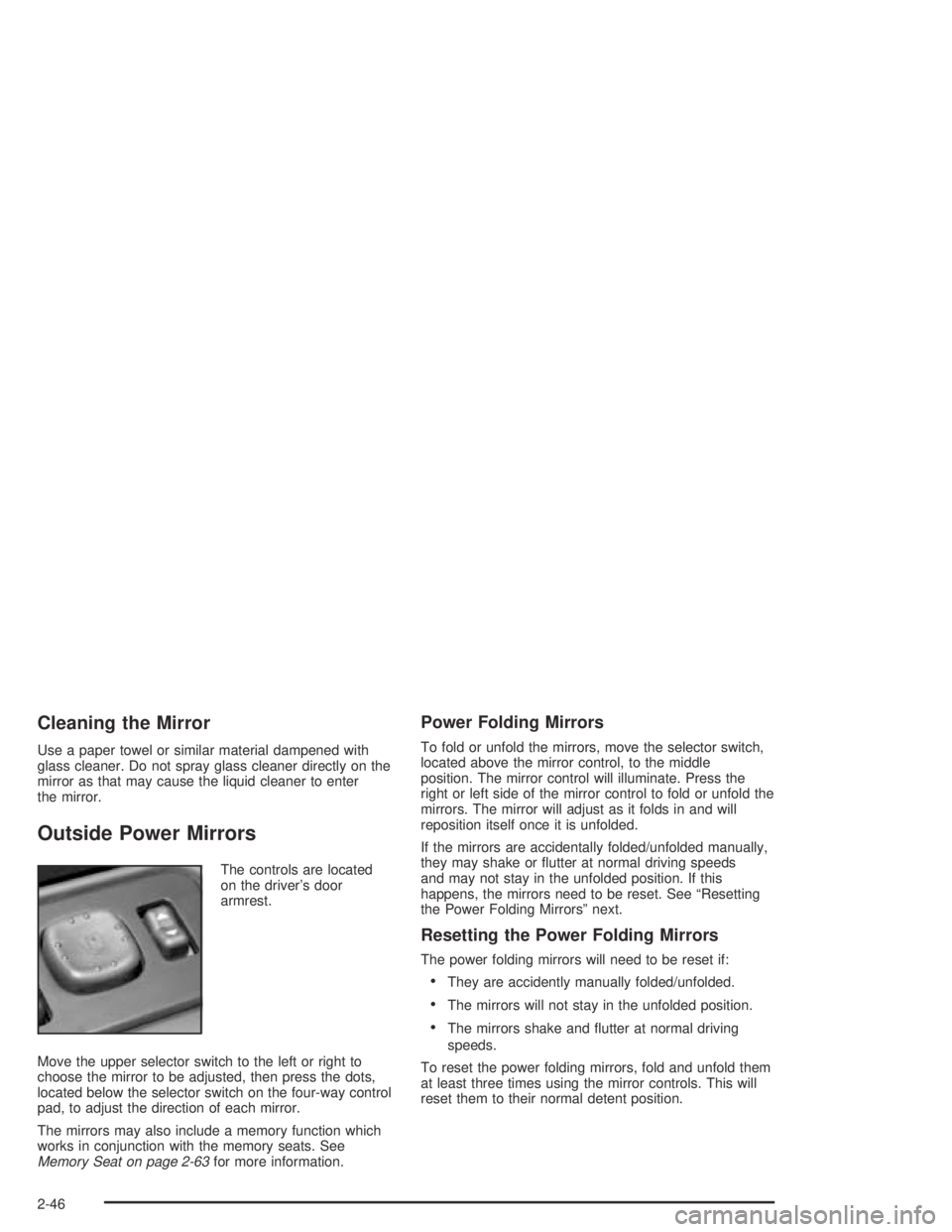
Outside Power Mirrors
The controls are located
on the driver’s door
armrest.
Move the upper selector switch to the left or right to
choose the mirror to be adjusted, then press the dots,
located below the selector switch on the four-way control
pad, to adjust the direction of each mirror.
The mirrors may also include a memory function which
works in conjunction with the memory seats. See
Memory Seat on page 2-63for more information.
Power Folding Mirrors
To fold or unfold the mirrors, move the selector switch,
located above the mirror control, to the middle
position. The mirror control will illuminate. Press the
right or left side of the mirror control to fold or unfold the
mirrors. The mirror will adjust as it folds in and will
reposition itself once it is unfolded.
If the mirrors are accidentally folded/unfolded manually,
they may shake or utter at normal driving speeds
and may not stay in the unfolded position. If this
happens, the mirrors need to be reset. See “Resetting
the Power Folding Mirrors” next.
Resetting the Power Folding Mirrors
The power folding mirrors will need to be reset if:
They are accidently manually folded/unfolded.
The mirrors will not stay in the unfolded position.
The mirrors shake and utter at normal driving
speeds.
To reset the power folding mirrors, fold and unfold them
at least three times using the mirror controls. This will
reset them to their normal detent position.
2-46
Page 131 of 468
To open a door on the console, push on the rear edge
of the door and let it swing open. Push the door up
until it latches to close the door.
The overhead consoles also includes reading lamps, the
HomeLink transmitter buttons and the sunroof switch
(if equipped).
Center Console Storage Area
Your vehicle has a console compartment between the
bucket seats.
To open it, press the button on the side of the console
and swing the console lid open.
Luggage Carrier
If your vehicle has this feature, you can load cargo on
your vehicle.
For the SUV the luggage carrier consists of siderails
attached to the roof. The crossrails attach into the
siderails and can be moved back and forth (fore and aft)
to accommodate securing various cargo sizes.For the SUT the luggage carrier consists of siderails
that run the length of the roof and the cargo area. The
crossrails attach into the siderails and can be moved
back and forth (fore and aft) to accommodate securing
various cargo sizes.
Notice:Loading cargo on the luggage carrier that
weighs more than 300 lbs. (136 kg) or hangs
over the rear or sides of the vehicle may damage
your vehicle. Load cargo only on top of the
crossrails and tie the cargo down to the crossrail
support cargo tie-down loops, making sure to fasten
it securely.
Don’t exceed the maximum vehicle capacity when
loading your vehicle. For more information on vehicle
capacity and loading, seeLoading Your Vehicle on
page 4-58.
2-55