ECU HUMMER H2 2005 Workshop Manual
[x] Cancel search | Manufacturer: HUMMER, Model Year: 2005, Model line: H2, Model: HUMMER H2 2005Pages: 468, PDF Size: 3.21 MB
Page 296 of 468
Towing
Towing Your Vehicle
Consult your dealer or a professional towing service if
you need to have your disabled vehicle towed. See
Roadside Assistance Program on page 7-6.
If you want to tow your vehicle behind another vehicle
for recreational purposes (such as behind a motorhome),
see “Recreational Vehicle Towing” following.
Recreational Vehicle Towing
Recreational vehicle towing means towing your vehicle
behind another vehicle – such as behind a motorhome.
The two most common types of recreational vehicle
towing are known as “dinghy towing” (towing your vehicle
with all four wheels on the ground) and “dolly towing”
(towing your vehicle with two wheels on the ground and
two wheels up on a device known as a “dolly”).
With the proper preparation and equipment, many
vehicles can be towed in these ways. See “Dinghy
Towing” and “Dolly Towing,” following.
Here are some important things to consider before you
do recreational vehicle towing:
What’s the towing capacity of the towing vehicle?
Be sure you read the tow vehicle manufacturer’s
recommendations.
How far will you tow? Some vehicles have
restrictions on how far and how long they can tow.
Do you have the proper towing equipment?
See your dealer or trailering professional for
additional advice and equipment recommendations.
Is your vehicle ready to be towed? Just as you
would prepare your vehicle for a long trip, you’ll
want to make sure your vehicle is prepared to be
towed. SeeBefore Leaving on a Long Trip on
page 4-45.
Dinghy Towing
Use the following procedure to tow your vehicle:
1. Shift the transmission to PARK (P).
2. Turn the engine off, but leave the ignition on.
3. Firmly set the parking brake.
4. Securely attach the vehicle being towed to the
tow vehicle.
5. Shift the transfer case to NEUTRAL (N). See
All-Wheel Drive on page 2-32for the proper
procedure to select the NEUTRAL position for
your vehicle.
4-64
Page 307 of 468
Driving with a Trailer
Towing a trailer requires a certain amount of experience.
Before setting out for the open road, you’ll want to get
to know your rig. Acquaint yourself with the feel of
handling and braking with the added weight of the trailer.
And always keep in mind that the vehicle you are
driving is now a good deal longer and not nearly as
responsive as your vehicle is by itself.
Before you start, check all trailer hitch parts and
attachments, safety chains, electrical connector, lamps,
tires and mirror adjustment. If the trailer has electric
brakes, start your vehicle and trailer moving and then
apply the trailer brake controller by hand to be sure
the brakes are working. This lets you check your
electrical connection at the same time.
During your trip, check occasionally to be sure that the
load is secure, and that the lamps and any trailer
brakes are still working.
Following Distance
Stay at least twice as far behind the vehicle ahead as
you would when driving your vehicle without a trailer.
This can help you avoid situations that require
heavy braking and sudden turns.
Passing
You’ll need more passing distance up ahead when
you’re towing a trailer. Because you’re a good
deal longer, you’ll need to go much farther beyond the
passed vehicle before you can return to your lane.
Backing Up
Hold the bottom of the steering wheel with one hand.
Then, to move the trailer to the left, just move that hand
to the left. To move the trailer to the right, move your
hand to the right. Always back up slowly and, if possible,
have someone guide you.
Making Turns
Notice:Making very sharp turns while trailering
could cause the trailer to come in contact with the
vehicle. Your vehicle could be damaged. Avoid
making very sharp turns while trailering.
When you’re turning with a trailer, make wider turns than
normal. Do this so your trailer won’t strike soft shoulders,
curbs, road signs, trees or other objects. Avoid jerky or
sudden maneuvers. Signal well in advance.
4-75
Page 338 of 468
Adding Coolant
If you need more coolant, add the proper DEX-COOL®
coolant mixtureat the surge tank, but only when the
engine is cool.
{CAUTION:
You can be burned if you spill coolant on hot
engine parts. Coolant contains ethylene glycol,
and it will burn if the engine parts are hot
enough. Do not spill coolant on a hot engine.
When replacing the pressure cap, make sure it is
hand-tight.
Coolant Surge Tank Pressure Cap
The coolant surge tank pressure cap must be fully
installed on the coolant surge tank. SeeEngine
Compartment Overview on page 5-12for more
information on location.
Notice:If the pressure cap is not tightly
installed, coolant loss and possible engine
damage may occur. Be sure the cap is properly
and tightly secured.
Engine Overheating
You will nd a coolant temperature gage on your
vehicle’s instrument panel. SeeEngine Coolant
Temperature Gage on page 3-35.
In addition, you will nd an ENGINE COOLANT HOT,
ENGINE OVERHEATED and a REDUCED ENGINE
POWER message in the Driver Information Center (DIC)
on the instrument panel. SeeDIC Warnings and
Messages on page 3-47.
5-26
Page 374 of 468

Make sure the spare tire is stored securely. Push, pull,
and then try to rotate or turn the tire. If it moves,
use the ratchet/wheel wrench to tighten the cable. See
Changing a Flat Tire on page 5-70.
The purpose of regular rotation is to achieve more
uniform wear for all tires on the vehicle. The rst rotation
is the most important. SeeScheduled Maintenance
on page 6-4.
When rotating your tires, always use the correct rotation
pattern shown here.
Do not include the spare tire in your tire rotation.After the tires have been rotated, adjust the front and
rear ination pressures as shown on the tire and loading
information label. SeeLoading Your Vehicle on
page 4-58andInation - Tire Pressure on page 5-60,
for more information. Make certain that all wheel
nuts are properly tightened. See “Wheel Nut Torque”
underCapacities and Specications on page 5-112.
{CAUTION:
Rust or dirt on a wheel, or on the parts to
which it is fastened, can make wheel nuts
become loose after a time. The wheel could
come off and cause an accident. When you
change a wheel, remove any rust or dirt from
places where the wheel attaches to the vehicle.
In an emergency, you can use a cloth or a
paper towel to do this; but be sure to use a
scraper or wire brush later, if you need to, to
get all the rust or dirt off. SeeChanging a Flat
Tire on page 5-70.
5-62
Page 379 of 468
Used Replacement Wheels
{CAUTION:
Putting a used wheel on your vehicle is
dangerous. You can’t know how it’s been used
or how far it’s been driven. It could fail
suddenly and cause a crash. If you have to
replace a wheel, use a new GM original
equipment wheel.
Tire Chains
Notice:Use tire chains only where legal and only
when you must. Use only SAE Class U-type
chains that are the proper size for your tires. Install
them on the rear axle tires and tighten them as
tightly as possible with the ends securely fastened.
Drive slowly and follow the chain manufacturer’s
instructions. If you can hear the chains contacting
your vehicle, stop and retighten them. If the contact
continues, slow down until it stops. Driving too
fast or spinning the wheels with chains on will
damage your vehicle.
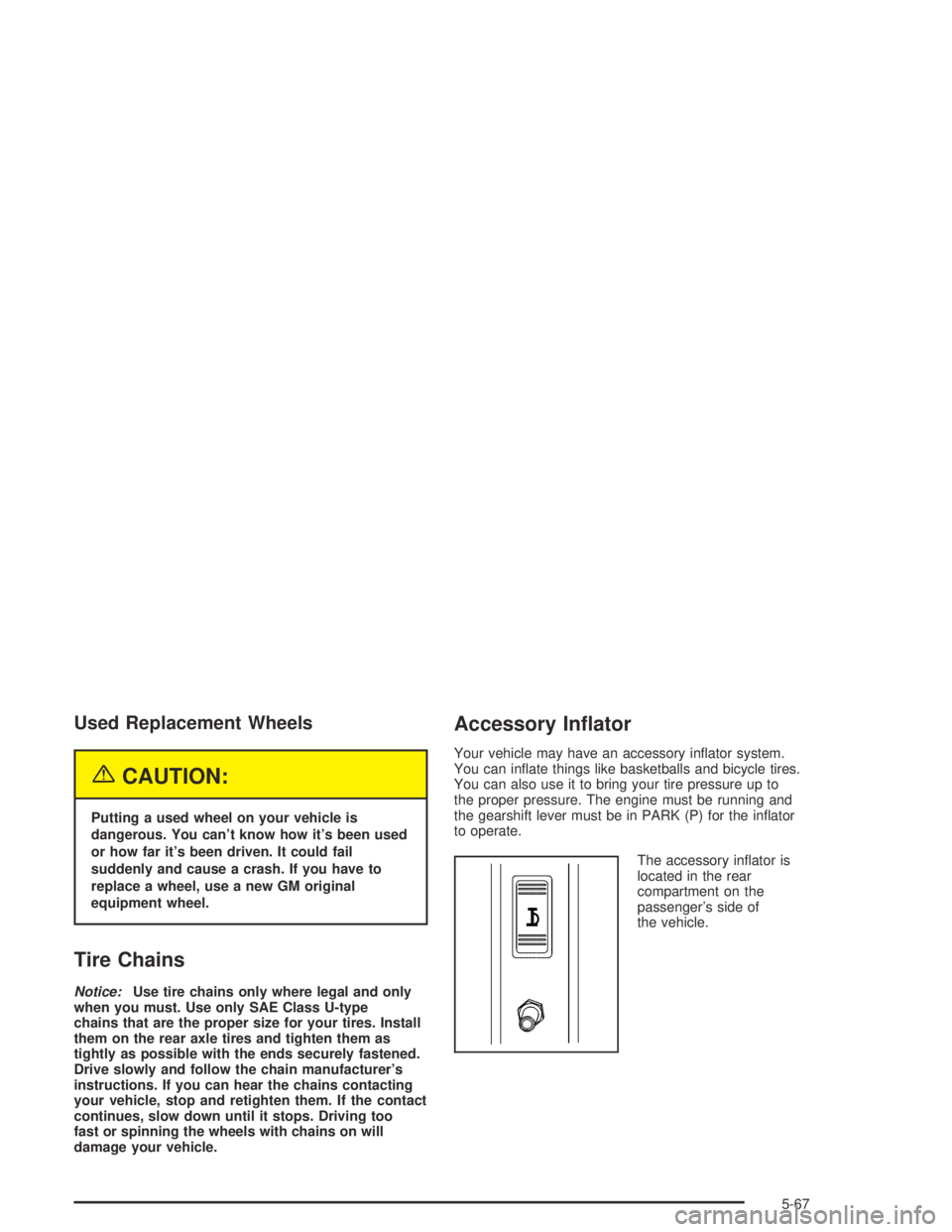
Accessory Inator
Your vehicle may have an accessory inator system.
You can inate things like basketballs and bicycle tires.
You can also use it to bring your tire pressure up to
the proper pressure. The engine must be running and
the gearshift lever must be in PARK (P) for the inator
to operate.
The accessory inator is
located in the rear
compartment on the
passenger’s side of
the vehicle.
5-67
Page 394 of 468

Rear Flat Tire:Place the
jack under the curved rear
axle pad. Make sure
the jack head is positioned
so that the rear axle
pad is resting securely on
the jack head.
{CAUTION:
Getting under a vehicle when it is jacked up is
dangerous. If the vehicle slips off the jack you
could be badly injured or killed. Never get
under a vehicle when it is supported only
by a jack.
{CAUTION:
Raising your vehicle with the jack improperly
positioned can damage the vehicle and even
make the vehicle fall. To help avoid personal
injury and vehicle damage, be sure to t the
jack lift head into the proper location before
raising the vehicle.
6. Turn the ratchet clockwise to raise the vehicle.
Raise the vehicle far enough off the ground so
there is enough room for the spare tire to clear
the ground. Rear Flat Tire
5-82
Page 399 of 468
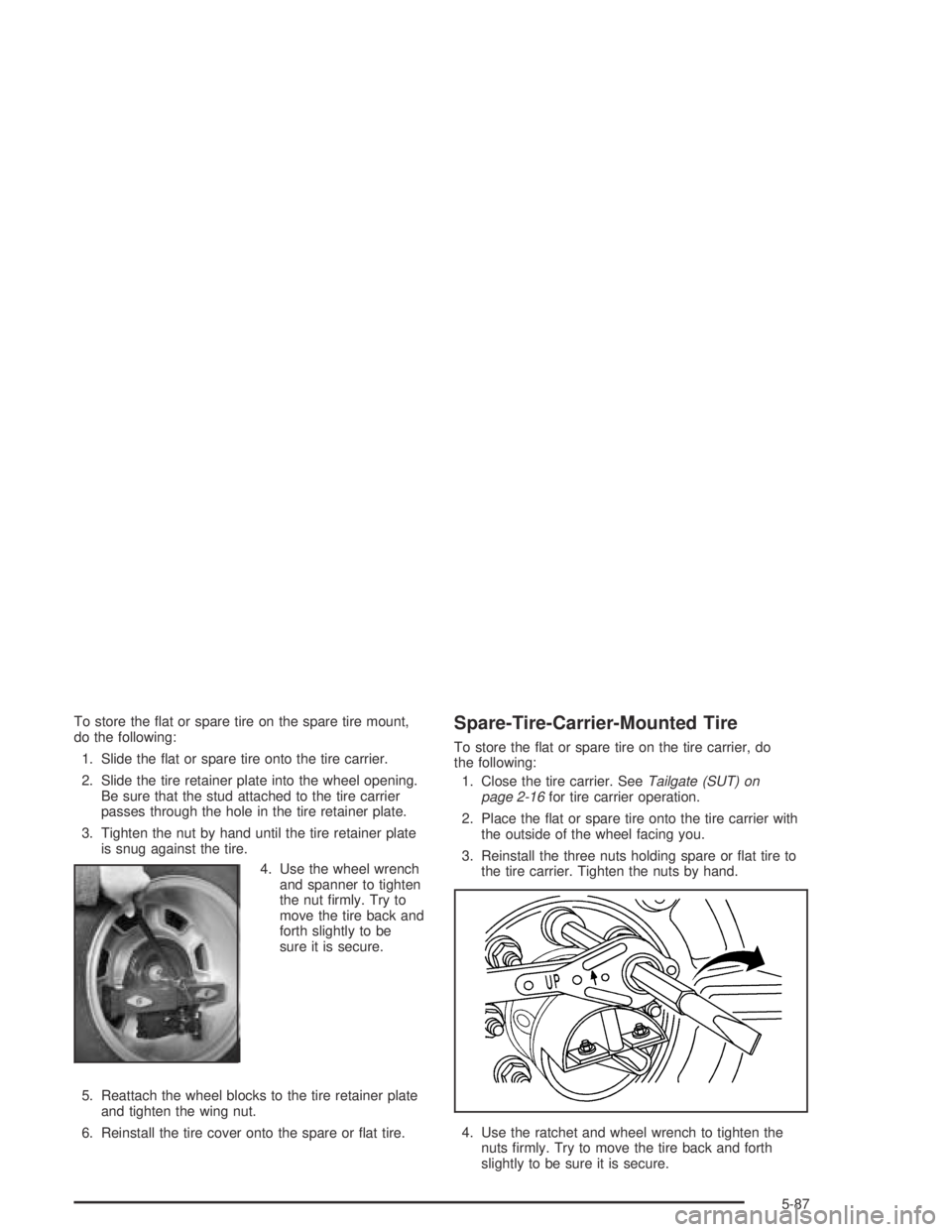
To store the at or spare tire on the spare tire mount,
do the following:
1. Slide the at or spare tire onto the tire carrier.
2. Slide the tire retainer plate into the wheel opening.
Be sure that the stud attached to the tire carrier
passes through the hole in the tire retainer plate.
3. Tighten the nut by hand until the tire retainer plate
is snug against the tire.
4. Use the wheel wrench
and spanner to tighten
the nut rmly. Try to
move the tire back and
forth slightly to be
sure it is secure.
5. Reattach the wheel blocks to the tire retainer plate
and tighten the wing nut.
6. Reinstall the tire cover onto the spare or at tire.Spare-Tire-Carrier-Mounted Tire
To store the at or spare tire on the tire carrier, do
the following:
1. Close the tire carrier. SeeTailgate (SUT) on
page 2-16for tire carrier operation.
2. Place the at or spare tire onto the tire carrier with
the outside of the wheel facing you.
3. Reinstall the three nuts holding spare or at tire to
the tire carrier. Tighten the nuts by hand.
4. Use the ratchet and wheel wrench to tighten the
nuts rmly. Try to move the tire back and forth
slightly to be sure it is secure.
5-87
Page 400 of 468

5. Slide the license plate holder onto the spare or at
tire. Secure it from the back of the tire carrier with
the wing nut.
If you choose not to reinstall the spare or at tire on
the vehicle, you will still need to reinstall the
license plate holder on the spare tire carrier.
Storing the Tools
SUV
Follow these instructions to store the jack and tools:
1. Lower the jack completely.
2. Place the jack in the mounting bracket.
3. Tighten the wingnut (A)
until the jack is
securely fastened.
4. Place the tools in the bag.
5. Slide the securing clip over the bag and secure the
bag to the oor by tightening the wingnut (B) to the
stud coming out of the oor.
In order to reduce the potential of the jack
squeaking or rattling, you will need to preload the
jack so it ts tightly in the mounting bracket.
To do this, turn the u-hook/clevis at the top of the
jack clockwise until the jack is held tight in the
mounting bracket.
5-88
Page 401 of 468

SUT
Follow these instructions to store the jack and tools:
1. Lower the jack completely.
2. Place the jack (B) in the mounting bracket in the
rear cargo compartment.3. Tighten the wingnut (C) until the jack is
securely fastened.
In order to reduce the potential of the jack
squeaking or rattling, you will need to preload the
jack so it ts tightly in the mounting bracket.
To do this, turn the u-hook/clevis at the top of the
jack clockwise until the jack is held tight in the
mounting bracket.
4. Place the wheel blocks (E) onto the mounting stud
and tighten the wingnut (D) to secure them.
5. Place the tools in the tool bag (A), roll the bag
together tightly and neatly and then close it with
the hook and loop fasteners.
If you do not roll the tool bag tightly and neatly, you
will have trouble getting it back into the storage
retention clips in the next step.
5-89
Page 403 of 468
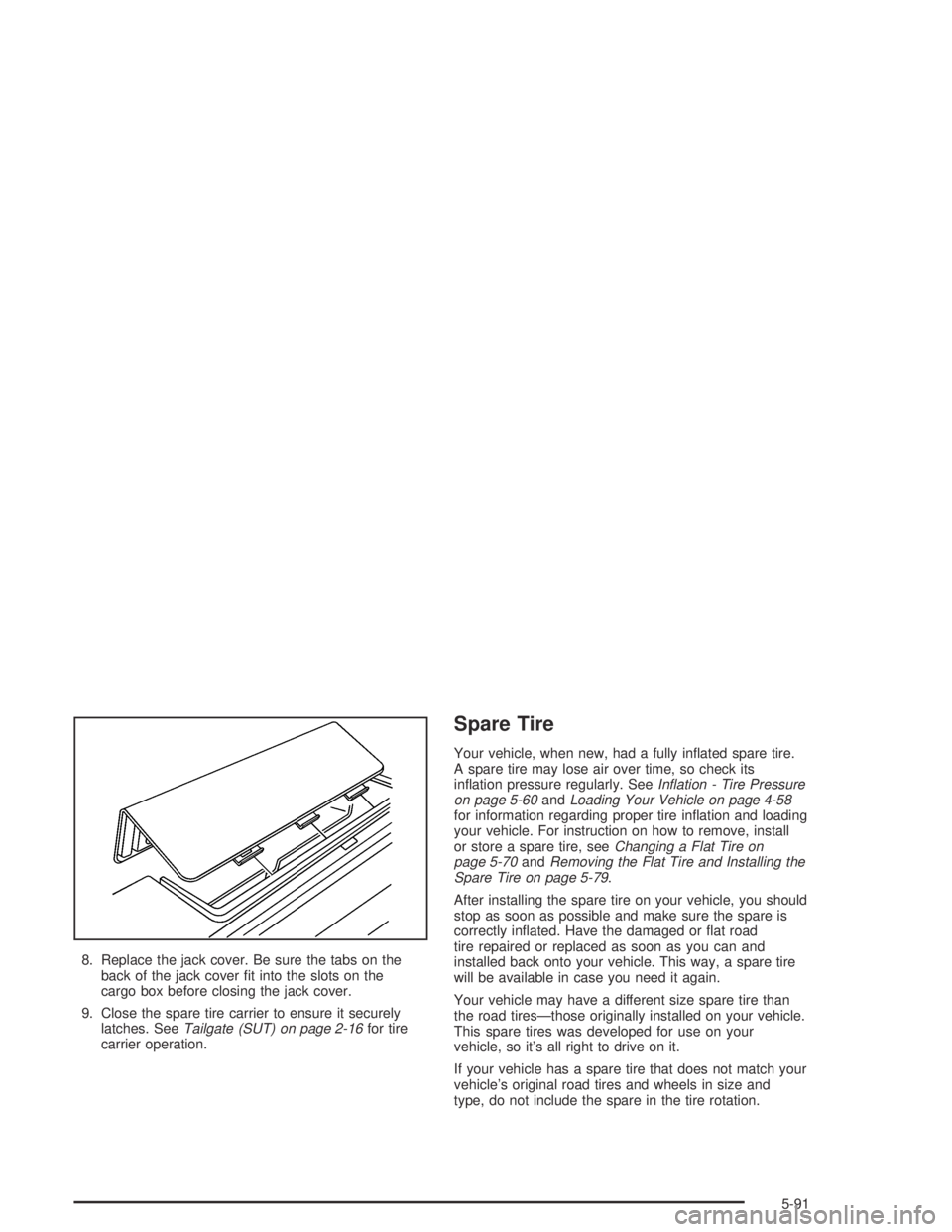
8. Replace the jack cover. Be sure the tabs on the
back of the jack cover t into the slots on the
cargo box before closing the jack cover.
9. Close the spare tire carrier to ensure it securely
latches. SeeTailgate (SUT) on page 2-16for tire
carrier operation.
Spare Tire
Your vehicle, when new, had a fully inated spare tire.
A spare tire may lose air over time, so check its
ination pressure regularly. SeeInation - Tire Pressure
on page 5-60andLoading Your Vehicle on page 4-58
for information regarding proper tire ination and loading
your vehicle. For instruction on how to remove, install
or store a spare tire, seeChanging a Flat Tire on
page 5-70andRemoving the Flat Tire and Installing the
Spare Tire on page 5-79.
After installing the spare tire on your vehicle, you should
stop as soon as possible and make sure the spare is
correctly inated. Have the damaged or at road
tire repaired or replaced as soon as you can and
installed back onto your vehicle. This way, a spare tire
will be available in case you need it again.
Your vehicle may have a different size spare tire than
the road tires—those originally installed on your vehicle.
This spare tires was developed for use on your
vehicle, so it’s all right to drive on it.
If your vehicle has a spare tire that does not match your
vehicle’s original road tires and wheels in size and
type, do not include the spare in the tire rotation.
5-91