light HUMMER H2 2007 Owners Manual
[x] Cancel search | Manufacturer: HUMMER, Model Year: 2007, Model line: H2, Model: HUMMER H2 2007Pages: 570, PDF Size: 3.34 MB
Page 349 of 570

Once you are moving on the freeway, make
certain you allow a reasonable following distance.
Expect to move slightly slower at night.
When you want to leave the freeway, move to the
proper lane well in advance. If you miss your
exit, do not, under any circumstances, stop and
back up. Drive on to the next exit.
The exit ramp can be curved, sometimes quite
sharply. The exit speed is usually posted.
Reduce your speed according to your
speedometer, not to your sense of motion. After
driving for any distance at higher speeds, you may
tend to think you are going slower than you
actually are.
Before Leaving on a Long Trip
Make sure you are ready. Try to be well rested.
If you must start when you are not fresh — such as
after a day’s work — do not plan to make too many
miles that rst part of the journey. Wear comfortable
clothing and shoes you can easily drive in.
Is your vehicle ready for a long trip? If you keep it
serviced and maintained, it is ready to go. If it
needs service, have it done before starting out.Of course, you will nd experienced and able
service experts in GM dealerships all across
North America. They will be ready and willing to
help if you need it.
Here are some things you can check before a trip:
Windshield Washer Fluid:Is the reservoir
full? Are all windows clean inside and outside?
Wiper Blades:Are they in good shape?
Fuel, Engine Oil, Other Fluids:Have you
checked all levels?
Lamps:Are they all working? Are the lenses
clean?
Tires:They are vitally important to a safe,
trouble-free trip. Is the tread good enough
for long-distance driving? Are the tires
all inated to the recommended pressure?
Weather Forecasts:What is the weather
outlook along your route? Should you
delay your trip a short time to avoid a major
storm system?
Maps:Do you have up-to-date maps?
349
Page 353 of 570

Winter Driving
Here are some tips for winter driving:
Have your vehicle in good shape for winter.
You may want to put winter emergency
supplies in your vehicle.
Also seeTires on page 448.Include an ice scraper, a small brush or broom,
a supply of windshield washer uid, a rag,
some winter outer clothing, a small shovel, a
ashlight, a red cloth, and a couple of reective
warning triangles. And, if you will be driving under
severe conditions, include a small bag of sand,
a piece of old carpet, or a couple of burlap bags to
help provide traction. Be sure you properly
secure these items in your vehicle.
353
Page 356 of 570

You can run the engine to keep warm, but be
careful.
{CAUTION:
Snow can trap exhaust gases under your
vehicle. This can cause deadly CO
(carbon monoxide) gas to get inside.
CO could overcome you and kill you. You
cannot see it or smell it, so you might not
know it is in your vehicle. Clear away
snow from around the base of your
vehicle, especially any that is blocking
your exhaust pipe. And check around
again from time to time to be sure snow
does not collect there.
Open a window just a little on the side of
the vehicle that is away from the wind.
This will help keep CO out.
Run your engine only as long as you must.
This saves fuel. When you run the engine, make it
go a little faster than just idle. That is, push the
accelerator slightly. This uses less fuel for the heat
that you get and it keeps the battery charged.
356
Page 358 of 570

Rocking Your Vehicle to Get It Out
First, turn the steering wheel left and right.
That will clear the area around the front wheels.
Your vehicle has a traction control system that
will activate when the system senses that
the wheels are spinning. SeeTraction Control
System (TCS) on page 309for more information.
Then, with the wheels straight ahead, shift
back and forth between REVERSE (R) and a
forward gear, spinning the wheels as little
as possible. Release the accelerator pedal while
you shift, and press lightly on the accelerator pedal
when the transmission is in gear. By slowly
spinning the wheels in the forward and reverse
directions, you will cause a rocking motion
that may free your vehicle. If that does not get
your vehicle out after a few tries, it may need to
be towed out. Or, you can use the recovery loops.
If your vehicle does need to be towed out, see
Towing Your Vehicle on page 369.
Recovery Loops
{CAUTION:
These loops, when used, are under a lot
of force. Keep people away from the
vicinity of the loops and any chains or
cables during use. Always pull the vehicle
straight out. Never pull on the loops at a
sideways angle. The loops could break off
and you or others could be injured from
the chain or cable snapping back.
Notice:Never use the recovery loops to tow
the vehicle. Your vehicle could be damaged
and it would not be covered by warranty.
358
Page 360 of 570
First Aid Kit and Tool Kit
The rst aid and tool kit is located in the storage bin
on top of the spare tire on SUV models. It is held in
place with a hook and loop fastener strap.
On SUT models, the kit is in the rear cargo
compartment on the passenger side of the vehicle.
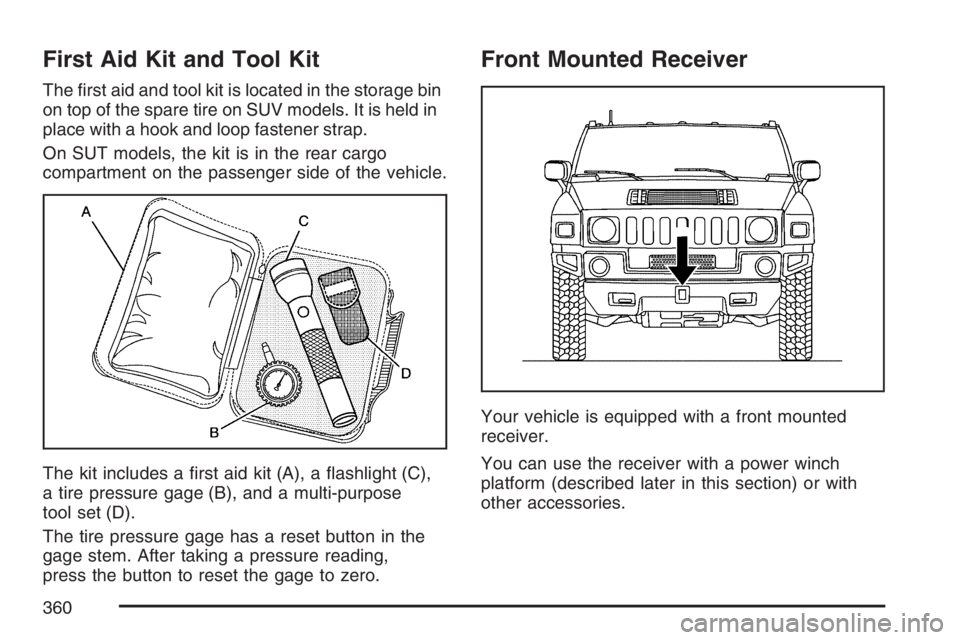
The kit includes a rst aid kit (A), a ashlight (C),
a tire pressure gage (B), and a multi-purpose
tool set (D).
The tire pressure gage has a reset button in the
gage stem. After taking a pressure reading,
press the button to reset the gage to zero.
Front Mounted Receiver
Your vehicle is equipped with a front mounted
receiver.
You can use the receiver with a power winch
platform (described later in this section) or with
other accessories.
360
Page 371 of 570
Selectable Extended Rear Ride
Height
If your vehicle has this feature it comes as part
of the electronically controlled air suspension
system.
The selectable rear ride height allows you to raise
the rear of the vehicle about 2 inches (5 cm)
over the normal ride height. This can be helpful
when driving off-road where you may need
more ground clearance to clear an obstacle.
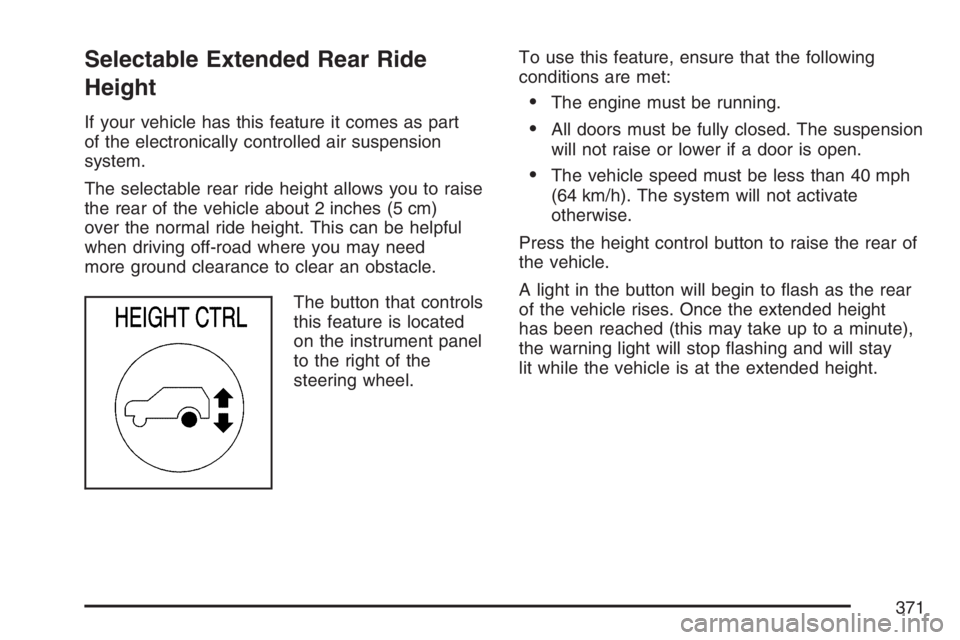
The button that controls
this feature is located
on the instrument panel
to the right of the
steering wheel.To use this feature, ensure that the following
conditions are met:
The engine must be running.
All doors must be fully closed. The suspension
will not raise or lower if a door is open.
The vehicle speed must be less than 40 mph
(64 km/h). The system will not activate
otherwise.
Press the height control button to raise the rear of
the vehicle.
A light in the button will begin to ash as the rear
of the vehicle rises. Once the extended height
has been reached (this may take up to a minute),
the warning light will stop ashing and will stay
lit while the vehicle is at the extended height.
371
Page 372 of 570
To lower the vehicle to the normal ride height,
press the button again. The light in the button will
ash as the suspension lowers. When the light
in the button stops ashing and goes out,
the suspension has reached the normal ride
height.
This feature will lower the vehicle to the normal
height if vehicle speed exceeds 40 mph (64 km/h).
You may also want to use this feature when
ascending, descending or cresting a steep hill as
this can help prevent the rear bumper from
dragging on the base of the hill or prevent the
vehicle from grounding out (high centering) on the
crest of the hill.
Do not use this feature when towing a trailer.Electronically Controlled Air
Suspension System
The electronically controlled air suspension, if
equipped, keeps the rear of your vehicle level as
you load and unload it. The system includes a
compressor, two height sensor and two air springs
supporting the vehicle.
The engine must be running for the system to
level the vehicle after loading or unloading.
The system will suspend transitioning between
the designed ride height and the extended
ride height if any of the doors are open. However,
the system will not suspend operation during
normal leveling and once the doors are closed,
system leveling will continue.
You may hear the compressor running when you
load your vehicle, and periodically as the system
adjusts the vehicle to the standard ride height.
372
Page 373 of 570
You may also hear the release of air similar to a
hissing sound during suspension operation.
This is normal.
Load leveling will not function normally with the
inator hose attached to the inator outlet.
Remove the inater hose from the outlet when
it is not in use. SeeAccessory Inator on
page 466.
Overload and Overheat Protection
Overload protection is designed to protect the air
suspension system and is an indication to the
driver that the vehicle is overloaded.
If the rear suspension remains at a low height, the
rear axle load has exceeded GAWR (Gross Axle
Weight Rating). When the overload protection
mode is activated, the compressor operates forabout 30 seconds to one minute without raising the
vehicle depending on the amount of overload.
This will continue each time the ignition is turned on
until the rear axle load is reduced below GAWR.
If the total rear GAWR (Gross Axle Weight Rating)
is reached, the suspension may be slightly less
than level. This is normal and does not mean there
is a problem with the air suspension.
If the system overheats due to normal operation,
the SERVICE AIR SUSPENSION message
will not be displayed on the DIC, but the system
will shut down and stop all leveling functions until it
cools down. If the system overheats and sets
the SERVICE AIR SUSPENSION message in the
DIC, then there is a fault. SeeDIC Warnings
and Messages on page 226for more information.
373
Page 376 of 570

Tow/Haul Mode
Tow/haul mode is used when using your vehicle to
pull a large or heavy load or trailer. Tow/haul is
also useful while pulling a load in rolling terrain, in
stop-and-go traffic, or when you need improved
low-speed control, such as when parking.
The purpose of the tow/haul mode is to do the
following:
Reduce the frequency and improve the
predictability of transmission shifts when
pulling a heavy trailer or a large or heavy load.
Provide the same solid shift feel when pulling a
heavy trailer or a large or heavy load as when
the vehicle is unloaded.
Improve control of vehicle speed while requiring
less accelerator pedal activity when pulling a
heavy trailer or a large or heavy load.
Tow/haul mode is most effective when the vehicle
and trailer combined weight is at least 75 percent of
the vehicle’s Gross Combination Weight Rating
(GCWR). See “Weight of the Trailer” later in this
section.Press the button on the
instrument panel to the
right of the steering
wheel to enable
the tow/haul mode.
A light on the instrument
panel will illuminate to
indicate that tow/haul
mode has been
selected.
Press the button again to turn off tow/haul mode.
The indicator light on the instrument panel will
turn off. The vehicle will automatically turn
off tow/haul mode every time it is started.
Driving with tow/haul mode activated without a
heavy load or with no trailer will cause reduced
fuel economy and unpleasant engine and
transmission driving characteristics, but will not
cause damage.
376
Page 386 of 570

Trailer Wiring Harness
Heavy-Duty Trailer Wiring Package
Your vehicle is equipped with a trailer towing
harness. This harness with a seven-pin universal
heavy-duty trailer connector is attached to a
bracket on the hitch platform.
The trailer towing harness contains the following
trailer circuits:
Yellow: Left Stop/Turn Signal
Dark Green: Right Stop/Turn Signal
Brown: Taillamps
White: Ground
Light Green: Back-up Lamps
Light Blue: Center High-Mounted Stoplamp
(CHMSL)
Red: Battery Feed
Dark Blue: Trailer Brake
A jumper harness for an electric trailer brake
controller and a trailer battery feed fuse may be
included with this trailering package. See
“Instrument Panel Jumper Wiring Harness” later in
this section.
If you need to tow a light-duty trailer with a
standard four-way, round pin connector, an
adapter may be included. See “Four-Wire Harness
Adapter” later in this section.
Instrument Panel Jumper Wiring Harness
Notice:If your vehicle has factory or
dealer-installed HUMMER off-road lamps, the
place where an electric trailer brake connection
must be made is already in use. Do not attempt
to double-up or “piggyback” the connection,
because this could cause a failure or damage to
your vehicle, the electric trailer brake system,
or both. If you want to connect a trailer with
electric brakes to your vehicle, see your dealer
to disconnect the off-road lamps. Also, read
Add-On Electrical Equipment on page 503for
more information.
386