brake light HUMMER H2 2007 User Guide
[x] Cancel search | Manufacturer: HUMMER, Model Year: 2007, Model line: H2, Model: HUMMER H2 2007Pages: 570, PDF Size: 3.34 MB
Page 310 of 570

Another feature of this system is the Traction
Control 2 (TC2) mode. TC2 should be selected for
improved traction and system performance
when the vehicle is on loose surfaces such as
deep sand or mud.
To enter this mode,
press the TC2 button
located on the
instrument panel to the
right of the steering
wheel.
TC2 only operates in the following transfer case
modes:
Four-Wheel-High Lock
Four-Wheel-Low Lock
Four-Wheel-Low Lock and Rear Axle Lock
SeeLocking Rear Axle on page 311for more
information on the rear axle lock.It will not operate in Four-Wheel-High. If the
TC2 button is pressed while in Four-Wheel High,
the light will ash for about 15 seconds and
then go out. The light should also come on briey
when you turn the ignition key to RUN; if it
doesn’t see your dealer for service.
If you restart your engine, the system reverts to
the standard TCS mode.
The traction off light will
come on when a
Traction Control System
or Anti-Lock Brake
System problem has
been detected and the
vehicle needs service.
SeeTraction Off Light on page 212.
When the traction off light is on, adjust your
driving accordingly.
The traction control system, as delivered from the
factory, will automatically come on whenever
you start your vehicle.
Adding non-GM accessories can affect your
vehicle’s performance. SeeAccessories and
Modications on page 392for more information.
310
Page 323 of 570
Brake and Accelerator Operation
Techniques for Off-Road Driving
For logs, walls, rocks, severe ditches,
hills, sand, etc.
1. Bring the vehicle to a complete stop. Do not
rev the engine.
2. Select the proper transmission and transfer
case gear range; usually FIRST (1) gear,
4LO LOCK for such obstacles.
3. If wheel spin is experienced, maintain steady
throttle, with your foot off the brake pedal, to
allow the Traction Control System (TCS)
to control the wheel spin. TCS will not operate
if the brakes are applied, even slightly.
4. If wheel spin cannot be controlled by the
system, fully press the brake pedal with
your left foot so all wheel spin is halted.
5. Back away from the obstacle so that a new
approach can be tried.
6. As the rst wheel crosses the obstacle, be
prepared to alternate the brake and
accelerator pedal to maintain control and
avoid tire drop-off from obstacles. Repeat this
process for the other wheels.
For mounds, washouts, loose up-hill
slopes, ditches, etc.
When wheel spin occurs as the vehicle is moving,
the driver may notice a slight shaking or
shuddering of the vehicle. This should be stopped
as soon as possible to prevent damage to
vehicle components. This is the indication that a
loss of traction is occurring on this terrain.
The operator should:
1. Reduce speed and apply the brakes.
2. Assess the terrain properly and adjust vehicle
speed and gear ranges accordingly: 4HI
position for higher speeds and 4LO LOCK for
more torque and lower speeds. Transmission
FIRST (1) gear is generally recommended.
3. Apply slight pressure to the brake when the
shaking or shuddering sensation is felt,
keeping the vehicle moving in a controlled
manner.
4. Be prepared to alternate between braking and
accelerating through the adverse terrain.
323
Page 332 of 570
Driving Downhill
When off-roading takes you downhill, you will want
to consider a number of things:
How steep is the downhill? Will I be able to
maintain vehicle control?
What is the surface like? Smooth? Rough?
Slippery? Hard-packed dirt? Gravel?
Are there hidden surface obstacles? Ruts?
Logs? Boulders?
What is at the bottom of the hill? Is there a
hidden creek bank or even a river bottom
with large rocks?
If you decide you can go down a hill safely, then
try to keep your vehicle headed straight down, and
use a low gear. This way, engine drag can help
your brakes and they will not have to do all
the work. Descend slowly, keeping your vehicle
under control at all times.
{CAUTION:
Heavy braking when going down a hill can
cause your brakes to overheat and fade.
This could cause loss of control and a
serious accident. Apply the brakes lightly
when descending a hill and use a low
gear to keep vehicle speed under control.
332
Page 345 of 570

{CAUTION:
Wet brakes can cause accidents. They may
not work as well in a quick stop and may
cause pulling to one side. You could lose
control of the vehicle.
After driving through a large puddle of
water or a car wash, apply your brake pedal
lightly until your brakes work normally.
Driving too fast through large water puddles or
even going through some car washes can cause
problems, too. The water may affect your brakes.
Try to avoid puddles. But if you cannot, try to slow
down before you hit them.
Hydroplaning
Hydroplaning is dangerous. So much water can
build up under your tires that they can actually ride
on the water. This can happen if the road is wet
enough and you are going fast enough. When your
vehicle is hydroplaning, it has little or no contact
with the road.
Hydroplaning does not happen often. But it can
if your tires do not have much tread or if the
pressure in one or more is low. It can happen if a
lot of water is standing on the road. If you can
see reections from trees, telephone poles,
or other vehicles, and raindrops dimple the water’s
surface, there could be hydroplaning.
Hydroplaning usually happens at higher speeds.
There just is not a hard and fast rule about
hydroplaning. The best advice is to slow down
when it is raining.
345
Page 386 of 570

Trailer Wiring Harness
Heavy-Duty Trailer Wiring Package
Your vehicle is equipped with a trailer towing
harness. This harness with a seven-pin universal
heavy-duty trailer connector is attached to a
bracket on the hitch platform.
The trailer towing harness contains the following
trailer circuits:
Yellow: Left Stop/Turn Signal
Dark Green: Right Stop/Turn Signal
Brown: Taillamps
White: Ground
Light Green: Back-up Lamps
Light Blue: Center High-Mounted Stoplamp
(CHMSL)
Red: Battery Feed
Dark Blue: Trailer Brake
A jumper harness for an electric trailer brake
controller and a trailer battery feed fuse may be
included with this trailering package. See
“Instrument Panel Jumper Wiring Harness” later in
this section.
If you need to tow a light-duty trailer with a
standard four-way, round pin connector, an
adapter may be included. See “Four-Wire Harness
Adapter” later in this section.
Instrument Panel Jumper Wiring Harness
Notice:If your vehicle has factory or
dealer-installed HUMMER off-road lamps, the
place where an electric trailer brake connection
must be made is already in use. Do not attempt
to double-up or “piggyback” the connection,
because this could cause a failure or damage to
your vehicle, the electric trailer brake system,
or both. If you want to connect a trailer with
electric brakes to your vehicle, see your dealer
to disconnect the off-road lamps. Also, read
Add-On Electrical Equipment on page 503for
more information.
386
Page 430 of 570
Some driving conditions or climates may cause a
brake squeal when the brakes are rst applied
or lightly applied. This does not mean something
is wrong with your brakes.
Properly torqued wheel nuts are necessary to help
prevent brake pulsation. When tires are rotated,
inspect brake pads for wear and evenly tighten
wheel nuts in the proper sequence to GM torque
specications.
Brake linings should always be replaced as
complete axle sets.
Brake Pedal Travel
See your dealer if the brake pedal does not return
to normal height, or if there is a rapid increase in
pedal travel. This could be a sign of brake trouble.
Brake Adjustment
Every time you make a brake stop, your disc
brakes adjust for wear.
Replacing Brake System Parts
The braking system on a vehicle is complex. Its
many parts have to be of top quality and work well
together if the vehicle is to have really good
braking. Your vehicle was designed and tested
with top-quality GM brake parts. When you replace
parts of your braking system — for example,
when your brake linings wear down and you need
new ones put in — be sure you get new
approved GM replacement parts. If you do not,
your brakes may no longer work properly. For
example, if someone puts in brake linings that are
wrong for your vehicle, the balance between your
front and rear brakes can change — for the worse.
The braking performance you have come to expect
can change in many other ways if someone puts in
the wrong replacement brake parts.
430
Page 433 of 570

To avoid the possibility of the vehicles rolling,
set the parking brake rmly on both vehicles
involved in the jump start procedure. Put
an automatic transmission in PARK (P) or a
manual transmission in NEUTRAL before
setting the parking brake.
Notice:If you leave your radio or other
accessories on during the jump starting
procedure, they could be damaged. The repairs
would not be covered by your warranty.
Always turn off your radio and other
accessories when jump starting your vehicle.
3. Turn off the ignition on both vehicles.
Unplug unnecessary accessories plugged into
the cigarette lighter or accessory power
outlets. Turn off the radio and all lamps that
are not needed. This will avoid sparks
and help save both batteries. And it could
save your radio!4. Open the hoods and locate the positive (+)
and negative (−) terminal locations of the
other vehicle.
Your vehicle has a remote positive (+) jump
starting terminal and a remote negative (−)
jump starting terminal. You should always use
these remote terminals instead of the
terminals on the battery.
The remote positive (+)
terminal is located near
the engine accessory
drive bracket. On some
vehicles, the terminal
may be covered
by a red plastic cover.
To access the
remote positive (+)
terminal, open
the cover, if equipped.
433
Page 511 of 570
Fuses Usage
RVC Regulated Voltage Control
IPC/DICInstrument Panel Cluster/
Driver Information Center
HVAC/ECASClimate Control
Controller/Electronically
Controlled Air Suspension
CIG LTR Cigarette Lighter
HI HDLP-RTPassenger’s Side High Beam
Headlamp
HDLP-LOW Headlamp Low Beam Relay
A/C COMPAir Conditioning
Compressor Relay
A/C COMP Air Conditioning Compressor
TCMB Transmission Control Module
RR WPR Rear Wiper/Washer
RADIO Audio System
SEO B1Mid Bussed Electrical Center,
Universal Home Remote
System, Rear Heated Seats
LO HDLP-LTDriver’s Side Headlamp
Low BeamFuses Usage
BTSIBrake Transmission Shift
Interlock System
CRNK Starting System
LO HDLP-RTPassenger’s Side Headlamp
Low Beam
FOG LP Not Used
FOG LP Not Used
HORN Horn Relay
W/S WASHWindshield and Rear Window
Washer Pump Relay
W/S WASHWindshield and Rear Window
Washer Pump
INFO OnStar
®
RADIO AMP Radio Amplier
RH HID Not Used
HORN Horn
EAP Not Used
TREC Four-Wheel Drive Module
SBA Not Used
511
Page 555 of 570
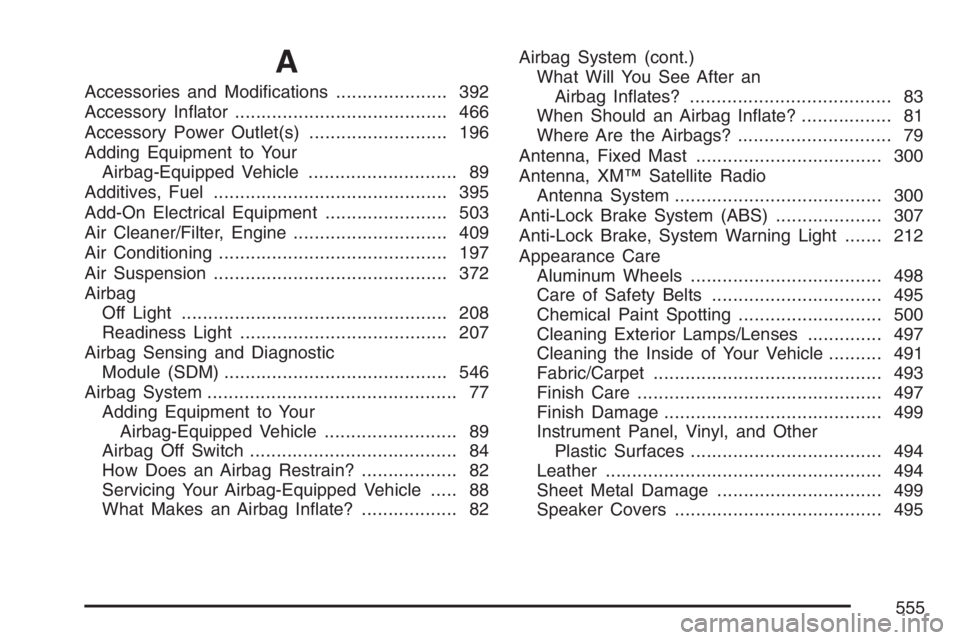
A
Accessories and Modications..................... 392
Accessory Inator........................................ 466
Accessory Power Outlet(s).......................... 196
Adding Equipment to Your
Airbag-Equipped Vehicle............................ 89
Additives, Fuel............................................ 395
Add-On Electrical Equipment....................... 503
Air Cleaner/Filter, Engine............................. 409
Air Conditioning........................................... 197
Air Suspension............................................ 372
Airbag
Off Light.................................................. 208
Readiness Light....................................... 207
Airbag Sensing and Diagnostic
Module (SDM).......................................... 546
Airbag System............................................... 77
Adding Equipment to Your
Airbag-Equipped Vehicle......................... 89
Airbag Off Switch....................................... 84
How Does an Airbag Restrain?.................. 82
Servicing Your Airbag-Equipped Vehicle..... 88
What Makes an Airbag Inate?.................. 82Airbag System (cont.)
What Will You See After an
Airbag Inates?...................................... 83
When Should an Airbag Inate?................. 81
Where Are the Airbags?............................. 79
Antenna, Fixed Mast................................... 300
Antenna, XM™ Satellite Radio
Antenna System....................................... 300
Anti-Lock Brake System (ABS).................... 307
Anti-Lock Brake, System Warning Light....... 212
Appearance Care
Aluminum Wheels.................................... 498
Care of Safety Belts................................ 495
Chemical Paint Spotting........................... 500
Cleaning Exterior Lamps/Lenses.............. 497
Cleaning the Inside of Your Vehicle.......... 491
Fabric/Carpet........................................... 493
Finish Care.............................................. 497
Finish Damage......................................... 499
Instrument Panel, Vinyl, and Other
Plastic Surfaces.................................... 494
Leather.................................................... 494
Sheet Metal Damage............................... 499
Speaker Covers....................................... 495
555
Page 556 of 570

Appearance Care (cont.)
Tires........................................................ 499
Underbody Maintenance........................... 500
Vehicle Care/Appearance Materials.......... 501
Washing Your Vehicle.............................. 495
Weatherstrips........................................... 495
Windshield, Backglass, and
Wiper Blades........................................ 498
Wood Panels........................................... 495
Ashtray(s).................................................... 197
Assist Steps................................................ 338
Audio System(s).......................................... 241
Audio Steering Wheel Controls................. 296
Care of Your Cassette Tape Player.......... 297
Care of Your CD and DVD Player............ 300
Care of Your CDs and DVDs................... 299
Chime Level Adjustment........................... 300
Fixed Mast Antenna................................. 300
Navigation/Radio System,
see Navigation Manual......................... 271
Radio with Cassette and CD.................... 243
Radio with Six-Disc CD............................ 256
Rear Seat Audio (RSA)............................ 294
Setting the Time...................................... 243Audio System(s) (cont.)
Theft-Deterrent Feature............................ 295
Understanding Radio Reception............... 297
XM™ Satellite Radio Antenna System........ 300
Automatic Headlamp System....................... 189
Automatic Transmission
Fluid........................................................ 412
Operation................................................. 124
B
Battery........................................................ 431
Run-Down Protection............................... 192
Before Leaving on a Long Trip.................... 349
Bench Seat, Split (60/40).............................. 15
Brake
Anti-Lock Brake System (ABS)................. 307
Emergencies............................................ 309
Parking.................................................... 133
System Warning Light.............................. 211
Brakes........................................................ 427
Braking....................................................... 306
Braking in Emergencies............................... 309
Break-In, New Vehicle................................. 119
556