transmission HUMMER H2 2007 Owner's Manual
[x] Cancel search | Manufacturer: HUMMER, Model Year: 2007, Model line: H2, Model: HUMMER H2 2007Pages: 570, PDF Size: 3.34 MB
Page 214 of 570
At approximately 265°F (130°C), the Driver
Information Center (DIC) will display a
TRANSMISSION HOT message and the
transmission will enter a transmission protection
mode. When the transmission enters the protection
mode, you may notice a change in the transmission
shifting patterns. The transmission will return to
normal shifting patterns when the transmission uid
temperature falls below 260°F (125°C).
If the transmission uid reaches temperatures of
approximately 275°F (135°C) or greater, the DIC
will display a TRANS HOT IDLE ENGINE warning
message and a chime will sound. Pull the vehicle
off the roadway when it is safe to do so. Set the
parking brake, place the transmission in PARK (P)
and allow the engine to idle until the transmission
temperature falls below 260°F (125°C). If the
transmission continues to operate above 265°F
(130°C), please contact your nearest dealer or the
GM Roadside Assistance Center.
SeeDriver Information Center (DIC) on page 222
for further information.Notice:If you drive your vehicle with the
transmission temperature gage above normal
operating range, you can damage the
transmission. This could lead to costly repairs
that would not be covered by your warranty.
Do not drive your vehicle while the
transmission temperature gage reading is
above normal. See your dealer for service.
The following situations can cause the
transmission to operate at higher temperatures:
Towing a trailer,
hot outside air temperatures,
hauling a large or heavy load,
low transmission uid level,
high transmission uid level,
restricted air ow to the radiator.
A temporary solution to hotter transmission
operating temperatures may be to let the
transmission cool down. If the transmission is
operated at higher temperatures on a frequent
basis, seeScheduled Maintenance on page 517
for the proper transmission maintenance intervals.
214
Page 215 of 570
Malfunction Indicator Lamp
Check Engine Light
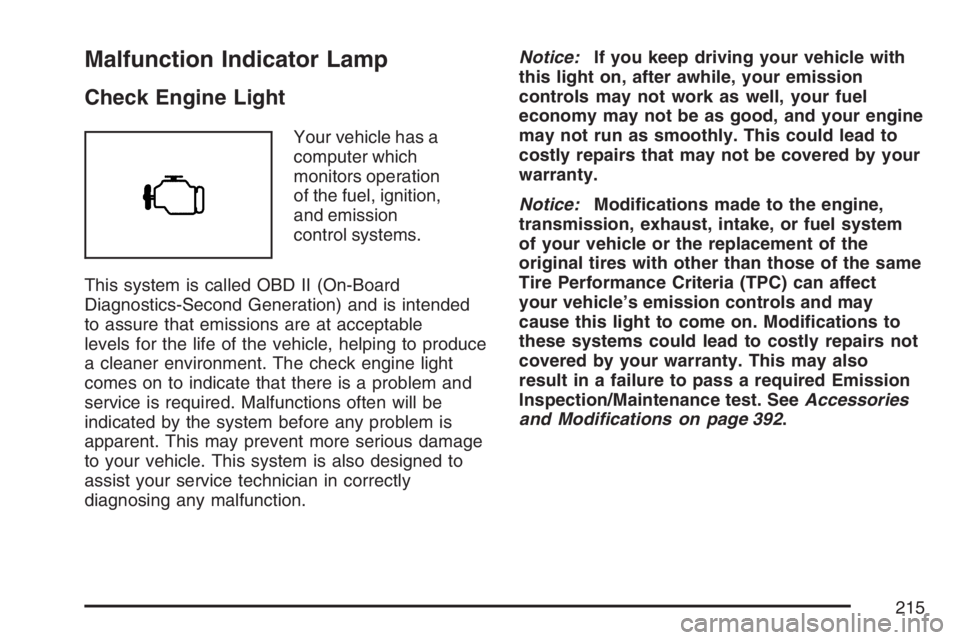
Your vehicle has a
computer which
monitors operation
of the fuel, ignition,
and emission
control systems.
This system is called OBD II (On-Board
Diagnostics-Second Generation) and is intended
to assure that emissions are at acceptable
levels for the life of the vehicle, helping to produce
a cleaner environment. The check engine light
comes on to indicate that there is a problem and
service is required. Malfunctions often will be
indicated by the system before any problem is
apparent. This may prevent more serious damage
to your vehicle. This system is also designed to
assist your service technician in correctly
diagnosing any malfunction.Notice:If you keep driving your vehicle with
this light on, after awhile, your emission
controls may not work as well, your fuel
economy may not be as good, and your engine
may not run as smoothly. This could lead to
costly repairs that may not be covered by your
warranty.
Notice:Modications made to the engine,
transmission, exhaust, intake, or fuel system
of your vehicle or the replacement of the
original tires with other than those of the same
Tire Performance Criteria (TPC) can affect
your vehicle’s emission controls and may
cause this light to come on. Modications to
these systems could lead to costly repairs not
covered by your warranty. This may also
result in a failure to pass a required Emission
Inspection/Maintenance test. SeeAccessories
and Modifications on page 392.
215
Page 232 of 570
TIGHTEN FUEL CAP
This message may display along with the check
engine light on the instrument panel cluster if
the vehicle’s fuel cap is not tightened properly.
SeeMalfunction Indicator Lamp on page 215.
Reinstall the fuel cap, making sure to fully install
the cap. SeeFilling the Tank on page 397.
The diagnostic system can determine if the fuel
cap has been left off or improperly installed.
A loose or missing fuel cap allows fuel to
evaporate into the atmosphere. A few driving trips
with the cap properly installed should turn the
light and message off.
TRACTION ACTIVE
This message displays when the Traction Control
System (TCS) is active. This happens when
the TCS has detected that any of the vehicle’s
wheels are slipping. SeeTraction Control
System (TCS) on page 309for more information.
TRANS (Transmission) HOT IDLE
ENGINE
Notice:If you drive your vehicle while the
transmission uid is overheating and the
transmission temperature warning is displayed
on the instrument panel cluster and/or DIC, you
can damage the transmission. This could lead
to costly repairs that would not be covered by
your warranty. Do not drive your vehicle with
overheated transmission uid or while the
transmission temperature warning is displayed.
This message displays and a continuous chime
sounds if the transmission uid in the vehicle gets
hot. Driving with the transmission uid temperature
high can cause damage to the vehicle. Stop the
vehicle and let it idle to allow the transmission
to cool. This message clears and the chime stops
when the uid temperature reaches a safe
level. SeeTransmission Temperature Gage on
page 213.
232
Page 233 of 570
TRANSMISSION HOT
Notice:If you drive your vehicle while the
transmission uid is overheating and the
transmission temperature warning is displayed
on the instrument panel cluster and/or DIC,
you can damage the transmission. This could
lead to costly repairs that would not be
covered by your warranty. Do not drive your
vehicle with overheated transmission uid
or while the transmission temperature warning
is displayed.
This message displays if the transmission uid
temperature becomes high.
When the transmission enters the protection
mode, you may notice a change in the
transmission shifting patterns. When the
transmission uid temperature returns to normal,
the display turns off and the transmission
shifting patterns return to normal.If the vehicle has the Tow/Haul mode, use this
feature if the transmission is operating at higher
temperatures and/or the following situations
exist, which can cause the transmission to operate
at higher temperatures:
Towing a trailer
Hot outside air temperatures
Hauling a large or heavy load
Over-loading
Low transmission uid level
High transmission uid level
Restricted air ow to the radiator and the
auxiliary transmission oil cooler, if your vehicle
has this feature
A temporary solution to hotter transmission
operating temperatures may be to let the
transmission cool down. If the transmission is
operated at higher temperatures on a frequent
basis, seeScheduled Maintenance on page 517
for the proper transmission maintenance intervals
for the transmission on your vehicle. Also see
Transmission Temperature Gage on page 213for
more information.
233
Page 309 of 570

Remember: ABS does not change the time you
need to get your foot up to the brake pedal or
always decrease stopping distance. If you get too
close to the vehicle in front of you, you will not have
time to apply your brakes if that vehicle suddenly
slows or stops. Always leave enough room up
ahead to stop, even though you have ABS.
Using ABS
Do not pump the brakes. Just hold the brake
pedal down rmly and let anti-lock work for you.
You may feel the brakes vibrate, or you may notice
some noise, but this is normal.
Braking in Emergencies
With ABS, you can steer and brake at the same
time. In many emergencies, steering can help you
more than even the very best braking.
Traction Control System (TCS)
Your vehicle has a Traction Control System (TCS)
that limits wheel spin. This is especially useful in
slippery road conditions. The system operates only
if it senses that any of the wheels are spinning or
beginning to lose traction. When this happens, the
system applies the brakes to limit wheel spin.
The Traction Control System may operate on dry
roads under some conditions. When this happens,
you may notice a reduction in acceleration or a
pumping sound. This is normal and doesn’t mean
there’s a problem with your vehicle. Examples of
these conditions include hard acceleration in a turn,
an abrupt upshift or downshift of the transmission or
driving on rough roads.
If your vehicle is in cruise control when the TCS
begins to limit wheel spin, the cruise control will
automatically disengage. When road conditions
allow you to safely use it again, you may re-engage
the cruise control. SeeCruise Control on page 183.
309
Page 323 of 570
Brake and Accelerator Operation
Techniques for Off-Road Driving
For logs, walls, rocks, severe ditches,
hills, sand, etc.
1. Bring the vehicle to a complete stop. Do not
rev the engine.
2. Select the proper transmission and transfer
case gear range; usually FIRST (1) gear,
4LO LOCK for such obstacles.
3. If wheel spin is experienced, maintain steady
throttle, with your foot off the brake pedal, to
allow the Traction Control System (TCS)
to control the wheel spin. TCS will not operate
if the brakes are applied, even slightly.
4. If wheel spin cannot be controlled by the
system, fully press the brake pedal with
your left foot so all wheel spin is halted.
5. Back away from the obstacle so that a new
approach can be tried.
6. As the rst wheel crosses the obstacle, be
prepared to alternate the brake and
accelerator pedal to maintain control and
avoid tire drop-off from obstacles. Repeat this
process for the other wheels.
For mounds, washouts, loose up-hill
slopes, ditches, etc.
When wheel spin occurs as the vehicle is moving,
the driver may notice a slight shaking or
shuddering of the vehicle. This should be stopped
as soon as possible to prevent damage to
vehicle components. This is the indication that a
loss of traction is occurring on this terrain.
The operator should:
1. Reduce speed and apply the brakes.
2. Assess the terrain properly and adjust vehicle
speed and gear ranges accordingly: 4HI
position for higher speeds and 4LO LOCK for
more torque and lower speeds. Transmission
FIRST (1) gear is generally recommended.
3. Apply slight pressure to the brake when the
shaking or shuddering sensation is felt,
keeping the vehicle moving in a controlled
manner.
4. Be prepared to alternate between braking and
accelerating through the adverse terrain.
323
Page 326 of 570

Crossing Obstacles
Approach Angle — a Key to Mobility
If you encounter a large dip in the terrain, do not
enter straight on; enter at an angle — 15° minimum
approach (A), 75° maximum approach angle (B).
For very large dips, ditches or small washes, coast
in, using the engine as a brake (transmission and
transfer case lowest gears). Then, use the low
ranges in the transmission and transfer case to
power out.
Roll Your Tires Over Large Rocks
Do not straddle large
rocks; drive over them,
letting the tire cover
the rock. The tread of
the tire is thicker
and tougher than the
sidewall of the tire
and is more resilient to
impact than underbody
components.
326
Page 327 of 570

Log Crossing
Using the proper technique, your vehicle will cross
logs up to 10 inches (25.4 cm) in diameter.
Approach the log at approximately a 15° angle (A)
with the transmission in FIRST (1) and the
transfer case in 4LO LOCK and “walk” your vehicle
over, one tire at a time. It may be necessary to
modulate your brake pedal and accelerator
to avoid spin-out. Ease the vehicle down from the
log with your brake.
Driving on Off-Road Hills
Off-road driving often takes you up, down, or
across a hill. Driving safely on hills requires good
judgment and an understanding of what your
vehicle can and cannot do. There are some hills
that simply cannot be driven, no matter how
well built the vehicle.
{CAUTION:
Many hills are simply too steep for any
vehicle. If you drive up them, you will
stall. If you drive down them, you cannot
control your speed. If you drive across
them, you will roll over. You could be
seriously injured or killed. If you have any
doubt about the steepness, do not drive
the hill.
327
Page 328 of 570

Approaching a Hill
When you approach a hill, you need to decide if it is
one of those hills that is just too steep to climb,
descend, or cross. Steepness can be hard to judge.
On a very small hill, for example, there may be a
smooth, constant incline with only a small change in
elevation where you can easily see all the way to
the top. On a large hill, the incline may get steeper
as you near the top, but you may not see this
because the crest of the hill is hidden by bushes,
grass, or shrubs.
Here are some other things to consider as you
approach a hill:
Is there a constant incline, or does the hill get
sharply steeper in places?
Is there good traction on the hillside, or will
the surface cause tire slipping?
Is there a straight path up or down the hill so
you will not have to make turning maneuvers?
Are there obstructions on the hill that can
block your path, such as boulders, trees, logs,
or ruts?
What is beyond the hill? Is there a cliff, an
embankment, a drop-off, a fence? Get out and
walk the hill if you do not know. It is the smart
way to nd out.
Is the hill simply too rough? Steep hills often
have ruts, gullies, troughs, and exposed rocks
because they are more susceptible to the
effects of erosion.
Driving Uphill
Once you decide you can safely drive up the hill,
you need to take some special steps:
Use transmission and transfer case low gear
and get a rm grip on the steering wheel.
Get a smooth start up the hill and try to
maintain your speed. Do not use more power
than you need, because you do not want
your wheels to start spinning or sliding.
Let the traction system work to control any
wheel slippage. The traction control system
allows for moderate wheel spin with some
capability to dig in and power up the hill.
328
Page 330 of 570

Q:What should I do if my vehicle stalls, or is
about to stall, and I cannot make it up
the hill?
A:If this happens, there are some things you
should do, and there are some things you
must not do. First, here is what youshoulddo:
Push the brake pedal to stop the vehicle
and keep it from rolling backwards. Also, apply
the parking brake.
If your engine is still running, shift the
transmission to REVERSE (R), release the
parking brake, and slowly back down the hill in
REVERSE (R).
If your engine has stopped running, you will
need to restart it. With the brake pedal
pressed and the parking brake still applied,
shift the transmission to PARK (P) and restart
the engine. Then, shift to REVERSE (R),
release the parking brake, and slowly back
down the hill as straight as possible in
REVERSE (R).
As you are backing down the hill, put your left
hand on the steering wheel at the 12 o’clock
position. This way, you will be able to tell
if your wheels are straight and maneuver as
you back down. It is best that you back
down the hill with your wheels straight rather
than in the left or right direction. Turning
the wheel too far to the left or right will
increase the possibility of a rollover.
Here are some things youmust notdo if you stall,
or are about to stall, when going up a hill:
Never attempt to prevent a stall by shifting
into NEUTRAL (N) to rev-up the engine
and regain forward momentum. This will not
work. Your vehicle will roll backwards
very quickly and you could go out of control.
Instead, apply the regular brake to stop
the vehicle. Then apply the parking brake.
Shift to REVERSE (R), release the parking
brake, and slowly back straight down.
Never attempt to turn around if you are about
to stall when going up a hill. If the hill is steep
enough to stall your vehicle, it is steep
enough to cause you to roll over if you turn
around. If you cannot make it up the hill, you
must back straight down the hill.
330