steering HUMMER H2 2007 Owner's Guide
[x] Cancel search | Manufacturer: HUMMER, Model Year: 2007, Model line: H2, Model: HUMMER H2 2007Pages: 570, PDF Size: 3.34 MB
Page 317 of 570

Of course, traction is reduced when water, snow,
ice, gravel, or other material is on the road.
For safety, you will want to slow down and adjust
your driving to these conditions. It is important
to slow down on slippery surfaces because
stopping distance will be longer and vehicle control
more limited.
While driving on a surface with reduced traction, try
your best to avoid sudden steering, acceleration,
or braking, including reducing vehicle speed by
shifting to a lower gear. Any sudden changes could
cause the tires to slide. You may not realize the
surface is slippery until your vehicle is skidding.
Learn to recognize warning clues — such as
enough water, ice, or packed snow on the road to
make a mirrored surface — and slow down when
you have any doubt.
Remember: Any Anti-Lock Brake System (ABS)
helps avoid only the braking skid.Off-Road Driving
This off-road guide is meant to provide advice for
when you drive your vehicle off paved roads.
Also, seeBraking on page 306.
Off-road driving can be great fun. But it does have
some denite hazards. The greatest of these is
the terrain itself.
“Off-roading” means you have left the great
North American road system behind. Traffic lanes
are not marked. Curves are not banked. There
are no road signs. Surfaces can be slippery, rough,
uphill or downhill. In short, you have gone right
back to nature.
Off-road driving involves some new skills. And that
is why it is very important that you read this guide.
You will nd many driving tips and suggestions.
These will help make your off-road driving
safer and more enjoyable.
317
Page 324 of 570

Getting Familiar with Off-Road Driving
It is a good idea to practice in an area that is
safe and close to home before you go into
the wilderness. Off-road driving does require some
new and different skills. Here is what we mean.
Tune your senses to different kinds of signals.
Your eyes, for example, need to constantly sweep
the terrain for unexpected obstacles. Your ears
need to listen for unusual tire or engine sounds.
With your arms, hands, feet and body, you
will need to respond to vibrations and vehicle
bounce.
Controlling your vehicle is the key to successful
off-road driving. One of the best ways to control
your vehicle is to control your speed. Here are
some things to keep in mind. At higher speeds:
You approach things faster and you have less
time to scan the terrain for obstacles.
You have less time to react.
You have more vehicle bounce when you drive
over obstacles.
You will need more distance for braking,
especially since you are on an unpaved
surface.
{CAUTION:
When you are driving off-road, bouncing
and quick changes in direction can easily
throw you out of position. This could cause
you to lose control and crash. So, whether
you are driving on or off the road, you and
your passengers should wear safety belts.
Scanning the Terrain
Off-road driving can take you over many different
kinds of terrain. You need to be familiar with
the terrain and its many different features.
Here are some things to consider.
Surface Conditions:Off-roading can take you
over hard-packed dirt, gravel, rocks, grass, sand,
mud, snow, or ice. Each of these surfaces affects
the steering, acceleration, and braking of your
vehicle in different ways. Depending upon the kind
of surface you are on, you may experience
slipping, sliding, wheel spinning, delayed
acceleration, poor traction, and longer braking
distances.
324
Page 325 of 570

Surface Obstacles:Unseen or hidden obstacles
can be hazardous. A rock, log, hole, rut, or
bump can startle you if you are not prepared for
them. Often these obstacles are hidden by
grass, bushes, snow, or even the rise and fall of
the terrain itself. Here are some things to consider:
Is the path ahead clear?
Will the surface texture change abruptly
up ahead?
Does the travel take you uphill or downhill?
There is more discussion of these subjects
later.
Will you have to stop suddenly or change
direction quickly?
When you drive over obstacles or rough terrain,
keep a rm grip on the steering wheel. Ruts,
troughs, or other surface features can jerk
the wheel out of your hands if you are not
prepared.
When possible, it is a good practice to survey the
landscape ahead on foot prior to driving to observe
hidden obstacles.When you drive over bumps, rocks, or other
obstacles, your wheels can leave the ground.
If this happens, even with one or two wheels,
you cannot control the vehicle as well or at all.
Because you will be on an unpaved surface, it is
especially important to avoid sudden acceleration,
sudden turns, or sudden braking.
In a way, off-road driving requires a different kind
of alertness from driving on paved roads and
highways. There are no road signs, posted speed
limits, or signal lights. You have to use your
own good judgment about what is safe and what
is not.
Drinking and driving can be very dangerous on
any road. And this is certainly true for off-road
driving. At the very time you need special alertness
and driving skills, your reexes, perceptions,
and judgment can be affected by even a small
amount of alcohol. You could have a serious — or
even fatal — accident if you drink and drive or
ride with a driver who has been drinking.
SeeDrunken Driving on page 303.
325
Page 328 of 570

Approaching a Hill
When you approach a hill, you need to decide if it is
one of those hills that is just too steep to climb,
descend, or cross. Steepness can be hard to judge.
On a very small hill, for example, there may be a
smooth, constant incline with only a small change in
elevation where you can easily see all the way to
the top. On a large hill, the incline may get steeper
as you near the top, but you may not see this
because the crest of the hill is hidden by bushes,
grass, or shrubs.
Here are some other things to consider as you
approach a hill:
Is there a constant incline, or does the hill get
sharply steeper in places?
Is there good traction on the hillside, or will
the surface cause tire slipping?
Is there a straight path up or down the hill so
you will not have to make turning maneuvers?
Are there obstructions on the hill that can
block your path, such as boulders, trees, logs,
or ruts?
What is beyond the hill? Is there a cliff, an
embankment, a drop-off, a fence? Get out and
walk the hill if you do not know. It is the smart
way to nd out.
Is the hill simply too rough? Steep hills often
have ruts, gullies, troughs, and exposed rocks
because they are more susceptible to the
effects of erosion.
Driving Uphill
Once you decide you can safely drive up the hill,
you need to take some special steps:
Use transmission and transfer case low gear
and get a rm grip on the steering wheel.
Get a smooth start up the hill and try to
maintain your speed. Do not use more power
than you need, because you do not want
your wheels to start spinning or sliding.
Let the traction system work to control any
wheel slippage. The traction control system
allows for moderate wheel spin with some
capability to dig in and power up the hill.
328
Page 330 of 570

Q:What should I do if my vehicle stalls, or is
about to stall, and I cannot make it up
the hill?
A:If this happens, there are some things you
should do, and there are some things you
must not do. First, here is what youshoulddo:
Push the brake pedal to stop the vehicle
and keep it from rolling backwards. Also, apply
the parking brake.
If your engine is still running, shift the
transmission to REVERSE (R), release the
parking brake, and slowly back down the hill in
REVERSE (R).
If your engine has stopped running, you will
need to restart it. With the brake pedal
pressed and the parking brake still applied,
shift the transmission to PARK (P) and restart
the engine. Then, shift to REVERSE (R),
release the parking brake, and slowly back
down the hill as straight as possible in
REVERSE (R).
As you are backing down the hill, put your left
hand on the steering wheel at the 12 o’clock
position. This way, you will be able to tell
if your wheels are straight and maneuver as
you back down. It is best that you back
down the hill with your wheels straight rather
than in the left or right direction. Turning
the wheel too far to the left or right will
increase the possibility of a rollover.
Here are some things youmust notdo if you stall,
or are about to stall, when going up a hill:
Never attempt to prevent a stall by shifting
into NEUTRAL (N) to rev-up the engine
and regain forward momentum. This will not
work. Your vehicle will roll backwards
very quickly and you could go out of control.
Instead, apply the regular brake to stop
the vehicle. Then apply the parking brake.
Shift to REVERSE (R), release the parking
brake, and slowly back straight down.
Never attempt to turn around if you are about
to stall when going up a hill. If the hill is steep
enough to stall your vehicle, it is steep
enough to cause you to roll over if you turn
around. If you cannot make it up the hill, you
must back straight down the hill.
330
Page 336 of 570

Driving in Mud, Sand, Snow, or Ice
When you drive in mud, snow, or sand, your
wheels will not get good traction. You cannot
accelerate as quickly, turning is more difficult, and
you will need longer braking distances.
It is best to use a low gear when you are in
mud —the deeper the mud, the lower the gear.
In really deep mud, the idea is to keep your vehicle
moving so you do not get stuck. Be careful to keep
mud from building up and washing onto the engine
cooling system.
When you drive on sand, you will sense a change
in wheel traction. But it will depend upon how
loosely packed the sand is. On loosely packed
sand, such as on beaches or sand dunes,
your tires will tend to sink into the sand. This has
an effect on steering, accelerating, and braking.
Drive at a reduced speed and avoid sharp turns or
abrupt maneuvers.Hard packed snow and ice offer the worst tire
traction. On these surfaces, it is very easy to lose
control. On wet ice, for example, the traction is
so poor that you will have difficulty accelerating.
And if you do get moving, poor steering and
difficult braking can cause you to slide out of
control.
{CAUTION:
Driving on frozen lakes, ponds, or rivers
can be dangerous. Underwater springs,
currents under the ice, or sudden thaws
can weaken the ice. Your vehicle could
fall through the ice and you and your
passengers could drown. Drive your
vehicle on safe surfaces only.
336
Page 338 of 570
After Off-Road Driving
Remove any brush or debris that has collected
on the underbody, chassis, or under the hood.
These accumulations can be a re hazard.
After operation in mud or sand, have the brake
linings cleaned and checked. These substances
can cause glazing and uneven braking. Check the
engine and oil coolers for mud accumulation.
Thoroughly and carefully clean these devices to
allow proper cooling. Check the body structure,
steering, suspension, wheels, tires, and exhaust
system for damage. Also, check the fuel lines and
cooling system for any leakage.
Your vehicle will require more frequent service
due to off-road use. See the Maintenance
Schedule for additional information.
Assist Steps
Your vehicle may be equipped with removable
side steps.
Remove the steps prior to off-roading to give your
vehicle more ground clearance and to prevent
damage to the vehicle from the side steps
dragging and/or catching on obstacles.
Notice:Do not drive off-road with the side
steps attached to your vehicle. You can damage
the side steps and/or your vehicle’s frame if
they get caught or drag against an obstacle.
This damage would not be covered by your
vehicle’s warranty. Always remove the side
steps prior to any off-road driving.
338
Page 355 of 570

The Anti-Lock Brake System (ABS) improve your
vehicle’s stability when you make a hard stop
on a slippery road. Even though you have ABS,
you will want to begin stopping sooner than
you would on dry pavement. SeeAnti-Lock Brake
System (ABS) on page 307.
Allow greater following distance on any
slippery road.
Watch for slippery spots. The road might be
ne until you hit a spot that is covered with
ice. On an otherwise clear road, ice patches
may appear in shaded areas where the
sun cannot reach, such as around clumps of
trees, behind buildings, or under bridges.
Sometimes the surface of a curve or an
overpass may remain icy when the
surrounding roads are clear. If you see a
patch of ice ahead of you, brake before you
are on it. Try not to brake while you are
actually on the ice, and avoid sudden steering
maneuvers.
If You Are Caught in a Blizzard
If you are stopped by heavy snow, you could be in
a serious situation. You should probably stay
with your vehicle unless you know for sure that you
are near help and you can hike through the
snow. Here are some things to do to summon
help and keep yourself and your passengers safe:
Turn on your hazard ashers.
Tie a red cloth to your vehicle to alert police
that you have been stopped by the snow.
Put on extra clothing or wrap a blanket
around you. If you do not have blankets
or extra clothing, make body insulators
from newspapers, burlap bags, rags,
oor mats — anything you can wrap around
yourself or tuck under your clothing to
keep warm.
355
Page 358 of 570

Rocking Your Vehicle to Get It Out
First, turn the steering wheel left and right.
That will clear the area around the front wheels.
Your vehicle has a traction control system that
will activate when the system senses that
the wheels are spinning. SeeTraction Control
System (TCS) on page 309for more information.
Then, with the wheels straight ahead, shift
back and forth between REVERSE (R) and a
forward gear, spinning the wheels as little
as possible. Release the accelerator pedal while
you shift, and press lightly on the accelerator pedal
when the transmission is in gear. By slowly
spinning the wheels in the forward and reverse
directions, you will cause a rocking motion
that may free your vehicle. If that does not get
your vehicle out after a few tries, it may need to
be towed out. Or, you can use the recovery loops.
If your vehicle does need to be towed out, see
Towing Your Vehicle on page 369.
Recovery Loops
{CAUTION:
These loops, when used, are under a lot
of force. Keep people away from the
vicinity of the loops and any chains or
cables during use. Always pull the vehicle
straight out. Never pull on the loops at a
sideways angle. The loops could break off
and you or others could be injured from
the chain or cable snapping back.
Notice:Never use the recovery loops to tow
the vehicle. Your vehicle could be damaged
and it would not be covered by warranty.
358
Page 371 of 570
Selectable Extended Rear Ride
Height
If your vehicle has this feature it comes as part
of the electronically controlled air suspension
system.
The selectable rear ride height allows you to raise
the rear of the vehicle about 2 inches (5 cm)
over the normal ride height. This can be helpful
when driving off-road where you may need
more ground clearance to clear an obstacle.
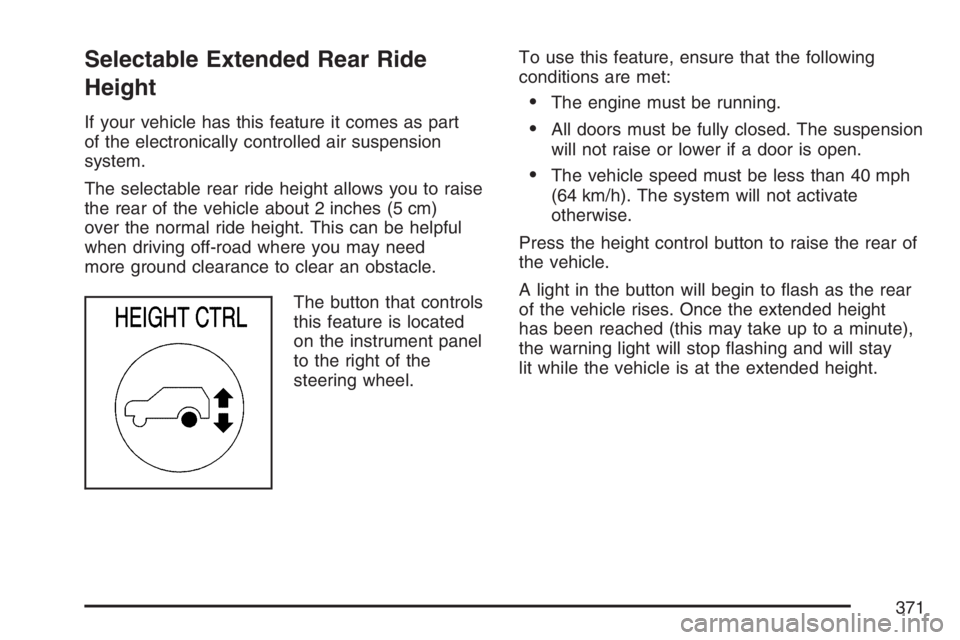
The button that controls
this feature is located
on the instrument panel
to the right of the
steering wheel.To use this feature, ensure that the following
conditions are met:
The engine must be running.
All doors must be fully closed. The suspension
will not raise or lower if a door is open.
The vehicle speed must be less than 40 mph
(64 km/h). The system will not activate
otherwise.
Press the height control button to raise the rear of
the vehicle.
A light in the button will begin to ash as the rear
of the vehicle rises. Once the extended height
has been reached (this may take up to a minute),
the warning light will stop ashing and will stay
lit while the vehicle is at the extended height.
371