light HUMMER H2 2008 Owners Manual
[x] Cancel search | Manufacturer: HUMMER, Model Year: 2008, Model line: H2, Model: HUMMER H2 2008Pages: 504, PDF Size: 7.12 MB
Page 321 of 504
Selectable Extended Rear
Ride Height
If your vehicle has this feature it comes as part of the
electronically controlled air suspension system.
The selectable rear ride height allows you to raise the
rear of the vehicle about 2 inches (5 cm) over the normal
ride height. This can be helpful when driving off-road
where you may need more ground clearance to clear
an obstacle.
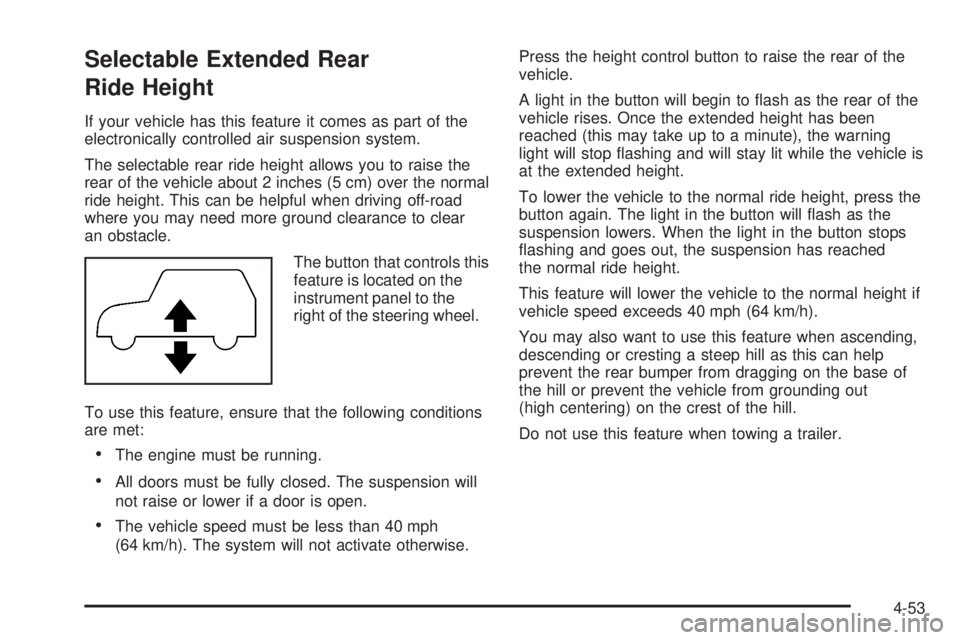
The button that controls this
feature is located on the
instrument panel to the
right of the steering wheel.
To use this feature, ensure that the following conditions
are met:
The engine must be running.
All doors must be fully closed. The suspension will
not raise or lower if a door is open.
The vehicle speed must be less than 40 mph
(64 km/h). The system will not activate otherwise.Press the height control button to raise the rear of the
vehicle.
A light in the button will begin to ash as the rear of the
vehicle rises. Once the extended height has been
reached (this may take up to a minute), the warning
light will stop ashing and will stay lit while the vehicle is
at the extended height.
To lower the vehicle to the normal ride height, press the
button again. The light in the button will ash as the
suspension lowers. When the light in the button stops
ashing and goes out, the suspension has reached
the normal ride height.
This feature will lower the vehicle to the normal height if
vehicle speed exceeds 40 mph (64 km/h).
You may also want to use this feature when ascending,
descending or cresting a steep hill as this can help
prevent the rear bumper from dragging on the base of
the hill or prevent the vehicle from grounding out
(high centering) on the crest of the hill.
Do not use this feature when towing a trailer.
4-53
Page 322 of 504
Electronically Controlled Air
Suspension System
The electronically controlled air suspension, if equipped,
keeps the rear of your vehicle level under all load
conditions. The system maintains the vehicle at the
currently selected ride height. There are two ride
heights: Normal Ride Height and Extended Ride Height.
The Extended Ride Height feature is only available if
the vehicle speed is below 40 mph (64 km/h). If the
vehicle is at Extended Ride Height and the speed
exceeds 40 mph (64 km/h), the system will automatically
return the vehicle to Normal Ride Height. The activation
and deactivation of the Extended Ride Height feature
is controlled by a switch on the instrument panel.
The system includes a compressor, two height sensors
and two air springs supporting the vehicle.
The system is activated when the engine is started and
deactivated when the ignition is returned to OFF.
The engine must be running for the rear of the vehicle
to be raised and the doors must be closed to enable
a transition between Normal Ride Height and Extended
Ride Height.
You may hear the compressor running whilst the system
is active and you may also hear the release of air
similar to a hissing sound. This is normal.Load leveling will not function normally with the
inater hose attached to the inator outlet. Remove
the hose from the outlet when it is not in use.
SeeAccessory Inflator on page 5-75.
Overload and Overheat Protection
Overload protection is designed to protect the air
suspension system and is an indication to the driver that
the vehicle is overloaded.
If the rear suspension remains at a low height, the rear
axle load has exceeded GAWR (Gross Axle Weight
Rating). When the overload protection mode is activated,
the compressor operates for about 30 seconds to
one minute without raising the vehicle depending on the
amount of overload. This will continue each time the
ignition is turned on until the rear axle load is reduced
below GAWR. The system may reactivate without
cycling the ignition if some of the excess load is
removed.
If the total rear GAWR (Gross Axle Weight Rating) is
reached, the suspension may be slightly less than level.
This is normal and does not mean there is a problem
with the air suspension.
4-54
Page 325 of 504
Tow/Haul mode is most effective when the vehicle and
trailer combined weight is at least 75 percent of the
vehicle’s Gross Combination Weight Rating (GCWR).
See “Weight of the Trailer” later in this section.
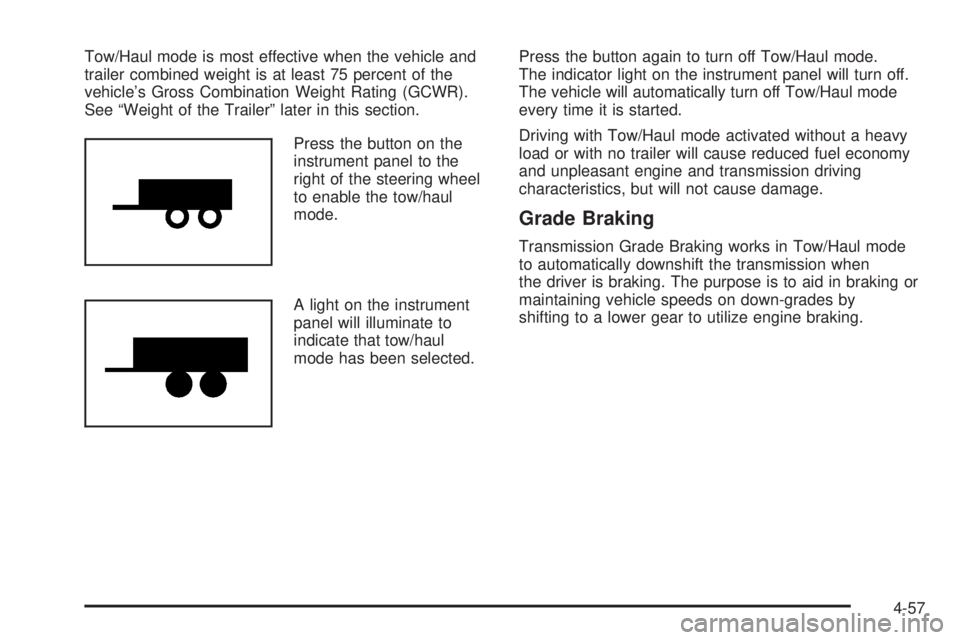
Press the button on the
instrument panel to the
right of the steering wheel
to enable the tow/haul
mode.
A light on the instrument
panel will illuminate to
indicate that tow/haul
mode has been selected.Press the button again to turn off Tow/Haul mode.
The indicator light on the instrument panel will turn off.
The vehicle will automatically turn off Tow/Haul mode
every time it is started.
Driving with Tow/Haul mode activated without a heavy
load or with no trailer will cause reduced fuel economy
and unpleasant engine and transmission driving
characteristics, but will not cause damage.
Grade Braking
Transmission Grade Braking works in Tow/Haul mode
to automatically downshift the transmission when
the driver is braking. The purpose is to aid in braking or
maintaining vehicle speeds on down-grades by
shifting to a lower gear to utilize engine braking.
4-57
Page 334 of 504
Trailer Wiring Harness
Heavy-Duty Trailer Wiring Harness
Package
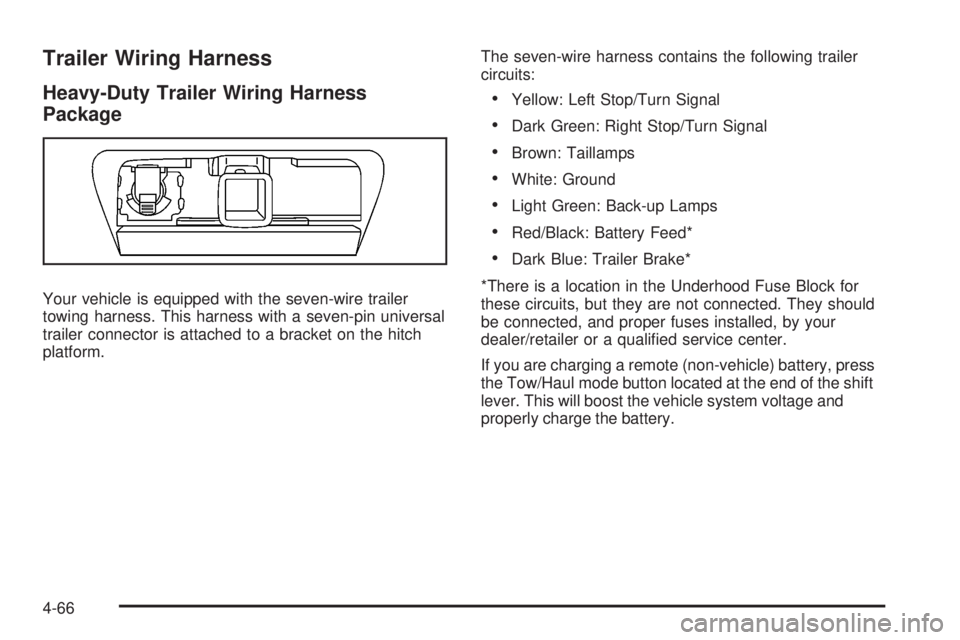
Your vehicle is equipped with the seven-wire trailer
towing harness. This harness with a seven-pin universal
trailer connector is attached to a bracket on the hitch
platform.The seven-wire harness contains the following trailer
circuits:
Yellow: Left Stop/Turn Signal
Dark Green: Right Stop/Turn Signal
Brown: Taillamps
White: Ground
Light Green: Back-up Lamps
Red/Black: Battery Feed*
Dark Blue: Trailer Brake*
*There is a location in the Underhood Fuse Block for
these circuits, but they are not connected. They should
be connected, and proper fuses installed, by your
dealer/retailer or a qualied service center.
If you are charging a remote (non-vehicle) battery, press
the Tow/Haul mode button located at the end of the shift
lever. This will boost the vehicle system voltage and
properly charge the battery.
4-66
Page 335 of 504
Electric Brake Control Wiring
Provisions
These wiring provisions are included with your vehicle
as part of the trailer wiring package. These provisions
are for an electric brake controller. The instrument panel
contains blunt cut wires near the data link connector
for the trailer brake controller. The harness contains the
following wires:
Dark Blue: Brake Signal to Trailer Connector
Red/Black: Battery
Light Blue/White: Brake Switch
White: Ground
It should be installed by your dealer/retailer or a
qualied service center.
Trailer Recommendations
You must subtract your hitch loads from the Cargo
Weight Rating (CWR). CWR is the maximum weight of
the load your vehicle can carry. It doesn’t include the
weight of the people inside, but you can gure about
150 lbs. (68 kg) for each seat. The total cargo load must
not be more than your vehicles CWR.
Weigh your vehicle with your trailer attached, so that
you won’t go over the GVWR or GAWR. If you are using
a weight-distributing hitch, weigh the vehicle without
the spring bars in place.
You’ll get the best performance if you spread out the
weight of your load the right way, and if you choose the
correct hitch and trailer brakes.
For more information seeTowing a Trailer on page 4-55.
4-67
Page 341 of 504
Fuel
Use of the recommended fuel is an important part of
the proper maintenance of your vehicle. To help keep
the engine clean and maintain optimum vehicle
performance, we recommend the use of gasoline
advertised as TOP TIER Detergent Gasoline.
Gasoline Octane
Use premium unleaded gasoline with a posted octane
rating of 91 or higher. You can also use regular
unleaded gasoline rated at 87 octane or higher, but
your vehicle’s acceleration could be slightly reduced,
and you might notice a slight audible knocking
noise, commonly referred to as spark knock. If the
octane is less than 87, you might notice a heavy
knocking noise when you drive. If this occurs, use a
gasoline rated at 87 octane or higher as soon as
possible. Otherwise, you could damage the engine.
If you are using gasoline rated at 87 octane or higher
and you hear heavy knocking, the engine needs service.
Gasoline Specications
At a minimum, gasoline should meet ASTM
specication D 4814 in the United States or
CAN/CGSB-3.5 or 3.511 in Canada. Some gasolines
contain an octane-enhancing additive called
methylcyclopentadienyl manganese tricarbonyl (MMT).
We recommend against the use of gasolines
containing MMT. SeeAdditives on page 5-6for
additional information.
California Fuel
If your vehicle is certied to meet California Emissions
Standards, it is designed to operate on fuels that
meet California specications. See the underhood
emission control label. If this fuel is not available
in states adopting California emissions standards,
your vehicle will operate satisfactorily on fuels meeting
federal specications, but emission control system
performance might be affected. The malfunction
indicator lamp could turn on and your vehicle might fail
a smog-check test. SeeMalfunction Indicator Lamp
on page 3-42. If this occurs, return to your authorized
dealer/retailer for diagnosis. If it is determined that
the condition is caused by the type of fuel used, repairs
might not be covered by your warranty.
5-5
Page 344 of 504
{CAUTION:
Fuel can spray out on you if you open the fuel
cap too quickly. If you spill fuel and then
something ignites it, you could be badly burned.
This spray can happen if your tank is nearly full,
and is more likely in hot weather. Open the fuel
cap slowly and wait for any hiss noise to stop.
Then unscrew the cap all the way.
Be careful not to spill fuel. Do not top off or overll the
tank and wait a few seconds after you have nished
pumping before removing the nozzle. Clean fuel
from painted surfaces as soon as possible.
SeeWashing Your Vehicle on page 5-103.
When replacing the fuel cap, turn it clockwise
until it clicks. Make sure the cap is fully installed.
The diagnostic system can determine if the fuel cap
has been left off or improperly installed. This would
allow fuel to evaporate into the atmosphere.
SeeMalfunction Indicator Lamp on page 3-42.The TIGHTEN GAS CAP message will be displayed on
the Driver Information Center (DIC) if the fuel cap is
not properly installed. SeeDIC Warnings and Messages
on page 3-56for more information.
{CAUTION:
If a re starts while you are refueling, do not
remove the nozzle. Shut off the ow of fuel by
shutting off the pump or by notifying the
station attendant. Leave the area immediately.
Notice:If you need a new fuel cap, be sure to get
the right type. Your dealer/retailer can get one
for you. If you get the wrong type, it may not t
properly. This may cause your malfunction indicator
lamp to light and may damage your fuel tank and
emissions system. SeeMalfunction Indicator Lamp
on page 3-42.
5-8
Page 355 of 504
How to Inspect the Engine
Air Cleaner/Filter
Vehicles With an Air Filter
Restriction Indicator
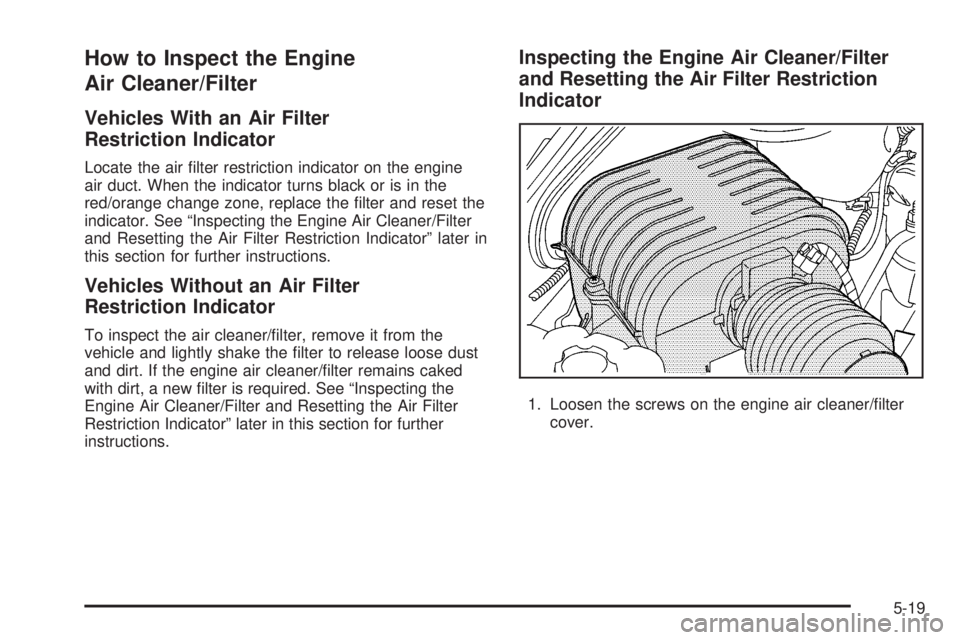
Locate the air lter restriction indicator on the engine
air duct. When the indicator turns black or is in the
red/orange change zone, replace the lter and reset the
indicator. See “Inspecting the Engine Air Cleaner/Filter
and Resetting the Air Filter Restriction Indicator” later in
this section for further instructions.
Vehicles Without an Air Filter
Restriction Indicator
To inspect the air cleaner/lter, remove it from the
vehicle and lightly shake the lter to release loose dust
and dirt. If the engine air cleaner/lter remains caked
with dirt, a new lter is required. See “Inspecting the
Engine Air Cleaner/Filter and Resetting the Air Filter
Restriction Indicator” later in this section for further
instructions.
Inspecting the Engine Air Cleaner/Filter
and Resetting the Air Filter Restriction
Indicator
1. Loosen the screws on the engine air cleaner/lter
cover.
5-19
Page 360 of 504
Consistency of Readings
Always check the uid level at least twice using the
procedures described. Consistency (repeatable
readings) is important to maintaining proper uid level.
If uid is added, it may take 15 minutes or longer to
obtain an accurate reading because of residual
uid draining down the dipstick tube. If inconsistent
readings persist, check the transmission breather to be
sure it is clean and not clogged. If readings are still
inconsistent, contact your dealer/retailer.
Engine Coolant
The cooling system in your vehicle is lled with
DEX-COOL®engine coolant. This coolant is designed
to remain in your vehicle for ve years or 150,000 miles
(240 000 km), whichever occurs rst, if you add only
DEX-COOL
®extended life coolant.
The following explains your cooling system and how to
add coolant when it is low. If you have a problem
with engine overheating, seeEngine Overheating on
page 5-27.A 50/50 mixture of clean, drinkable water and
DEX-COOL
®coolant will:
Give freezing protection down to−34°F (−37°C).
Give boiling protection up to 265°F (129°C).
Protect against rust and corrosion.
Help keep the proper engine temperature.
Let the warning lights and gages work as they
should.
Notice:Using coolant other than DEX-COOL
®may
cause premature engine, heater core, or radiator
corrosion. In addition, the engine coolant may
require changing sooner, at the rst maintenance
service after each 30,000 miles (50 000 km) or
24 months, whichever occurs rst. Any repairs
would not be covered by your warranty. Always use
DEX-COOL
®(silicate-free) coolant in your vehicle.
5-24
Page 374 of 504
Brake Wear
Your vehicle has disc brakes. Disc brake pads have
built-in wear indicators that make a high-pitched warning
sound when the brake pads are worn and new pads
are needed. The sound can come and go or be heard all
the time your vehicle is moving, except when you are
pushing on the brake pedal rmly.
{CAUTION:
The brake wear warning sound means that
soon the brakes will not work well. That could
lead to an accident. When you hear the brake
wear warning sound, have your vehicle
serviced.
Notice:Continuing to drive with worn-out brake
pads could result in costly brake repair.Some driving conditions or climates can cause a brake
squeal when the brakes are rst applied or lightly
applied. This does not mean something is wrong with
the brakes.
Properly torqued wheel nuts are necessary to help
prevent brake pulsation. When tires are rotated, inspect
brake pads for wear and evenly tighten wheel nuts in
the proper sequence to torque specications in
Capacities and Specifications on page 5-117.
Brake linings should always be replaced as complete
axle sets.Brake Pedal Travel
See your dealer/retailer if the brake pedal does not
return to normal height, or if there is a rapid increase in
pedal travel. This could be a sign that brake service
might be required.
Brake Adjustment
Every time you make a brake stop, the disc brakes
adjust for wear.
5-38