heating HUMMER H2 2008 User Guide
[x] Cancel search | Manufacturer: HUMMER, Model Year: 2008, Model line: H2, Model: HUMMER H2 2008Pages: 504, PDF Size: 7.12 MB
Page 212 of 504
TIGHTEN GAS CAP
This message may display along with the check engine
light on the instrument panel cluster if the vehicle’s
fuel cap is not tightened properly. SeeMalfunction
Indicator Lamp on page 3-42. Reinstall the fuel cap
fully. SeeFilling the Tank on page 5-7. The diagnostic
system can determine if the fuel cap has been left off
or improperly installed. A loose or missing fuel cap
allows fuel to evaporate into the atmosphere.
A few driving trips with the cap properly installed
should turn this light and message off.
TIRE LEARNING ACTIVE
This message displays when the Tire Pressure Monitor
System (TPMS) is re-learning the tire positions on your
vehicle. The tire positions must be re-learned after
rotating the tires or after replacing a tire or sensor. See
Tire Inspection and Rotation on page 5-67,Tire Pressure
Monitor System on page 5-62, andInflation - Tire
Pressure on page 5-61for more information.
TRACTION CONTROL OFF
This message displays when you turn off the Traction
Control System (TCS) or when the TCS has been
automatically disabled. Adjust your driving accordingly.
SeeTraction Control System (TCS) on page 4-5and
StabiliTrak
®System on page 4-7for more information.
TCS may be automatically disabled due to overheating,
which could occur if the TCS activates continuously
for an extended period of time.
TRANSMISSION HOT IDLE ENGINE
Notice:If you drive your vehicle while the
transmission uid is overheating and the
transmission temperature warning is displayed
on the instrument panel cluster and/or DIC, you
can damage the transmission. This could lead
to costly repairs that would not be covered by
your warranty. Do not drive your vehicle with
overheated transmission uid or while the
transmission temperature warning is displayed.
3-62
Page 332 of 504
Making Turns
Notice:Making very sharp turns while trailering
could cause the trailer to come in contact with the
vehicle. Your vehicle could be damaged. Avoid
making very sharp turns while trailering.
When you are turning with a trailer, make wider turns
than normal. Do this so your trailer will not strike
soft shoulders, curbs, road signs, trees or other objects.
Avoid jerky or sudden maneuvers. Signal well in
advance.
Turn Signals When Towing a Trailer
The arrows on your instrument panel will ash whenever
you signal a turn or lane change. Properly hooked up,
the trailer lamps will also ash, telling other drivers
you’re about to turn, change lanes or stop.
When towing a trailer, the arrows on your instrument
panel will ash for turns even if the bulbs on the trailer
are burned out. Thus, you may think drivers behind
you are seeing your signal when they are not. It is
important to check occasionally to be sure the trailer
bulbs are still working.
Driving On Grades
Reduce speed and shift to a lower gearbeforeyou start
down a long or steep downgrade. If you do not shift down,
you might have to use your brakes so much that they
would get hot and no longer work well.
You can tow in DRIVE (D). You may want to shift the
transmission to THIRD (3) or, if necessary, a lower gear
selection if the transmission shifts too often (e.g., under
heavy loads and/or hilly conditions).
You may also want to activate the tow/haul mode if the
transmission shifts too often. See “Tow/Haul Mode”
earlier.
When towing at high altitude on steep uphill grades,
consider the following: Engine coolant will boil at a lower
temperature than at normal altitudes. If you turn your
engine off immediately after towing at high altitude on
steep uphill grades, your vehicle may show signs similar
to engine overheating. To avoid this, let the engine run
while parked (preferably on level ground) with the
automatic transmission in PARK (P) for a few minutes
before turning the engine off. If you do get the overheat
warning, seeEngine Overheating on page 5-27.
4-64
Page 337 of 504
Service............................................................5-3
Accessories and Modications..........................5-3
California Proposition 65 Warning.....................5-3
California Perchlorate Materials Requirements.....5-4
Doing Your Own Service Work.........................5-4
Adding Equipment to the Outside of
Your Vehicle..............................................5-4
Fuel................................................................5-5
Gasoline Octane............................................5-5
Gasoline Specications....................................5-5
California Fuel...............................................5-5
Additives.......................................................5-6
Fuels in Foreign Countries...............................5-6
Filling the Tank..............................................5-7
Filling a Portable Fuel Container.......................5-9
Checking Things Under the Hood.....................5-9
Hood Release..............................................5-10
Engine Compartment Overview.......................5-12
Engine Oil...................................................5-13
Engine Oil Life System..................................5-16
Engine Air Cleaner/Filter................................5-18
Automatic Transmission Fluid.........................5-21
Engine Coolant.............................................5-24
Coolant Surge Tank Pressure Cap..................5-26
Engine Overheating.......................................5-27Overheated Engine Protection
Operating Mode.........................................5-28
Cooling System............................................5-29
Engine Fan Noise.........................................5-33
Power Steering Fluid.....................................5-34
Windshield Washer Fluid................................5-35
Brakes........................................................5-36
Battery........................................................5-39
Jump Starting...............................................5-40
Rear Axle.......................................................5-45
Four-Wheel Drive............................................5-46
Front Axle......................................................5-47
Bulb Replacement..........................................5-48
Halogen Bulbs..............................................5-48
Headlamps..................................................5-48
Front Turn Signal and Parking Lamps..............5-49
Daytime Running Lamps (DRL).......................5-50
Roof Marker Lamps......................................5-50
Taillamps, Turn Signal, Stoplamps and
Back-up Lamps.........................................5-51
Replacement Bulbs.......................................5-53
Windshield Wiper Blade Replacement..............5-54
Tires..............................................................5-55
Tire Sidewall Labeling...................................5-56
Tire Terminology and Denitions.....................5-58
Section 5 Service and Appearance Care
5-1
Page 357 of 504
Automatic Transmission Fluid
When to Check and Change Automatic
Transmission Fluid
It is usually not necessary to check the transmission
uid level. The only reason for uid loss is a
transmission leak or overheating the transmission. If you
suspect a small leak, then use the following checking
procedures to check the uid level. However, if there is
a large leak, then it may be necessary to have the
vehicle towed to a dealer/retailer service department and
have it repaired before driving the vehicle further.
Notice:Use of the incorrect automatic transmission
uid may damage your vehicle, and the damages
may not be covered by your warranty. Always
use the automatic transmission uid listed in
Recommended Fluids and Lubricants on page 6-12.
Change the uid and lter at the intervals listed in the
Maintenance Schedule. SeeScheduled Maintenance on
page 6-4. Be sure to use the transmission uid listed in
Recommended Fluids and Lubricants on page 6-12.
How to Check Automatic
Transmission Fluid
Notice:Too much or too little uid can damage
your transmission. Too much can mean that some
of the uid could come out and fall on hot engine
parts or exhaust system parts, starting a re.
Too little uid could cause the transmission to
overheat. Be sure to get an accurate reading if you
check your transmission uid.
Before checking the uid level, prepare your vehicle
as follows:
1. Start the engine and park your vehicle on a level
surface. Keep the engine running.
2. Apply the parking brake and place the shift lever
in PARK (P).
3. With your foot on the brake pedal, move the shift
lever through each gear range, pausing for about
three seconds in each range. Then, move the
shift lever back to PARK (P).
4. Allow the engine to idle (500 – 800 rpm) for at least
one minute. Slowly release the brake pedal.
5. Keep the engine running and press the Trip/Fuel
button or trip odometer reset stem until TRANS
TEMP (Transmission Temperature) displays on the
Driver Information Center (DIC).
5-21
Page 360 of 504
Consistency of Readings
Always check the uid level at least twice using the
procedures described. Consistency (repeatable
readings) is important to maintaining proper uid level.
If uid is added, it may take 15 minutes or longer to
obtain an accurate reading because of residual
uid draining down the dipstick tube. If inconsistent
readings persist, check the transmission breather to be
sure it is clean and not clogged. If readings are still
inconsistent, contact your dealer/retailer.
Engine Coolant
The cooling system in your vehicle is lled with
DEX-COOL®engine coolant. This coolant is designed
to remain in your vehicle for ve years or 150,000 miles
(240 000 km), whichever occurs rst, if you add only
DEX-COOL
®extended life coolant.
The following explains your cooling system and how to
add coolant when it is low. If you have a problem
with engine overheating, seeEngine Overheating on
page 5-27.A 50/50 mixture of clean, drinkable water and
DEX-COOL
®coolant will:
Give freezing protection down to−34°F (−37°C).
Give boiling protection up to 265°F (129°C).
Protect against rust and corrosion.
Help keep the proper engine temperature.
Let the warning lights and gages work as they
should.
Notice:Using coolant other than DEX-COOL
®may
cause premature engine, heater core, or radiator
corrosion. In addition, the engine coolant may
require changing sooner, at the rst maintenance
service after each 30,000 miles (50 000 km) or
24 months, whichever occurs rst. Any repairs
would not be covered by your warranty. Always use
DEX-COOL
®(silicate-free) coolant in your vehicle.
5-24
Page 363 of 504
Engine Overheating
You will nd a coolant temperature gage on your
vehicle’s instrument panel. SeeEngine Coolant
Temperature Gage on page 3-40.
In addition, you will nd an ENGINE OVERHEATED
IDLE ENGINE and an ENGINE POWER IS REDUCED
message in the Driver Information Center (DIC) on
the instrument panel. SeeDIC Warnings and Messages
on page 3-56.
If Steam Is Coming From Your Engine
{CAUTION:
Steam from an overheated engine can burn
you badly, even if you just open the hood.
Stay away from the engine if you see or hear
steam coming from it. Turn it off and get
everyone away from the vehicle until it cools
down. Wait until there is no sign of steam or
coolant before you open the hood.
CAUTION: (Continued)
CAUTION: (Continued)
If you keep driving when the vehicles engine
is overheated, the liquids in it can catch re.
You or others could be badly burned. Stop
your engine if it overheats, and get out of the
vehicle until the engine is cool.
SeeOverheated Engine Protection Operating
Mode on page 5-28for information on driving
to a safe place in an emergency.
Notice:If your engine catches re because you
keep driving with no coolant, your vehicle can
be badly damaged. The costly repairs would not
be covered by your warranty. SeeOverheated
Engine Protection Operating Mode on page 5-28
for information on driving to a safe place in an
emergency.
5-27
Page 365 of 504
Cooling System
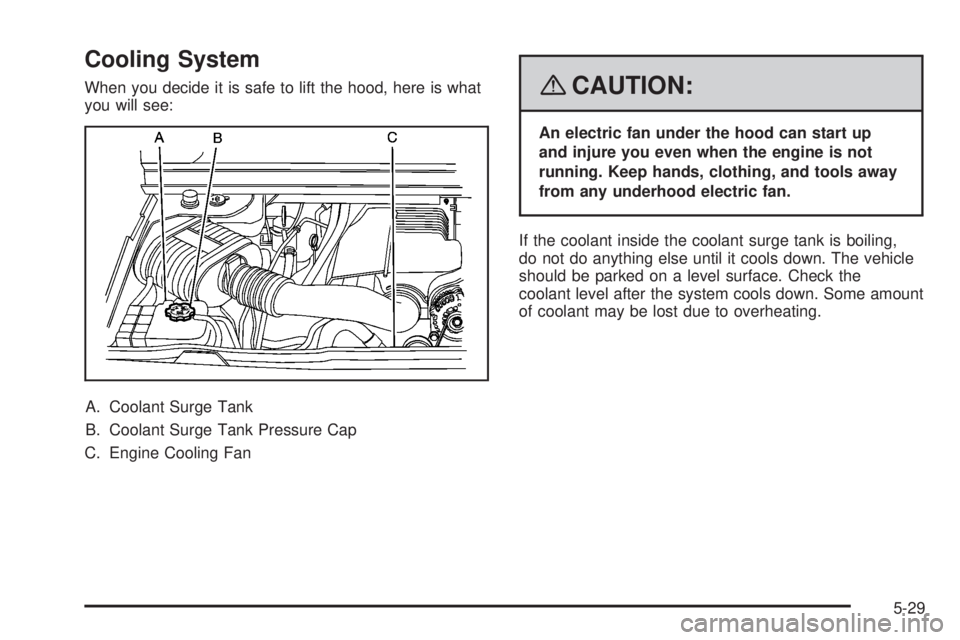
When you decide it is safe to lift the hood, here is what
you will see:
A. Coolant Surge Tank
B. Coolant Surge Tank Pressure Cap
C. Engine Cooling Fan{CAUTION:
An electric fan under the hood can start up
and injure you even when the engine is not
running. Keep hands, clothing, and tools away
from any underhood electric fan.
If the coolant inside the coolant surge tank is boiling,
do not do anything else until it cools down. The vehicle
should be parked on a level surface. Check the
coolant level after the system cools down. Some amount
of coolant may be lost due to overheating.
5-29
Page 391 of 504
Tires
Your new vehicle comes with high-quality tires
made by a leading tire manufacturer. If you ever
have questions about your tire warranty and where
to obtain service, see your vehicle Warranty
booklet for details.
{CAUTION:
Poorly maintained and improperly used
tires are dangerous.
Overloading your vehicle’s tires can
cause overheating as a result of too
much exing. You could have an
air-out and a serious accident. See
Loading Your Vehicle on page 4-44.
CAUTION: (Continued)
CAUTION: (Continued)
Underinated tires pose the same
danger as overloaded tires. The
resulting accident could cause serious
injury. Check all tires frequently to
maintain the recommended pressure.
Tire pressure should be checked when
your vehicle’s tires are cold. See
Inflation - Tire Pressure on page 5-61.
Overinated tires are more likely to be
cut, punctured, or broken by a sudden
impact — such as when you hit a
pothole. Keep tires at the
recommended pressure.
Worn, old tires can cause accidents.
If the tire’s tread is badly worn, or if
your vehicle’s tires have been
damaged, replace them.
5-55
Page 493 of 504

Child Restraints
Child Restraint Systems...............................1-43
Infants and Young Children...........................1-39
Lower Anchors and Tethers for Children..........1-47
Older Children.............................................1-36
Securing a Child Restraint in a
Rear Seat Position...................................1-57
Securing a Child Restraint in the
Right Front Seat Position..........................1-60
Where to Put the Restraint...........................1-46
Cigarette Lighter.............................................3-21
Cleaning
Aluminum Wheels......................................5-106
Exterior Lamps/Lenses................................5-104
Fabric/Carpet............................................5-101
Finish Care...............................................5-104
Instrument Panel, Vinyl, and Other
Plastic Surfaces.....................................5-102
Interior.....................................................5-100
Leather....................................................5-102
Speaker Covers.........................................5-103
Tires........................................................5-106
Underbody Maintenance.............................5-107
Washing Your Vehicle.................................5-103
Weatherstrips............................................5-103
Windshield, Backglass, and Wiper Blades......5-105
Wood Panels............................................5-103Climate Control System
Dual Automatic............................................3-22
Outlet Adjustment........................................3-29
Rear Air Conditioning and Heating System,
Electronic................................................3-29
Clock............................................................3-21
Clock, Setting.................................................3-73
Collision Damage Repair..................................7-10
Compass.......................................................2-45
Content Theft-Deterrent....................................2-24
Control of a Vehicle.......................................... 4-3
Coolant
Engine Temperature Gage
............................3-40
Heater, Engine............................................2-31
Surge Tank Pressure Cap.............................5-26
Cooling System..............................................5-29
Cruise Control................................................3-12
Cruise Control Light........................................3-46
Cupholder(s)..................................................2-64
Customer Assistance Information
Courtesy Transportation.................................. 7-9
Customer Assistance for
Text Telephone (TTY) Users........................ 7-4
Customer Assistance Offices........................... 7-5
Customer Satisfaction Procedure..................... 7-2
GM Mobility Reimbursement Program............... 7-6
Reporting Safety Defects to General Motors....7-14
3
Page 495 of 504
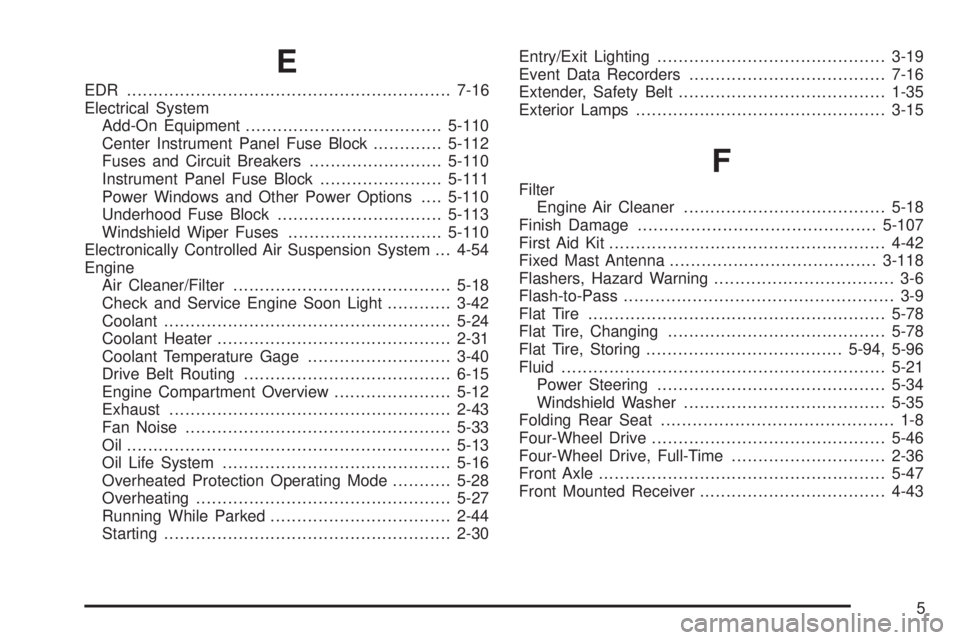
E
EDR .............................................................7-16
Electrical System
Add-On Equipment.....................................5-110
Center Instrument Panel Fuse Block.............5-112
Fuses and Circuit Breakers.........................5-110
Instrument Panel Fuse Block.......................5-111
Power Windows and Other Power Options....5-110
Underhood Fuse Block...............................5-113
Windshield Wiper Fuses.............................5-110
Electronically Controlled Air Suspension System . . . 4-54
Engine
Air Cleaner/Filter.........................................5-18
Check and Service Engine Soon Light............3-42
Coolant......................................................5-24
Coolant Heater............................................2-31
Coolant Temperature Gage...........................3-40
Drive Belt Routing.......................................6-15
Engine Compartment Overview......................5-12
Exhaust.....................................................2-43
Fan Noise..................................................5-33
Oil .............................................................5-13
Oil Life System...........................................5-16
Overheated Protection Operating Mode...........5-28
Overheating................................................5-27
Running While Parked..................................2-44
Starting......................................................2-30Entry/Exit Lighting...........................................3-19
Event Data Recorders.....................................7-16
Extender, Safety Belt.......................................1-35
Exterior Lamps...............................................3-15
F
Filter
Engine Air Cleaner......................................5-18
Finish Damage.............................................5-107
First Aid Kit....................................................4-42
Fixed Mast Antenna.......................................3-118
Flashers, Hazard Warning.................................. 3-6
Flash-to-Pass................................................... 3-9
Flat Tire........................................................5-78
Flat Tire, Changing.........................................5-78
Flat Tire, Storing.....................................5-94, 5-96
Fluid.............................................................5-21
Power Steering...........................................5-34
Windshield Washer......................................5-35
Folding Rear Seat............................................ 1-8
Four-Wheel Drive............................................5-46
Four-Wheel Drive, Full-Time.............................2-36
Front Axle......................................................5-47
Front Mounted Receiver...................................4-43
5