instrument panel HUMMER H2 2008 User Guide
[x] Cancel search | Manufacturer: HUMMER, Model Year: 2008, Model line: H2, Model: HUMMER H2 2008Pages: 504, PDF Size: 7.12 MB
Page 104 of 504
Midgate Window
K(Midgate Window):On vehicles with a Midgate,
the switch to operate the window is located on the
instrument panel to the left of the steering wheel.
SeeInstrument Panel Overview on page 3-4.
ª:Press to express-down the window.
y:Press to express-up the window.
Press the top or bottom of the switch a second time to
stop the window
The window switch will operate while the ignition is in
ON/RUN or ACC/ACCESSORY, or while Retained
Accessory Power (RAP) is active. SeeRetained
Accessory Power (RAP) on page 2-29.
The window can also be operated using the global
window buttons. See “Global Window Feature”
previously.
{CAUTION:
If express override is activated, the midgate
window will not reverse automatically. You or
others could be injured and the window could
be damaged. Before you use express override,
make sure that all people and obstructions are
clear of the midgate window path.
Midgate Window Express Override Mode
If an obstruction or weather condition such as severe
icing stops the window as it is moving upward, the
window will automatically reverse to a partially open
position. The window will return to normal operation
once the obstruction or condition is removed.
2-22
Page 106 of 504

Theft-Deterrent Systems
Vehicle theft is big business, especially in some cities.
Although your vehicle has a number of theft-deterrent
features, we know that nothing we put on it can make it
impossible to steal.
Content Theft-Deterrent
Your vehicle is equipped with a content theft-deterrent
alarm system.
With this system, the
security light in the
instrument panel cluster
will ash as you open
the door if your ignition
is off.
This light reminds you to activate the theft-deterrent
system.To activate the theft-deterrent system:
1. Open the door.
2. Lock the door with the Remote Keyless Entry (RKE)
transmitter. The security light will illuminate to
inform the driver the system is arming. If a door is
open when the doors are locked, the security
light will ash.
3. Close all doors. The security light should go off
after about 30 seconds. The alarm is not armed
until the security light goes off.
If the delayed locking feature is turned on, the
theft-deterrent system will not start the arming
process until the last door is closed and the delay
timer has expired. SeeDelayed Locking on
page 2-11.
If a locked door is opened without the RKE transmitter,
the alarm will go off. The headlamps and parking
lamps will ash and the horn will sound for 30 seconds,
then will turn off to save the battery power.
2-24
Page 107 of 504
Remember, the theft-deterrent system will not activate if
you lock the doors with the vehicle’s key or use the
manual door lock. It activates only if you use a power
door lock switch with the door open, or with the
RKE transmitter. You should also remember that you
can start your vehicle with the correct ignition key if the
alarm has been set off.
Here is how to avoid setting off the alarm by accident:
If you do not want to activate the theft-deterrent
system, the vehicle should be locked with the
door keyafterthe doors are closed.
Always unlock a door with the RKE transmitter.
Unlocking a door any other way will set off the
alarm.
If you set off the alarm by accident, press unlock on the
RKE transmitter or place the key in the ignition and
turn it to START to turn it off. The alarm will not stop
if you try to unlock a door any other way.
Testing the Alarm
To test the alarm:
1. From inside the vehicle, lower the driver’s window
and open the driver’s door.
2. Activate the system by locking the doors with the
power door lock switch while the door is open, or
with the RKE transmitter.
3. Get out of the vehicle, close the door and wait for
the security light to go out.
4. Then reach in through the window, unlock the
door with the manual door lock and open the
door. This should set off the alarm.
While the alarm is set, the power door unlock switch is
not operational.
If the alarm does not sound when it should but the
headlamps ash, check to see if the horn works.
The horn fuse may be blown. To replace the fuse,
seeInstrument Panel Fuse Block on page 5-111and
Underhood Fuse Block on page 5-113.
If the alarm does not sound or the headlamps do not
ash, the vehicle should be serviced by your
dealer/retailer.
2-25
Page 108 of 504

PASS-Key®III+
The PASS-Key®III+ system operates on a radio
frequency subject to Federal Communications
Commission (FCC) Rules and with Industry Canada.
This device complies with Part 15 of the FCC Rules.
Operation is subject to the following two conditions:
1. This device may not cause harmful interference.
2. This device must accept any interference received,
including interference that may cause undesired
operation.
This device complies with RSS-210 of Industry Canada.
Operation is subject to the following two conditions:
1. This device may not cause interference.
2. This device must accept any interference received,
including interference that may cause undesired
operation of the device.
Changes or modications to this system by other than
an authorized service facility could void authorization to
use this equipment.
PASS-Key
®III+ uses a radio frequency transponder in
the key that matches a decoder in your vehicle.
PASS-Key®III+ Operation
Your vehicle has PASS-Key®III+ (Personalized
Automotive Security System) theft-deterrent system.
PASS-Key
®III+ is a passive theft-deterrent system.
The system is automatically armed when the key
is removed from the ignition.
The system is automatically disarmed when the key is
turned to ON/RUN, ACC/ACCESSORY or START
from the LOCK/OFF position.
You do not have to manually arm or disarm the system.
The security light will come on if there is a problem
with arming or disarming the theft-deterrent system.
When the PASS-Key
®III+ system senses that someone
is using the wrong key, it prevents the vehicle from
starting. Anyone using a trial-and-error method to start
the vehicle will be discouraged because of the high
number of electrical key codes.
If the engine does not start and the security light on the
instrument panel cluster comes on when trying to
start the vehicle, there may be a problem with your
theft-deterrent system. Turn the ignition off and try again.
2-26
Page 114 of 504
Automatic Transmission Operation
Your vehicle has a Hydra-Matic®6L80 automatic
transmission, and has an electronic shift position
indicator within the instrument panel cluster. This display
comes on when the ignition key is turned to the
ON/RUN position.
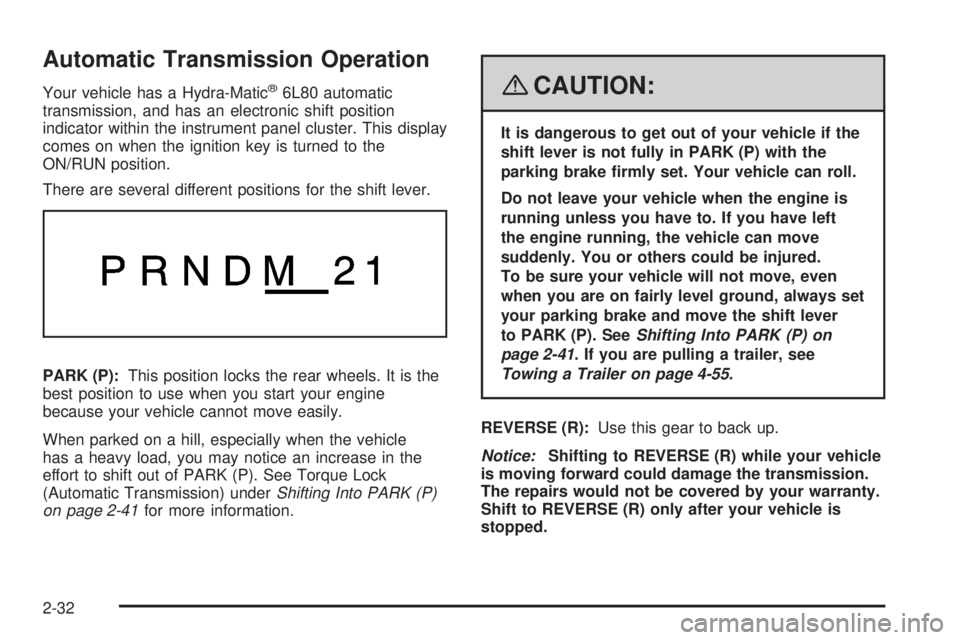
There are several different positions for the shift lever.
PARK (P):This position locks the rear wheels. It is the
best position to use when you start your engine
because your vehicle cannot move easily.
When parked on a hill, especially when the vehicle
has a heavy load, you may notice an increase in the
effort to shift out of PARK (P). See Torque Lock
(Automatic Transmission) underShifting Into PARK (P)
on page 2-41for more information.{CAUTION:
It is dangerous to get out of your vehicle if the
shift lever is not fully in PARK (P) with the
parking brake rmly set. Your vehicle can roll.
Do not leave your vehicle when the engine is
running unless you have to. If you have left
the engine running, the vehicle can move
suddenly. You or others could be injured.
To be sure your vehicle will not move, even
when you are on fairly level ground, always set
your parking brake and move the shift lever
to PARK (P). SeeShifting Into PARK (P) on
page 2-41. If you are pulling a trailer, see
Towing a Trailer on page 4-55.
REVERSE (R):Use this gear to back up.
Notice:Shifting to REVERSE (R) while your vehicle
is moving forward could damage the transmission.
The repairs would not be covered by your warranty.
Shift to REVERSE (R) only after your vehicle is
stopped.
2-32
Page 118 of 504
Tow/Haul Mode
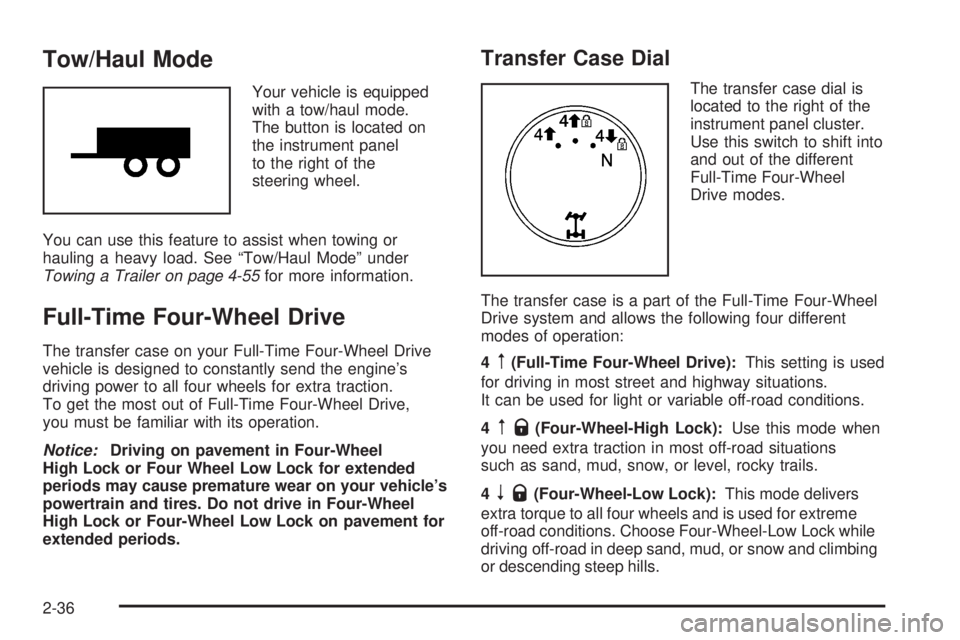
Your vehicle is equipped
with a tow/haul mode.
The button is located on
the instrument panel
to the right of the
steering wheel.
You can use this feature to assist when towing or
hauling a heavy load. See “Tow/Haul Mode” under
Towing a Trailer on page 4-55for more information.
Full-Time Four-Wheel Drive
The transfer case on your Full-Time Four-Wheel Drive
vehicle is designed to constantly send the engine’s
driving power to all four wheels for extra traction.
To get the most out of Full-Time Four-Wheel Drive,
you must be familiar with its operation.
Notice:Driving on pavement in Four-Wheel
High Lock or Four Wheel Low Lock for extended
periods may cause premature wear on your vehicle’s
powertrain and tires. Do not drive in Four-Wheel
High Lock or Four-Wheel Low Lock on pavement for
extended periods.
Transfer Case Dial
The transfer case dial is
located to the right of the
instrument panel cluster.
Use this switch to shift into
and out of the different
Full-Time Four-Wheel
Drive modes.
The transfer case is a part of the Full-Time Four-Wheel
Drive system and allows the following four different
modes of operation:
4
m(Full-Time Four-Wheel Drive):This setting is used
for driving in most street and highway situations.
It can be used for light or variable off-road conditions.
4
mQ(Four-Wheel-High Lock):Use this mode when
you need extra traction in most off-road situations
such as sand, mud, snow, or level, rocky trails.
4
nQ(Four-Wheel-Low Lock):This mode delivers
extra torque to all four wheels and is used for extreme
off-road conditions. Choose Four-Wheel-Low Lock while
driving off-road in deep sand, mud, or snow and climbing
or descending steep hills.
2-36
Page 151 of 504
Instrument Panel Overview...............................3-4
Hazard Warning Flashers................................3-6
Other Warning Devices...................................3-6
Horn.............................................................3-6
Tilt Wheel.....................................................3-6
Turn Signal/Multifunction Lever.........................3-7
Turn and Lane-Change Signals........................3-8
Headlamp High/Low-Beam Changer..................3-8
Flash-to-Pass.................................................3-9
Windshield Wipers..........................................3-9
Windshield Washer.......................................3-10
Rear Window Wiper/Washer...........................3-11
Cruise Control..............................................3-12
Exterior Lamps.............................................3-15
Headlamps on Reminder................................3-17
Daytime Running Lamps (DRL).......................3-17
Automatic Headlamp System..........................3-18
Instrument Panel Brightness...........................3-18
Dome Lamps...............................................3-19
Dome Lamp Override....................................3-19
Entry/Exit Lighting.........................................3-19
Reading Lamps............................................3-19
Battery Run-Down Protection..........................3-19
Accessory Power Outlet(s).............................3-20
Ashtray(s) and Cigarette Lighter......................3-21
Analog Clock...............................................3-21Climate Controls............................................3-22
Dual Automatic Climate Control System...........3-22
Outlet Adjustment.........................................3-29
Rear Air Conditioning and Heating System
and Electronic Climate Controls...................3-29
Warning Lights, Gages, and Indicators............3-31
Instrument Panel Cluster................................3-32
Speedometer and Odometer...........................3-33
Trip Odometer
..............................................3-33
Tachometer.................................................3-33
Safety Belt Reminders...................................3-33
Airbag Readiness Light..................................3-34
Airbag Off Light............................................3-35
Charging System Light..................................3-37
Voltmeter Gage............................................3-37
Brake System Warning Light..........................3-38
Antilock Brake System Warning Light...............3-39
StabiliTrak
®Indicator Light..............................3-40
Engine Coolant Temperature Gage..................3-40
Tire Pressure Light.......................................3-41
Malfunction Indicator Lamp.............................3-42
Oil Pressure Gage........................................3-45
Oil Pressure Light.........................................3-46
Security Light...............................................3-46
Cruise Control Light......................................3-46
Section 3 Instrument Panel
3-1
Page 152 of 504
Highbeam On Light.......................................3-47
Tow/Haul Mode Light....................................3-47
Fuel Gage...................................................3-47
Low Fuel Warning Light.................................3-48
Driver Information Center (DIC).......................3-49
DIC Operation and Displays
(Using DIC Buttons)...................................3-49
DIC Operation and Displays
(Using Trip Odometer Reset Stem)..............3-54
DIC Warnings and Messages.........................3-56
DIC Vehicle Customization (With DIC Buttons) . . .3-63
Audio System(s).............................................3-72
Setting the Clock..........................................3-73
Radio(s) (MP3).............................................3-75Using an MP3 (Radio with Six-Disc Player)......3-94
Using an MP3 (Radio with CD and
DVD Player).............................................3-98
XM Radio Messages...................................3-103
Navigation/Radio System..............................3-104
Rear Seat Entertainment (RSE) System.........3-105
Rear Seat Audio (RSA)................................3-114
Theft-Deterrent Feature................................3-116
Audio Steering Wheel Controls......................3-116
Radio Reception.........................................3-117
Fixed Mast Antenna....................................3-118
XM™ Satellite Radio Antenna System............3-118
Section 3 Instrument Panel
3-2
Page 154 of 504
Instrument Panel Overview
3-4
Page 155 of 504
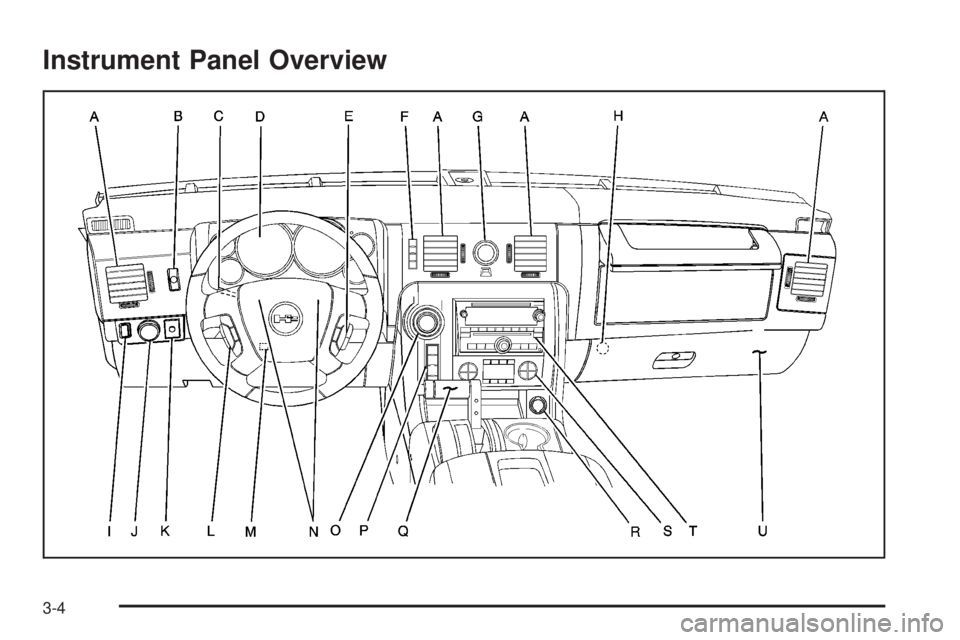
The main components of the instrument panel are the following:
A. Air Outlets. SeeOutlet Adjustment on page 3-29.
B. Midgate Window Switch (SUT). SeePower Windows
on page 2-20. Rear Wiper/Washer Switch (SUV).
SeeRear Window Wiper/Washer on page 3-11.
C. Turn Signal/Multifunction Lever. SeeTurn
Signal/Multifunction Lever on page 3-7.
D. Instrument Panel Cluster. SeeInstrument Panel
Cluster on page 3-32.
E. Audio Steering Wheel Buttons. SeeAudio Steering
Wheel Controls on page 3-116.
F. Driver Information Center (DIC) Buttons. SeeDriver
Information Center (DIC) on page 3-49.
G. Analog Clock.Analog Clock on page 3-21.
H. Airbag Switch. SeeAirbag Off Switch on page 1-72.
I. Global Window Switch. SeePower Windows
on page 2-20.
J. Exterior Lamps Control. SeeExterior Lamps
on page 3-15.
K. Dome Lamp Override Button. SeeDome Lamp
Override on page 3-19Instrument Panel Brightness
Control. SeeInstrument Panel Brightness on
page 3-18. Heated Windshield Washer Control
(If Equipped). SeeWindshield Washer on page 3-10.L. Cruise Control Buttons. SeeCruise Control
on page 3-12.
M. Tilt Lever. SeeTilt Wheel on page 3-6.
N. Horn. SeeHorn on page 3-6.
O. Full-Time Four-Wheel Drive Buttons. SeeFull-Time
Four-Wheel Drive on page 2-36.
P. Locking Rear Axle. SeeLocking Rear Axle on
page 4-6. Tow/Haul Selector Button. SeeTow/Haul
Mode on page 2-36. Traction Control (TCS) Button.
SeeTraction Control System (TCS) on page 4-5.
Ride Height Selector Button (If Equipped). See
Selectable Extended Rear Ride Height on page 4-53.
Q. Shift Lever. SeeAutomatic Transmission Operation
on page 2-32.
R. Accessory Power Outlet. SeeAccessory Power
Outlet(s) on page 3-20.
S. Climate Control System. SeeDual Automatic
Climate Control System on page 3-22.
T. Audio System. SeeAudio System(s) on page 3-72.
U. Glove Box. SeeGlove Box on page 2-64.
3-5