trailer HUMMER H2 2008 User Guide
[x] Cancel search | Manufacturer: HUMMER, Model Year: 2008, Model line: H2, Model: HUMMER H2 2008Pages: 504, PDF Size: 7.12 MB
Page 269 of 504
Your Driving, the Road, and Your Vehicle..........4-2
Defensive Driving...........................................4-2
Drunk Driving.................................................4-2
Control of a Vehicle........................................4-3
Braking.........................................................4-3
Antilock Brake System (ABS)...........................4-4
Braking in Emergencies...................................4-5
Traction Control System (TCS).........................4-5
Locking Rear Axle..........................................4-6
StabiliTrak
®System........................................4-7
Steering........................................................4-9
Off-Road Recovery.......................................4-11
Passing.......................................................4-12
Loss of Control.............................................4-12
Off-Road Driving...........................................4-13
Assist Steps.................................................4-32
Driving at Night............................................4-32
Driving in Rain and on Wet Roads..................4-33
Before Leaving on a Long Trip.......................4-34
Highway Hypnosis........................................4-34Hill and Mountain Roads................................4-35
Winter Driving..............................................4-36
If Your Vehicle is Stuck in Sand, Mud,
Ice, or Snow.............................................4-39
Rocking Your Vehicle to Get It Out.................4-40
Recovery Loops...........................................4-40
First Aid Kit and Tool Kit...............................4-42
Front Mounted Receiver.................................4-43
Power Winch Platform...................................4-43
Loading Your Vehicle....................................4-44
Towing..........................................................4-51
Towing Your Vehicle.....................................4-51
Recreational Vehicle Towing...........................4-51
Selectable Extended Rear Ride Height.............4-53
Electronically Controlled Air Suspension
System....................................................4-54
Towing a Trailer...........................................4-55
Trailer Recommendations...............................4-67
Section 4 Driving Your Vehicle
4-1
Page 311 of 504
Front Mounted Receiver
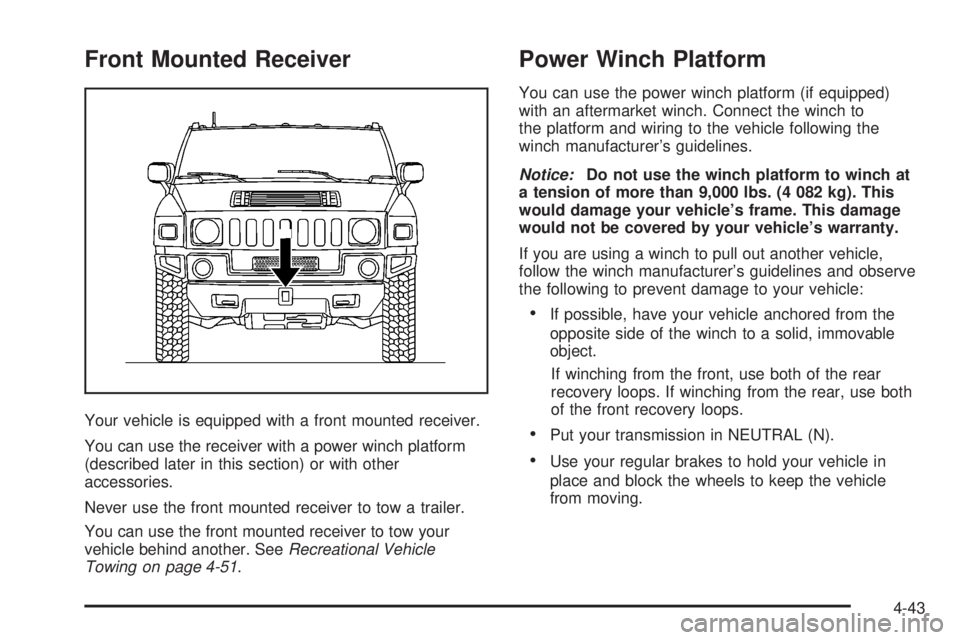
Your vehicle is equipped with a front mounted receiver.
You can use the receiver with a power winch platform
(described later in this section) or with other
accessories.
Never use the front mounted receiver to tow a trailer.
You can use the front mounted receiver to tow your
vehicle behind another. SeeRecreational Vehicle
Towing on page 4-51.
Power Winch Platform
You can use the power winch platform (if equipped)
with an aftermarket winch. Connect the winch to
the platform and wiring to the vehicle following the
winch manufacturer’s guidelines.
Notice:Do not use the winch platform to winch at
a tension of more than 9,000 lbs. (4 082 kg). This
would damage your vehicle’s frame. This damage
would not be covered by your vehicle’s warranty.
If you are using a winch to pull out another vehicle,
follow the winch manufacturer’s guidelines and observe
the following to prevent damage to your vehicle:
If possible, have your vehicle anchored from the
opposite side of the winch to a solid, immovable
object.
If winching from the front, use both of the rear
recovery loops. If winching from the rear, use both
of the front recovery loops.
Put your transmission in NEUTRAL (N).
Use your regular brakes to hold your vehicle in
place and block the wheels to keep the vehicle
from moving.
4-43
Page 314 of 504
Steps for Determining Correct Load Limit
1.Locate the statement “The combined weight
of occupants and cargo should never
exceed XXX kg or XXX lbs” on your vehicle’s
placard.
2.Determine the combined weight of the driver
and passengers that will be riding in your
vehicle.
3.Subtract the combined weight of the driver
and passengers from XXX kg or XXX lbs.
4.The resulting gure equals the available
amount of cargo and luggage load capacity.
For example, if the “XXX” amount equals
1400 lbs and there will be ve 150 lb
passengers in your vehicle, the amount of
available cargo and luggage load capacity is
650 lbs (1400−750 (5 x 150) = 650 lbs).
5.Determine the combined weight of luggage
and cargo being loaded on the vehicle.
That weight may not safely exceed the
available cargo and luggage load capacity
calculated in Step 4.
6.If your vehicle will be towing a trailer, the load
from your trailer will be transferred to your
vehicle. Consult this manual to determine how
this reduces the available cargo and luggage
load capacity of your vehicle.
SeeTowing a Trailer on page 4-55for important
information on towing a trailer, towing safety
rules and trailering tips.
4-46
Page 319 of 504
Towing
Towing Your Vehicle
Consult your dealer/retailer or a professional towing
service if you need to have your disabled vehicle towed.
SeeRoadside Assistance Program on page 7-6.
If you want to tow your vehicle behind another vehicle
for recreational purposes (such as behind a motorhome),
see “Recreational Vehicle Towing” following.
Recreational Vehicle Towing
Recreational vehicle towing means towing your vehicle
behind another vehicle – such as behind a motorhome.
The two most common types of recreational vehicle
towing are known as “dinghy towing” (towing your
vehicle with all four wheels on the ground) and “dolly
towing” (towing your vehicle with two wheels on
the ground and two wheels up on a device known as
a “dolly”).With the proper preparation and equipment, many
vehicles can be towed in these ways. See “Dinghy
Towing” and “Dolly Towing,” following.
Here are some important things to consider before you
do recreational vehicle towing:
What’s the towing capacity of the towing vehicle?
Be sure you read the tow vehicle manufacturer’s
recommendations.
How far will you tow? Some vehicles have
restrictions on how far and how long they can tow.
Do you have the proper towing equipment?
See your dealer or trailering professional for
additional advice and equipment recommendations.
Is your vehicle ready to be towed? Just as you
would prepare your vehicle for a long trip, you’ll
want to make sure your vehicle is prepared to be
towed. SeeBefore Leaving on a Long Trip on
page 4-34.
4-51
Page 321 of 504
Selectable Extended Rear
Ride Height
If your vehicle has this feature it comes as part of the
electronically controlled air suspension system.
The selectable rear ride height allows you to raise the
rear of the vehicle about 2 inches (5 cm) over the normal
ride height. This can be helpful when driving off-road
where you may need more ground clearance to clear
an obstacle.
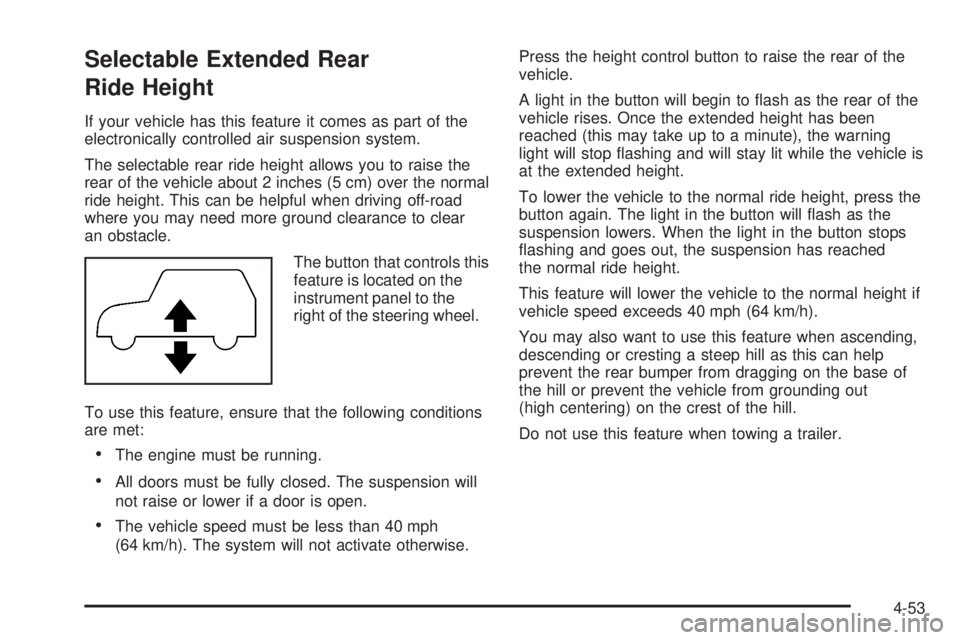
The button that controls this
feature is located on the
instrument panel to the
right of the steering wheel.
To use this feature, ensure that the following conditions
are met:
The engine must be running.
All doors must be fully closed. The suspension will
not raise or lower if a door is open.
The vehicle speed must be less than 40 mph
(64 km/h). The system will not activate otherwise.Press the height control button to raise the rear of the
vehicle.
A light in the button will begin to ash as the rear of the
vehicle rises. Once the extended height has been
reached (this may take up to a minute), the warning
light will stop ashing and will stay lit while the vehicle is
at the extended height.
To lower the vehicle to the normal ride height, press the
button again. The light in the button will ash as the
suspension lowers. When the light in the button stops
ashing and goes out, the suspension has reached
the normal ride height.
This feature will lower the vehicle to the normal height if
vehicle speed exceeds 40 mph (64 km/h).
You may also want to use this feature when ascending,
descending or cresting a steep hill as this can help
prevent the rear bumper from dragging on the base of
the hill or prevent the vehicle from grounding out
(high centering) on the crest of the hill.
Do not use this feature when towing a trailer.
4-53
Page 323 of 504
In some instances the compressor may stop working
due to being overheated. This is normal. In the instance
of an abnormal overheat condition though the
compressor will stop working and the SERVICE
SUSPENSION SYSTEM will be displayed on the DIC.
SeeDIC Warnings and Messages on page 3-56for
more information.
Towing a Trailer
{CAUTION:
If you do not use the correct equipment and
drive properly, you can lose control when you
pull a trailer. For example, if the trailer is too
heavy, the brakes may not work well — or even
at all. You and your passengers could be
seriously injured. Pull a trailer only if you have
followed all the steps in this section. Ask your
dealer for advice and information about towing
a trailer with your vehicle.Notice:Pulling a trailer improperly can damage
your vehicle and result in costly repairs not covered
by your warranty. To pull a trailer correctly, follow
the advice in this part, and see your dealer for
important information about towing a trailer with
your vehicle.
To identify the trailering capacity of your vehicle, you
should read the information in “Weight of the Trailer” that
appears later in this section.
Trailering is different than just driving your vehicle by
itself. Trailering means changes in handling,
acceleration, braking, durability and fuel economy.
Successful, safe trailering takes correct equipment, and
it has to be used properly.
That is the reason for this part. In it are many
time-tested, important trailering tips and safety rules.
Many of these are important for your safety and that of
your passengers. So please read this section carefully
before you pull a trailer.
4-55
Page 324 of 504
If You Do Decide To Pull A Trailer
If you do, here are some important points:
There are many different laws, including speed limit
restrictions, having to do with trailering. Make sure
your rig will be legal, not only where you live
but also where you’ll be driving. A good source for
this information can be state or provincial police.
Consider using a sway control. See “Hitches” later
in this section.
Do not tow a trailer at all during the rst 500 miles
(800 km) your new vehicle is driven. Your engine,
axle or other parts could be damaged.
Then, during the rst 500 miles (800 km) that you
tow a trailer, do not drive over 50 mph (80 km/h)
and do not make starts at full throttle. This
helps your engine and other parts of your vehicle
wear in at the heavier loads.
You can tow in DRIVE (D). You may want to shift
the transmission to THIRD (3) or, if necessary, a
lower gear selection if the transmission shifts
too often (e.g., under heavy loads and/or hilly
conditions). See “Tow/Haul Mode” following.Three important considerations have to do with weight:
the weight of the trailer
the weight of the trailer tongue
and the weight on your vehicle’s tires
Tow/Haul Mode
Tow/Haul mode is used when using your vehicle to pull a
large or heavy load or trailer. Tow/haul is also useful
while pulling a load in rolling terrain, in stop-and-go traffic,
or when you need improved low-speed control, such as
when parking. The purpose of the tow/haul mode is to do
the following:
Reduce the frequency and improve the predictability
of transmission shifts when pulling a heavy trailer or
a large or heavy load.
Provide the same solid shift feel when pulling a
heavy trailer or a large or heavy load as when the
vehicle is unloaded.
Improve control of vehicle speed while requiring less
accelerator pedal activity when pulling a heavy trailer
or a large or heavy load.
4-56
Page 325 of 504
Tow/Haul mode is most effective when the vehicle and
trailer combined weight is at least 75 percent of the
vehicle’s Gross Combination Weight Rating (GCWR).
See “Weight of the Trailer” later in this section.
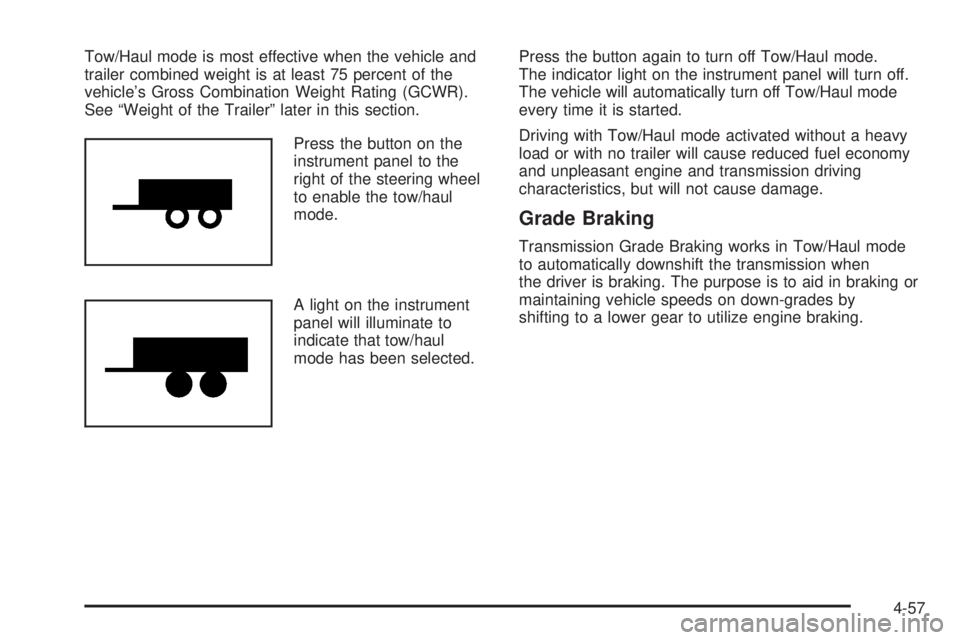
Press the button on the
instrument panel to the
right of the steering wheel
to enable the tow/haul
mode.
A light on the instrument
panel will illuminate to
indicate that tow/haul
mode has been selected.Press the button again to turn off Tow/Haul mode.
The indicator light on the instrument panel will turn off.
The vehicle will automatically turn off Tow/Haul mode
every time it is started.
Driving with Tow/Haul mode activated without a heavy
load or with no trailer will cause reduced fuel economy
and unpleasant engine and transmission driving
characteristics, but will not cause damage.
Grade Braking
Transmission Grade Braking works in Tow/Haul mode
to automatically downshift the transmission when
the driver is braking. The purpose is to aid in braking or
maintaining vehicle speeds on down-grades by
shifting to a lower gear to utilize engine braking.
4-57
Page 326 of 504
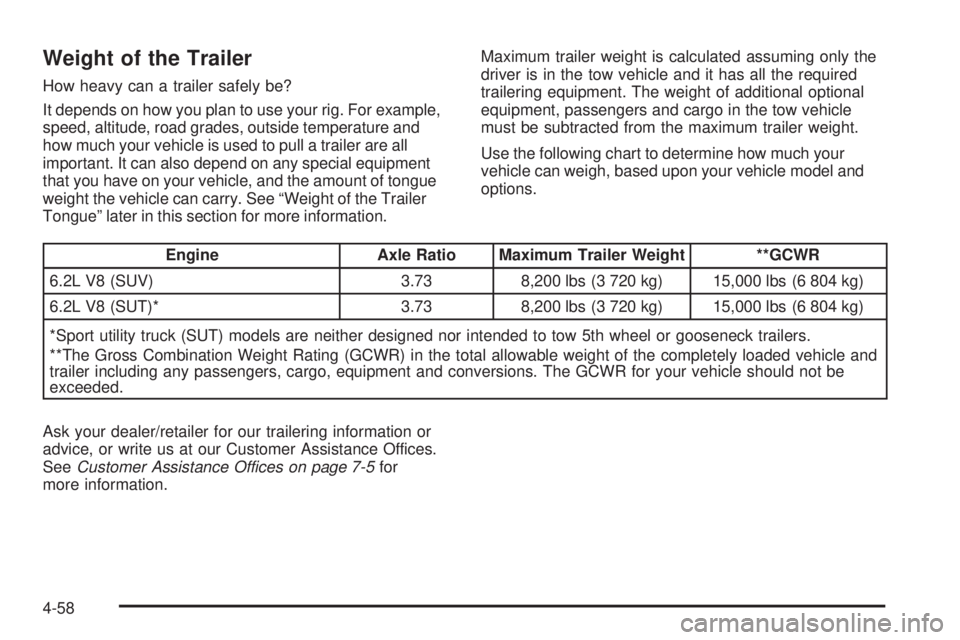
Weight of the Trailer
How heavy can a trailer safely be?
It depends on how you plan to use your rig. For example,
speed, altitude, road grades, outside temperature and
how much your vehicle is used to pull a trailer are all
important. It can also depend on any special equipment
that you have on your vehicle, and the amount of tongue
weight the vehicle can carry. See “Weight of the Trailer
Tongue” later in this section for more information.Maximum trailer weight is calculated assuming only the
driver is in the tow vehicle and it has all the required
trailering equipment. The weight of additional optional
equipment, passengers and cargo in the tow vehicle
must be subtracted from the maximum trailer weight.
Use the following chart to determine how much your
vehicle can weigh, based upon your vehicle model and
options.
Engine Axle Ratio Maximum Trailer Weight **GCWR
6.2L V8 (SUV) 3.73 8,200 lbs (3 720 kg) 15,000 lbs (6 804 kg)
6.2L V8 (SUT)* 3.73 8,200 lbs (3 720 kg) 15,000 lbs (6 804 kg)
*Sport utility truck (SUT) models are neither designed nor intended to tow 5th wheel or gooseneck trailers.
**The Gross Combination Weight Rating (GCWR) in the total allowable weight of the completely loaded vehicle and
trailer including any passengers, cargo, equipment and conversions. The GCWR for your vehicle should not be
exceeded.
Ask your dealer/retailer for our trailering information or
advice, or write us at our Customer Assistance Offices.
SeeCustomer Assistance Offices on page 7-5for
more information.
4-58
Page 327 of 504
Weight of the Trailer Tongue
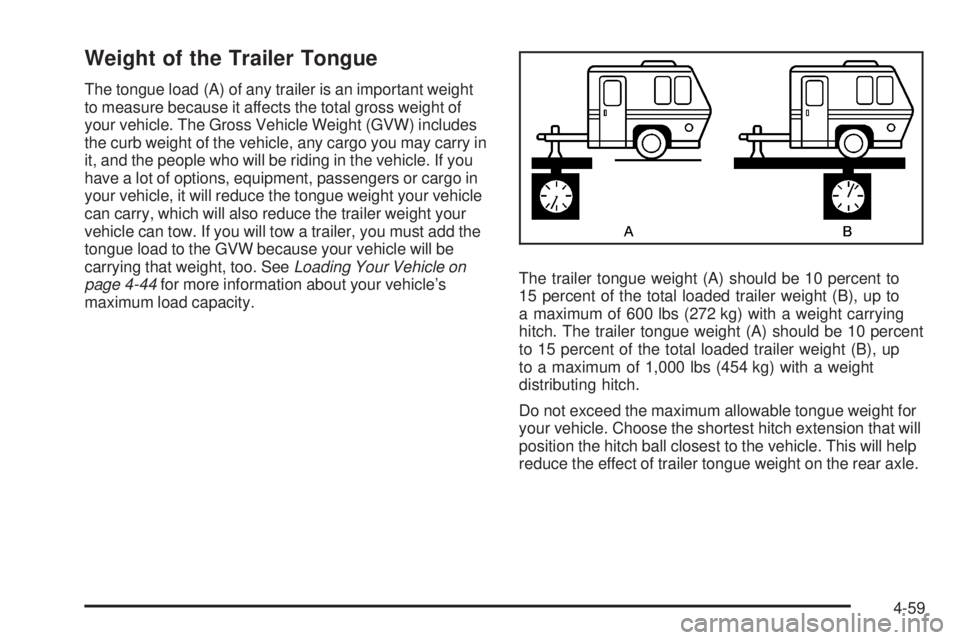
The tongue load (A) of any trailer is an important weight
to measure because it affects the total gross weight of
your vehicle. The Gross Vehicle Weight (GVW) includes
the curb weight of the vehicle, any cargo you may carry in
it, and the people who will be riding in the vehicle. If you
have a lot of options, equipment, passengers or cargo in
your vehicle, it will reduce the tongue weight your vehicle
can carry, which will also reduce the trailer weight your
vehicle can tow. If you will tow a trailer, you must add the
tongue load to the GVW because your vehicle will be
carrying that weight, too. SeeLoading Your Vehicle on
page 4-44for more information about your vehicle’s
maximum load capacity.The trailer tongue weight (A) should be 10 percent to
15 percent of the total loaded trailer weight (B), up to
a maximum of 600 lbs (272 kg) with a weight carrying
hitch. The trailer tongue weight (A) should be 10 percent
to 15 percent of the total loaded trailer weight (B), up
to a maximum of 1,000 lbs (454 kg) with a weight
distributing hitch.
Do not exceed the maximum allowable tongue weight for
your vehicle. Choose the shortest hitch extension that will
position the hitch ball closest to the vehicle. This will help
reduce the effect of trailer tongue weight on the rear axle.
4-59