ECU HUMMER H2 2008 Workshop Manual
[x] Cancel search | Manufacturer: HUMMER, Model Year: 2008, Model line: H2, Model: HUMMER H2 2008Pages: 504, PDF Size: 7.12 MB
Page 320 of 504
Dinghy Towing
Use the following procedure to tow your vehicle:
1. Shift the transmission to PARK (P).
2. Turn the engine off, but leave the ignition in
ACCESSORY.
3. Firmly set the parking brake.
4. Securely attach the vehicle being towed to the
tow vehicle.
{CAUTION:
Shifting a full-time four-wheel-drive vehicle’s
transfer case into NEUTRAL can cause your
vehicle to roll even if the transmission is in
PARK (P). You or others could be injured.
Make sure the parking brake is rmly set
before you shift the transfer case to NEUTRAL.
5. Shift the transfer case to NEUTRAL (N). See
Full-Time Four-Wheel Drive on page 2-36for
the proper procedure to select the NEUTRAL
position for your vehicle.6. Release the parking brake only after the vehicle
being towed is rmly attached to the towing
vehicle. You can use your vehicle’s front mounted
receiver with the proper accessories to tow it.
See “Front Mounted Receiver” underIf Your Vehicle
is Stuck in Sand, Mud, Ice, or Snow on page 4-39.
7. Turn the ignition to ACCESSORY.
8. Disconnect the battery if you are going to tow for
long distances or long periods of time.
When towing your vehicle for extended periods of time,
start your vehicle as often as possible to prevent
battery drain. This should only be done when the tow
vehicle is parked.Dolly Towing
Your vehicle cannot be dolly towed. If you must tow
your vehicle behind another, use the dinghy towing
procedure listed previously.
Notice:Dolly towing your vehicle will damage
drivetrain components. Do not dolly tow your
vehicle.
4-52
Page 326 of 504
Weight of the Trailer
How heavy can a trailer safely be?
It depends on how you plan to use your rig. For example,
speed, altitude, road grades, outside temperature and
how much your vehicle is used to pull a trailer are all
important. It can also depend on any special equipment
that you have on your vehicle, and the amount of tongue
weight the vehicle can carry. See “Weight of the Trailer
Tongue” later in this section for more information.Maximum trailer weight is calculated assuming only the
driver is in the tow vehicle and it has all the required
trailering equipment. The weight of additional optional
equipment, passengers and cargo in the tow vehicle
must be subtracted from the maximum trailer weight.
Use the following chart to determine how much your
vehicle can weigh, based upon your vehicle model and
options.
Engine Axle Ratio Maximum Trailer Weight **GCWR
6.2L V8 (SUV) 3.73 8,200 lbs (3 720 kg) 15,000 lbs (6 804 kg)
6.2L V8 (SUT)* 3.73 8,200 lbs (3 720 kg) 15,000 lbs (6 804 kg)
*Sport utility truck (SUT) models are neither designed nor intended to tow 5th wheel or gooseneck trailers.
**The Gross Combination Weight Rating (GCWR) in the total allowable weight of the completely loaded vehicle and
trailer including any passengers, cargo, equipment and conversions. The GCWR for your vehicle should not be
exceeded.
Ask your dealer/retailer for our trailering information or
advice, or write us at our Customer Assistance Offices.
SeeCustomer Assistance Offices on page 7-5for
more information.
4-58
Page 331 of 504
Driving with a Trailer
Towing a trailer requires a certain amount of experience.
Before setting out for the open road, you’ll want to get to
know your rig. Acquaint yourself with the feel of handling
and braking with the added weight of the trailer. And
always keep in mind that the vehicle you are driving is
now a good deal longer and not nearly as responsive as
your vehicle is by itself.
Before you start, check all trailer hitch parts and
attachments, safety chains, electrical connector, lamps,
tires and mirror adjustment. If the trailer has electric
brakes, start your vehicle and trailer moving and then
apply the trailer brake controller by hand to be sure
the brakes are working. This lets you check your
electrical connection at the same time.
During your trip, check occasionally to be sure that the
load is secure, and that the lamps and any trailer
brakes are still working.
Following Distance
Stay at least twice as far behind the vehicle ahead as
you would when driving your vehicle without a trailer.
This can help you avoid situations that require
heavy braking and sudden turns.
Passing
You will need more passing distance up ahead when
you’re towing a trailer. Because you are a good deal
longer, you will need to go much farther beyond the
passed vehicle before you can return to your lane.
Backing Up
Hold the bottom of the steering wheel with one hand.
Then, to move the trailer to the left, just move that hand
to the left. To move the trailer to the right, move your
hand to the right. Always back up slowly and, if possible,
have someone guide you.
4-63
Page 362 of 504
Checking Coolant
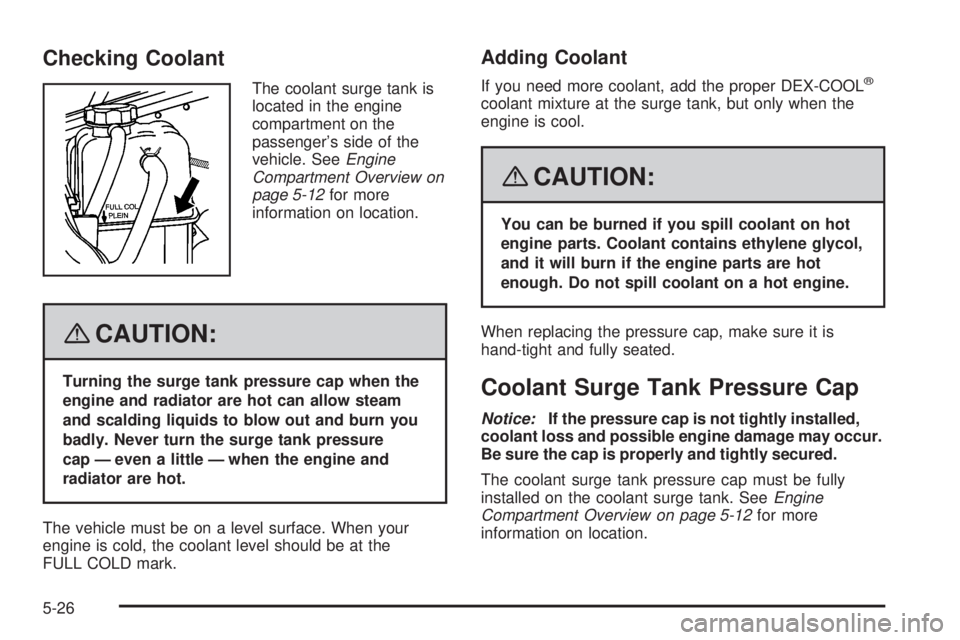
The coolant surge tank is
located in the engine
compartment on the
passenger’s side of the
vehicle. SeeEngine
Compartment Overview on
page 5-12for more
information on location.
{CAUTION:
Turning the surge tank pressure cap when the
engine and radiator are hot can allow steam
and scalding liquids to blow out and burn you
badly. Never turn the surge tank pressure
cap — even a little — when the engine and
radiator are hot.
The vehicle must be on a level surface. When your
engine is cold, the coolant level should be at the
FULL COLD mark.
Adding Coolant
If you need more coolant, add the proper DEX-COOL®
coolant mixture at the surge tank, but only when the
engine is cool.
{CAUTION:
You can be burned if you spill coolant on hot
engine parts. Coolant contains ethylene glycol,
and it will burn if the engine parts are hot
enough. Do not spill coolant on a hot engine.
When replacing the pressure cap, make sure it is
hand-tight and fully seated.
Coolant Surge Tank Pressure Cap
Notice:If the pressure cap is not tightly installed,
coolant loss and possible engine damage may occur.
Be sure the cap is properly and tightly secured.
The coolant surge tank pressure cap must be fully
installed on the coolant surge tank. SeeEngine
Compartment Overview on page 5-12for more
information on location.
5-26
Page 390 of 504
Windshield Wiper Blade
Replacement
Windshield wiper blades should be inspected for wear
and cracking. SeeScheduled Maintenance on page 6-4
for more information.
Replacement blades come in different types and are
removed in different ways. For proper type and length,
seeMaintenance Replacement Parts on page 6-14.
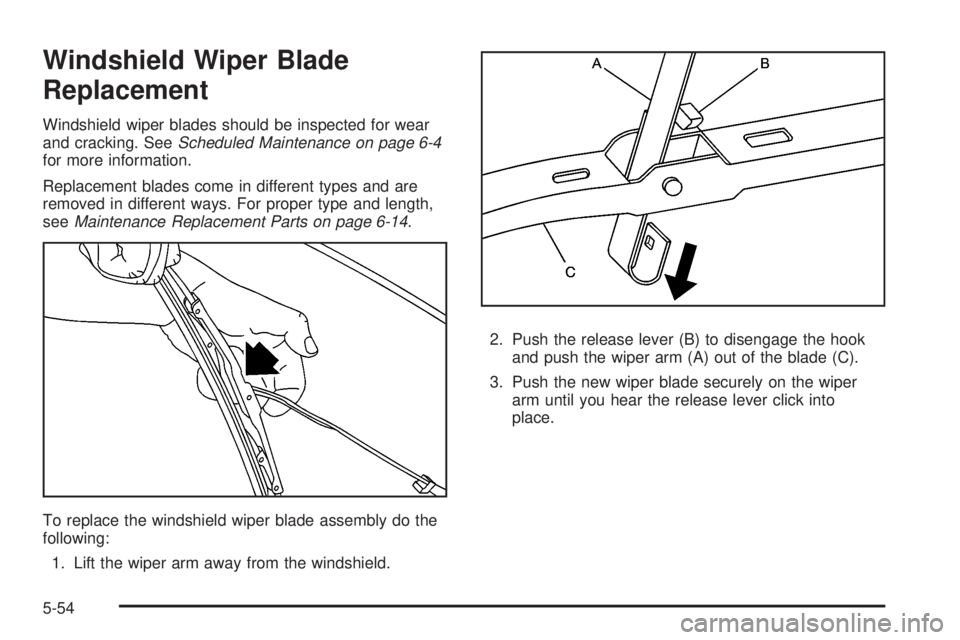
To replace the windshield wiper blade assembly do the
following:
1. Lift the wiper arm away from the windshield.2. Push the release lever (B) to disengage the hook
and push the wiper arm (A) out of the blade (C).
3. Push the new wiper blade securely on the wiper
arm until you hear the release lever click into
place.
5-54
Page 405 of 504
{CAUTION:
Rust or dirt on a wheel, or on the parts to
which it is fastened, can make wheel nuts
become loose after time. The wheel could
come off and cause an accident. When
you change a wheel, remove any rust or
dirt from places where the wheel attaches
to the vehicle. In an emergency, you can
use a cloth or a paper towel to do this;
but be sure to use a scraper or wire brush
later, if needed, to get all the rust or dirt
off. SeeChanging a Flat Tire on page 5-78.
Make sure the spare tire is stored securely. Push,
pull, and then try to rotate or turn the tire. If it
moves, tighten the cable. SeeStoring a Flat or
Spare Tire and Tools (SUT) on page 5-94or
Storing a Flat or Spare Tire and Tools (SUV) on
page 5-96.
When It Is Time for New Tires
Various factors, such as maintenance, temperatures,
driving speeds, vehicle loading, and road conditions,
inuence when you need new tires.
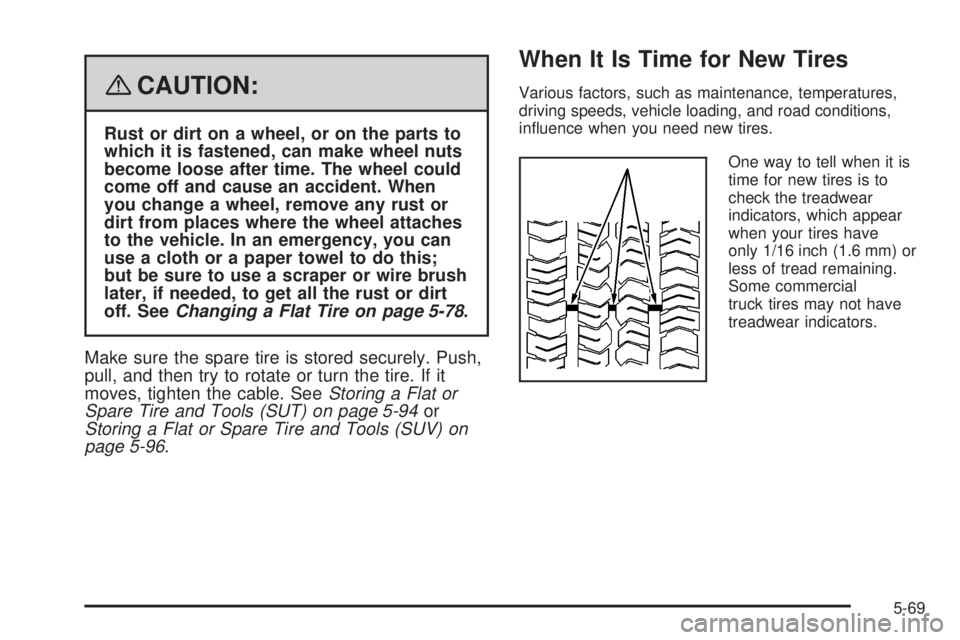
One way to tell when it is
time for new tires is to
check the treadwear
indicators, which appear
when your tires have
only 1/16 inch (1.6 mm) or
less of tread remaining.
Some commercial
truck tires may not have
treadwear indicators.
5-69
Page 411 of 504
Notice:The wrong wheel can also cause problems
with bearing life, brake cooling, speedometer or
odometer calibration, headlamp aim, bumper height,
vehicle ground clearance, and tire or tire chain
clearance to the body and chassis.
SeeChanging a Flat Tire on page 5-78for more
information.
Used Replacement Wheels
{CAUTION:
Putting a used wheel on your vehicle is
dangerous. You cannot know how it has been
used or how far it has been driven. It could fail
suddenly and cause a crash. If you have to
replace a wheel, use a new GM original
equipment wheel.
Tire Chains
Notice:Use tire chains only where legal and only
when you must. Use only SAE Class U-type
chains that are the proper size for your tires. Install
them on the rear axle tires and tighten them as
tightly as possible with the ends securely fastened.
Drive slowly and follow the chain manufacturer’s
instructions. If you can hear the chains contacting
your vehicle, stop and retighten them. If the contact
continues, slow down until it stops. Driving too
fast or spinning the wheels with chains on will
damage your vehicle.
5-75
Page 426 of 504
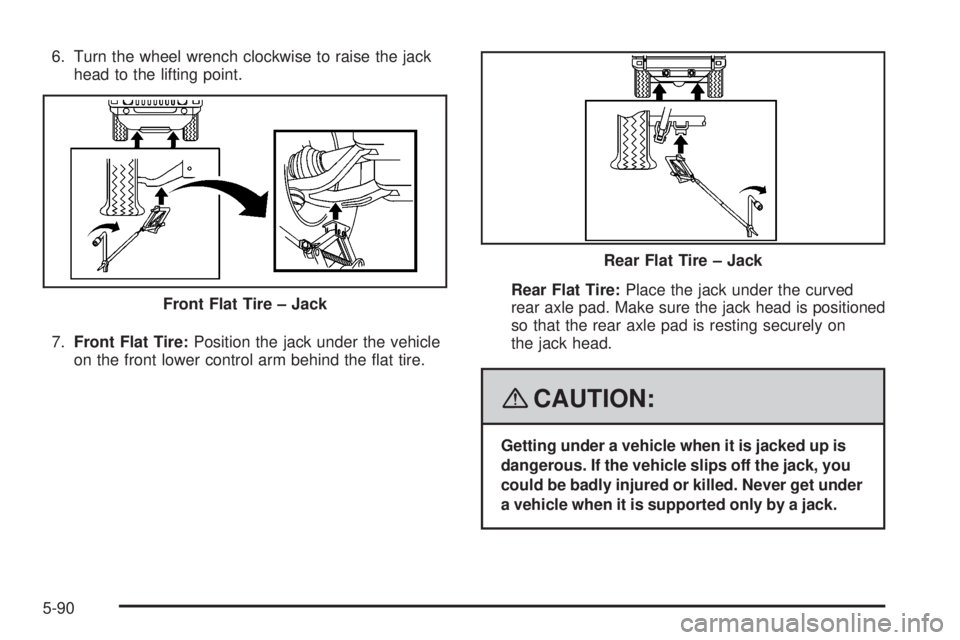
6. Turn the wheel wrench clockwise to raise the jack
head to the lifting point.
7.Front Flat Tire:Position the jack under the vehicle
on the front lower control arm behind the at tire.Rear Flat Tire:Place the jack under the curved
rear axle pad. Make sure the jack head is positioned
so that the rear axle pad is resting securely on
the jack head.
{CAUTION:
Getting under a vehicle when it is jacked up is
dangerous. If the vehicle slips off the jack, you
could be badly injured or killed. Never get under
a vehicle when it is supported only by a jack. Front Flat Tire – Jack
Rear Flat Tire – Jack
5-90
Page 430 of 504
Storing a Flat or Spare Tire and
Tools (SUT)
Storing the Flat or Spare Tire
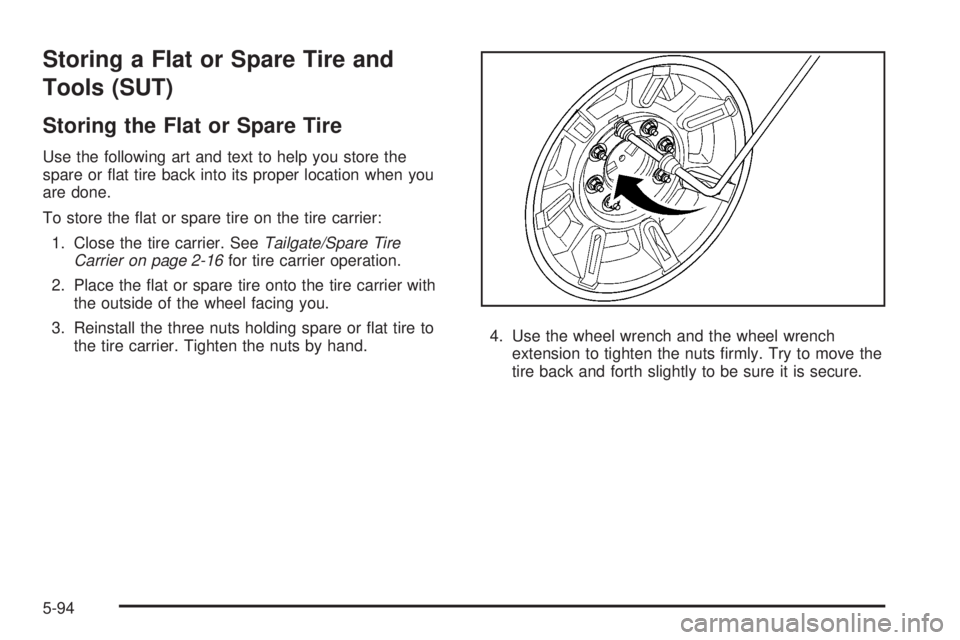
Use the following art and text to help you store the
spare or at tire back into its proper location when you
are done.
To store the at or spare tire on the tire carrier:
1. Close the tire carrier. SeeTailgate/Spare Tire
Carrier on page 2-16for tire carrier operation.
2. Place the at or spare tire onto the tire carrier with
the outside of the wheel facing you.
3. Reinstall the three nuts holding spare or at tire to
the tire carrier. Tighten the nuts by hand.4. Use the wheel wrench and the wheel wrench
extension to tighten the nuts rmly. Try to move the
tire back and forth slightly to be sure it is secure.
5-94
Page 431 of 504
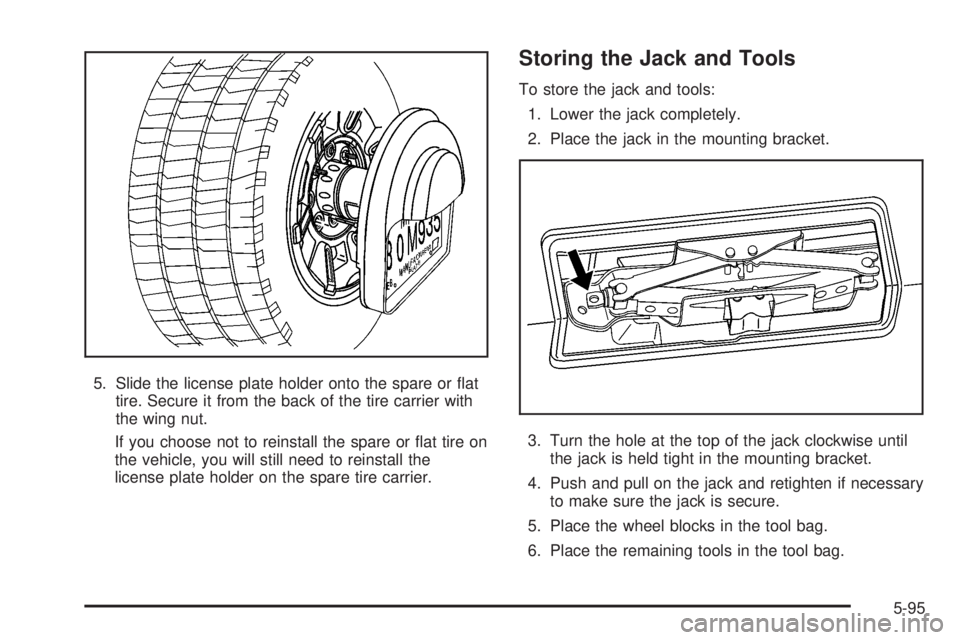
5. Slide the license plate holder onto the spare or at
tire. Secure it from the back of the tire carrier with
the wing nut.
If you choose not to reinstall the spare or at tire on
the vehicle, you will still need to reinstall the
license plate holder on the spare tire carrier.
Storing the Jack and Tools
To store the jack and tools:
1. Lower the jack completely.
2. Place the jack in the mounting bracket.
3. Turn the hole at the top of the jack clockwise until
the jack is held tight in the mounting bracket.
4. Push and pull on the jack and retighten if necessary
to make sure the jack is secure.
5. Place the wheel blocks in the tool bag.
6. Place the remaining tools in the tool bag.
5-95