climate control HUMMER H2 2008 Owners Manual
[x] Cancel search | Manufacturer: HUMMER, Model Year: 2008, Model line: H2, Model: HUMMER H2 2008Pages: 504, PDF Size: 7.12 MB
Page 1 of 504
Seats and Restraint Systems........................... 1-1
Front Seats
............................................... 1-2
Rear Seats
............................................... 1-8
Safety Belts
.............................................1-16
Child Restraints
.......................................1-36
Airbag System
.........................................1-64
Restraint System Check
............................1-76
Features and Controls..................................... 2-1
Keys
........................................................ 2-3
Doors and Locks
......................................2-10
Windows
.................................................2-19
Theft-Deterrent Systems
............................2-24
Starting and Operating Your Vehicle
...........2-28
Mirrors
....................................................2-45
Object Detection Systems
..........................2-50
OnStar
®System
......................................2-53
Universal Home Remote System
................2-57
Storage Areas
.........................................2-64
Sunroof
..................................................2-67
Instrument Panel............................................. 3-1
Instrument Panel Overview
.......................... 3-4
Climate Controls
......................................3-22
Warning Lights, Gages, and Indicators
........3-31
Driver Information Center (DIC)
..................3-49
Audio System(s)
.......................................3-72Driving Your Vehicle....................................... 4-1
Your Driving, the Road, and Your Vehicle
..... 4-2
Towing
...................................................4-51
Service and Appearance Care.......................... 5-1
Service
..................................................... 5-3
Fuel
......................................................... 5-5
Checking Things Under the Hood
................. 5-9
Rear Axle
...............................................5-45
Four-Wheel Drive
.....................................5-46
Front Axle
...............................................5-47
Bulb Replacement
....................................5-48
Windshield Wiper Blade Replacement
.........5-54
Tires
......................................................5-55
Appearance Care
...................................5-100
Vehicle Identication
...............................5-109
Electrical System
....................................5-110
Capacities and Specications
...................5-117
Maintenance Schedule..................................... 6-1
Maintenance Schedule
................................ 6-2
Customer Assistance Information.................... 7-1
Customer Assistance and Information
........... 7-2
Reporting Safety Defects
...........................7-14
Vehicle Data Recording and Privacy
...........7-16
Index................................................................ 1
2008 HUMMER H2 Owner ManualM
Page 90 of 504

Remote Vehicle Start
The remote start feature allows you to start the engine
from outside of the vehicle. It may also start up the
vehicle’s heating or air conditioning systems and rear
window defogger. Normal operation of the system
will return after the key is turned to the ON/RUN
position.
During a remote start, the climate control system will
default to a heating mode during colder outside
temperatures and a cooling mode during warmer outside
temperatures.
During a remote start, the rear window defogger and
heated mirrors, if equipped, will turn on during colder
outside temperatures and will shut off when the
key is turned to ON/RUN.
During a remote start, the heated seats will turn on
during colder outside temperatures and will shut
off when the key is turned to ON/RUN. SeeHeated
Seats on page 1-4for additional information.Laws in some communities may restrict the use of
remote starters. For example, some laws may require a
person using the remote start to have the vehicle in
view when doing so. Check local regulations for
any requirements on remote starting of vehicles.
Do not use the remote start feature if your vehicle is
low on fuel. Your vehicle may run out of fuel.
The RKE transmitter with the remote start button,
provides an increased range of operation. However, the
range may be less while the vehicle is running. As a
result, you may need to be closer to your vehicle to turn
it off, than you were to turn it on.
There are other conditions which can affect the
performance of the transmitter, seeRemote Keyless
Entry (RKE) System on page 2-4for additional
information.
2-8
Page 95 of 504
Liftgate (SUV)
{CAUTION:
It can be dangerous to drive with the liftgate
open because carbon monoxide (CO) gas can
come into your vehicle. You can not see or
smell CO. It can cause unconsciousness and
even death. If you must drive with the liftgate
open or if electrical wiring or other cable
connections must pass through the seal
between the body and the liftgate:
Make sure all other windows are shut.
Turn the fan on your heating or cooling
system to its highest speed and select the
control setting that will force outside air
into your vehicle. SeeDual Automatic
Climate Control System on page 3-22.
If you have air outlets on or under the
instrument panel, open them all the way.
SeeEngine Exhaust on page 2-43.To lock and unlock the liftgate, use any of the power
door lock switches or the remote keyless entry (RKE)
transmitter.
To open the liftgate, do the following:
1. Move the spare tire carrier out of the way.
See “Opening the Spare Tire Carrier” under
Tailgate/Spare Tire Carrier on page 2-16.
2. Pull the handle located in the center of the door.
To close the liftgate, do the following:
1. Pull the liftgate down until it latches.
2. Move the spare tire carrier back into place.
See “Closing the Spare Tire Carrier” under
Tailgate/Spare Tire Carrier on page 2-16.
2-13
Page 96 of 504
Midgate®(SUT)
{CAUTION:
It can be dangerous to drive with the cargo area
covered and the tailgate and the Midgate®open
because carbon monoxide (CO) gas can come
into your vehicle. You can not see or smell CO.
It can cause unconsciousness and even death.
If you must drive with the cargo covers on and
the tailgate and Midgate
®open or if electrical
wiring or other cable connections must pass
through the seal between the body and the
Midgate
®:
Make sure all windows are shut.
Turn the fan on your heating or cooling
system to its highest speed on the setting
that brings in outside air. This will force
outside air into your vehicle. SeeDual
Automatic Climate Control System on
page 3-22.
If you have air outlets on or under the
instrument panel, open them all the way.
SeeEngine Exhaust on page 2-43.The Midgate
®allows you to extend the length of your
vehicle’s cargo area into the cab.
Lowering the Midgate
The Midgate window must be completely lowered for
the Midgate®to be lowered. See “Midgate®Window”
underPower Windows on page 2-20.
Both the Midgate and the Midgate window can be
lowered while the ignition is in either ON/RUN or
ACC/ACCESSORY, or while in Retained Accessory
Power (RAP) mode. SeeRetained Accessory Power
(RAP) on page 2-29for more information.
To lower the Midgate, do the following:
1. Fold the rear seats forward. SeeSplit Folding Rear
Seat on page 1-8. The front seats may have to be
moved forward slightly.
2.
K(Midgate Window):Press the bottom part
of this switch to lower the Midgate window.
SeeInstrument Panel Overview on page 3-4for
the location of this switch. The window can also be
operated using the global express-down button.
See “Global Glass Feature” underPower Windows
on page 2-20.
2-14
Page 126 of 504
Running the Engine While Parked
It is better not to park with the engine running. But if you
ever have to, here are some things to know.
{CAUTION:
Idling the engine with the climate control
system off could allow dangerous exhaust into
your vehicle. See the earlier caution under
Engine Exhaust on page 2-43.
Also, idling in a closed-in place can let deadly
carbon monoxide (CO) into your vehicle
even if the climate control fan is at the highest
setting. One place this can happen is a garage.
Exhaust — with CO — can come in easily.
NEVER park in a garage with the engine
running.
Another closed-in place can be a blizzard.
SeeWinter Driving on page 4-36.
{CAUTION:
It can be dangerous to get out of your vehicle
if the shift lever is not fully in PARK (P) with
the parking brake rmly set. Your vehicle can
roll. Do not leave your vehicle when the engine
is running unless you have to. If you have left
the engine running, the vehicle can move
suddenly. You or others could be injured.
To be sure your vehicle will not move, even
when you are on fairly level ground, always set
the parking brake and move the shift lever
to PARK (P).
2-44
Page 131 of 504
Outside Automatic Dimming Mirror
If the vehicle has this feature, the driver’s outside mirror
adjusts for the glare of the headlamps behind you.
SeeAutomatic Dimming Rearview Mirror with Compass
and Temperature Display on page 2-45.
Park Tilt Mirrors
The vehicle’s outside mirrors can also perform a park tilt
function. This causes the passenger’s and/or driver’s
mirror to tilt to a preselected position when the vehicle is
in REVERSE (R). This feature may be useful in
viewing the curb when parallel parking.
When the vehicle is shifted out of REVERSE (R) and a
short delay has occurred, the passenger’s and/or
driver’s mirror will return to its original position.
To change the preselected tilt position, adjust the
mirrors to the desired position while the vehicle is in
REVERSE (R). When the vehicle is shifted out of
REVERSE (R), this new position is saved in memory as
the tilt position.
This feature can be enabled/disabled through the Driver
Information Center. SeeDIC Vehicle Customization
(With DIC Buttons) on page 3-63for more information.
Outside Convex Mirror
{CAUTION:
A convex mirror can make things (like other
vehicles) look farther away than they really are.
If you cut too sharply into the right lane, you
could hit a vehicle on your right. Check your
inside mirror or glance over your shoulder
before changing lanes.
The passenger side mirror is convex. A convex mirror’s
surface is curved so more can be seen from the
driver seat. It also makes things, like other vehicles,
look farther away than they really are.
Outside Heated Mirrors
The vehicle may have outside heated mirrors which
help clear them of condensation, snow, and ice.
When the rear window defogger button is pressed, the
heated mirrors are also turned on. See “Rear Window
Defogger” underDual Automatic Climate Control System
on page 3-22for more information.
2-49
Page 151 of 504
Instrument Panel Overview...............................3-4
Hazard Warning Flashers................................3-6
Other Warning Devices...................................3-6
Horn.............................................................3-6
Tilt Wheel.....................................................3-6
Turn Signal/Multifunction Lever.........................3-7
Turn and Lane-Change Signals........................3-8
Headlamp High/Low-Beam Changer..................3-8
Flash-to-Pass.................................................3-9
Windshield Wipers..........................................3-9
Windshield Washer.......................................3-10
Rear Window Wiper/Washer...........................3-11
Cruise Control..............................................3-12
Exterior Lamps.............................................3-15
Headlamps on Reminder................................3-17
Daytime Running Lamps (DRL).......................3-17
Automatic Headlamp System..........................3-18
Instrument Panel Brightness...........................3-18
Dome Lamps...............................................3-19
Dome Lamp Override....................................3-19
Entry/Exit Lighting.........................................3-19
Reading Lamps............................................3-19
Battery Run-Down Protection..........................3-19
Accessory Power Outlet(s).............................3-20
Ashtray(s) and Cigarette Lighter......................3-21
Analog Clock...............................................3-21Climate Controls............................................3-22
Dual Automatic Climate Control System...........3-22
Outlet Adjustment.........................................3-29
Rear Air Conditioning and Heating System
and Electronic Climate Controls...................3-29
Warning Lights, Gages, and Indicators............3-31
Instrument Panel Cluster................................3-32
Speedometer and Odometer...........................3-33
Trip Odometer
..............................................3-33
Tachometer.................................................3-33
Safety Belt Reminders...................................3-33
Airbag Readiness Light..................................3-34
Airbag Off Light............................................3-35
Charging System Light..................................3-37
Voltmeter Gage............................................3-37
Brake System Warning Light..........................3-38
Antilock Brake System Warning Light...............3-39
StabiliTrak
®Indicator Light..............................3-40
Engine Coolant Temperature Gage..................3-40
Tire Pressure Light.......................................3-41
Malfunction Indicator Lamp.............................3-42
Oil Pressure Gage........................................3-45
Oil Pressure Light.........................................3-46
Security Light...............................................3-46
Cruise Control Light......................................3-46
Section 3 Instrument Panel
3-1
Page 155 of 504
The main components of the instrument panel are the following:
A. Air Outlets. SeeOutlet Adjustment on page 3-29.
B. Midgate Window Switch (SUT). SeePower Windows
on page 2-20. Rear Wiper/Washer Switch (SUV).
SeeRear Window Wiper/Washer on page 3-11.
C. Turn Signal/Multifunction Lever. SeeTurn
Signal/Multifunction Lever on page 3-7.
D. Instrument Panel Cluster. SeeInstrument Panel
Cluster on page 3-32.
E. Audio Steering Wheel Buttons. SeeAudio Steering
Wheel Controls on page 3-116.
F. Driver Information Center (DIC) Buttons. SeeDriver
Information Center (DIC) on page 3-49.
G. Analog Clock.Analog Clock on page 3-21.
H. Airbag Switch. SeeAirbag Off Switch on page 1-72.
I. Global Window Switch. SeePower Windows
on page 2-20.
J. Exterior Lamps Control. SeeExterior Lamps
on page 3-15.
K. Dome Lamp Override Button. SeeDome Lamp
Override on page 3-19Instrument Panel Brightness
Control. SeeInstrument Panel Brightness on
page 3-18. Heated Windshield Washer Control
(If Equipped). SeeWindshield Washer on page 3-10.L. Cruise Control Buttons. SeeCruise Control
on page 3-12.
M. Tilt Lever. SeeTilt Wheel on page 3-6.
N. Horn. SeeHorn on page 3-6.
O. Full-Time Four-Wheel Drive Buttons. SeeFull-Time
Four-Wheel Drive on page 2-36.
P. Locking Rear Axle. SeeLocking Rear Axle on
page 4-6. Tow/Haul Selector Button. SeeTow/Haul
Mode on page 2-36. Traction Control (TCS) Button.
SeeTraction Control System (TCS) on page 4-5.
Ride Height Selector Button (If Equipped). See
Selectable Extended Rear Ride Height on page 4-53.
Q. Shift Lever. SeeAutomatic Transmission Operation
on page 2-32.
R. Accessory Power Outlet. SeeAccessory Power
Outlet(s) on page 3-20.
S. Climate Control System. SeeDual Automatic
Climate Control System on page 3-22.
T. Audio System. SeeAudio System(s) on page 3-72.
U. Glove Box. SeeGlove Box on page 2-64.
3-5
Page 170 of 504
Accessory Power Outlet(s)
Accessory power outlets can be used to connect
auxiliary electrical equipment, such as a cellular
telephone or CB radio.
Your vehicle may have one outlet located inside the
storage bin below the climate control system, one outlet
inside the center oor console and two outlets on the
rear of the center oor console.
The outlet located inside the storage bin below the
climate control system can only use equipment that
does not exceed 15 amperes.
Notice:Leaving electrical equipment on for
extended periods will drain the battery. Always
turn off electrical equipment when not in use
and do not plug in equipment that exceeds the
maximum
15 ampere rating.
There may also be an accessory power outlet located
in the rear of the vehicle near the liftgate. To use
an accessory power outlet, remove the protective cap.
When not in use, always cover the accessory power
outlet with the protective cap.If your vehicle is the SUT model, there is an accessory
power outlet in the rear cargo area on the passenger
side of the vehicle.
Notice:Adding any electrical equipment to your
vehicle may damage it or keep other components
from working as they should. The repairs would not
be covered by your warranty. Do not use equipment
exceeding maximum amperage rating of 20 amperes.
Check with your dealer/retailer before adding
electrical equipment.
Certain power accessory plugs may not be compatible
to the accessory power outlets and could result in
blown vehicle or adapter fuses. If you experience
a problem, see your dealer/retailer for additional
information on the accessory power plugs.
The accessory power outlets are powered, even
when the ignition is in LOCK/OFF. Continuing to use
power outlets while the ignition is in LOCK/OFF
may cause the vehicle’s battery to run down.
Notice:Improper use of the power outlet can cause
damage not covered by your warranty. Do not
hang any type of accessory or accessory bracket
from the plug because the power outlets are
designed for accessory power plugs only.
3-20
Page 172 of 504
Climate Controls
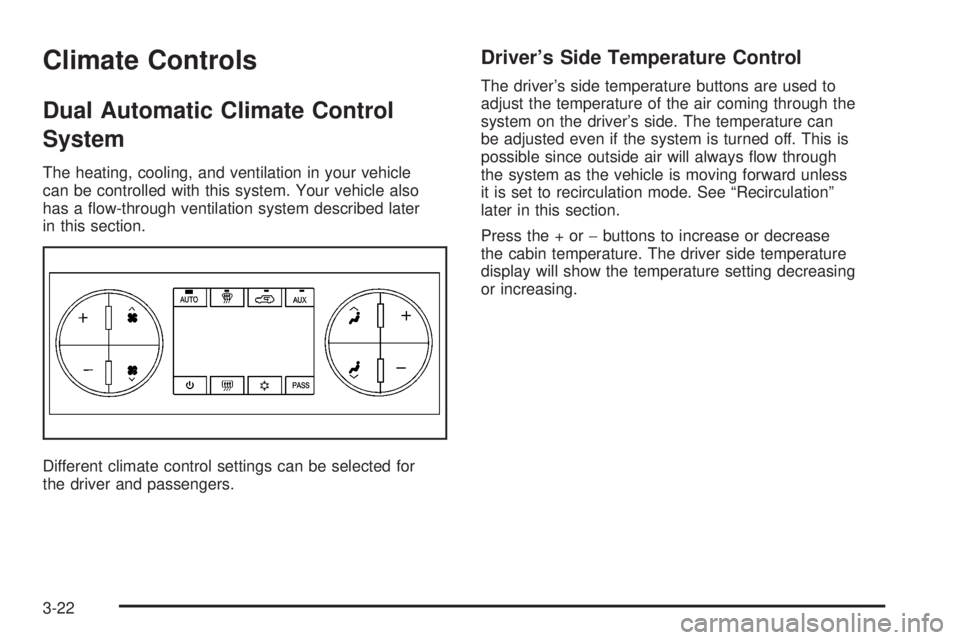
Dual Automatic Climate Control
System
The heating, cooling, and ventilation in your vehicle
can be controlled with this system. Your vehicle also
has a ow-through ventilation system described later
in this section.
Different climate control settings can be selected for
the driver and passengers.
Driver’s Side Temperature Control
The driver’s side temperature buttons are used to
adjust the temperature of the air coming through the
system on the driver’s side. The temperature can
be adjusted even if the system is turned off. This is
possible since outside air will always ow through
the system as the vehicle is moving forward unless
it is set to recirculation mode. See “Recirculation”
later in this section.
Press the + or−buttons to increase or decrease
the cabin temperature. The driver side temperature
display will show the temperature setting decreasing
or increasing.
3-22