change wheel HUMMER H2 2009 User Guide
[x] Cancel search | Manufacturer: HUMMER, Model Year: 2009, Model line: H2, Model: HUMMER H2 2009Pages: 524, PDF Size: 3.1 MB
Page 309 of 524

Surface Obstacles:Unseen or hidden obstacles can
be hazardous. A rock, log, hole, rut, or bump can startle
you if you are not prepared for them. Often these
obstacles are hidden by grass, bushes, snow, or even
the rise and fall of the terrain itself.
Some things to consider:
Is the path ahead clear?
Will the surface texture change abruptly up ahead?
Does the travel take you uphill or downhill?
Will you have to stop suddenly or change direction
quickly?
When driving over obstacles or rough terrain, keep a rm
grip on the steering wheel. Ruts, troughs, or other surface
features can jerk the wheel out of your hands.
When driving over bumps, rocks, or other obstacles, the
wheels can leave the ground. If this happens, even with
one or two wheels, you cannot control the vehicle as well
or at all.
Because you will be on an unpaved surface, it is
especially important to avoid sudden acceleration,
sudden turns, or sudden braking.
Off-roading requires a different kind of alertness from
driving on paved roads and highways. There are no road
signs, posted speed limits, or signal lights. Use good
judgment about what is safe and what is not.
Crossing Obstacles
Approach Angle — a Key to Mobility
If you encounter a large dip in the terrain, do not
enter straight on; enter at an angle — 15° minimum
approach (A), 75° maximum approach angle (B). For
very large dips, ditches or small washes, coast in, using
the engine as a brake (transmission and transfer case
lowest gears). Then, use the low ranges in the
transmission and transfer case to power out.
4-23
Page 317 of 524

Stalling on an Incline
{CAUTION:
Getting out on the downhill (low) side of a vehicle
stopped across an incline is dangerous. If the
vehicle rolls over, you could be crushed or killed.
Always get out on the uphill (high) side of the
vehicle and stay well clear of the rollover path.
If the vehicle stalls when crossing an incline, be sure
you, and any passengers, get out on the uphill side, even
if the door there is harder to open. If you get out on the
downhill side and the vehicle starts to roll over, you will
be right in its path.
If you have to walk down the slope, stay out of the path
the vehicle will take if it does roll over.
Driving in Mud, Sand, Snow, or Ice
When you drive in mud, snow, or sand, the wheels do not
get good traction. Acceleration is not as quick, turning is
more difficult, and braking distances are longer.
It is best to use a low gear when in mud — the deeper
the mud, the lower the gear. In really deep mud,
keep the vehicle moving so it does not get stuck.When driving on sand, wheel traction changes. On
loosely packed sand, such as on beaches or sand
dunes, the tires will tend to sink into the sand. This
affects steering, accelerating, and braking. Drive
at a reduced speed and avoid sharp turns or abrupt
maneuvers.
Hard packed snow and ice offer the worst tire traction.
On these surfaces, it is very easy to lose control.
On wet ice, for example, the traction is so poor that you
will have difficulty accelerating. And, if the vehicle
does get moving, poor steering and difficult braking can
cause it to slide out of control.
{CAUTION:
Driving on frozen lakes, ponds, or rivers can be
dangerous. Underwater springs, currents under
the ice, or sudden thaws can weaken the ice. Your
vehicle could fall through the ice and you and your
passengers could drown. Drive your vehicle on
safe surfaces only.
4-31
Page 330 of 524

Put your transmission in N (Neutral).
Use your regular brakes to hold your vehicle in
place and block the wheels to keep the vehicle from
moving.
Notice:Using a power winch with the transmission
in gear to pull out another vehicle may damage
the transmission. When operating a power winch,
always leave the transmission in N (Neutral).
Notice:Driving your vehicle through an automatic
car wash with the winch installed, can cause
damage to your vehicle and the car wash. Always
remove the winch from your vehicle before using an
automatic car wash. SeeWashing Your Vehicle
on page 5-105for more information.
If you are using a winch to pull out your own vehicle,
follow the winch manufacturer’s guidelines for self
recovery and observe the following to prevent damage
to your vehicle:
Do not self recover your vehicle by wrapping the
winch cable around an object (such as a pulley
block or tree) and attaching it back to your vehicle’s
recovery loops.
Always attach the winch cable directly to a solid
anchor directly in front of your vehicle to achieve
a straight line pull.
Loading the Vehicle
It is very important to know how much weight your
vehicle can carry. This weight is called the vehicle
capacity weight and includes the weight of all
occupants, cargo, and all nonfactory-installed
options. Two labels on your vehicle show how much
weight it may properly carry, the Tire and Loading
Information label and the Certication/Tire label.
{CAUTION:
Do not load the vehicle any heavier than
the Gross Vehicle Weight Rating (GVWR),
or either the maximum front or rear Gross
Axle Weight Rating (GAWR). If you do, parts
on the vehicle can break, and it can change
the way your vehicle handles. These could
cause you to lose control and crash. Also,
overloading can shorten the life of the
vehicle.
4-44
Page 402 of 524
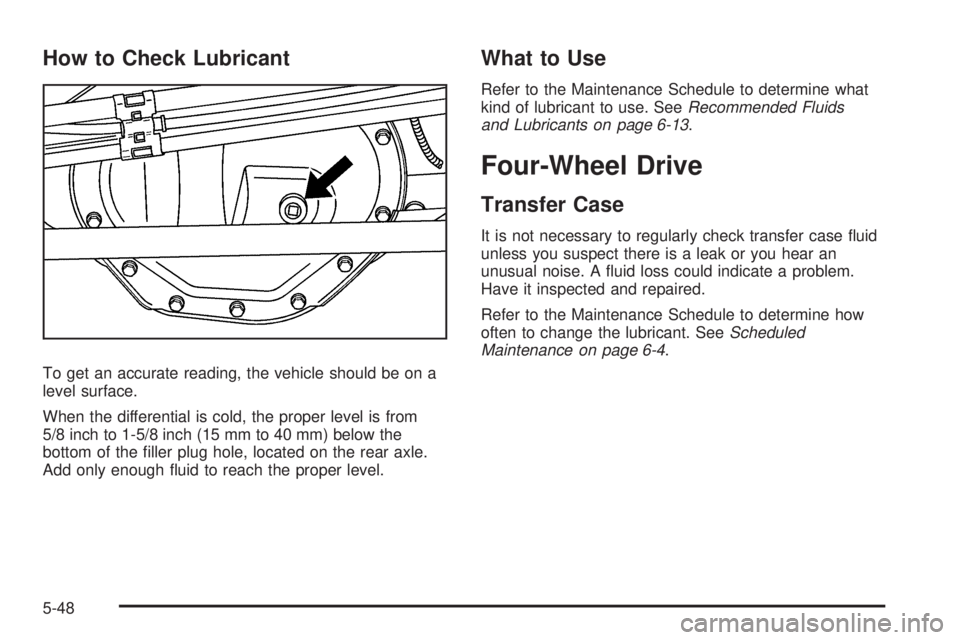
How to Check Lubricant
To get an accurate reading, the vehicle should be on a
level surface.
When the differential is cold, the proper level is from
5/8 inch to 1-5/8 inch (15 mm to 40 mm) below the
bottom of the ller plug hole, located on the rear axle.
Add only enough uid to reach the proper level.
What to Use
Refer to the Maintenance Schedule to determine what
kind of lubricant to use. SeeRecommended Fluids
and Lubricants on page 6-13.
Four-Wheel Drive
Transfer Case
It is not necessary to regularly check transfer case uid
unless you suspect there is a leak or you hear an
unusual noise. A uid loss could indicate a problem.
Have it inspected and repaired.
Refer to the Maintenance Schedule to determine how
often to change the lubricant. SeeScheduled
Maintenance on page 6-4.
5-48
Page 419 of 524

Please note that the TPMS is not a substitute for proper
tire maintenance, and it is the driver’s responsibility to
maintain correct tire pressure, even if under-ination has
not reached the level to trigger illumination of the
TPMS low tire pressure telltale.
Your vehicle has also been equipped with a TPMS
malfunction indicator to indicate when the system is
not operating properly. The TPMS malfunction indicator
is combined with the low tire pressure telltale. When
the system detects a malfunction, the telltale will
ash for approximately one minute and then remain
continuously illuminated. This sequence will continue
upon subsequent vehicle start-ups as long as the
malfunction exists.
When the malfunction indicator is illuminated, the system
may not be able to detect or signal low tire pressure as
intended. TPMS malfunctions may occur for a variety of
reasons, including the installation of replacement or
alternate tires or wheels on the vehicle that prevent the
TPMS from functioning properly. Always check the TPMS
malfunction telltale after replacing one or more tires or
wheels on your vehicle to ensure that the replacement or
alternate tires and wheels allow the TPMS to continue to
function properly.
SeeTire Pressure Monitor Operation on page 5-66for
additional information.Federal Communications Commission
(FCC) and Industry and Science Canada
The Tire Pressure Monitor System (TPMS) operates on
a radio frequency and complies with Part 15 of the
FCC Rules. Operation is subject to the following two
conditions:
1. This device may not cause harmful interference.
2. This device must accept any interference received,
including interference that may cause undesired
operation.
The TPMS operates on a radio frequency and complies
with RSS-210 of Industry and Science Canada.
Operation is subject to the following two conditions:
1. This device may not cause interference.
2. This device must accept any interference received,
including interference that may cause undesired
operation of the device.
Changes or modications to this system by other than
an authorized service facility could void authorization to
use this equipment.
5-65
Page 425 of 524
Reset the Tire Pressure Monitor System. SeeTire
Pressure Monitor Operation on page 5-66.
Make certain that all wheel nuts are properly
tightened. See “Wheel Nut Torque” under
Capacities and Specifications on page 5-117.
{CAUTION:
Rust or dirt on a wheel, or on the parts to
which it is fastened, can make wheel nuts
become loose after time. The wheel could
come off and cause an accident. When you
change a wheel, remove any rust or dirt from
places where the wheel attaches to the
vehicle. In an emergency, you can use a
cloth or a paper towel to do this; but be sure
to use a scraper or wire brush later, if
needed, to get all the rust or dirt off. See
Changing a Flat Tire on page 5-80.
Make sure the spare tire is stored securely. Push,
pull, and then try to rotate or turn the tire. See
Storing a Flat or Spare Tire and Tools (SUT) on
page 5-95orStoring a Flat or Spare Tire and
Tools (SUV) on page 5-98.
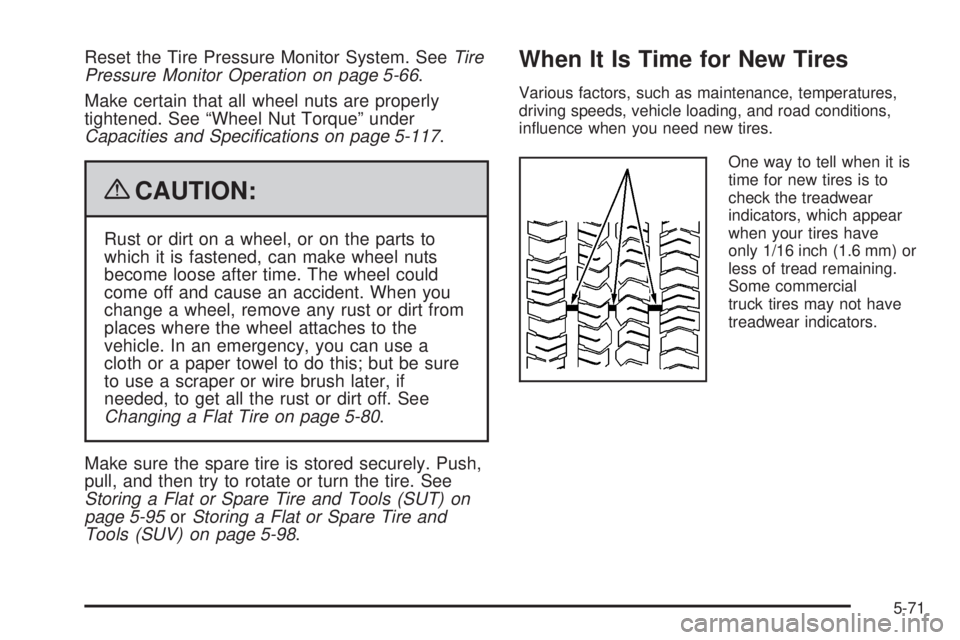
When It Is Time for New Tires
Various factors, such as maintenance, temperatures,
driving speeds, vehicle loading, and road conditions,
inuence when you need new tires.
One way to tell when it is
time for new tires is to
check the treadwear
indicators, which appear
when your tires have
only 1/16 inch (1.6 mm) or
less of tread remaining.
Some commercial
truck tires may not have
treadwear indicators.
5-71
Page 434 of 524

A rear blowout, particularly on a curve, acts much like a
skid and may require the same correction you would
use in a skid. In any rear blowout remove your foot from
the accelerator pedal. Get the vehicle under control
by steering the way you want the vehicle to go. It may
be very bumpy and noisy, but you can still steer. Gently
brake to a stop, well off the road if possible.
{CAUTION:
Lifting a vehicle and getting under it to do
maintenance or repairs is dangerous without the
appropriate safety equipment and training. If a jack
is provided with the vehicle, it is designed only for
changing a at tire. If it is used for anything else,
you or others could be badly injured or killed if the
vehicle slips off the jack. If a jack is provided with
the vehicle, only use it for changing a at tire.
If a tire goes at, the next part shows how to use the
jacking equipment to change a at tire safely.
Changing a Flat Tire
If a tire goes at, avoid further tire and wheel damage
by driving slowly to a level place. Turn on the hazard
warning ashers. SeeHazard Warning Flashers
on page 3-6.
{CAUTION:
Changing a tire can be dangerous. The vehicle
can slip off the jack and roll over or fall on you or
other people. You and they could be badly injured
or even killed. Find a level place to change your
tire. To help prevent the vehicle from moving:
1. Set the parking brake rmly.
2. Put the shift lever in P (Park).
3. Be sure the transfer case is in a drive
gear — not in Neutral.
CAUTION: (Continued)
5-80
Page 435 of 524

CAUTION: (Continued)
4. Turn off the engine and do not restart while
the vehicle is raised.
5. Do not allow passengers to remain in the
vehicle.
To be even more certain the vehicle will not move,
you can put blocks at the front and rear of the tire
farthest away from the one being changed. That
would be the tire on the other side, at the opposite
end of the vehicle.
When the vehicle has a at tire (B), use the following
example as a guide to assist you in the placement
of wheel blocks (A).A. Wheel Block
B. Flat Tire
The following information explains how to use the jack
and change a tire.
5-81
Page 440 of 524

Removing the Spare Tire and
Tools (SUV)
Removing the Tools (SUV)
The equipment you will need to change a at tire is
stored under the storage tray, which is located on the
driver side trim panel (over the rear wheelhouse).
To remove the equipment:
1. Remove the tray to access the tools by pulling up
on the nger depression.2. Turn the retainer nut (C) counterclockwise. Remove
the tool bag (A) and the two wheel blocks (B) from
the storage area.
5-86
Page 516 of 524

Fuel (cont.)
Filling the Tank............................................. 5-8
Fuels in Foreign Countries.............................. 5-8
Gage .........................................................3-45
Gasoline Octane........................................... 5-5
Gasoline Specications.................................. 5-5
Low Warning Light.......................................3-46
Fuses
Center Instrument Panel Fuse Block.............5-112
Fuses and Circuit Breakers.........................5-110
Instrument Panel Fuse Block.......................5-111
Underhood Fuse Block...............................5-113
Windshield Wiper.......................................5-110
G
Gage
Engine Coolant Temperature.........................3-39
Fuel..........................................................3-45
Oil Pressure...............................................3-42
Speedometer..............................................3-31
Tachometer.................................................3-31
Voltmeter Gage...........................................3-36
Garage Door Opener.......................................2-57
Gasoline
Octane........................................................ 5-5
Specications............................................... 5-5
Glove Box.....................................................2-64
GM Mobility Reimbursement Program.................. 7-7
H
Hazard Warning Flashers................................... 3-6
Head Restraints............................................... 1-2
Headlamps....................................................5-51
Bulb Replacement.......................................5-50
Daytime Running Lamp........................3-16, 5-52
Exterior Lamps............................................3-15
Flash-to-Pass............................................... 3-9
Front Turn Signal and Parking Lamps.............5-52
Halogen Bulbs............................................5-50
High/Low Beam Changer................................ 3-9
On Reminder..............................................3-16
Roof Marker Lamps.....................................5-53
Heated Seats................................................... 1-6
Heated Steering Wheel..................................... 3-7
Heater
Engine Coolant...........................................2-31
Heater...........................................................3-22
Highbeam On Light.........................................3-44
Highway Hypnosis...........................................4-35
Hill and Mountain Roads..................................4-36
Hood
Checking Things Under................................5-11
Release.....................................................5-12
Horn ............................................................... 3-6
How to Wear Safety Belts Properly...................1-25
6