maintenance HUMMER H2 2009 User Guide
[x] Cancel search | Manufacturer: HUMMER, Model Year: 2009, Model line: H2, Model: HUMMER H2 2009Pages: 524, PDF Size: 3.1 MB
Page 353 of 524
Maintenance When Trailer Towing
The vehicle needs service more often when pulling a
trailer. See this manual’s Maintenance Schedule or Index
for more information. Things that are especially important
in trailer operation are automatic transmission uid,
engine oil, axle lubricant, belts, cooling system and brake
system. It is a good idea to inspect these before and
during the trip.
Check periodically to see that all hitch nuts and bolts
are tight.
Trailer Wiring Harness
Heavy-Duty Trailer Wiring Harness
Package
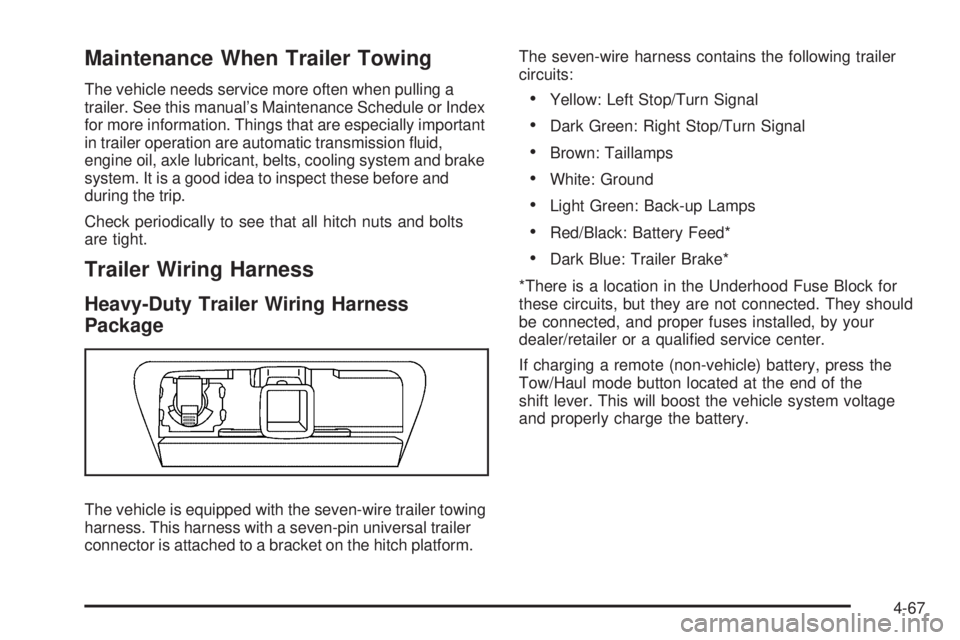
The vehicle is equipped with the seven-wire trailer towing
harness. This harness with a seven-pin universal trailer
connector is attached to a bracket on the hitch platform.The seven-wire harness contains the following trailer
circuits:
Yellow: Left Stop/Turn Signal
Dark Green: Right Stop/Turn Signal
Brown: Taillamps
White: Ground
Light Green: Back-up Lamps
Red/Black: Battery Feed*
Dark Blue: Trailer Brake*
*There is a location in the Underhood Fuse Block for
these circuits, but they are not connected. They should
be connected, and proper fuses installed, by your
dealer/retailer or a qualied service center.
If charging a remote (non-vehicle) battery, press the
Tow/Haul mode button located at the end of the
shift lever. This will boost the vehicle system voltage
and properly charge the battery.
4-67
Page 356 of 524
Tire Pressure Monitor Operation.....................5-66
Tire Inspection and Rotation...........................5-69
When It Is Time for New Tires.......................5-71
Buying New Tires.........................................5-72
Different Size Tires and Wheels......................5-74
Uniform Tire Quality Grading..........................5-74
Wheel Alignment and Tire Balance..................5-76
Wheel Replacement......................................5-76
Tire Chains..................................................5-77
Accessory Inator.........................................5-78
If a Tire Goes Flat........................................5-79
Changing a Flat Tire.....................................5-80
Removing the Spare Tire and Tools (SUT).......5-82
Removing the Spare Tire and Tools (SUV).......5-86
Removing the Flat Tire and Installing the
Spare Tire................................................5-90
Storing a Flat or Spare Tire and Tools (SUT) . . .5-95
Storing a Flat or Spare Tire and Tools (SUV) . . .5-98
Spare Tire.................................................5-101
Appearance Care..........................................5-102
Interior Cleaning.........................................5-102
Fabric/Carpet..............................................5-103
Leather......................................................5-104
Instrument Panel, Vinyl, and Other Plastic
Surfaces.................................................5-104
Wood Panels..............................................5-104Speaker Covers..........................................5-105
Care of Safety Belts....................................5-105
Weatherstrips.............................................5-105
Washing Your Vehicle..................................5-105
Cleaning Exterior Lamps/Lenses....................5-106
Finish Care................................................5-106
Windshield, Backglass, and Wiper Blades.......5-107
Aluminum Wheels.......................................5-107
Tires.........................................................5-108
Sheet Metal Damage...................................5-108
Finish Damage...........................................5-108
Underbody Maintenance...............................5-108
Chemical Paint Spotting...............................5-108
Vehicle Identication.....................................5-109
Vehicle Identication Number (VIN)................5-109
Service Parts Identication Label...................5-109
Electrical System..........................................5-109
Add-On Electrical Equipment.........................5-109
Windshield Wiper Fuses...............................5-110
Power Windows and Other Power Options......5-110
Fuses and Circuit Breakers..........................5-110
Instrument Panel Fuse Block........................5-111
Center Instrument Panel Fuse Block..............5-112
Underhood Fuse Block................................5-113
Capacities and Specications........................5-117
Section 5 Service and Appearance Care
5-2
Page 358 of 524
California Proposition 65 Warning
Most motor vehicles, including this one, contain and/or
emit chemicals known to the State of California to
cause cancer and birth defects or other reproductive
harm. Engine exhaust, many parts and systems
(including some inside the vehicle), many uids, and
some component wear by-products contain and/or emit
these chemicals.
California Perchlorate Materials
Requirements
Certain types of automotive applications, such as airbag
initiators, seat belt pretensioners, and lithium batteries
contained in remote keyless transmitters, may contain
perchlorate materials. Special handling may be
necessary. For additional information, see
www.dtsc.ca.gov/hazardouswaste/perchlorate.
Doing Your Own Service Work
{CAUTION:
You can be injured and the vehicle could be
damaged if you try to do service work on a vehicle
without knowing enough about it.
Be sure you have sufficient knowledge,
experience, the proper replacement parts,
and tools before attempting any vehicle
maintenance task.
Be sure to use the proper nuts, bolts, and
other fasteners. English and metric fasteners
can be easily confused. If the wrong fasteners
are used, parts can later break or fall off.
You could be hurt.
If doing some of your own service work, use the proper
service manual. It tells you much more about how to
service the vehicle than this manual can. To order
the proper service manual, seeService Publications
Ordering Information on page 7-15.
This vehicle has an airbag system. Before attempting
to do your own service work, seeServicing Your
Airbag-Equipped Vehicle on page 1-79.
5-4
Page 359 of 524
Keep a record with all parts receipts and list the
mileage and the date of any service work performed.
SeeMaintenance Record on page 6-17.
Adding Equipment to the Outside of
the Vehicle
Things added to the outside of the vehicle can affect the
airow around it. This can cause wind noise and can
affect fuel economy and windshield washer performance.
Check with your dealer/retailer before adding equipment
to the outside of the vehicle.
Fuel
Use of the recommended fuel is an important part of
the proper maintenance of this vehicle. To help keep the
engine clean and maintain optimum vehicle performance,
we recommend the use of gasoline advertised as
TOP TIER Detergent Gasoline.
This vehicle can use either unleaded gasoline or
ethanol fuel containing up to 85% ethanol (E85).
SeeGasoline Octane on page 5-5and
Fuel E85 (85% Ethanol) on page 5-7.
Gasoline Octane
Use premium unleaded gasoline with a posted octane
rating of 91 or higher. You can also use regular unleaded
gasoline rated at 87 octane or higher, but the vehicle’s
acceleration could be slightly reduced, and you might
notice a slight audible knocking noise, commonly referred
to as spark knock. If the octane is less than 87, you might
notice a heavy knocking noise when you drive. If this
occurs, use a gasoline rated at 87 octane or higher as
soon as possible. Otherwise, you could damage the
engine. If you are using gasoline rated at 87 octane or
higher and you hear heavy knocking, the engine needs
service.
Gasoline Specications
At a minimum, gasoline should meet ASTM specication
D 4814 in the United States or CAN/CGSB-3.5 or 3.511
in Canada. Some gasolines contain an octane-enhancing
additive called methylcyclopentadienyl manganese
tricarbonyl (MMT). We recommend against the use of
gasolines containing MMT. SeeAdditives on page 5-6for
additional information.
5-5
Page 374 of 524

Engine Air Cleaner/Filter
Notice:If you spray water into the engine air
cleaner/lter intake and water enters the engine air
cleaner/lter housing, as shown in the illustration,
you could damage your vehicle’s engine. The repairs
would not be covered by your warranty. Do not
spray water into the engine air cleaner/lter intake
and/or housing.SeeEngine Compartment
Overview on page 5-14for
the location of the engine
air cleaner/lter and the air
lter restriction indicator,
if equipped.
When to Inspect the Engine Air
Cleaner/Filter
If the vehicle is equipped with an air lter restriction
indicator, it lets you know when the engine air cleaner/
lter needs to be replaced. On vehicles with a restriction
indicator, you should inspect the air lter restriction
indicator at every oil change and replace the engine air
cleaner/lter when the indicator tells you to.
On vehicles without an air lter restriction indicator, you
should inspect the air cleaner/lter at every oil change
and replace it at the rst oil change after 100,000 miles
(160 000 km). SeeScheduled Maintenance on
page 6-4for more information.
5-20
Page 376 of 524
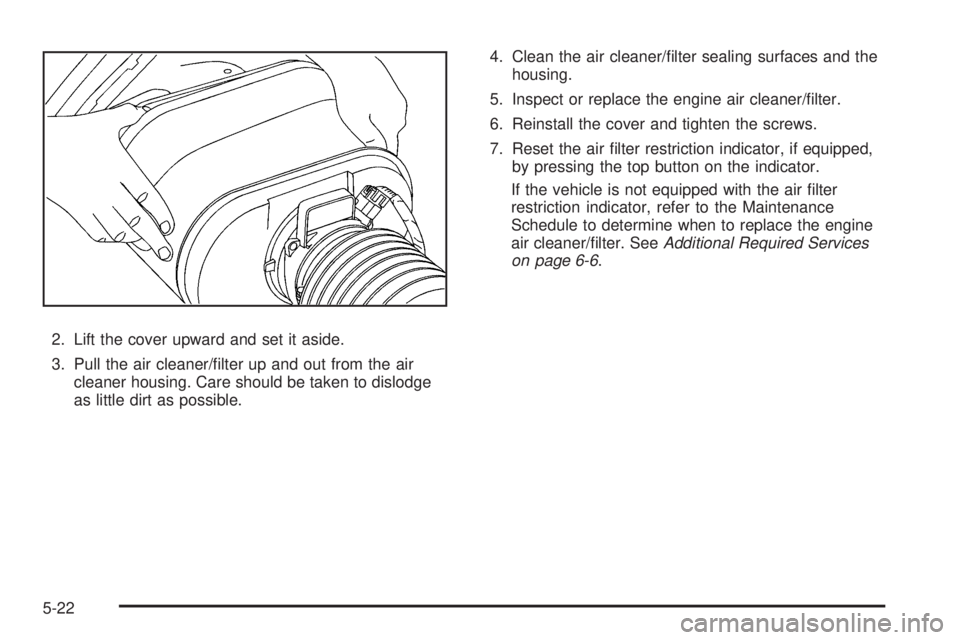
2. Lift the cover upward and set it aside.
3. Pull the air cleaner/lter up and out from the air
cleaner housing. Care should be taken to dislodge
as little dirt as possible.4. Clean the air cleaner/lter sealing surfaces and the
housing.
5. Inspect or replace the engine air cleaner/lter.
6. Reinstall the cover and tighten the screws.
7. Reset the air lter restriction indicator, if equipped,
by pressing the top button on the indicator.
If the vehicle is not equipped with the air lter
restriction indicator, refer to the Maintenance
Schedule to determine when to replace the engine
air cleaner/lter. SeeAdditional Required Services
on page 6-6.
5-22
Page 377 of 524
{CAUTION:
Operating the engine with the air cleaner/lter off
can cause you or others to be burned. The air
cleaner not only cleans the air; it helps to stop
ames if the engine backres. If it is not there and
the engine backres, you could be burned. Do not
drive with it off, and be careful working on the
engine with the air cleaner/lter off.
Notice:If the air cleaner/lter is off, a backre can
cause a damaging engine re. And, dirt can easily get
into the engine, which will damage it. Always have
the air cleaner/lter in place when you are driving.
Automatic Transmission Fluid
When to Check and Change Automatic
Transmission Fluid
It is usually not necessary to check the transmission uid
level. The only reason for uid loss is a transmission leak
or overheating the transmission. If you suspect a small
leak, then use the following checking procedures to check
the uid level. However, if there is a large leak, then it
may be necessary to have the vehicle towed to a dealer/
retailer service department and have it repaired before
driving the vehicle further.
Notice:Use of the incorrect automatic transmission
uid may damage the vehicle, and the damages may
not be covered by the vehicle’s warranty. Always
use the automatic transmission uid listed in
Recommended Fluids and Lubricants on page 6-13.
Change the uid and lter at the intervals listed in the
Maintenance Schedule. SeeScheduled Maintenance on
page 6-4. Be sure to use the transmission uid listed
inRecommended Fluids and Lubricants on page 6-13.
5-23
Page 385 of 524
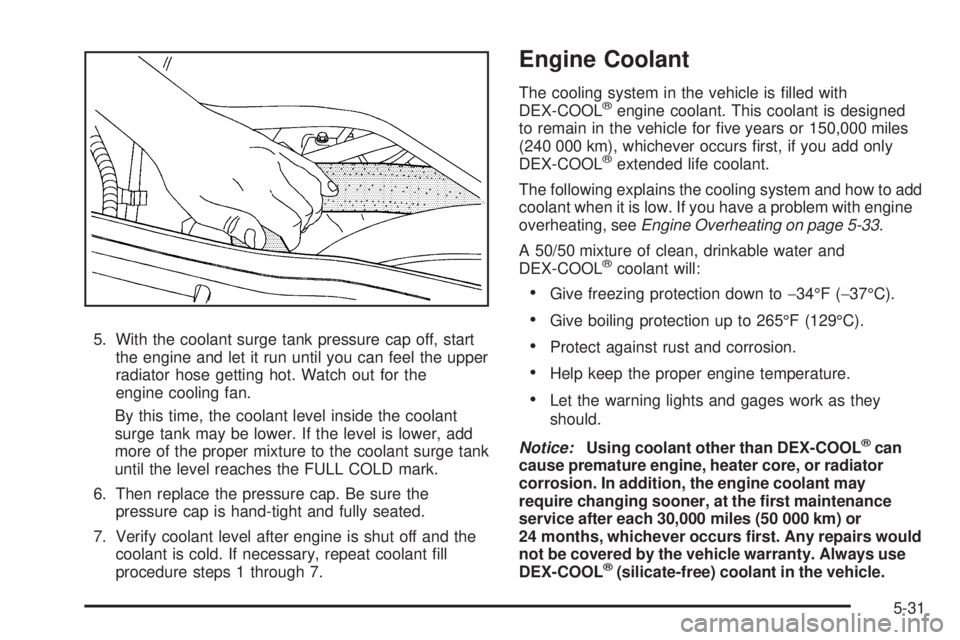
5. With the coolant surge tank pressure cap off, start
the engine and let it run until you can feel the upper
radiator hose getting hot. Watch out for the
engine cooling fan.
By this time, the coolant level inside the coolant
surge tank may be lower. If the level is lower, add
more of the proper mixture to the coolant surge tank
until the level reaches the FULL COLD mark.
6. Then replace the pressure cap. Be sure the
pressure cap is hand-tight and fully seated.
7. Verify coolant level after engine is shut off and the
coolant is cold. If necessary, repeat coolant ll
procedure steps 1 through 7.
Engine Coolant
The cooling system in the vehicle is lled with
DEX-COOL®engine coolant. This coolant is designed
to remain in the vehicle for ve years or 150,000 miles
(240 000 km), whichever occurs rst, if you add only
DEX-COOL
®extended life coolant.
The following explains the cooling system and how to add
coolant when it is low. If you have a problem with engine
overheating, seeEngine Overheating on page 5-33.
A 50/50 mixture of clean, drinkable water and
DEX-COOL
®coolant will:
Give freezing protection down to−34°F (−37°C).
Give boiling protection up to 265°F (129°C).
Protect against rust and corrosion.
Help keep the proper engine temperature.
Let the warning lights and gages work as they
should.
Notice:Using coolant other than DEX-COOL
®can
cause premature engine, heater core, or radiator
corrosion. In addition, the engine coolant may
require changing sooner, at the rst maintenance
service after each 30,000 miles (50 000 km) or
24 months, whichever occurs rst. Any repairs would
not be covered by the vehicle warranty. Always use
DEX-COOL
®(silicate-free) coolant in the vehicle.
5-31
Page 392 of 524

Brakes
Brake Fluid
The brake master cylinder
reservoir is lled with
DOT-3 brake uid. See
Engine Compartment
Overview on page 5-14
for the location of the
reservoir.
There are only two reasons why the brake uid level in
the reservoir might go down:
The brake uid level goes down because of normal
brake lining wear. When new linings are installed,
the uid level goes back up.
A uid leak in the brake hydraulic system can also
cause a low uid level. Have the brake hydraulic
system xed, since a leak means that sooner
or later the brakes will not work well.Do not top off the brake uid. Adding uid does not
correct a leak. If uid is added when the linings
are worn, there will be too much uid when new brake
linings are installed. Add or remove brake uid, as
necessary, only when work is done on the brake
hydraulic system.
{CAUTION:
If too much brake uid is added, it can spill on the
engine and burn, if the engine is hot enough. You
or others could be burned, and the vehicle could
be damaged. Add brake uid only when work is
done on the brake hydraulic system. See
“Checking Brake Fluid” in this section.
Refer to the Maintenance Schedule to determine when
to check the brake uid. SeeScheduled Maintenance
on page 6-4.
5-38
Page 395 of 524

Replacing Brake System Parts
The braking system on a vehicle is complex. Its many
parts have to be of top quality and work well together if
the vehicle is to have really good braking. The vehicle
was designed and tested with top-quality brake parts.
When parts of the braking system are replaced — for
example, when the brake linings wear down and new
ones are installed — be sure to get new approved
replacement parts. If this is not done, the brakes might
not work properly. For example, if someone puts in brake
linings that are wrong for the vehicle, the balance
between the front and rear brakes can change — for the
worse. The braking performance expected can change in
many other ways if the wrong replacement brake parts
are installed.
Battery
This vehicle has a maintenance free battery. When it is
time for a new battery, see your dealer/retailer for
one that has the replacement number shown on the
original battery’s label. SeeEngine Compartment
Overview on page 5-14for battery location.
Warning:Battery posts, terminals, and related
accessories contain lead and lead compounds,
chemicals known to the State of California to cause
cancer and reproductive harm. Wash hands after
handling.
5-41