air condition HUMMER H2 2009 Owner's Guide
[x] Cancel search | Manufacturer: HUMMER, Model Year: 2009, Model line: H2, Model: HUMMER H2 2009Pages: 524, PDF Size: 3.1 MB
Page 426 of 524

You need new tires if any of the following statements
are true:
You can see the indicators at three or more places
around the tire.
You can see cord or fabric showing through the
tire’s rubber.
The tread or sidewall is cracked, cut, or snagged
deep enough to show cord or fabric.
The tire has a bump, bulge, or split.
The tire has a puncture, cut, or other damage that
cannot be repaired well because of the size or
location of the damage.
The rubber in tires degrades over time, even if they are
not being used. This is also true for the spare tire, if
your vehicle has one. Multiple conditions affect how fast
this aging takes place, including temperatures, loading
conditions, and ination pressure maintenance. With
proper care and maintenance tires will typically wear out
before they degrade due to age. If you are unsure
about the need to replace your tires as they get older,
consult the tire manufacturer for more information.
Buying New Tires
GM has developed and matched specic tires for
your vehicle. The original equipment tires installed
on your vehicle, when it was new, were designed to
meet General Motors Tire Performance Criteria
Specication (TPC spec) system rating. If you need
replacement tires, GM strongly recommends that
you get tires with the same TPC Spec rating. This
way, your vehicle will continue to have tires that are
designed to give the same performance and vehicle
safety, during normal use, as the original tires.
GM’s exclusive TPC Spec system considers over a
dozen critical specications that impact the overall
performance of your vehicle, including brake
system performance, ride and handling, traction
control, and tire pressure monitoring performance.
GM’s TPC Spec number is molded onto the tire’s
sidewall near the tire size. If the tires have an
all-season tread design, the TPC spec number will
be followed by a MS, for mud and snow. SeeTire
Sidewall Labeling on page 5-58for additional
information.
5-72
Page 430 of 524

Temperature – A, B, C
The temperature grades are A (the highest), B,
and C, representing the tire’s resistance to the
generation of heat and its ability to dissipate heat
when tested under controlled conditions on a
specied indoor laboratory test wheel. Sustained
high temperature can cause the material of the tire
to degenerate and reduce tire life, and excessive
temperature can lead to sudden tire failure. The
grade C corresponds to a level of performance
which all passenger car tires must meet under the
Federal Motor Vehicle Safety Standard No. 109.
Grades B and A represent higher levels of
performance on the laboratory test wheel than the
minimum required by law.
{WARNING:
The temperature grade for this tire is
established for a tire that is properly inated
and not overloaded. Excessive speed,
underination, or excessive loading, either
separately or in combination, can cause heat
buildup and possible tire failure.
Wheel Alignment and Tire Balance
The tires and wheels on your vehicle were aligned
and balanced carefully at the factory to give you
the longest tire life and best overall performance.
Adjustments to wheel alignment and tire balancing will
not be necessary on a regular basis. However, if
you notice unusual tire wear or your vehicle pulling to
one side or the other, the alignment might need to
be checked. If you notice your vehicle vibrating when
driving on a smooth road, the tires and wheels
might need to be rebalanced. See your dealer/retailer
for proper diagnosis.
Wheel Replacement
Replace any wheel that is bent, cracked, or badly rusted
or corroded. If wheel nuts keep coming loose, the wheel,
wheel bolts, and wheel nuts should be replaced. If the
wheel leaks air, replace it (except some aluminum
wheels, which can sometimes be repaired). See your
dealer/retailer if any of these conditions exist.
Your dealer/retailer will know the kind of wheel you need.
Each new wheel should have the same load-carrying
capacity, diameter, width, offset, and be mounted
the same way as the one it replaces.
5-76
Page 461 of 524

Windshield, Backglass, and Wiper
Blades
Clean the outside of the windshield and backglass with
glass cleaner.
Clean the rubber blades using a lint free cloth or paper
towel soaked with windshield washer uid or a mild
detergent. Wash the windshield thoroughly when you
clean the blades. Bugs, road grime, sap and a buildup of
vehicle wash/wax treatments may cause wiper streaking.
Replace the wiper blades if they are worn or damaged.
Wipers can be damaged by:
Extreme dusty conditions
Sand and salt
Heat and sun
Snow and ice, without proper removal
Aluminum Wheels
Notice:Using strong soaps, chemicals, abrasive
polishes, cleaners, brushes, or cleaners that contain
acid on aluminum or chrome-plated wheels, could
damage the surface of the wheel(s). The repairs
would not be covered by the warranty. Use
only approved cleaners on aluminum or
chrome-plated wheels.Keep the wheels clean using a soft clean cloth with mild
soap and water. Rinse with clean water. After rinsing
thoroughly, dry with a soft clean towel. A wax may then
be applied.
Notice:Using chrome polish on aluminum wheels
could damage the wheels. The repairs would not
be covered by the warranty. Use chrome polish on
chrome wheels only.
The surface of these wheels is similar to the painted
surface of the vehicle. Do not use strong soaps,
chemicals, abrasive polishes, abrasive cleaners,
cleaners with acid, or abrasive cleaning brushes on
them because the surface could be damaged. Do not
use chrome polish on aluminum wheels.
Notice:Driving the vehicle through an automatic
car wash that has silicone carbide tire cleaning
brushes, could damage the aluminum or
chrome-plated wheels. The repairs would not be
covered by the warranty. Never drive a vehicle
equipped with aluminum or chrome-plated wheels
through an automatic car wash that uses silicone
carbide tire cleaning brushes.
5-107
Page 462 of 524

Tires
To clean the tires, use a stiff brush with tire cleaner.
Notice:Using petroleum-based tire dressing
products on the vehicle may damage the paint nish
and/or tires. When applying a tire dressing, always
wipe off any overspray from all painted surfaces
on the vehicle.
Sheet Metal Damage
If the vehicle is damaged and requires sheet metal
repair or replacement, make sure the body repair shop
applies anti-corrosion material to parts repaired or
replaced to restore corrosion protection.
Original manufacturer replacement parts will provide
the corrosion protection while maintaining the vehicle
warranty.
Finish Damage
Any stone chips, fractures or deep scratches in the nish
should be repaired right away. Bare metal will corrode
quickly and may develop into major repair expense.
Minor chips and scratches can be repaired with touch-up
materials available from your dealer/retailer. Larger
areas of nish damage can be corrected in your
dealer’s/retailer’s body and paint shop.
Underbody Maintenance
Chemicals used for ice and snow removal and dust
control can collect on the underbody. If these are not
removed, corrosion and rust can develop on the
underbody parts such as fuel lines, frame, oor pan, and
exhaust system even though they have corrosion
protection.
At least every spring, ush these materials from the
underbody with plain water. Clean any areas where mud
and debris can collect. Dirt packed in close areas of
the frame should be loosened before being ushed.
Your dealer/retailer or an underbody car washing system
can do this.
Chemical Paint Spotting
Some weather and atmospheric conditions can create a
chemical fallout. Airborne pollutants can fall upon and
attack painted surfaces on the vehicle. This damage can
take two forms: blotchy, ring-shaped discolorations, and
small, irregular dark spots etched into the paint surface.
Although no defect in the paint job causes this, we will
repair, at no charge to the owner, the surfaces of
new vehicles damaged by this fallout condition within
12 months or 12,000 miles (20 000 km) of purchase,
whichever occurs rst.
5-108
Page 469 of 524

Fuses Usage
9 Left Low-Beam Headlamp
10 Engine Control Module (Battery)
11Fuel Injectors, Ignition Coils
(Right Side)
12Transmission Control Module
(Battery)
13 Vehicle Back-up Lamps
14 Right Low-Beam Headlamp
15 Air Conditioning Compressor
16 Oxygen Sensors
17 Transmission Controls (Ignition)
18 Fuel Pump
19 Rear Washer
20Fuel Injectors, Ignition Coils
(Left Side)
21 Trailer Park Lamps
22 Left Park Lamps
23 Right Park Lamps
24 Horn
25 Right Side High-Beam Headlamp
26 Daytime Running Lamps (DRL)
27 Left High-Beam Headlamp
28 SunroofFuses Usage
29Key Ignition System, Theft Deterrent
System
30 Windshield Wiper
31 SEO B2 Uptter Usage (Battery)
32Electrically Controlled Air
Suspension
33 Climate Controls (Battery)
34 Airbag System (Ignition)
35 Amplier
36 Audio System
37Miscellaneous (Ignition), Cruise
Control, Rear Vision Camera
38 Airbag System (Battery)
39 Instrument Panel Cluster
40 Run, Accessory
41 Auxiliary Climate Control (Ignition)
42 Rear Defogger
43 SEO B1 Uptter Usage (Battery)
44Cigarette Lighter, Auxiliary Power
Outlet
45 Special Equipment Option (SEO)
46 Climate Controls (Ignition)
47 Engine Control Module (Ignition)
5-115
Page 470 of 524

Fuses Usage
50 Cooling Fan 1 (J-Case)
51Electronically Controlled Air
Suspension (J-Case)
52Vehicle Stability System, Antilock
Brake System-1 (J-Case)
53 Cooling Fan 2 (J-Case)
54 Starter (J-Case)
55Stud 2 Trailer Brake Module
(J-Case)
56Left Bussed Electrical Center 1
(J-Case)
57Heated Windshield Washer System
(J-Case)
58 Four-Wheel Drive System (J-Case)
59Stud 1 Trailer Connector Battery
Power (J-Case)Fuses Usage
60Mid Bussed Electrical Center 1
(J-Case)
61 Climate Control Blower (J-Case)
62Left Bussed Electrical Center 2
(J-Case)
Relays Usage
A/C CMPRSR Air Conditioning Compressor
FAN CNTRL Cooling Fan Control
FAN HI Cooling Fan High Speed
FAN LO Cooling Fan Low Speed
HDLP LO Low-Beam Headlamp
PRK LAMP Parking Lamps
PWR/TRN Powertrain
REAR DEFOG Rear Defogger
RUN/CRNK Switched Power
STRTR Starter
5-116
Page 471 of 524
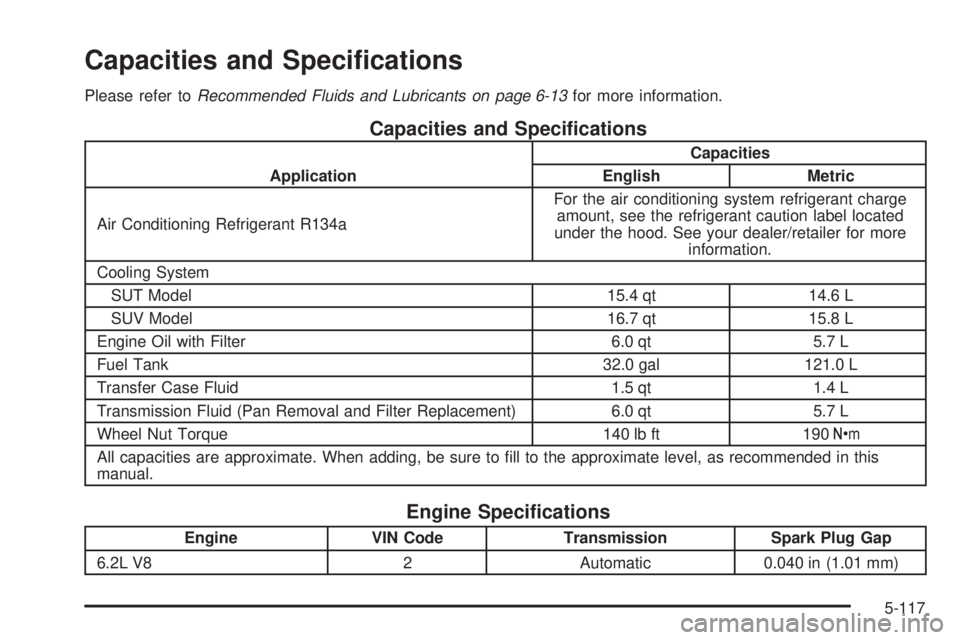
Capacities and Specications
Please refer toRecommended Fluids and Lubricants on page 6-13for more information.
Capacities and Specications
ApplicationCapacities
English Metric
Air Conditioning Refrigerant R134aFor the air conditioning system refrigerant charge
amount, see the refrigerant caution label located
under the hood. See your dealer/retailer for more
information.
Cooling System
SUT Model 15.4 qt 14.6 L
SUV Model 16.7 qt 15.8 L
Engine Oil with Filter 6.0 qt 5.7 L
Fuel Tank 32.0 gal 121.0 L
Transfer Case Fluid 1.5 qt 1.4 L
Transmission Fluid (Pan Removal and Filter Replacement) 6.0 qt 5.7 L
Wheel Nut Torque 140 lb ft 190Y
All capacities are approximate. When adding, be sure to ll to the approximate level, as recommended in this
manual.
Engine Specications
Engine VIN Code Transmission Spark Plug Gap
6.2L V8 2 Automatic 0.040 in (1.01 mm)
5-117
Page 474 of 524

Maintenance Schedule
Introduction
Important: Keep engine oil at the proper level and
change as recommended.
Have you purchased the GM Protection Plan? The Plan
supplements the vehicle warranties. See the Warranty
and Owner Assistance booklet or your dealer/retailer for
details.
Maintenance Requirements
Notice:Maintenance intervals, checks, inspections,
replacement parts, and recommended uids and
lubricants as prescribed in this manual are necessary
to keep this vehicle in good working condition.
Any damage caused by failure to follow scheduled
maintenance might not be covered by the vehicle
warranty.
Your Vehicle and the Environment
Proper vehicle maintenance not only helps to keep
the vehicle in good working condition, but also helps
the environment. All recommended maintenance is
important. Improper vehicle maintenance can even affect
the quality of the air we breathe. Improper uid levels or
the wrong tire ination can increase the level of emissions
from the vehicle. To help protect the environment, and to
keep the vehicle in good condition, be sure to maintain
the vehicle properly.
6-2
Page 476 of 524
Owner Checks and Services on page 6-9tells what
should be checked, when to check it, and what can easily
be done to help keep the vehicle in good condition.
The proper replacement parts, uids, and lubricants to
use are listed inRecommended Fluids and Lubricants
on page 6-13andMaintenance Replacement Parts
on page 6-15. When the vehicle is serviced, make sure
these are used. All parts should be replaced and all
necessary repairs done before you or anyone else
drives the vehicle. We recommend the use of genuine
parts from your dealer/retailer.
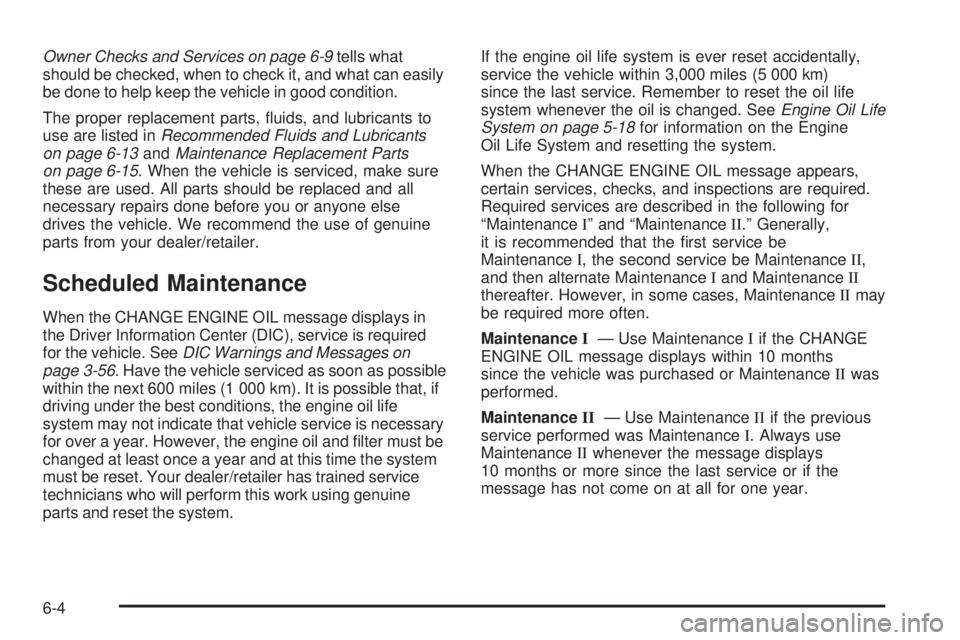
Scheduled Maintenance
When the CHANGE ENGINE OIL message displays in
the Driver Information Center (DIC), service is required
for the vehicle. SeeDIC Warnings and Messages on
page 3-56. Have the vehicle serviced as soon as possible
within the next 600 miles (1 000 km). It is possible that, if
driving under the best conditions, the engine oil life
system may not indicate that vehicle service is necessary
for over a year. However, the engine oil and lter must be
changed at least once a year and at this time the system
must be reset. Your dealer/retailer has trained service
technicians who will perform this work using genuine
parts and reset the system.If the engine oil life system is ever reset accidentally,
service the vehicle within 3,000 miles (5 000 km)
since the last service. Remember to reset the oil life
system whenever the oil is changed. SeeEngine Oil Life
System on page 5-18for information on the Engine
Oil Life System and resetting the system.
When the CHANGE ENGINE OIL message appears,
certain services, checks, and inspections are required.
Required services are described in the following for
“MaintenanceI” and “MaintenanceII.” Generally,
it is recommended that the rst service be
MaintenanceI, the second service be MaintenanceII,
and then alternate MaintenanceIand MaintenanceII
thereafter. However, in some cases, MaintenanceIImay
be required more often.
MaintenanceI— Use MaintenanceIif the CHANGE
ENGINE OIL message displays within 10 months
since the vehicle was purchased or MaintenanceIIwas
performed.
MaintenanceII— Use MaintenanceIIif the previous
service performed was MaintenanceI. Always use
MaintenanceIIwhenever the message displays
10 months or more since the last service or if the
message has not come on at all for one year.
6-4
Page 477 of 524

Scheduled Maintenance
Service MaintenanceIMaintenanceII
Change engine oil and lter. SeeEngine Oil on page 5-15. Reset oil life system.
SeeEngine Oil Life System on page 5-18.An Emission Control Service.••
Lubricate chassis components.See footnote #.••
Visually check for any leaks or damage.See footnote (j).••
For vehicles driven in dusty/dirty conditions: Inspect engine air cleaner lter.
If necessary, replace lter. SeeEngine Air Cleaner/Filter on page 5-20.•
Rotate tires and check ination pressures and wear. SeeTire Inspection and
Rotation on page 5-69and “Tire Wear Inspection” inAt Least Once a Month on
page 6-10.••
Inspect brake system.See footnote (a).••
Check engine coolant and windshield washer uid levels and add uid as
needed.••
Perform any needed additional services. See “Additional Required Services”
in this section.••
Inspect suspension and steering components.See footnote (b).•
Inspect engine cooling system.See footnote (c).•
Inspect wiper blades.See footnote (d).•
Inspect restraint system components.See footnote (e).•
Lubricate body components.See footnote (f).•
Check transmission uid level and add uid as needed.•
6-5