ECU HUMMER H2 2009 Workshop Manual
[x] Cancel search | Manufacturer: HUMMER, Model Year: 2009, Model line: H2, Model: HUMMER H2 2009Pages: 524, PDF Size: 3.1 MB
Page 350 of 524
Before starting, check all trailer hitch parts and
attachments, safety chains, electrical connectors, lamps,
tires and mirror adjustments. If the trailer has electric
brakes, start the vehicle and trailer moving and then
apply the trailer brake controller by hand to be sure the
brakes are working. This checks the electrical connection
at the same time.
During the trip, check occasionally to be sure that the
load is secure, and that the lamps and any trailer brakes
are still working.
Following Distance
Stay at least twice as far behind the vehicle ahead as
you would when driving the vehicle without a trailer. This
can help to avoid situations that require heavy braking
and sudden turns.
Passing
More passing distance is needed when towing a trailer.
Because the rig is longer, it is necessary to go much
farther beyond the passed vehicle before returning to
the lane.
Backing Up
Hold the bottom of the steering wheel with one hand.
Then, to move the trailer to the left, move that hand
to the left. To move the trailer to the right, move your
hand to the right. Always back up slowly and, if possible,
have someone guide you.
4-64
Page 410 of 524
Windshield Wiper Blade
Replacement
Windshield wiper blades should be inspected for wear
and cracking. SeeScheduled Maintenance on page 6-4
for more information.
Replacement blades come in different types and are
removed in different ways. For proper type and length,
seeMaintenance Replacement Parts on page 6-15.
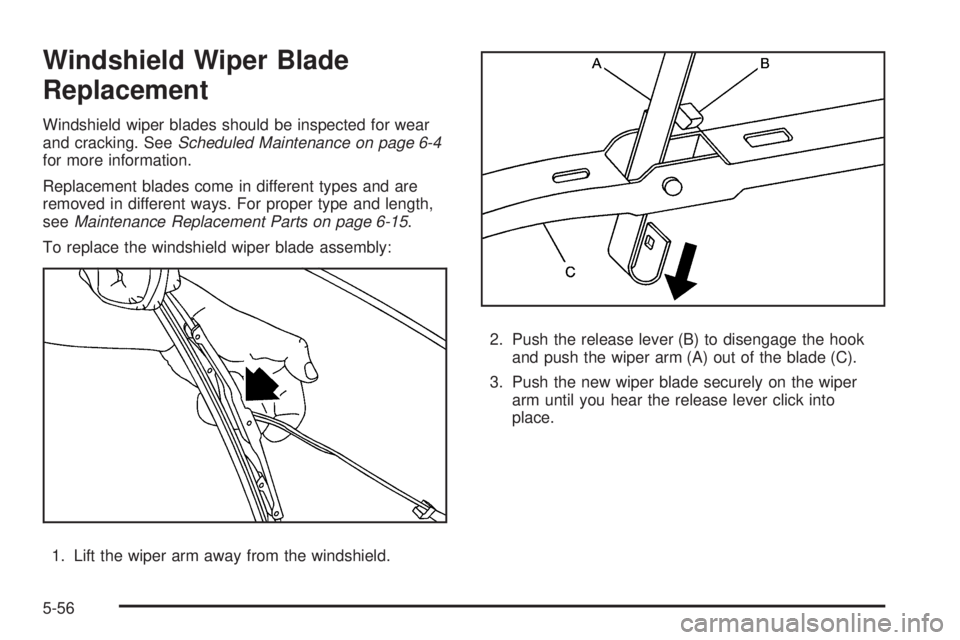
To replace the windshield wiper blade assembly:
1. Lift the wiper arm away from the windshield.2. Push the release lever (B) to disengage the hook
and push the wiper arm (A) out of the blade (C).
3. Push the new wiper blade securely on the wiper
arm until you hear the release lever click into
place.
5-56
Page 425 of 524
Reset the Tire Pressure Monitor System. SeeTire
Pressure Monitor Operation on page 5-66.
Make certain that all wheel nuts are properly
tightened. See “Wheel Nut Torque” under
Capacities and Specifications on page 5-117.
{CAUTION:
Rust or dirt on a wheel, or on the parts to
which it is fastened, can make wheel nuts
become loose after time. The wheel could
come off and cause an accident. When you
change a wheel, remove any rust or dirt from
places where the wheel attaches to the
vehicle. In an emergency, you can use a
cloth or a paper towel to do this; but be sure
to use a scraper or wire brush later, if
needed, to get all the rust or dirt off. See
Changing a Flat Tire on page 5-80.
Make sure the spare tire is stored securely. Push,
pull, and then try to rotate or turn the tire. See
Storing a Flat or Spare Tire and Tools (SUT) on
page 5-95orStoring a Flat or Spare Tire and
Tools (SUV) on page 5-98.
When It Is Time for New Tires
Various factors, such as maintenance, temperatures,
driving speeds, vehicle loading, and road conditions,
inuence when you need new tires.
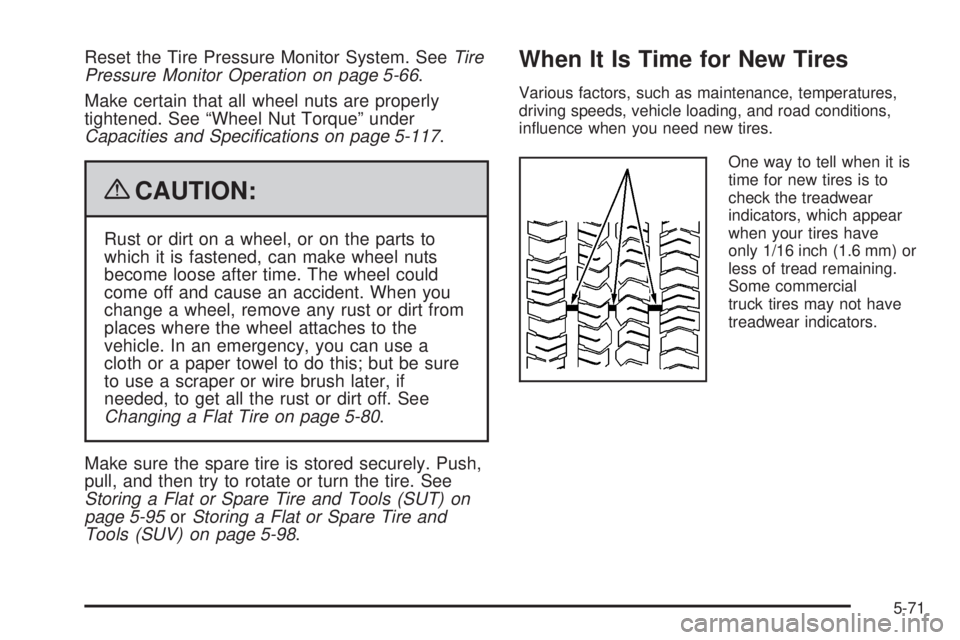
One way to tell when it is
time for new tires is to
check the treadwear
indicators, which appear
when your tires have
only 1/16 inch (1.6 mm) or
less of tread remaining.
Some commercial
truck tires may not have
treadwear indicators.
5-71
Page 431 of 524

If you need to replace any of your wheels, wheel bolts,
wheel nuts, or Tire Pressure Monitor System (TPMS)
sensors, replace them only with new GM original
equipment parts. This way, you will be sure to have the
right wheel, wheel bolts, wheel nuts, and TPMS
sensors for your vehicle.
{CAUTION:
Using the wrong replacement wheels, wheel bolts,
or wheel nuts on your vehicle can be dangerous. It
could affect the braking and handling of your
vehicle, make your tires lose air and make you
lose control. You could have a collision in which
you or others could be injured. Always use the
correct wheel, wheel bolts, and wheel nuts for
replacement.
Notice:The wrong wheel can also cause problems
with bearing life, brake cooling, speedometer or
odometer calibration, headlamp aim, bumper height,
vehicle ground clearance, and tire or tire chain
clearance to the body and chassis.
SeeChanging a Flat Tire on page 5-80for more
information.
Used Replacement Wheels
{CAUTION:
Putting a used wheel on the vehicle is dangerous.
You cannot know how it has been used or how far
it has been driven. It could fail suddenly and
cause a crash. If you have to replace a wheel, use
a new GM original equipment wheel.
Tire Chains
Notice:Use tire chains only where legal and only
when you must. Use chains that are the proper size
for the vehicle’s tires. Install them on the tires of
the rear axle. Do not use chains on the tires of the
front axle. Tighten them as tightly as possible
with the ends securely fastened. Drive slowly and
follow the chain manufacturer’s instructions. If
you can hear the chains contacting the vehicle, stop
and retighten them. If the contact continues, slow
down until it stops. Driving too fast or spinning the
wheels with chains on will damage the vehicle.
5-77
Page 446 of 524

Rear Flat Tire:Place the jack under the curved
rear axle pad. Make sure the jack head is positioned
so that the rear axle pad is resting securely on
the jack head.
{CAUTION:
Getting under a vehicle when it is jacked up is
dangerous. If the vehicle slips off the jack, you
could be badly injured or killed. Never get under a
vehicle when it is supported only by a jack.
{CAUTION:
Raising your vehicle with the jack improperly
positioned can damage the vehicle and even
make the vehicle fall. To help avoid personal injury
and vehicle damage, be sure to t the jack lift
head into the proper location before raising the
vehicle.
8. Turn the wheel wrench clockwise to raise the
vehicle. Raise the vehicle far enough off the ground
so there is enough room for the spare tire to
clear the ground. Rear Flat Tire – Jack
5-92
Page 450 of 524

4. Use the wheel wrench and the wheel wrench
extension to tighten the nuts rmly. Try to move the
tire back and forth slightly to be sure it is secure.
5. Slide the license plate holder onto the spare or at
tire. Secure it from the back of the tire carrier with
the wing nut.
If you choose not to reinstall the spare or at tire on
the vehicle, you will still need to reinstall the
license plate holder on the spare tire carrier.
5-96
Page 451 of 524

Storing the Jack and Tools
To store the jack and tools:
1. Lower the jack completely.
2. Place the jack in the mounting bracket.
3. Turn the hole at the top of the jack clockwise until
the jack is held tight in the mounting bracket.
4. Push and pull on the jack and retighten if necessary
to make sure the jack is secure.
5. Place the wheel blocks in the tool bag.6. Place the remaining tools in the tool bag.
7. Make sure nothing is located under or in front of the
seat and then lift the rear driver’s side second row
seat so that the oor is exposed.
8. Place the narrow end of the tool bag under the seat
rails as shown. Slide the tool bag under the rear seat.
Be careful not to pinch the seat cables or electrical
harnesses.
9. Reinstall the strap to the seat rail.
10. Return the seat to the correct position.
5-97
Page 452 of 524

Storing a Flat or Spare Tire and
Tools (SUV)
Storing the Flat or Spare Tire
Use the following art and text to help store the spare or
at tire back into its proper location when done
changing a tire.
To store the at or spare tire on the tire carrier:
1. Close the tire carrier. SeeTailgate/Spare Tire
Carrier on page 2-16for tire carrier operation.
2. Place the at or spare tire onto the tire carrier with
the outside of the wheel facing out.
3. Reinstall the wheel nuts holding the spare or the at
tire to the tire carrier. Tighten the nuts by hand.4. Use the wheel wrench and wheel wrench extension
to tighten the nuts rmly.
5. Try to move the tire back and forth slightly to make
sure it is secure.
5-98
Page 453 of 524

6. Slide the license plate holder onto the spare or at
tire. Secure it from the back of the tire carrier with
the wing nut.
If you choose not to reinstall the spare or at tire on
the vehicle, you still need to reinstall the license
plate holder on the spare tire carrier.
Storing the Jack and Tools
To store the jack and tools:
1. Lower the jack completely.
2. Place the jack in the mounting bracket.
3. Turn the hole at the top of the jack clockwise until
the jack is held tight in the mounting bracket.
4. Push and pull on the jack and retighten if necessary
to make sure the jack is secure.
5-99
Page 454 of 524

5. Replace the trim cover. Make sure the latches are
pushed down.
6. Place all the tools, except for the wheel blocks, in
the tool bag.
7. Place the tool bag in the storage area.8. Use the wheel blocks (B) to secure the tool bag (A)
to the bracket.
9. Turn the retainer nut (C) clockwise to secure the
wheel blocks (B) and tool bag (A) into place.
5-100