mirror HUMMER H3 2006 User Guide
[x] Cancel search | Manufacturer: HUMMER, Model Year: 2006, Model line: H3, Model: HUMMER H3 2006Pages: 410, PDF Size: 2.61 MB
Page 237 of 410

Freeway Driving
Mile for mile, freeways — also called thruways, parkways,
expressways, turnpikes, or superhighways — are the
safest of all roads. But they have their own special rules.The most important advice on freeway driving is: Keep
up with traffic and keep to the right. Drive at the
same speed most of the other drivers are driving.
Too-fast or too-slow driving breaks a smooth traffic ow.
Treat the left lane on a freeway as a passing lane.
At the entrance, there is usually a ramp that leads to the
freeway. If you have a clear view of the freeway as you
drive along the entrance ramp, you should begin to check
traffic. Try to determine where you expect to blend with
the ow. Try to merge into the gap at close to the
prevailing speed. Switch on your turn signal, check your
mirrors, and glance over your shoulder as often as
necessary. Try to blend smoothly with the traffic ow.
Once you are on the freeway, adjust your speed to the
posted limit or to the prevailing rate if it is slower.
Stay in the right lane unless you want to pass.
Before changing lanes, check your mirrors. Then use
your turn signal.
Just before you leave the lane, glance quickly over your
shoulder to make sure there is not another vehicle in
your blind spot.
4-41
Page 239 of 410

Highway Hypnosis
Is there actually such a condition as highway hypnosis?
Or is it just plain falling asleep at the wheel? Call it
highway hypnosis, lack of awareness, or whatever.
There is something about an easy stretch of road with
the same scenery, along with the hum of the tires on the
road, the drone of the engine, and the rush of the
wind against the vehicle that can make you sleepy. Do
not let it happen to you! If it does, your vehicle can
leave the road in less than a second, and you could
crash and be injured.
What can you do about highway hypnosis? First, be
aware that it can happen.
Then here are some tips:
Make sure your vehicle is well ventilated, with a
comfortably cool interior.
Keep your eyes moving. Scan the road ahead and
to the sides. Check your mirrors and your
instruments frequently.
If you get sleepy, pull off the road into a rest,
service, or parking area and take a nap, get some
exercise, or both. For safety, treat drowsiness
on the highway as an emergency.
Hill and Mountain Roads
Driving on steep hills or mountains is different from
driving in at or rolling terrain.
4-43
Page 262 of 410

And always keep in mind that the vehicle you are
driving is now a good deal longer and not nearly as
responsive as your vehicle is by itself.
Before you start, check all trailer hitch parts and
attachments, safety chains, electrical connector, lamps,
tires and mirror adjustment. If the trailer has electric
brakes, start your vehicle and trailer moving and then
apply the trailer brake controller by hand to be sure
the brakes are working. This lets you check your
electrical connection at the same time.
During your trip, check occasionally to be sure that the
load is secure, and that the lamps and any trailer
brakes are still working.
Following Distance
Stay at least twice as far behind the vehicle ahead as
you would when driving your vehicle without a trailer.
This can help you avoid situations that require
heavy braking and sudden turns.
Passing
You’ll need more passing distance up ahead when
you’re towing a trailer. Because you’re a good
deal longer, you’ll need to go much farther beyond the
passed vehicle before you can return to your lane.
Backing Up
Hold the bottom of the steering wheel with one hand.
Then, to move the trailer to the left, just move that hand
to the left. To move the trailer to the right, move your
hand to the right. Always back up slowly and, if possible,
have someone guide you.
Making Turns
Notice:Making very sharp turns while trailering
could cause the trailer to come in contact with the
vehicle. Your vehicle could be damaged. Avoid
making very sharp turns while trailering.
When you’re turning with a trailer, make wider turns than
normal. Do this so your trailer won’t strike soft shoulders,
curbs, road signs, trees or other objects. Avoid jerky or
sudden maneuvers. Signal well in advance.
Turn Signals When Towing a Trailer
The arrows on your instrument panel will ash whenever
you signal a turn or lane change. Properly hooked up,
the trailer lamps will also ash, telling other drivers
you’re about to turn, change lanes or stop.
When towing a trailer, the arrows on your instrument
panel will ash for turns even if the bulbs on the trailer
are burned out. Thus, you may think drivers behind
you are seeing your signal when they are not. It’s
important to check occasionally to be sure the trailer
bulbs are still working.
4-66
Page 366 of 410

Fuse Usage
35 Cruise, Inside Rearview Mirror
36 Horn
37 Driver’s Side Rear Park Lamp
38 Amplier
39 Spare 7
40 Passenger’s Side Headlamp
41 Driver’s Side Headlamp
42 Trailer Back-Up Lamp
43 Front Park Lamps
44 Not Used
45 Auxiliary Power 2
46 Electronic Throttle Control
47 Oxygen Sensor
48 Air Conditioning Clutch
49 Passenger’s Side Rear Park Lamp
50 XM™ Satellite Radio
51 Auxiliary Power 1Fuse Usage
52 StabiliTrak
®, Anti-lock Brakes
53 Power Heater Switch
54 Stop
55 Trailer Parking Lamps
56 Front Turn Signal, Hazard Signal
57 Power Sunroof
58Transfer Case Control Module
Switch
59 Climate Control
60 Spare 8
61 Power Seats
62 Air Pump
63 Passenger’s Side Power Window
64Anti-lock Brakes, StabiliTrak
®2
Motor
67Anti-lock Brakes, StabiliTrak
®1
Solenoid
68 Driver’s Side Power Window
5-100
Page 404 of 410
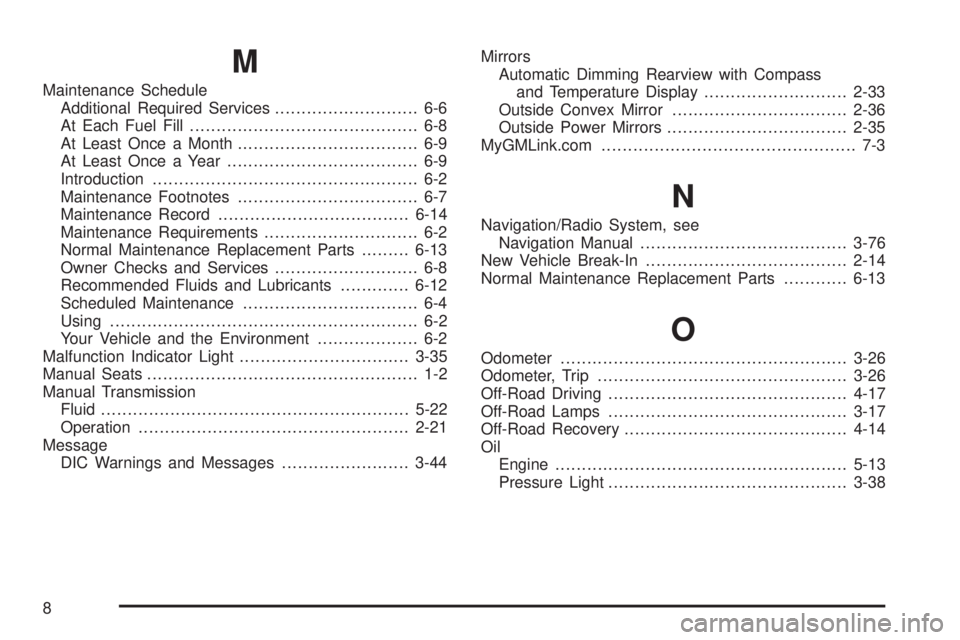
M
Maintenance Schedule
Additional Required Services........................... 6-6
At Each Fuel Fill........................................... 6-8
At Least Once a Month.................................. 6-9
At Least Once a Year.................................... 6-9
Introduction.................................................. 6-2
Maintenance Footnotes.................................. 6-7
Maintenance Record....................................6-14
Maintenance Requirements............................. 6-2
Normal Maintenance Replacement Parts.........6-13
Owner Checks and Services........................... 6-8
Recommended Fluids and Lubricants.............6-12
Scheduled Maintenance................................. 6-4
Using.......................................................... 6-2
Your Vehicle and the Environment................... 6-2
Malfunction Indicator Light................................3-35
Manual Seats................................................... 1-2
Manual Transmission
Fluid..........................................................5-22
Operation...................................................2-21
Message
DIC Warnings and Messages........................3-44Mirrors
Automatic Dimming Rearview with Compass
and Temperature Display...........................2-33
Outside Convex Mirror.................................2-36
Outside Power Mirrors..................................2-35
MyGMLink.com................................................ 7-3
N
Navigation/Radio System, see
Navigation Manual.......................................3-76
New Vehicle Break-In......................................2-14
Normal Maintenance Replacement Parts............6-13
O
Odometer......................................................3-26
Odometer, Trip...............................................3-26
Off-Road Driving.............................................4-17
Off-Road Lamps.............................................3-17
Off-Road Recovery..........................................4-14
Oil
Engine.......................................................5-13
Pressure Light.............................................3-38
8
Page 405 of 410
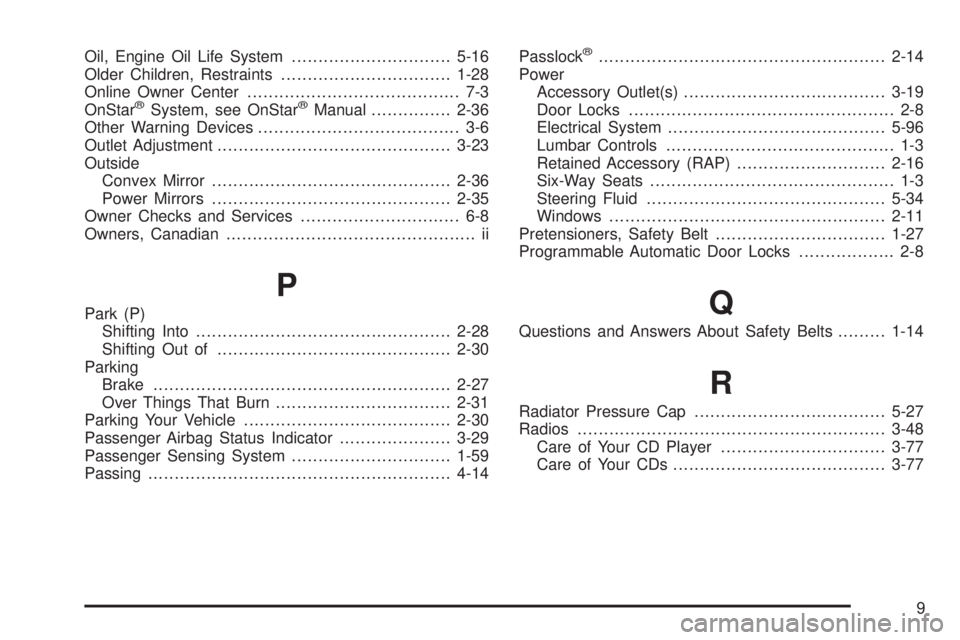
Oil, Engine Oil Life System..............................5-16
Older Children, Restraints................................1-28
Online Owner Center........................................ 7-3
OnStar
®System, see OnStar®Manual...............2-36
Other Warning Devices...................................... 3-6
Outlet Adjustment............................................3-23
Outside
Convex Mirror.............................................2-36
Power Mirrors.............................................2-35
Owner Checks and Services.............................. 6-8
Owners, Canadian............................................... ii
P
Park (P)
Shifting Into................................................2-28
Shifting Out of............................................2-30
Parking
Brake........................................................2-27
Over Things That Burn.................................2-31
Parking Your Vehicle.......................................2-30
Passenger Airbag Status Indicator.....................3-29
Passenger Sensing System..............................1-59
Passing.........................................................4-14Passlock
®......................................................2-14
Power
Accessory Outlet(s)......................................3-19
Door Locks.................................................. 2-8
Electrical System.........................................5-96
Lumbar Controls........................................... 1-3
Retained Accessory (RAP)............................2-16
Six-Way Seats.............................................. 1-3
Steering Fluid.............................................5-34
Windows....................................................2-11
Pretensioners, Safety Belt................................1-27
Programmable Automatic Door Locks.................. 2-8
Q
Questions and Answers About Safety Belts.........1-14
R
Radiator Pressure Cap....................................5-27
Radios..........................................................3-48
Care of Your CD Player...............................3-77
Care of Your CDs........................................3-77
9
Page 406 of 410
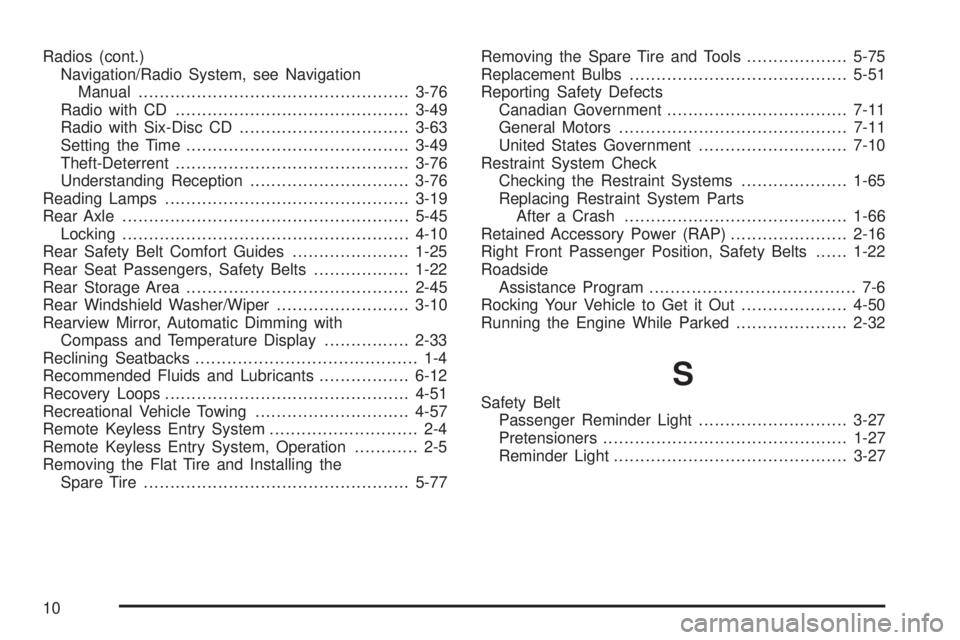
Radios (cont.)
Navigation/Radio System, see Navigation
Manual...................................................3-76
Radio with CD............................................3-49
Radio with Six-Disc CD................................3-63
Setting the Time..........................................3-49
Theft-Deterrent............................................3-76
Understanding Reception..............................3-76
Reading Lamps..............................................3-19
Rear Axle......................................................5-45
Locking......................................................4-10
Rear Safety Belt Comfort Guides......................1-25
Rear Seat Passengers, Safety Belts..................1-22
Rear Storage Area..........................................2-45
Rear Windshield Washer/Wiper.........................3-10
Rearview Mirror, Automatic Dimming with
Compass and Temperature Display................2-33
Reclining Seatbacks.......................................... 1-4
Recommended Fluids and Lubricants.................6-12
Recovery Loops..............................................4-51
Recreational Vehicle Towing.............................4-57
Remote Keyless Entry System............................ 2-4
Remote Keyless Entry System, Operation............ 2-5
Removing the Flat Tire and Installing the
Spare Tire..................................................5-77Removing the Spare Tire and Tools...................5-75
Replacement Bulbs.........................................5-51
Reporting Safety Defects
Canadian Government..................................7-11
General Motors...........................................7-11
United States Government............................7-10
Restraint System Check
Checking the Restraint Systems....................1-65
Replacing Restraint System Parts
After a Crash..........................................1-66
Retained Accessory Power (RAP)......................2-16
Right Front Passenger Position, Safety Belts......1-22
Roadside
Assistance Program....................................... 7-6
Rocking Your Vehicle to Get it Out....................4-50
Running the Engine While Parked.....................2-32
S
Safety Belt
Passenger Reminder Light............................3-27
Pretensioners..............................................1-27
Reminder Light............................................3-27
10