ground towing HUMMER H3 2006 Owners Manual
[x] Cancel search | Manufacturer: HUMMER, Model Year: 2006, Model line: H3, Model: HUMMER H3 2006Pages: 410, PDF Size: 2.61 MB
Page 91 of 410
There are several different positions for your shift lever.
PARK (P):This position locks your rear wheels. It is
the best position to use when you start the engine
because your vehicle cannot move easily.
{CAUTION:
It is dangerous to get out of your vehicle if the
shift lever is not fully in PARK (P) with the
parking brake rmly set. Your vehicle can roll.
Do not leave your vehicle when the engine is
running unless you have to. If you have left
the engine running, the vehicle can move
suddenly. You or others could be injured. To
be sure your vehicle will not move, even when
you are on fairly level ground, always set your
parking brake and move the shift lever to
PARK (P). SeeShifting Into Park (P) (Automatic
Transmission) on page 2-28. If you are pulling
a trailer, seeTowing a Trailer on page 4-59.Make sure the shift lever is fully in PARK (P) before
starting the engine. Your vehicle has an automatic
transmission shift lock control system. You have to fully
apply your regular brakes before you can shift from
PARK (P) when the ignition key is in ON. If you cannot
shift out of PARK (P), ease pressure on the shift
lever by pushing the shift lever all the way into PARK (P)
as you maintain brake application. Then move the
shift lever into the gear you want. SeeShifting Out of
Park (P) (Automatic Transmission) on page 2-30
REVERSE (R):Use this gear to back up.
Notice:Shifting to REVERSE (R) while your vehicle
is moving forward could damage the transmission.
The repairs would not be covered by your warranty.
Shift to REVERSE (R) only after your vehicle is
stopped.
To rock your vehicle back and forth to get out of snow,
ice, or sand without damaging your transmission,
seeIf Your Vehicle is Stuck in Sand, Mud, Ice or Snow
on page 4-50
.
2-19
Page 100 of 410
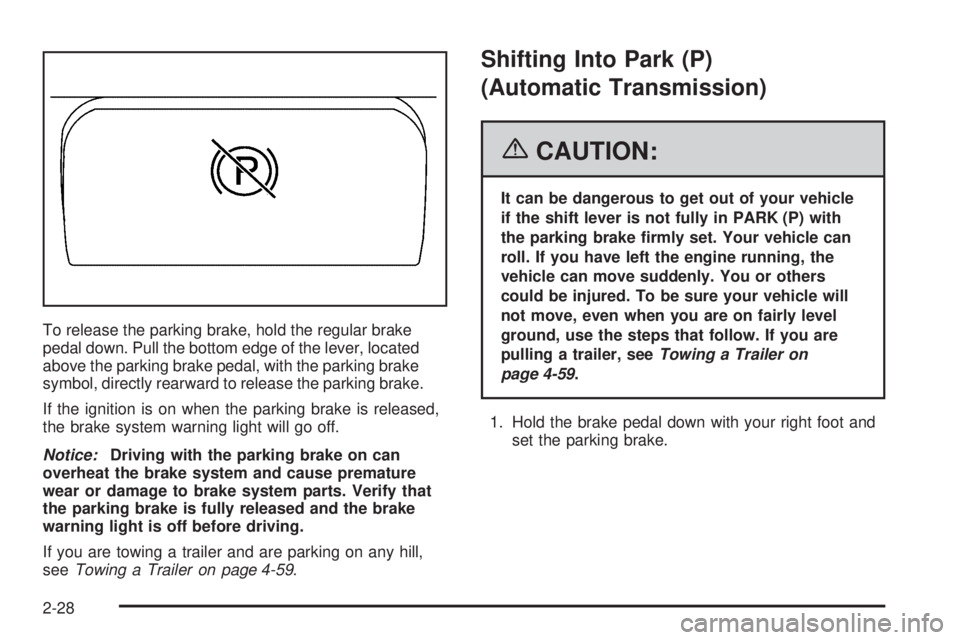
To release the parking brake, hold the regular brake
pedal down. Pull the bottom edge of the lever, located
above the parking brake pedal, with the parking brake
symbol, directly rearward to release the parking brake.
If the ignition is on when the parking brake is released,
the brake system warning light will go off.
Notice:Driving with the parking brake on can
overheat the brake system and cause premature
wear or damage to brake system parts. Verify that
the parking brake is fully released and the brake
warning light is off before driving.
If you are towing a trailer and are parking on any hill,
seeTowing a Trailer on page 4-59.
Shifting Into Park (P)
(Automatic Transmission)
{CAUTION:
It can be dangerous to get out of your vehicle
if the shift lever is not fully in PARK (P) with
the parking brake rmly set. Your vehicle can
roll. If you have left the engine running, the
vehicle can move suddenly. You or others
could be injured. To be sure your vehicle will
not move, even when you are on fairly level
ground, use the steps that follow. If you are
pulling a trailer, seeTowing a Trailer on
page 4-59.
1. Hold the brake pedal down with your right foot and
set the parking brake.
2-28
Page 104 of 410
Running the Engine While Parked
It is better not to park with the engine running. But if you
ever have to, here are some things to know.
{CAUTION:
Idling the engine with the climate control
system off could allow dangerous exhaust into
your vehicle. See the earlier caution under
Engine Exhaust on page 2-31.
Also, idling in a closed-in place can let deadly
carbon monoxide (CO) into your vehicle even if
the climate control fan is at the highest setting.
One place this can happen is a garage.
Exhaust — with CO — can come in easily.
NEVER park in a garage with the engine
running.
Another closed-in place can be a blizzard. See
Winter Driving on page 4-45.
{CAUTION:
It can be dangerous to get out of your vehicle
if the automatic transmission shift lever is not
fully in PARK (P) with the parking brake rmly
set. Your vehicle can roll. Do not leave your
vehicle when the engine is running unless you
have to. If you have left the engine running,
the vehicle can move suddenly. You or others
could be injured. To be sure your vehicle will
not move, even when it is on fairly level
ground, always set the parking brake and
move the automatic transmission shift lever to
PARK (P), or the manual transmission shift
lever to NEUTRAL.
Follow the proper steps to be sure your vehicle will not
move. SeeShifting Into Park (P) (Automatic
Transmission) on page 2-28andParking Your Vehicle
(Manual Transmission) on page 2-30.
If you are pulling a trailer with your vehicle, seeTowing
a Trailer on page 4-59.
2-32
Page 253 of 410
If you put things inside your vehicle – like suitcases,
tools, packages, or anything else – they will go as fast
as the vehicle goes. If you have to stop or turn
quickly, or if there is a crash, they will keep going.
{CAUTION:
Things you put inside your vehicle can strike
and injure people in a sudden stop or turn, or
in a crash.
Put things in the cargo area of your
vehicle. Try to spread the weight evenly.
Never stack heavier things, like suitcases,
inside the vehicle so that some of them
are above the tops of the seats.
Do not leave an unsecured child restraint
in your vehicle.
When you carry something inside the
vehicle, secure it whenever you can.
Do not leave a seat folded down unless
you need to.
There is also important loading information for off-road
driving in this manual. See“Loading Your Vehicle
for Off-Road Driving”underOff-Road Driving on
page 4-17.
Towing
Towing Your Vehicle
Consult your dealer or a professional towing service if
you need to have your disabled vehicle towed. See
Roadside Assistance Program on page 7-6.
If you want to tow your vehicle behind another vehicle
for recreational purposes (such as behind a motorhome),
see “Recreational Vehicle Towing” following.
Recreational Vehicle Towing
Recreational vehicle towing means towing your vehicle
behind another vehicle – such as behind a motorhome.
The two most common types of recreational vehicle
towing are known as “dinghy towing” (towing your
vehicle with all four wheels on the ground) and “dolly
towing” (towing your vehicle with two wheels on
the ground and two wheels up on a device known
as a “dolly”).
With the proper preparation and equipment, many
vehicles can be towed in these ways. See “Dinghy
Towing” and “Dolly Towing,” following.
4-57
Page 261 of 410

But, you must still consider the effect on the rear axle.
Because your rear axle now weighs 3,100 lbs (1 406 kg),
you can only put 900 lbs (408 kg) on the rear axle
without exceeding RGAWR. The effect of tongue weight
is about 1.5 times the actual weight. Dividing the
900 lbs (408 kg) by 1.5 leaves you with being able to
handle only 600 lbs (272 kg) of tongue weight.
Since tongue weight is usually at least 10 percent of
total loaded trailer weight, you can expect that the
largest trailer your vehicle can properly handle is
6,000 lbs (2 721 kg).
It is important that you make sure your vehicle does not
exceed any of its ratings — GCWR, GVWR, RGAWR,
Maximum Trailer Rating or Tongue Weight. The
only way to be sure you are not exceeding any of these
ratings is to weigh your vehicle and trailer.
Safety Chains
You should always attach chains between your vehicle
and your trailer. Cross the safety chains under the
tongue of the trailer to help prevent the tongue from
contacting the road if it becomes separated from
the hitch. Always leave just enough slack so you can
turn with your rig. Never allow safety chains to drag on
the ground.
Trailer Brakes
If your trailer weighs more than 1,500 lbs (680 kg)
loaded, then it needs its own brakes – and they must be
adequate. Be sure to read and follow the instructions
for the trailer brakes so you’ll be able to install,
adjust and maintain them properly.
Your trailer brake system can tap into the vehicle’s
hydraulic brake system only if:
The trailer parts can withstand 3,000 psi
(20 650 kPa) of pressure.
The trailer’s brake system will use less than
0.02 cubic inch (0.3 cc) of uid from your vehicle’s
master cylinder. Otherwise, both braking systems
won’t work well. You could even lose your brakes.
If everything checks out this far, make the brake tap at
the port on the master cylinder that sends the uid
to the rear brakes. But don’t use copper tubing for this.
If you do, it will bend and nally break off. Use steel
brake tubing.
Driving with a Trailer
Towing a trailer requires a certain amount of experience.
Before setting out for the open road, you’ll want to get
to know your rig. Acquaint yourself with the feel of
handling and braking with the added weight of the trailer.
4-65
Page 263 of 410
Driving On Grades
Reduce speed and shift to a lower gearbeforeyou start
down a long or steep downgrade. If you don’t shift
down, you might have to use your brakes so much that
they would get hot and no longer work well.
If you have an automatic transmission, you can tow in
DRIVE (D). You may want to shift the transmission
to THIRD (3) or, if necessary, a lower gear selection if
the transmission shifts too often under heavy loads
and/or hilly conditions.
If you have a manual transmission and you are towing a
trailer, it is better not to use the highest gear.
When towing at high altitude on steep uphill grades,
consider the following: Engine coolant will boil at a lower
temperature than at normal altitudes. If you turn your
engine off immediately after towing at high altitude
on steep uphill grades, your vehicle may show signs
similar to engine overheating. To avoid this, let the
engine run while parked, preferably on level ground, with
the automatic transmission in PARK (P) for a few
minutes before turning the engine off. For manual
transmissions, let the engine run while parked,
preferably on level ground, with the transmission out of
gear and the parking brake applied, for a few minutes
before turning the engine off. If you do get the overheat
warning, seeEngine Overheating on page 5-27.
Parking on Hills
{CAUTION:
You really should not park your vehicle, with a
trailer attached, on a hill. If something goes
wrong, your rig could start to move. People
can be injured, and both your vehicle and the
trailer can be damaged.
But if you ever have to park your rig on a hill, here’s
how to do it:
1. Apply your regular brakes, but don’t shift into
PARK (P) yet for an automatic transmission, or into
gear for a manual transmission. Turn your wheels
into the curb if facing downhill or into traffic if
facing uphill.
2. Have someone place chocks under the
trailer wheels.
3. When the wheel chocks are in place, release the
regular brakes until the chocks absorb the load.
4. Reapply the regular brakes. Then apply your parking
brake and shift into PARK (P) for an automatic
transmission or into gear for a manual transmission.
5. Release the regular brakes.
4-67
Page 264 of 410
When You Are Ready to Leave After
Parking on a Hill
1. Apply your regular brakes and hold the pedal down
while you:
start your engine,
shift into a gear, and
release the parking brake.
2. Let up on the brake pedal.
3. Drive slowly until the trailer is clear of the chocks.
4. Stop and have someone pick up and store
the chocks.
Maintenance When Trailer Towing
Your vehicle will need service more often when you’re
pulling a trailer. See the Maintenance Schedule for more
on this. Things that are especially important in trailer
operation are automatic transmission uid, engine
oil, axle lubricant, belts, cooling system and brake
system. Each of these is covered in this manual, and
the Index will help you nd them quickly. If you’re
trailering, it’s a good idea to review these sections
before you start your trip.
Check periodically to see that all hitch nuts and bolts
are tight.
Trailer Wiring Harness
Light-Duty Trailer Wiring Package
If your vehicle is not equipped with a trailer towing
package, the chassis harness will contain the following
blunt cut circuits:
Yellow: Left Stop/Turn Signal
Dark Green: Right Stop/Turn Signal
White: Ground
Brown: Tail Lamps
If you want to add on a trailer tow, it should be installed
by your dealer or a qualied service center. Also, see
Add-On Electrical Equipment on page 5-95for more
information.
4-68
Page 265 of 410
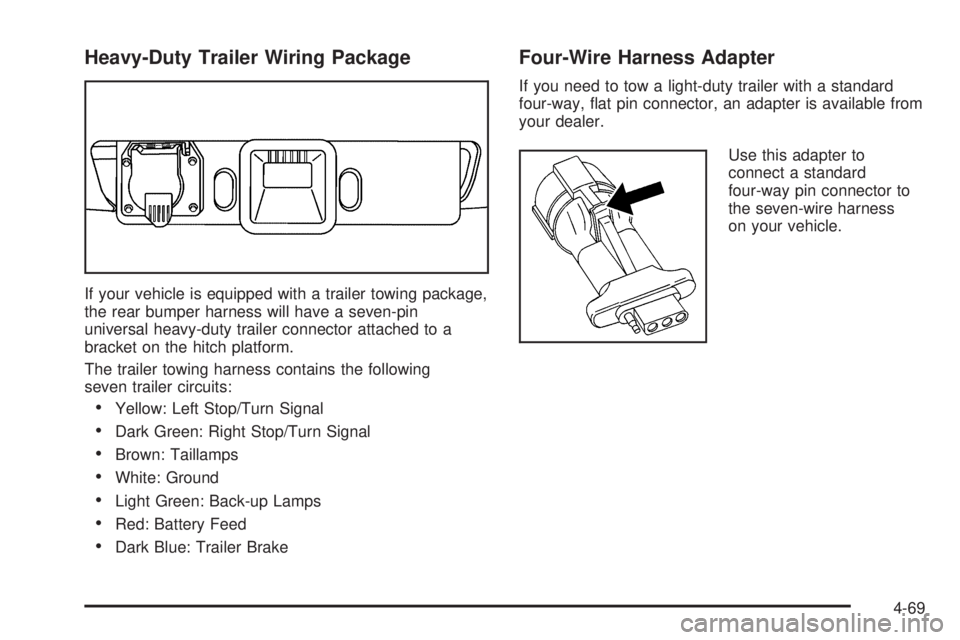
Heavy-Duty Trailer Wiring Package
If your vehicle is equipped with a trailer towing package,
the rear bumper harness will have a seven-pin
universal heavy-duty trailer connector attached to a
bracket on the hitch platform.
The trailer towing harness contains the following
seven trailer circuits:
Yellow: Left Stop/Turn Signal
Dark Green: Right Stop/Turn Signal
Brown: Taillamps
White: Ground
Light Green: Back-up Lamps
Red: Battery Feed
Dark Blue: Trailer Brake
Four-Wire Harness Adapter
If you need to tow a light-duty trailer with a standard
four-way, at pin connector, an adapter is available from
your dealer.
Use this adapter to
connect a standard
four-way pin connector to
the seven-wire harness
on your vehicle.
4-69