manual transmission HUMMER H3 2006 Owners Manual
[x] Cancel search | Manufacturer: HUMMER, Model Year: 2006, Model line: H3, Model: HUMMER H3 2006Pages: 410, PDF Size: 2.61 MB
Page 73 of 410
Keys...............................................................2-2
Remote Keyless Entry System.........................2-4
Remote Keyless Entry System Operation...........2-5
Doors and Locks.............................................2-7
Door Locks....................................................2-7
Power Door Locks..........................................2-8
Programmable Automatic Door Locks................2-8
Lockout Protection..........................................2-8
Swing-gate....................................................2-9
Windows........................................................2-10
Power Windows............................................2-11
Sun Visors...................................................2-11
Theft-Deterrent Systems..................................2-12
Content Theft-Deterrent.................................2-12
Passlock
®....................................................2-14
Starting and Operating Your Vehicle................2-14
New Vehicle Break-In....................................2-14
Ignition Positions..........................................2-15
Retained Accessory Power (RAP)...................2-16
Starting the Engine.......................................2-16
Engine Coolant Heater..................................2-17
Automatic Transmission Operation...................2-18
Manual Transmission Operation......................2-21
All-Wheel Drive............................................2-22
Parking Brake..............................................2-27Shifting Into Park (P) (Automatic Transmission) . . .2-28
Shifting Out of Park (P)
(Automatic Transmission)............................2-30
Parking Your Vehicle (Manual Transmission).....2-30
Parking Over Things That Burn.......................2-31
Engine Exhaust............................................2-31
Running the Engine While Parked...................2-32
Mirrors...........................................................2-33
Automatic Dimming Rearview Mirror with
Compass and Temperature Display..............2-33
Outside Power Mirrors...................................2-35
Outside Convex Mirror...................................2-36
OnStar
®System.............................................2-36
Universal Home Remote System......................2-38
Universal Home Remote System Operation......2-39
Storage Areas................................................2-42
Glove Box...................................................2-42
Cupholder(s)................................................2-42
Front Seat Storage Net.................................2-42
Front Armrest Storage Area...........................2-43
Luggage Carrier...........................................2-43
Rear Storage Area........................................2-45
Convenience Net..........................................2-45
Cargo Cover................................................2-45
Cargo Tie Downs..........................................2-45
Sunroof.........................................................2-46
Section 2 Features and Controls
2-1
Page 80 of 410
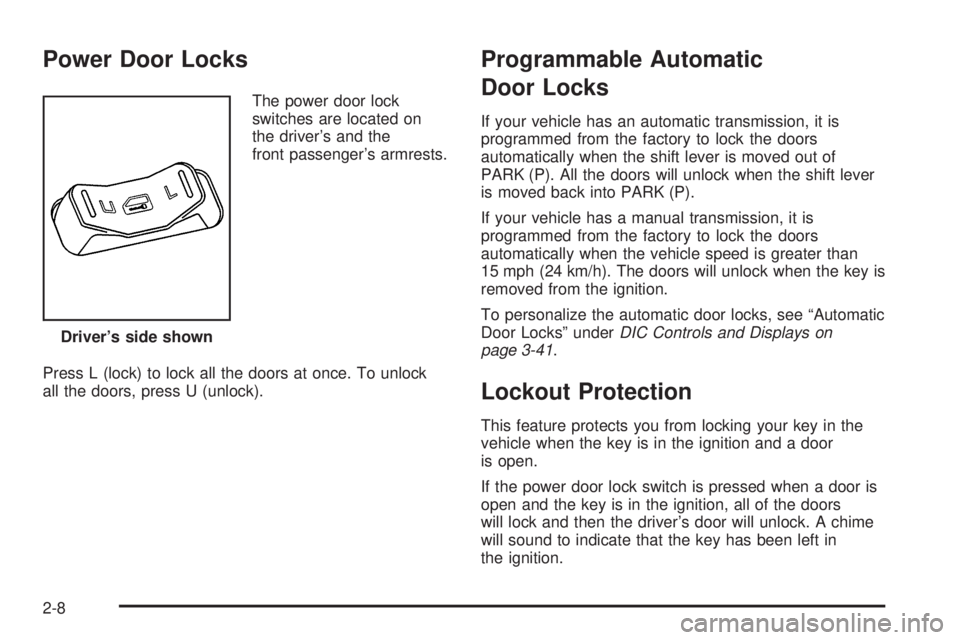
Power Door Locks
The power door lock
switches are located on
the driver’s and the
front passenger’s armrests.
Press L (lock) to lock all the doors at once. To unlock
all the doors, press U (unlock).
Programmable Automatic
Door Locks
If your vehicle has an automatic transmission, it is
programmed from the factory to lock the doors
automatically when the shift lever is moved out of
PARK (P). All the doors will unlock when the shift lever
is moved back into PARK (P).
If your vehicle has a manual transmission, it is
programmed from the factory to lock the doors
automatically when the vehicle speed is greater than
15 mph (24 km/h). The doors will unlock when the key is
removed from the ignition.
To personalize the automatic door locks, see “Automatic
Door Locks” underDIC Controls and Displays on
page 3-41.
Lockout Protection
This feature protects you from locking your key in the
vehicle when the key is in the ignition and a door
is open.
If the power door lock switch is pressed when a door is
open and the key is in the ignition, all of the doors
will lock and then the driver’s door will unlock. A chime
will sound to indicate that the key has been left in
the ignition. Driver’s side shown
2-8
Page 87 of 410
Ignition Positions
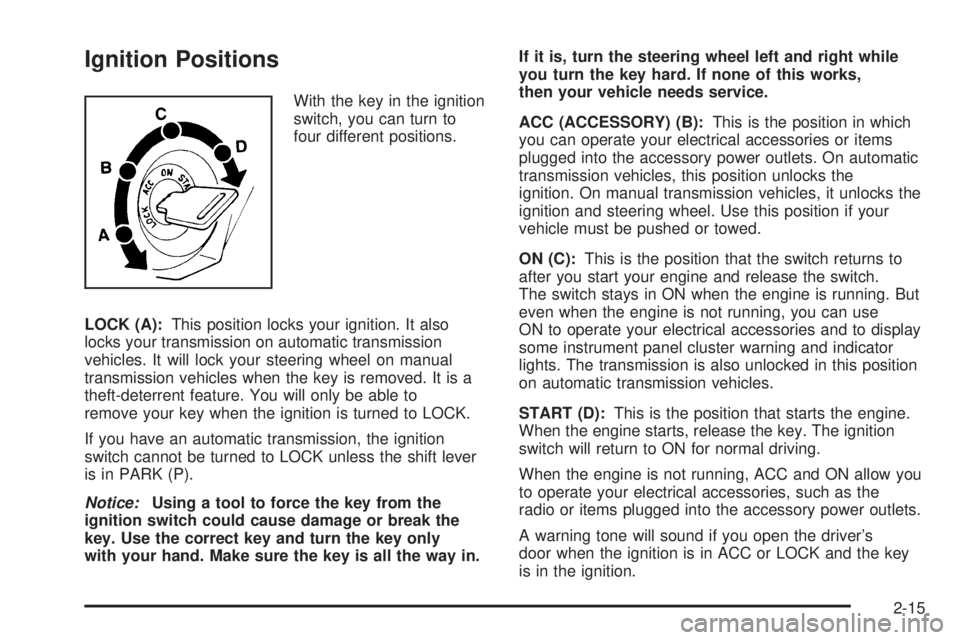
With the key in the ignition
switch, you can turn to
four different positions.
LOCK (A):This position locks your ignition. It also
locks your transmission on automatic transmission
vehicles. It will lock your steering wheel on manual
transmission vehicles when the key is removed. It is a
theft-deterrent feature. You will only be able to
remove your key when the ignition is turned to LOCK.
If you have an automatic transmission, the ignition
switch cannot be turned to LOCK unless the shift lever
is in PARK (P).
Notice:Using a tool to force the key from the
ignition switch could cause damage or break the
key. Use the correct key and turn the key only
with your hand. Make sure the key is all the way in.If it is, turn the steering wheel left and right while
you turn the key hard. If none of this works,
then your vehicle needs service.
ACC (ACCESSORY) (B):This is the position in which
you can operate your electrical accessories or items
plugged into the accessory power outlets. On automatic
transmission vehicles, this position unlocks the
ignition. On manual transmission vehicles, it unlocks the
ignition and steering wheel. Use this position if your
vehicle must be pushed or towed.
ON (C):This is the position that the switch returns to
after you start your engine and release the switch.
The switch stays in ON when the engine is running. But
even when the engine is not running, you can use
ON to operate your electrical accessories and to display
some instrument panel cluster warning and indicator
lights. The transmission is also unlocked in this position
on automatic transmission vehicles.
START (D):This is the position that starts the engine.
When the engine starts, release the key. The ignition
switch will return to ON for normal driving.
When the engine is not running, ACC and ON allow you
to operate your electrical accessories, such as the
radio or items plugged into the accessory power outlets.
A warning tone will sound if you open the driver’s
door when the ignition is in ACC or LOCK and the key
is in the ignition.
2-15
Page 88 of 410
Retained Accessory Power (RAP)
Your vehicle is equipped with Retained Accessory
Power (RAP) which will allow certain features of your
vehicle to continue working for up to 20 minutes after the
ignition key is turned to LOCK.
Your radio, front wipers, sunroof, if equipped, and power
windows will work when the ignition key is in ON or
ACC. Once the key is turned from ON to LOCK, these
features will continue to work for up to 20 minutes
or until a door is opened.
Starting the Engine
Automatic Transmission
Move your shift lever to PARK (P) or NEUTRAL (N).
Your engine will not start in any other position — that is
a safety feature. To restart when you are already
moving, use NEUTRAL (N) only.
Notice:Do not try to shift to PARK (P) if your
vehicle is moving. If you do, you could damage the
transmission. Shift to PARK (P) only when your
vehicle is stopped.
Manual Transmission
The gear selector should be in NEUTRAL and the
parking brake engaged. Hold the clutch pedal to the oor
and start the engine. Your vehicle will not start if the
clutch pedal is not all the way down — that is a
safety feature.
Starting Your Engine
1. With your foot off the accelerator pedal, turn the
ignition key to START. When the engine starts,
let go of the key. The idle speed will go down as
your engine gets warm.
Notice:Holding your key in START for longer than
15 seconds at a time will cause your battery to
be drained much sooner. And the excessive heat
can damage your starter motor. Wait about
15 seconds between each try to help avoid draining
your battery or damaging your starter.
2. If the engine does not start within 10 seconds, push
the accelerator pedal all the way to the oor, while
you hold the ignition key in START. When the
engine starts, let go of the key and let up on the
accelerator pedal. Wait about 15 seconds between
each try.
2-16
Page 89 of 410

For both the manual and automatic transmissions,
depending on the outside temperature, the engine
starter may continue cranking the engine up to
approximately four seconds after you release the
ignition key. This is normal.
When starting your engine in very cold weather
(below 0°F or 18°C), do this:
1. With your foot off the accelerator pedal, turn the
ignition key to START and hold it there up to
15 seconds. When the engine starts, let go of
the key.
2. If your engine still will not start, or starts but then
stops, it could be ooded with too much gasoline.
Try pushing your accelerator pedal all the way to the
oor and holding it there as you hold the key in
START for about three seconds. When the engine
starts, let go of the key and accelerator. If the
vehicle starts briey but then stops again, do the
same thing, but this time keep the pedal down
for ve or six seconds. This clears the extra
gasoline from the engine.
Notice:Your engine is designed to work with the
electronics in your vehicle. If you add electrical
parts or accessories, you could change the way the
engine operates. Before adding electrical equipment,
check with your dealer. If you do not, your engine
might not perform properly. Any resulting damage
would not be covered by your vehicle’s warranty.Engine Coolant Heater
Your vehicle may be equipped with this feature.
In very cold weather, 0°F (–18°C) or colder, the engine
coolant heater can help. You will get easier starting
and better fuel economy during engine warm-up.
Usually, the coolant heater should be plugged in a
minimum of four hours prior to starting your vehicle.
At temperatures above 32°F (0°C), use of the coolant
heater is not required.
To Use the Engine Coolant Heater
1. Turn off the engine.
2. Open the hood and unwrap the electrical cord.
The cord is located in the engine compartment
behind the underhood fuse block on the driver’s side
of the vehicle.
2-17
Page 93 of 410
Manual Transmission Operation
Five-Speed
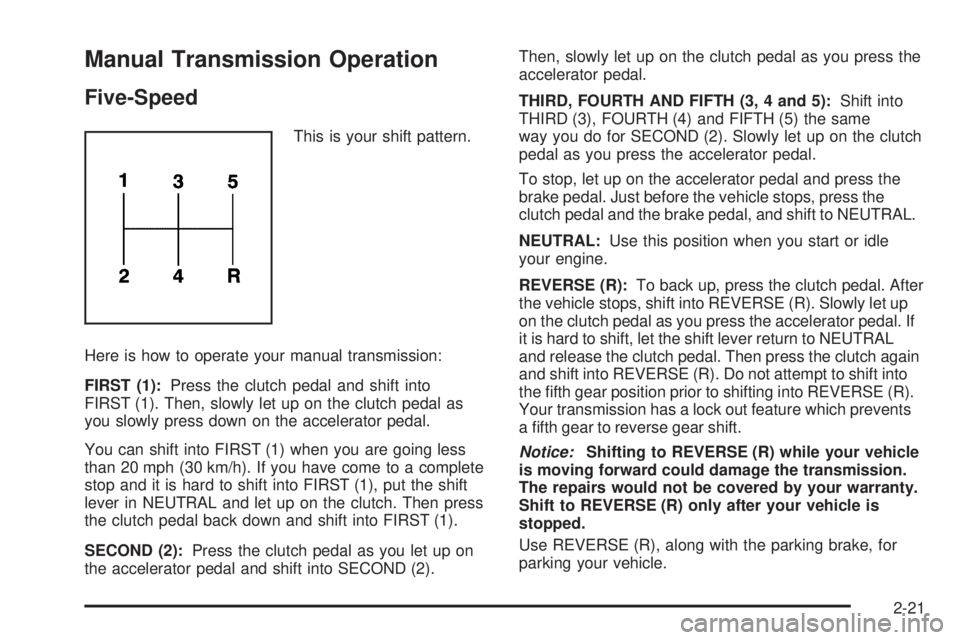
This is your shift pattern.
Here is how to operate your manual transmission:
FIRST (1):Press the clutch pedal and shift into
FIRST (1). Then, slowly let up on the clutch pedal as
you slowly press down on the accelerator pedal.
You can shift into FIRST (1) when you are going less
than 20 mph (30 km/h). If you have come to a complete
stop and it is hard to shift into FIRST (1), put the shift
lever in NEUTRAL and let up on the clutch. Then press
the clutch pedal back down and shift into FIRST (1).
SECOND (2):Press the clutch pedal as you let up on
the accelerator pedal and shift into SECOND (2).Then, slowly let up on the clutch pedal as you press the
accelerator pedal.
THIRD, FOURTH AND FIFTH (3, 4 and 5):Shift into
THIRD (3), FOURTH (4) and FIFTH (5) the same
way you do for SECOND (2). Slowly let up on the clutch
pedal as you press the accelerator pedal.
To stop, let up on the accelerator pedal and press the
brake pedal. Just before the vehicle stops, press the
clutch pedal and the brake pedal, and shift to NEUTRAL.
NEUTRAL:Use this position when you start or idle
your engine.
REVERSE (R):To back up, press the clutch pedal. After
the vehicle stops, shift into REVERSE (R). Slowly let up
on the clutch pedal as you press the accelerator pedal. If
it is hard to shift, let the shift lever return to NEUTRAL
and release the clutch pedal. Then press the clutch again
and shift into REVERSE (R). Do not attempt to shift into
the fth gear position prior to shifting into REVERSE (R).
Your transmission has a lock out feature which prevents
a fth gear to reverse gear shift.
Notice:Shifting to REVERSE (R) while your vehicle
is moving forward could damage the transmission.
The repairs would not be covered by your warranty.
Shift to REVERSE (R) only after your vehicle is
stopped.
Use REVERSE (R), along with the parking brake, for
parking your vehicle.
2-21
Page 94 of 410
Up-Shift Light
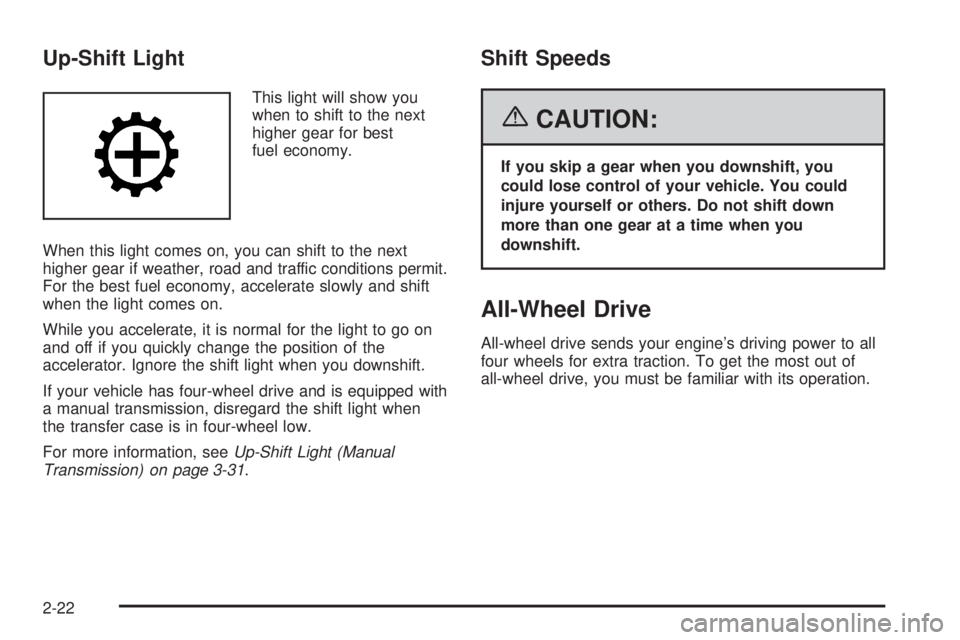
This light will show you
when to shift to the next
higher gear for best
fuel economy.
When this light comes on, you can shift to the next
higher gear if weather, road and traffic conditions permit.
For the best fuel economy, accelerate slowly and shift
when the light comes on.
While you accelerate, it is normal for the light to go on
and off if you quickly change the position of the
accelerator. Ignore the shift light when you downshift.
If your vehicle has four-wheel drive and is equipped with
a manual transmission, disregard the shift light when
the transfer case is in four-wheel low.
For more information, seeUp-Shift Light (Manual
Transmission) on page 3-31.
Shift Speeds
{CAUTION:
If you skip a gear when you downshift, you
could lose control of your vehicle. You could
injure yourself or others. Do not shift down
more than one gear at a time when you
downshift.
All-Wheel Drive
All-wheel drive sends your engine’s driving power to all
four wheels for extra traction. To get the most out of
all-wheel drive, you must be familiar with its operation.
2-22
Page 96 of 410
When in this mode you can also choose to lock the rear
axle, if equipped, for additional traction in extreme
off-road situations. SeeLocking Rear Axle on page 4-10.
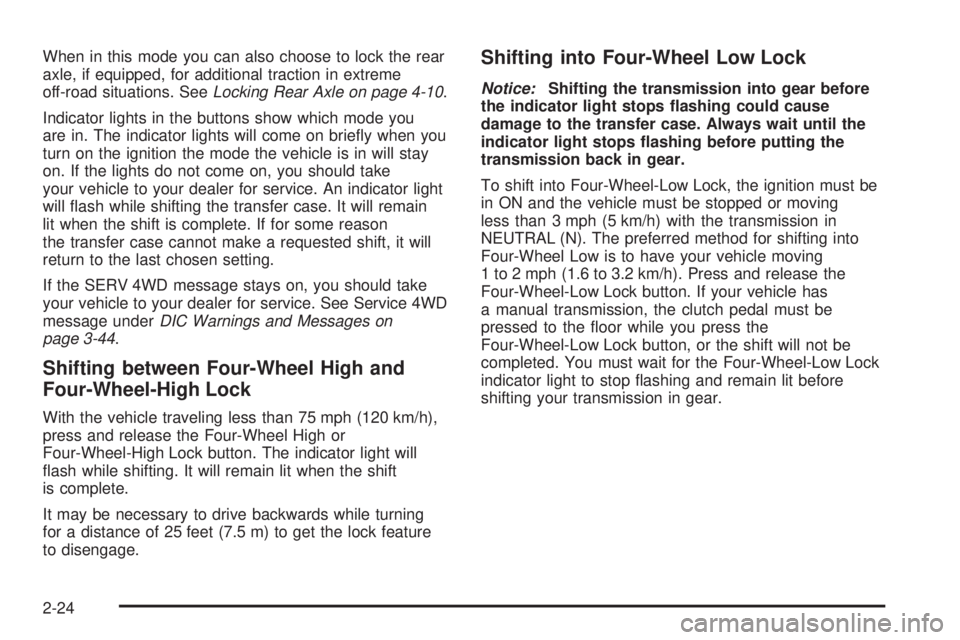
Indicator lights in the buttons show which mode you
are in. The indicator lights will come on briey when you
turn on the ignition the mode the vehicle is in will stay
on. If the lights do not come on, you should take
your vehicle to your dealer for service. An indicator light
will ash while shifting the transfer case. It will remain
lit when the shift is complete. If for some reason
the transfer case cannot make a requested shift, it will
return to the last chosen setting.
If the SERV 4WD message stays on, you should take
your vehicle to your dealer for service. See Service 4WD
message underDIC Warnings and Messages on
page 3-44.
Shifting between Four-Wheel High and
Four-Wheel-High Lock
With the vehicle traveling less than 75 mph (120 km/h),
press and release the Four-Wheel High or
Four-Wheel-High Lock button. The indicator light will
ash while shifting. It will remain lit when the shift
is complete.
It may be necessary to drive backwards while turning
for a distance of 25 feet (7.5 m) to get the lock feature
to disengage.
Shifting into Four-Wheel Low Lock
Notice:Shifting the transmission into gear before
the indicator light stops ashing could cause
damage to the transfer case. Always wait until the
indicator light stops ashing before putting the
transmission back in gear.
To shift into Four-Wheel-Low Lock, the ignition must be
in ON and the vehicle must be stopped or moving
less than 3 mph (5 km/h) with the transmission in
NEUTRAL (N). The preferred method for shifting into
Four-Wheel Low is to have your vehicle moving
1 to 2 mph (1.6 to 3.2 km/h). Press and release the
Four-Wheel-Low Lock button. If your vehicle has
a manual transmission, the clutch pedal must be
pressed to the oor while you press the
Four-Wheel-Low Lock button, or the shift will not be
completed. You must wait for the Four-Wheel-Low Lock
indicator light to stop ashing and remain lit before
shifting your transmission in gear.
2-24
Page 97 of 410
It is normal for your vehicle to have engagement noise
and bump when shifting between Four-Wheel Low
and Four-Wheel High ranges or from NEUTRAL with
the engine running.
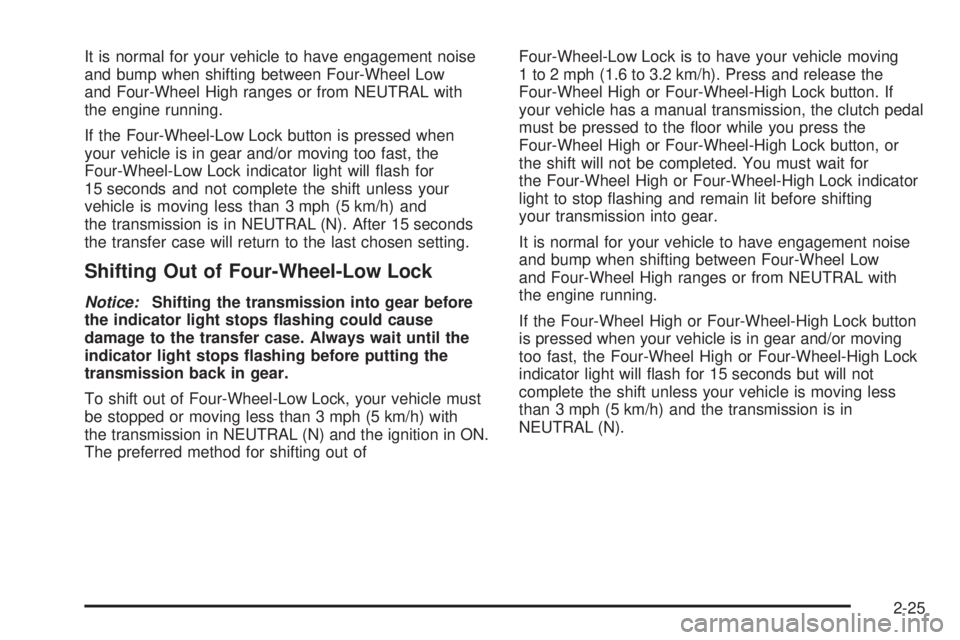
If the Four-Wheel-Low Lock button is pressed when
your vehicle is in gear and/or moving too fast, the
Four-Wheel-Low Lock indicator light will ash for
15 seconds and not complete the shift unless your
vehicle is moving less than 3 mph (5 km/h) and
the transmission is in NEUTRAL (N). After 15 seconds
the transfer case will return to the last chosen setting.
Shifting Out of Four-Wheel-Low Lock
Notice:Shifting the transmission into gear before
the indicator light stops ashing could cause
damage to the transfer case. Always wait until the
indicator light stops ashing before putting the
transmission back in gear.
To shift out of Four-Wheel-Low Lock, your vehicle must
be stopped or moving less than 3 mph (5 km/h) with
the transmission in NEUTRAL (N) and the ignition in ON.
The preferred method for shifting out ofFour-Wheel-Low Lock is to have your vehicle moving
1 to 2 mph (1.6 to 3.2 km/h). Press and release the
Four-Wheel High or Four-Wheel-High Lock button. If
your vehicle has a manual transmission, the clutch pedal
must be pressed to the oor while you press the
Four-Wheel High or Four-Wheel-High Lock button, or
the shift will not be completed. You must wait for
the Four-Wheel High or Four-Wheel-High Lock indicator
light to stop ashing and remain lit before shifting
your transmission into gear.
It is normal for your vehicle to have engagement noise
and bump when shifting between Four-Wheel Low
and Four-Wheel High ranges or from NEUTRAL with
the engine running.
If the Four-Wheel High or Four-Wheel-High Lock button
is pressed when your vehicle is in gear and/or moving
too fast, the Four-Wheel High or Four-Wheel-High Lock
indicator light will ash for 15 seconds but will not
complete the shift unless your vehicle is moving less
than 3 mph (5 km/h) and the transmission is in
NEUTRAL (N).
2-25
Page 98 of 410
Shifting Into NEUTRAL
To shift the transfer case to NEUTRAL, do the following:
1. Set the parking brake.
2. Start the vehicle by turning the ignition to START.
3. Put the transmission in NEUTRAL (N). If your
vehicle has a manual transmission, press and
hold the clutch pedal down while you perform
Steps 5 through 9.
4. Shift the transfer case to Four-Wheel High.
{CAUTION:
Shifting an all-wheel-drive vehicle’s transfer
case into NEUTRAL can cause your vehicle to
roll even if the automatic transmission is in
PARK (P) or the manual transmission is in any
gear. You or others could be injured. Make
sure the parking brake is rmly set before you
shift the transfer case to NEUTRAL.5. Simultaneously press and hold the Four-Wheel
High and Four-Wheel-Low Lock buttons for
10 seconds. The NEUTRAL light will come on when
the transfer case shift to NEUTRAL is complete.
6. Press and hold the regular brake pedal and Shift
the transmission to REVERSE (R) for one second,
then shift the transmission for one second to
DRIVE (D) for an automatic transmission, or
FIRST (1) for vehicles equipped with a manual
transmission and then let out the clutch. This is to
ensure the transfer case is in NEUTRAL. If not,
repeat this procedure starting at Step 3.
7. Turn the engine off, by turning the key to ACC.
8. Place the transmission shift lever in PARK (P) for
an automatic transmission, or FIRST (1) for
vehicles equipped with a manual transmission.
9. Turn the ignition to LOCK.
2-26