tire size HUMMER H3 2007 User Guide
[x] Cancel search | Manufacturer: HUMMER, Model Year: 2007, Model line: H3, Model: HUMMER H3 2007Pages: 480, PDF Size: 2.73 MB
Page 384 of 480
If the tires have an all-season tread design, the
TPC spec number will be followed by a MS,
for mud and snow. SeeTire Sidewall Labeling on
page 368for additional information.
{CAUTION:
Mixing tires could cause you to lose
control while driving. If you mix tires of
different sizes, brands, or types (radial
and bias-belted tires) the vehicle may not
handle properly, and you could have a
crash. Using tires of different sizes,
brands, or types may also cause damage
to your vehicle. Be sure to use the correct
size, brand, and type of tires on your
vehicle’s wheels.
{CAUTION:
If you use bias-ply tires on your vehicle,
the wheel rim anges could develop
cracks after many miles of driving. A tire
and/or wheel could fail suddenly, causing
a crash. Use only radial-ply tires with the
wheels on your vehicle.
If you must replace your vehicle’s tires with those
that do not have a TPC Spec number, make
sure they are the same size, load range, speed
rating, and construction type (radial and
bias-belted tires) as your vehicle’s original tires.
384
Page 385 of 480
Vehicles equipped with a tire pressure monitoring
system may give an inaccurate low-pressure
warning if non-TPC spec rated tires are installed
on your vehicle. Non-TPC Spec rated tires
may give a low-pressure warning that is higher or
lower than the proper warning level you would
get with TPC Spec rated tires. SeeTire Pressure
Monitor System on page 376.
Your vehicle’s original equipment tires are listed
on the Tire and Loading Information Label.
This label is attached to the vehicle’s center pillar
(B-pillar). SeeLoading Your Vehicle on page 289,
for more information about the Tire and Loading
Information Label.
Different Size Tires and Wheels
If you add wheels or tires that are a different size
than your original equipment wheels and tires,
this may affect the way your vehicle performs,
including its braking, ride and handling
characteristics, stability, and resistance to rollover.
Additionally, if your vehicle has electronic
systems such as, anti-lock brakes, traction control,
and electronic stability control, the performance
of these systems can be affected.
{CAUTION:
If you add different sized wheels, your
vehicle may not provide an acceptable
level of performance and safety if tires
not recommended for those wheels are
selected. You may increase the chance
that you will crash and suffer serious
injury. Only use GM specic wheel and
tire systems developed for your vehicle,
and have them properly installed by a
GM certied technician.
SeeBuying New Tires on page 383and
Accessories and Modications on page 314for
additional information.
385
Page 389 of 480
Tire Chains
{CAUTION:
If your vehicle has LT285/75R16 or
P265/65R18 size tires, do not use tire
chains. They can damage your vehicle
because there is not enough clearance.
Tire chains used on a vehicle without the
proper amount of clearance can cause
damage to the brakes, suspension, or
other vehicle parts. The area damaged by
the tire chains could cause you to lose
control of your vehicle and you or others
may be injured in a crash.
Use another type of traction device only if
its manufacturer recommends it for use
on your vehicle and tire size combination
and road conditions.
CAUTION: (Continued)
CAUTION: (Continued)
Follow that manufacturer’s instructions.
To help avoid damage to your vehicle,
drive slowly, readjust, or remove the
device if it is contacting your vehicle, and
do not spin your vehicle’s wheels.
If you do nd traction devices that will t,
install them on the rear tires.
Notice:If your vehicle has a tire size other than
LT285/75R16 or P265/65R18 use tire chains only
where legal and only when you must. Use
chains that are the proper size for your tires.
Install them on the tires of the rear axle. Do not
use chains on the tires of the front axle. Tighten
them as tightly as possible with the ends
securely fastened. Drive slowly and follow the
chain manufacturer’s instructions. If you can
hear the chains contacting your vehicle, stop
and retighten them. If the contact continues,
slow down until it stops. Driving too fast or
spinning the wheels with chains on will damage
your vehicle.
389
Page 405 of 480
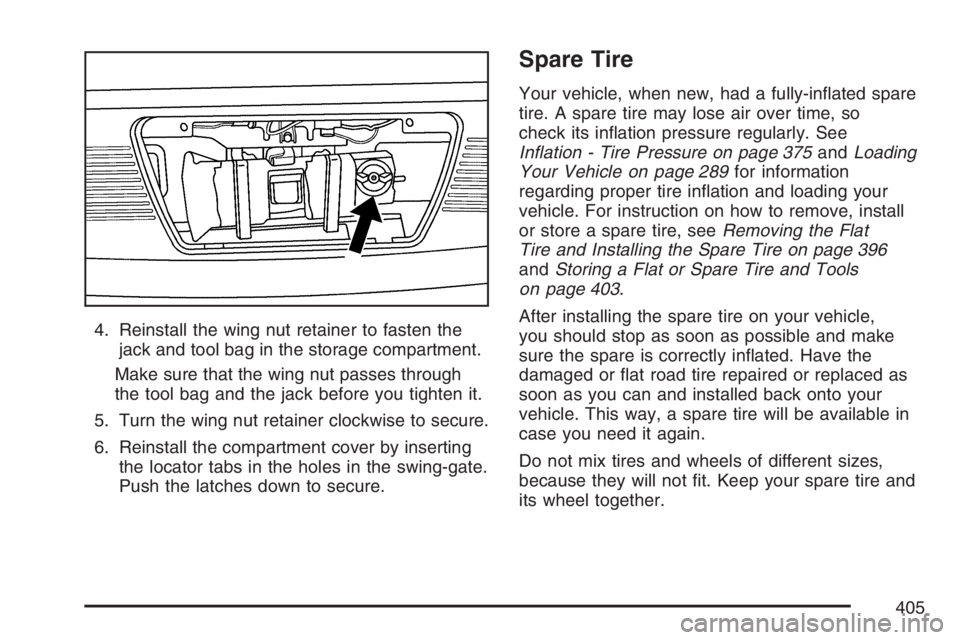
4. Reinstall the wing nut retainer to fasten the
jack and tool bag in the storage compartment.
Make sure that the wing nut passes through
the tool bag and the jack before you tighten it.
5. Turn the wing nut retainer clockwise to secure.
6. Reinstall the compartment cover by inserting
the locator tabs in the holes in the swing-gate.
Push the latches down to secure.
Spare Tire
Your vehicle, when new, had a fully-inated spare
tire. A spare tire may lose air over time, so
check its ination pressure regularly. See
Ination - Tire Pressure on page 375andLoading
Your Vehicle on page 289for information
regarding proper tire ination and loading your
vehicle. For instruction on how to remove, install
or store a spare tire, seeRemoving the Flat
Tire and Installing the Spare Tire on page 396
andStoring a Flat or Spare Tire and Tools
on page 403.
After installing the spare tire on your vehicle,
you should stop as soon as possible and make
sure the spare is correctly inated. Have the
damaged or at road tire repaired or replaced as
soon as you can and installed back onto your
vehicle. This way, a spare tire will be available in
case you need it again.
Do not mix tires and wheels of different sizes,
because they will not t. Keep your spare tire and
its wheel together.
405
Page 479 of 480
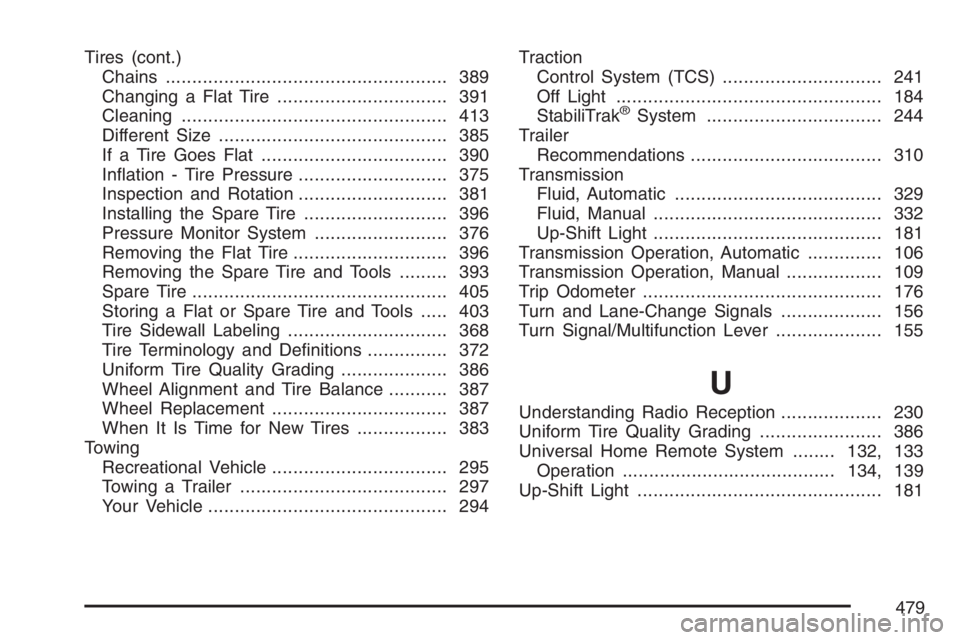
Tires (cont.)
Chains..................................................... 389
Changing a Flat Tire................................ 391
Cleaning.................................................. 413
Different Size........................................... 385
If a Tire Goes Flat................................... 390
Ination - Tire Pressure............................ 375
Inspection and Rotation............................ 381
Installing the Spare Tire........................... 396
Pressure Monitor System......................... 376
Removing the Flat Tire............................. 396
Removing the Spare Tire and Tools......... 393
Spare Tire................................................ 405
Storing a Flat or Spare Tire and Tools..... 403
Tire Sidewall Labeling.............................. 368
Tire Terminology and Denitions............... 372
Uniform Tire Quality Grading.................... 386
Wheel Alignment and Tire Balance........... 387
Wheel Replacement................................. 387
When It Is Time for New Tires................. 383
Towing
Recreational Vehicle................................. 295
Towing a Trailer....................................... 297
Your Vehicle............................................. 294Traction
Control System (TCS) .............................. 241
Off Light.................................................. 184
StabiliTrak
®System................................. 244
Trailer
Recommendations.................................... 310
Transmission
Fluid, Automatic....................................... 329
Fluid, Manual........................................... 332
Up-Shift Light........................................... 181
Transmission Operation, Automatic.............. 106
Transmission Operation, Manual.................. 109
Trip Odometer............................................. 176
Turn and Lane-Change Signals................... 156
Turn Signal/Multifunction Lever.................... 155
U
Understanding Radio Reception................... 230
Uniform Tire Quality Grading....................... 386
Universal Home Remote System........132, 133
Operation........................................134, 139
Up-Shift Light.............................................. 181
479
Page 480 of 480

V
Vehicle
Control..................................................... 238
Damage Warnings....................................... 5
Loading.................................................... 289
Parking Your............................................ 119
Symbols...................................................... 5
Vehicle Data Collection and Event
Data Recorders........................................ 458
Vehicle Identication
Number (VIN).......................................... 415
Service Parts Identication Label.............. 416
Ventilation Adjustment.................................. 173
Visors........................................................... 97
W
Warning Lights, Gages and Indicators......... 174
Warnings
DIC Warnings and Messages................... 196
Hazard Warning Flashers......................... 154
Other Warning Devices............................ 154
Safety and Symbols..................................... 4
Vehicle Damage.......................................... 5Wheels
Alignment and Tire Balance..................... 387
Different Size........................................... 385
Replacement............................................ 387
Where to Put the Restraint............................ 49
Windows....................................................... 96
Power........................................................ 97
Windshield
Backglass, and Wiper Blades,
Cleaning............................................... 411
Washer.................................................... 158
Washer Fluid........................................... 346
Wiper Blade Replacement........................ 365
Wiper Fuses............................................ 417
Wipers..................................................... 157
Windshield, Rear Washer/Wiper................... 159
Winter Driving............................................. 281X
XM Radio Messages................................... 228
XM™ Satellite Radio Antenna System......... 232
Y
Your Vehicle and the Environment............... 427
480