front seats HUMMER H3 2007 Owners Manual
[x] Cancel search | Manufacturer: HUMMER, Model Year: 2007, Model line: H3, Model: HUMMER H3 2007Pages: 480, PDF Size: 2.73 MB
Page 1 of 480
Seats and Restraint Systems
....................... 7
Front Seats
.............................................. 8
Rear Seats
............................................. 14
Safety Belts
............................................ 17
Child Restraints
...................................... 39
Airbag System
........................................ 65
Restraint System Check
......................... 82
Features and Controls
................................ 85
Keys
....................................................... 87
Doors and Locks
.................................... 92
Windows
................................................ 96
Theft-Deterrent Systems
......................... 98
Starting and Operating Your Vehicle
....... 101
Mirrors
.................................................. 122
OnStar
®System
................................... 129Universal Home Remote System
.......... 132
Storage Areas
...................................... 143
Sunroof
................................................ 147
Instrument Panel
....................................... 149
Instrument Panel Overview
................... 152
Climate Controls
................................... 170
Warning Lights, Gages, and
Indicators
.......................................... 174
Driver Information Center (DIC)
............ 192
Audio System(s)
................................... 201
Driving Your Vehicle
................................. 233
Your Driving, the Road, and
Your Vehicle
..................................... 234
Towing
................................................. 294
2007 HUMMER H3 Owner ManualM
1
Page 3 of 480

GENERAL MOTORS, GM, the GM Emblem,
HUMMER, and H3 are registered trademarks
of General Motors Corporation.
This manual includes the latest information at
the time it was printed. We reserve the right
to make changes after that time without further
notice. For vehicles rst sold in Canada, substitute
the name “General Motors of Canada Limited”
for HUMMER whenever it appears in this manual.
This manual describes features that may be
available in this model, but your vehicle may not
have all of them. For example, more than one
entertainment system may be offered or your
vehicle may have been ordered without a front
passenger or rear seats.Keep this manual in the vehicle, so it will be there
if it is needed while on the road. If the vehicle
is sold, leave this manual in the vehicle.
Canadian Owners
A French language copy of this manual can be
obtained from your dealer or from:
Helm, Incorporated
P.O. Box 07130
Detroit, MI 48207
Litho in U.S.A.
Part No. 15862067 A First Printing
©2006 General Motors Corporation. All Rights Reserved.
3
Page 7 of 480

Front Seats..................................................... 8
Manual Seats................................................ 8
Power Seats................................................. 9
Power Lumbar.............................................. 9
Heated Seats.............................................. 10
Reclining Seatbacks.................................... 10
Head Restraints.......................................... 13
Rear Seats.................................................... 14
60/40 Split Bench Seat............................... 14
Safety Belts.................................................. 17
Safety Belts: They Are for Everyone........... 17
Questions and Answers About Safety Belts.... 21
How to Wear Safety Belts Properly............. 22
Driver Position............................................. 22
Shoulder Belt Height Adjustment................. 30
Safety Belt Use During Pregnancy.............. 31
Right Front Passenger Position................... 31
Rear Seat Passengers................................ 32
Rear Safety Belt Comfort Guides................ 35
Safety Belt Pretensioners............................ 38
Safety Belt Extender................................... 38
Child Restraints............................................ 39
Older Children............................................. 39
Infants and Young Children......................... 42Child Restraint Systems.............................. 45
Where to Put the Restraint.......................... 49
Lower Anchors and Tethers for
Children (LATCH).................................... 51
Securing a Child Restraint in a
Rear Outside Seat Position...................... 57
Securing a Child Restraint in the
Center Rear Seat Position....................... 60
Securing a Child Restraint in the
Right Front Seat Position......................... 60
Airbag System.............................................. 65
Where Are the Airbags?.............................. 69
When Should an Airbag Inate?.................. 71
What Makes an Airbag Inate?................... 73
How Does an Airbag Restrain?................... 73
What Will You See After an Airbag Inates? ... 74
Passenger Sensing System......................... 75
Servicing Your Airbag-Equipped Vehicle...... 80
Adding Equipment to Your
Airbag-Equipped Vehicle.......................... 81
Restraint System Check............................... 82
Checking the Restraint Systems.................. 82
Replacing Restraint System Parts
After a Crash........................................... 83
Section 1 Seats and Restraint Systems
7
Page 8 of 480
Front Seats
Manual Seats
{CAUTION:
You can lose control of the vehicle if
you try to adjust a manual driver’s seat
while the vehicle is moving. The sudden
movement could startle and confuse you,
or make you push a pedal when you do
not want to. Adjust the driver’s seat only
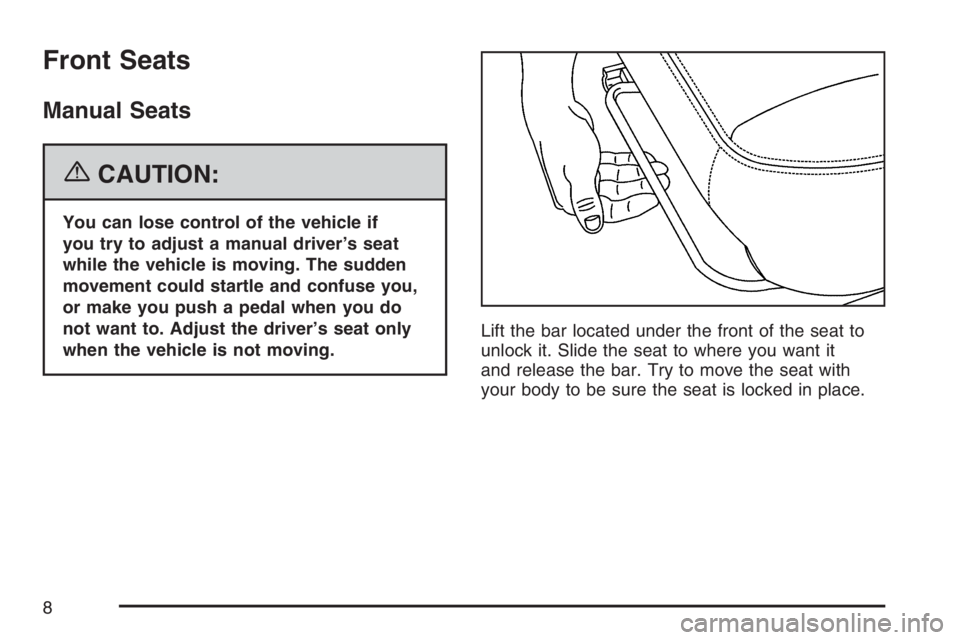
when the vehicle is not moving.Lift the bar located under the front of the seat to
unlock it. Slide the seat to where you want it
and release the bar. Try to move the seat with
your body to be sure the seat is locked in place.
8
Page 9 of 480

Power Seats
If the vehicle has power
seats, the controls used
to operate them are
located on the outboard
side of the seats.
To adjust the seat, do any of the following:
Move the seat forward or rearward by
sliding the control forward or rearward.
Raise or lower the front part of the seat
cushion by moving the front of the control
up or down.
Raise or lower the rear part of the seat
cushion by moving the rear of the control
up or down.
Power Lumbar
If your vehicle has this
feature, the control is
located on the outboard
side of the seat(s).
Press and hold the front of the control until you
have the desired lumbar support. To decrease
lumbar support, press and hold the rear of
the control.
9
Page 10 of 480

Heated Seats
If your vehicle has this
feature, the controls
are located on the
outboard side of the
front seats.
This feature will heat the cushion and back of
the seats.
Press the top of the switch to turn the heat to the
high setting. Press the bottom of the switch to
turn the heat to the low setting. Put the switch in
the center position to turn the heat off.
The ignition must be on for the heated seat
feature to work. The seat will heat to the last
setting if the ignition has been turned off and
then turned back on.
The passenger’s safety belt must be fastened for the
heated seat feature to work on the passenger’s seat.
Reclining Seatbacks
{CAUTION:
You can lose control of the vehicle if
you try to adjust a manual driver’s seat
while the vehicle is moving. The sudden
movement could startle and confuse you,
or make you push a pedal when you do
not want to. Adjust the driver’s seat only
when the vehicle is not moving.
{CAUTION:
If the seatback is not locked, it could
move forward in a sudden stop or crash.
That could cause injury to the person
sitting there. Always push and pull on
the seatback to be sure it is locked.
10
Page 14 of 480
Rear Seats
60/40 Split Bench Seat
The 60/40 split bench seats can be folded to give
you more cargo space.
Folding the Seatbacks
To fold the rear seatback(s), do the following:
1. Make sure that nothing is on, under, or in
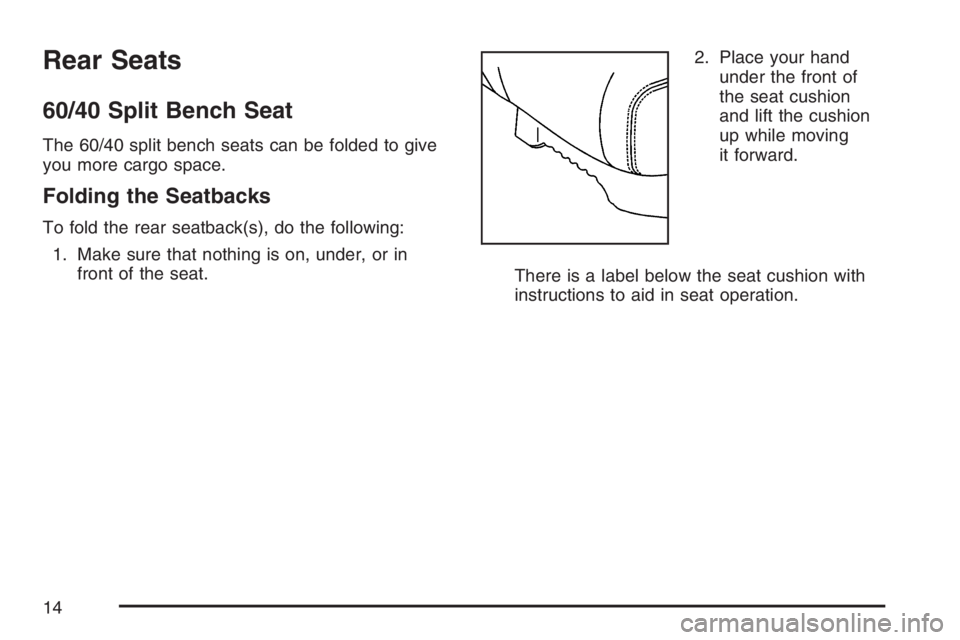
front of the seat.2. Place your hand
under the front of
the seat cushion
and lift the cushion
up while moving
it forward.
There is a label below the seat cushion with
instructions to aid in seat operation.
14
Page 38 of 480

Safety Belt Pretensioners
Your vehicle has safety belt pretensioners for the
driver and right front passenger. Although you
cannot see them, they are part of the safety belt
assembly. They help tighten the safety belts during
the early stages of a moderate to severe frontal
or near frontal crash if the threshold conditions for
pretensioner activation are met. And, if your
vehicle has side impact rollover airbags, safety
belt pretensioners can help tighten the safety belts
in a side crash or a rollover event.
Pretensioners work only once. If they activate
in a crash, you will need to get new ones,
and probably other new parts for your safety
belt system. SeeReplacing Restraint System
Parts After a Crash on page 83.
Safety Belt Extender
If the vehicle’s safety belt will fasten around you,
you should use it.
But if a safety belt is not long enough, your dealer
will order you an extender. When you go in to
order it, take the heaviest coat you will wear,
so the extender will be long enough for you.
To help avoid personal injury, do not let someone
else use it, and use it only for the seat it is
made to t. The extender has been designed for
adults. Never use it for securing child seats.
To wear it, just attach it to the regular safety belt.
For more information see the instruction sheet
that comes with the extender.
38
Page 39 of 480

Child Restraints
Older Children
Older children who have outgrown booster seats
should wear the vehicle’s safety belts.
Q:What is the proper way to wear safety belts?
A:An older child should wear a lap-shoulder belt
and get the additional restraint a shoulder
belt can provide. The shoulder belt should not
cross the face or neck. The lap belt should
t snugly below the hips, just touching the
top of the thighs. It should never be worn over
the abdomen, which could cause severe or
even fatal internal injuries in a crash.
According to accident statistics, children are
safer when properly restrained in the rear seating
positions than in the front seating positions.
In a crash, children who are not buckled up can
strike other people who are buckled up, or can
be thrown out of the vehicle. Older children need
to use safety belts properly.
39
Page 61 of 480
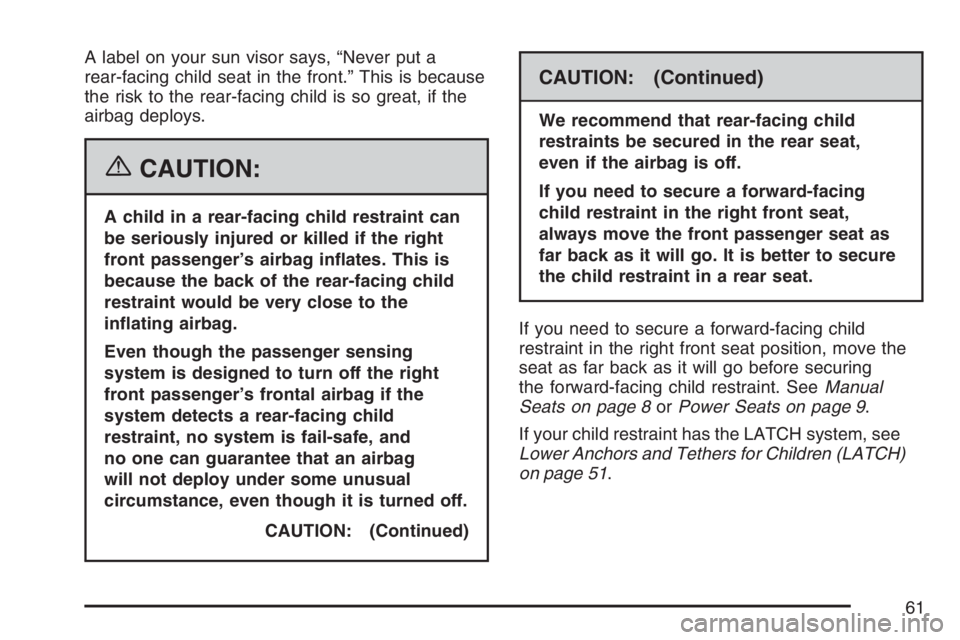
A label on your sun visor says, “Never put a
rear-facing child seat in the front.” This is because
the risk to the rear-facing child is so great, if the
airbag deploys.
{CAUTION:
A child in a rear-facing child restraint can
be seriously injured or killed if the right
front passenger’s airbag inates. This is
because the back of the rear-facing child
restraint would be very close to the
inating airbag.
Even though the passenger sensing
system is designed to turn off the right
front passenger’s frontal airbag if the
system detects a rear-facing child
restraint, no system is fail-safe, and
no one can guarantee that an airbag
will not deploy under some unusual
circumstance, even though it is turned off.
CAUTION: (Continued)
CAUTION: (Continued)
We recommend that rear-facing child
restraints be secured in the rear seat,
even if the airbag is off.
If you need to secure a forward-facing
child restraint in the right front seat,
always move the front passenger seat as
far back as it will go. It is better to secure
the child restraint in a rear seat.
If you need to secure a forward-facing child
restraint in the right front seat position, move the
seat as far back as it will go before securing
the forward-facing child restraint. SeeManual
Seats on page 8orPower Seats on page 9.
If your child restraint has the LATCH system, see
Lower Anchors and Tethers for Children (LATCH)
on page 51.
61