Transfer case HUMMER H3 2008 User Guide
[x] Cancel search | Manufacturer: HUMMER, Model Year: 2008, Model line: H3, Model: HUMMER H3 2008Pages: 416, PDF Size: 5.66 MB
Page 213 of 416
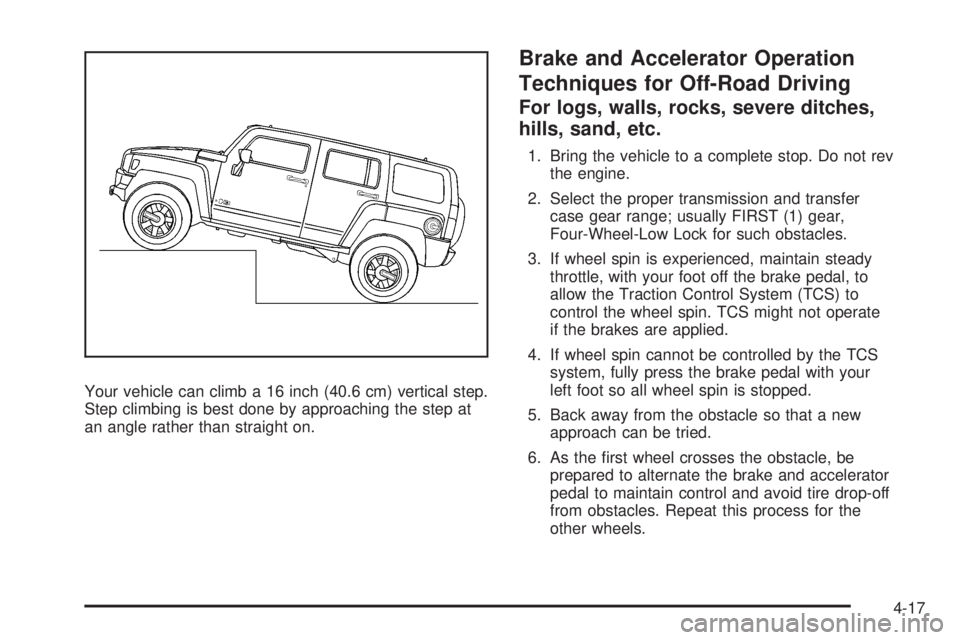
Your vehicle can climb a 16 inch (40.6 cm) vertical step.
Step climbing is best done by approaching the step at
an angle rather than straight on.
Brake and Accelerator Operation
Techniques for Off-Road Driving
For logs, walls, rocks, severe ditches,
hills, sand, etc.
1. Bring the vehicle to a complete stop. Do not rev
the engine.
2. Select the proper transmission and transfer
case gear range; usually FIRST (1) gear,
Four-Wheel-Low Lock for such obstacles.
3. If wheel spin is experienced, maintain steady
throttle, with your foot off the brake pedal, to
allow the Traction Control System (TCS) to
control the wheel spin. TCS might not operate
if the brakes are applied.
4. If wheel spin cannot be controlled by the TCS
system, fully press the brake pedal with your
left foot so all wheel spin is stopped.
5. Back away from the obstacle so that a new
approach can be tried.
6. As the rst wheel crosses the obstacle, be
prepared to alternate the brake and accelerator
pedal to maintain control and avoid tire drop-off
from obstacles. Repeat this process for the
other wheels.
4-17
Page 216 of 416
Because you will be on an unpaved surface, it is
especially important to avoid sudden acceleration,
sudden turns, or sudden braking.
In a way, off-road driving requires a different kind of
alertness from driving on paved roads and highways.
There are no road signs, posted speed limits, or signal
lights. You have to use your own good judgment
about what is safe and what is not.
Drinking and driving can be very dangerous on any
road. And this is certainly true for off-road driving.
At the very time you need special alertness and
driving skills, your reexes, perceptions, and judgment
can be affected by even a small amount of alcohol.
You could have a serious — or even fatal — accident
if you drink and drive or ride with a driver who has
been drinking. SeeDrunk Driving on page 4-2.Crossing Obstacles
Approach Angle — a Key to Mobility
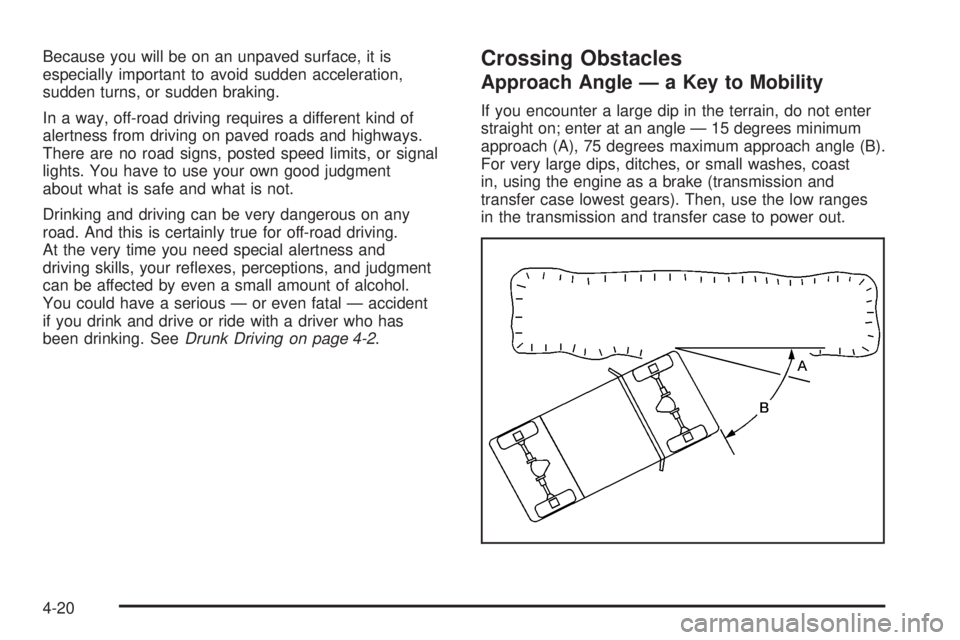
If you encounter a large dip in the terrain, do not enter
straight on; enter at an angle — 15 degrees minimum
approach (A), 75 degrees maximum approach angle (B).
For very large dips, ditches, or small washes, coast
in, using the engine as a brake (transmission and
transfer case lowest gears). Then, use the low ranges
in the transmission and transfer case to power out.
4-20
Page 217 of 416
Roll Your Tires Over Large Rocks
Do not straddle large
rocks; drive over them,
letting the tire cover
the rock. The tread of
the tire is thicker and
tougher than the
sidewall of the tire and
is more resilient to
impact than underbody
components.
Log Crossing
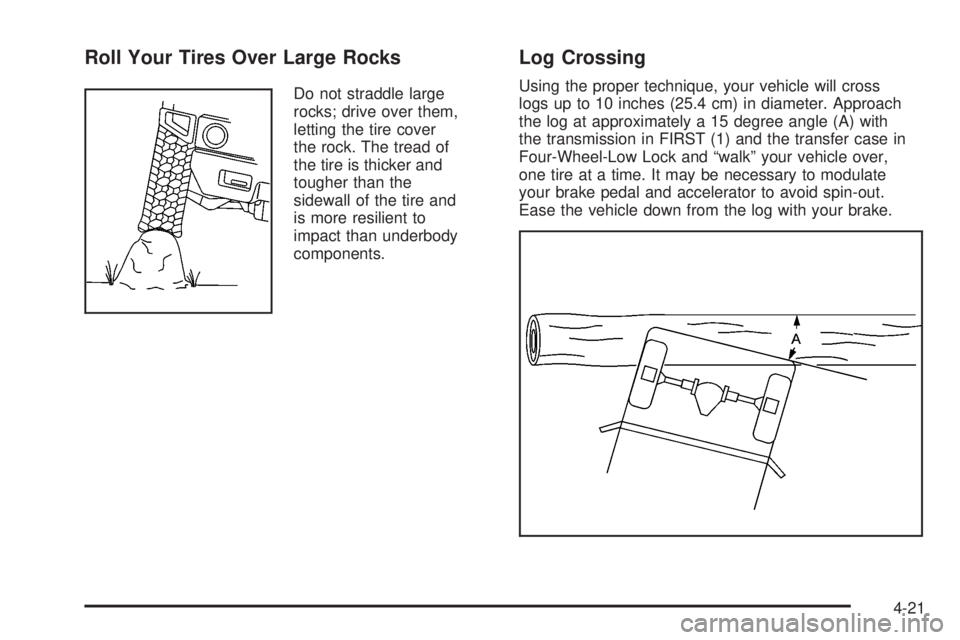
Using the proper technique, your vehicle will cross
logs up to 10 inches (25.4 cm) in diameter. Approach
the log at approximately a 15 degree angle (A) with
the transmission in FIRST (1) and the transfer case in
Four-Wheel-Low Lock and “walk” your vehicle over,
one tire at a time. It may be necessary to modulate
your brake pedal and accelerator to avoid spin-out.
Ease the vehicle down from the log with your brake.
4-21
Page 219 of 416
Driving Uphill
Once you decide you can safely drive up the hill,
you need to take some special steps:
Use transmission and transfer case low gear
and get a rm grip on the steering wheel.
Get a smooth start up the hill and try to maintain
your speed. Do not use more power than you
need, because you do not want the wheels to
start spinning or sliding.
Let the traction system work to control any wheel
slippage. The traction control system allows for
moderate wheel spin with some capability to dig
in and power up the hill.
Do not continue if the vehicle shudders or exhibits
suspension hopping. This can cause damage to
the driveline or suspension components. Improper
driving technique is not covered by your vehicle
warranty.
{CAUTION:
Turning or driving across steep hills can be
dangerous. You could lose traction, slide
sideways, and possibly roll over. You could
be seriously injured or killed. When driving up
hills, always try to go straight up.
Try to drive straight up the hill if at all possible.
If the path twists and turns, you might want to
nd another route.
Ease up on your speed as you approach the top
of the hill.
Attach a ag to the vehicle to make you more
visible to approaching traffic on trails or hills.
4-23
Page 221 of 416
There are also some things you must not do if you stall,
or are about to stall, when going up a hill:
Never attempt to prevent a stall by shifting into
NEUTRAL (N) to rev-up the engine and regain
forward momentum. This will not work. Your vehicle
will roll backwards very quickly and you could go
out of control.
Instead, apply the regular brake to stop the
vehicle. Then apply the parking brake. Shift to
REVERSE (R), release the parking brake,
and slowly back straight down.
Never attempt to turn around if you are about to
stall when going up a hill. If the hill is steep
enough to stall your vehicle, it is steep enough to
cause you to roll over if you turn around. If you
cannot make it up the hill, you must back straight
down the hill.
If, after stalling, you try to back down the hill and decide
you just cannot do it, set the parking brake. If you
have an automatic transmission, shift to PARK (P).
Turn off the engine. Leave the vehicle and go get
some help. Exit on the uphill side and stay clear of
the path the vehicle would take if it rolled downhill.
Do not shift the transfer case to NEUTRAL when you
leave the vehicle. Leave it in some gear.
{CAUTION:
Shifting the transfer case to NEUTRAL
can cause your vehicle to roll even if the
transmission is in PARK (P), or, if you have a
manual transmission, even if you are in gear.
This is because the NEUTRAL position on the
transfer case overrides the transmission. You
or someone else could be injured. If you are
going to leave your vehicle, set the parking
brake and shift the transmission to PARK (P),
or, put the manual transmission in FIRST (1).
But do not shift the transfer case to
NEUTRAL. Leave the transfer case in the
Four-Wheel High, Four-Wheel-High Lock,
or Four-Wheel-Low Lock position.
4-25
Page 245 of 416
Dinghy Towing
Use the following procedure to tow your vehicle:
1. Shift the transmission to NEUTRAL (N).
2. Turn the engine off, but leave the ignition in ON.
3. Firmly set the parking brake.
4. Securely attach the vehicle being towed to the tow
vehicle.
{CAUTION:
Shifting a full-time four-wheel-drive vehicle’s
transfer case into NEUTRAL can cause
your vehicle to roll even if the automatic
transmission is in PARK (P) or the manual
transmission is in any gear. You or others
could be injured. Make sure the parking brake
is rmly set before you shift the transfer case
to NEUTRAL.
5. Shift the transfer case to NEUTRAL (N). See
Full-Time Four-Wheel Drive on page 2-27for
the proper procedure to select the NEUTRAL
position for your vehicle.6. Put the transmission in PARK (P) for an
automatic transmission or in FIRST (1) for
a manual transmission.
7. Release the parking brake only after the vehicle
being towed is rmly attached to the towing
vehicle.
8. Turn the ignition off.
After towing, see “Shifting Out of NEUTRAL” under
Full-Time Four-Wheel Drive on page 2-27.
Dolly Towing
Notice:Dolly towing your vehicle will damage
drivetrain components. Do not dolly tow your
vehicle.
Your vehicle cannot be dolly towed. If you must tow
your vehicle behind another, use the dinghy towing
procedure listed previously.
4-49
Page 300 of 416
Jump Starting
If your vehicle’s battery has run down, you may want to
use another vehicle and some jumper cables to start your
vehicle. Be sure to use the following steps to do it safely.
{CAUTION:
Batteries can hurt you. They can be dangerous
because:
They contain acid that can burn you.
They contain gas that can explode or
ignite.
They contain enough electricity to
burn you.
If you do not follow these steps exactly, some
or all of these things can hurt you.
Notice:Ignoring these steps could result in costly
damage to your vehicle that would not be covered
by your warranty.
Trying to start your vehicle by pushing or pulling it
will not work, and it could damage your vehicle.
1. Check the other vehicle. It must have a 12-volt
battery with a negative ground system.Notice:If the other vehicle’s system is not a 12-volt
system with a negative ground, both vehicles can
be damaged. Only use vehicles with 12-volt systems
with negative grounds to jump start your vehicle.
2. Get the vehicles close enough so the jumper cables
can reach, but be sure the vehicles are not touching
each other. If they are, it could cause a ground
connection you do not want. You would not be able
to start your vehicle, and the bad grounding
could damage the electrical systems.
To avoid the possibility of the vehicles rolling, set
the parking brake rmly on both vehicles involved
in the jump start procedure. Put an automatic
transmission in PARK (P) or a manual transmission
in NEUTRAL before setting the parking brake.
If you have a four-wheel-drive vehicle, be sure the
transfer case is not in NEUTRAL.
Notice:If you leave your radio or other accessories
on during the jump starting procedure, they could
be damaged. The repairs would not be covered
by your warranty. Always turn off your radio and
other accessories when jump starting your vehicle.
3. Turn off the ignition on both vehicles. Unplug
unnecessary accessories plugged into the cigarette
lighter or the accessory power outlets. Turn off
the radio and all lamps that are not needed. This
will avoid sparks and help save both batteries. And
it could save the radio!
5-42
Page 304 of 416
Four-Wheel Drive
It is recommended that the four-wheel drive transfer
case uid be checked and lled by your dealer.
Front Axle
It is not necessary to regularly check front axle uid
unless you suspect there is a leak or you hear an
unusual noise. A uid loss could indicate a problem.
It is recommended that the front axle uid be checked
and lled by your dealer.
Headlamp Aiming
The vehicle may have a visual optical headlamp aiming
system. The aim has been preset at the factory and
should need no further adjustment.
However, if the vehicle is damaged in a crash, the
headlamp aim may be affected and adjustment may be
necessary.
If oncoming vehicles ash their high beams at you, this
may also mean the vertical aim needs to be adjusted.It is recommended that the vehicle is taken to your
dealer/retailer for service if the headlamps need to be
re-aimed. It is possible however, to re-aim the
headlamps as described.
The vehicle should:
Be placed so the headlamps are 25 ft. (7.6 m) from
a light colored wall or other at surface.
Have all four tires on a level surface which is level
all the way to a wall.
Be placed so it is perpendicular to the wall or other
at surface.
Not have any snow, ice, or mud on it.
Be fully assembled and all other work stopped while
headlamp aiming is being performed.
Be normally loaded with a full tank of fuel and one
person or 160 lbs (75 kg) sitting on the driver seat.
Have the tires properly inated.
Have the spare tire is in its original location in the
vehicle.
5-46
Page 337 of 416
Changing a Flat Tire
If a tire goes at, avoid further tire and wheel damage
by driving slowly to a level place. Turn on your
hazard warning ashers.
{CAUTION:
Changing a tire can be dangerous. The vehicle
can slip off the jack and roll over or fall on you
or other people. You and they could be badly
injured or even killed. Find a level place to
change your tire. To help prevent the vehicle
from moving:
1. Set the parking brake rmly.
2. Put the shift lever in PARK (P).
3. If you have a four-wheel-drive vehicle,
be sure the transfer case is in a drive
gear – not in NEUTRAL.
CAUTION: (Continued)
CAUTION: (Continued)
4. Turn off the engine and do not restart
while the vehicle is raised.
5. Do not allow passengers to remain in the
vehicle.
To be even more certain the vehicle will not
move, put blocks at the front and rear of the
tire farthest away from the one being changed.
That would be the tire on the other side, at the
opposite end of the vehicle.
When you have a at tire, you will rst need to set up
the wheel blocks before changing it. They are located in
the tool bag, in the swing-gate. SeeRemoving the
Spare Tire and Tools on page 5-81for more information.
5-79
Page 349 of 416
Spare Tire
Your vehicle, when new, had a fully-inated spare tire.
A spare tire may lose air over time, so check its
ination pressure regularly. SeeInflation - Tire Pressure
on page 5-62andLoading Your Vehicle on page 4-42
for information regarding proper tire ination and loading
your vehicle. For instruction on how to remove, install
or store a spare tire, seeRemoving the Flat Tire
and Installing the Spare Tire on page 5-83andStoring
a Flat or Spare Tire and Tools on page 5-89.
After installing the spare tire on your vehicle, you should
stop as soon as possible and make sure the spare is
correctly inated. The spare tire is made to perform well
at speeds up to 70 mph (112 km/h) at the recommended
ination pressure, so you can nish your trip.
Have the damaged or at road tire repaired or replaced
as soon as you can and installed back onto your
vehicle. This way, a spare tire will be available in case
you need it again. Do not mix tires and wheels of
different sizes, because they will not t. Keep your spare
tire and its wheel together.
Appearance Care
Interior Cleaning
Your vehicle’s interior will continue to look its best if it is
cleaned often. Although not always visible, dust and
dirt can accumulate on your upholstery. Dirt can damage
carpet, fabric, leather, and plastic surfaces. Regular
vacuuming is recommended to remove particles
from your upholstery. It is important to keep your
upholstery from becoming and remaining heavily soiled.
Soils should be removed as quickly as possible. Your
vehicle’s interior may experience extremes of heat
that could cause stains to set rapidly.
Lighter colored interiors may require more frequent
cleaning. Use care because newspapers and garments
that transfer color to your home furnishings may also
transfer color to your vehicle’s interior.
5-91