5-3 HUMMER H3 2008 Owner's Manual
[x] Cancel search | Manufacturer: HUMMER, Model Year: 2008, Model line: H3, Model: HUMMER H3 2008Pages: 416, PDF Size: 5.66 MB
Page 293 of 416
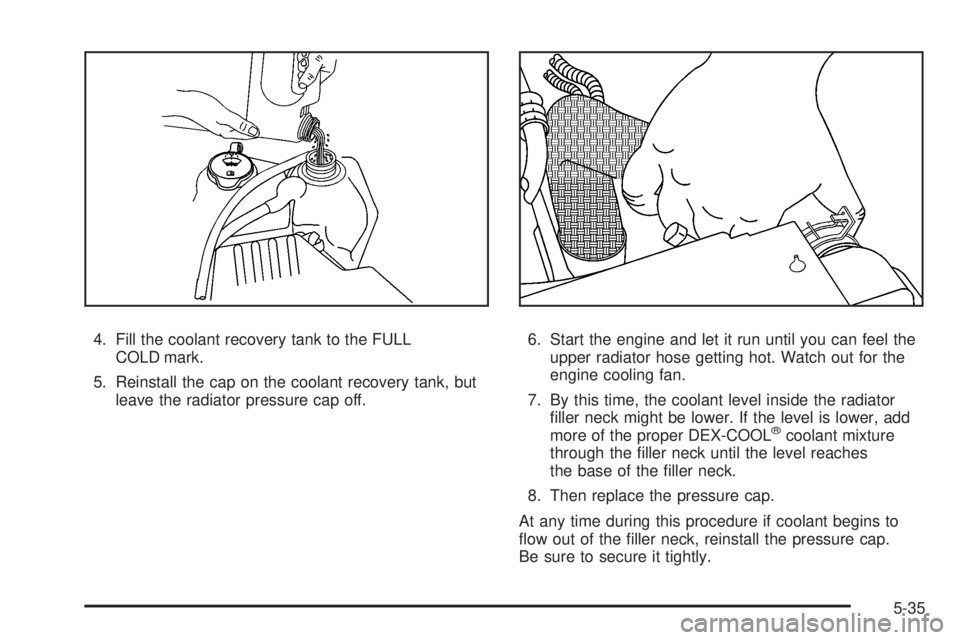
4. Fill the coolant recovery tank to the FULL
COLD mark.
5. Reinstall the cap on the coolant recovery tank, but
leave the radiator pressure cap off.6. Start the engine and let it run until you can feel the
upper radiator hose getting hot. Watch out for the
engine cooling fan.
7. By this time, the coolant level inside the radiator
ller neck might be lower. If the level is lower, add
more of the proper DEX-COOL
®coolant mixture
through the ller neck until the level reaches
the base of the ller neck.
8. Then replace the pressure cap.
At any time during this procedure if coolant begins to
ow out of the ller neck, reinstall the pressure cap.
Be sure to secure it tightly.
5-35
Page 294 of 416
Engine Fan Noise
This vehicle has a clutched engine cooling fan. When
the clutch is engaged, the fan spins faster to provide
more air to cool the engine. In most everyday driving
conditions, the clutch is not engaged. This improves fuel
economy and reduces fan noise. Under heavy vehicle
loading, trailer towing and/or high outside temperatures,
the fan speed increases when the clutch engages.
So you may hear an increase in fan noise. This
is normal and should not be mistaken as the
transmission slipping or making extra shifts. It is merely
the cooling system functioning properly. The fan will
slow down when additional cooling is not required and
the clutch disengages.
You may also hear this fan noise when you start the
engine. It will go away as the fan clutch disengages.
Power Steering Fluid
SeeEngine Compartment
Overview on page 5-12for
reservoir location.
When to Check Power Steering Fluid
It is not necessary to regularly check power steering uid
unless you suspect there is a leak in the system or
you hear an unusual noise. A uid loss in this system
could indicate a problem. Have the system inspected
and repaired.
How to Check Power Steering Fluid
1. Turn the key off and let the engine compartment
cool down.
2. Wipe the cap and the top of the reservoir clean.
3. Unscrew the cap and wipe the dipstick with a
clean rag.
5-36
Page 295 of 416
4. Replace the cap and completely tighten it.
5. Then remove the cap again and look at the uid
level on the dipstick.
The level should be between the ADD and FULL marks.
If necessary, add only enough uid to bring the level
up to the proper range.
What to Use
To determine what kind of uid to use, see
Recommended Fluids and Lubricants on page 6-12.
Always use the proper uid.
Notice:Use of the incorrect uid may damage your
vehicle and the damages may not be covered by
your warranty. Always use the correct uid listed in
Recommended Fluids and Lubricants on page 6-12.
Windshield Washer Fluid
What to Use
When you need windshield washer uid, be sure to read
the manufacturer’s instructions before use. If you will be
operating your vehicle in an area where the temperature
may fall below freezing, use a uid that has sufficient
protection against freezing.
Adding Washer Fluid
Open the cap with the
washer symbol on it. Add
washer uid until the
tank is full. SeeEngine
Compartment Overview on
page 5-12for reservoir
location.
Notice:
When using concentrated washer uid, follow the
manufacturer’s instructions for adding water.
Do not mix water with ready-to-use washer uid.
Water can cause the solution to freeze and
damage your washer uid tank and other parts of
the washer system. Also, water does not clean as
well as washer uid.
Fill the washer uid tank only three-quarters full
when it is very cold. This allows for uid
expansion if freezing occurs, which could
damage the tank if it is completely full.
Do not use engine coolant (antifreeze) in your
windshield washer. It can damage the vehicle’s
windshield washer system and paint.
5-37
Page 296 of 416
Brakes
Brake Fluid
The brake master cylinder
reservoir is lled with
DOT-3 brake uid. See
Engine Compartment
Overview on page 5-12for
the location of the
reservoir.
There are only two reasons why the brake uid level
in the reservoir might go down. The rst is that the brake
uid goes down to an acceptable level during normal
brake lining wear. When new linings are put in, the uid
level goes back up. The other reason is that uid
is leaking out of the brake hydraulic system.
If it is, you should have the brake hydraulic system
xed, since a leak means that sooner or later the
brakes will not work well.It is not a good idea to top off the brake uid. Adding
brake uid will not correct a leak. If uid is added when
the linings are worn, there will be too much uid
when new brake linings are installed. Add or remove
brake uid, as necessary, only when work is done on the
brake hydraulic system.
{CAUTION:
If you have too much brake uid, it can spill on
the engine. The uid will burn if the engine is
hot enough. You or others could be burned,
and your vehicle could be damaged. Add brake
uid only when work is done on the brake
hydraulic system. See “Checking Brake Fluid”
in this section.
Refer to the Maintenance Schedule to determine when
to check your brake uid. SeeScheduled Maintenance
on page 6-4.
5-38
Page 297 of 416
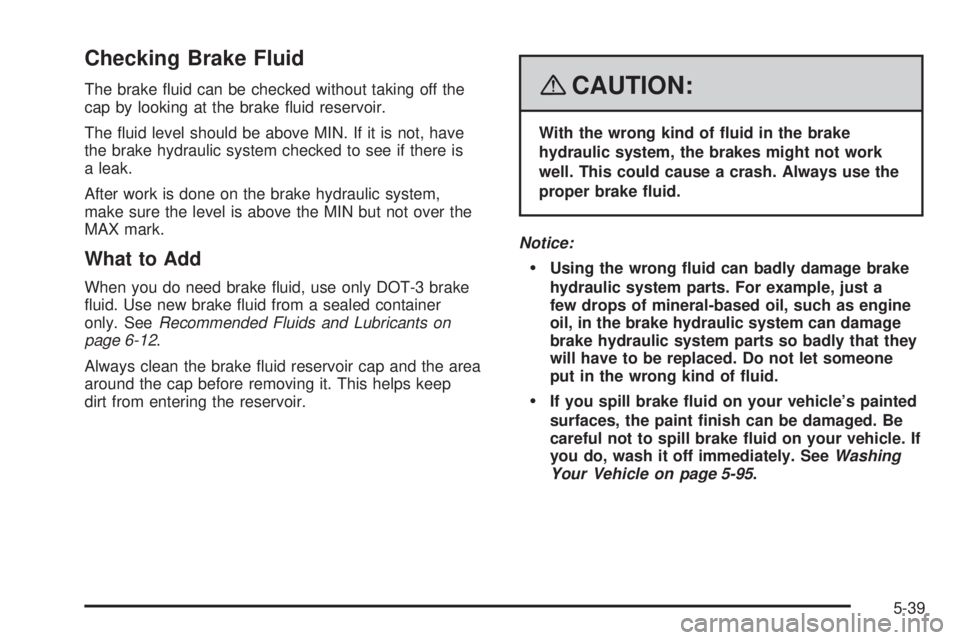
Checking Brake Fluid
The brake uid can be checked without taking off the
cap by looking at the brake uid reservoir.
The uid level should be above MIN. If it is not, have
the brake hydraulic system checked to see if there is
a leak.
After work is done on the brake hydraulic system,
make sure the level is above the MIN but not over the
MAX mark.
What to Add
When you do need brake uid, use only DOT-3 brake
uid. Use new brake uid from a sealed container
only. SeeRecommended Fluids and Lubricants on
page 6-12.
Always clean the brake uid reservoir cap and the area
around the cap before removing it. This helps keep
dirt from entering the reservoir.
{CAUTION:
With the wrong kind of uid in the brake
hydraulic system, the brakes might not work
well. This could cause a crash. Always use the
proper brake uid.
Notice:
Using the wrong uid can badly damage brake
hydraulic system parts. For example, just a
few drops of mineral-based oil, such as engine
oil, in the brake hydraulic system can damage
brake hydraulic system parts so badly that they
will have to be replaced. Do not let someone
put in the wrong kind of uid.
If you spill brake uid on your vehicle’s painted
surfaces, the paint nish can be damaged. Be
careful not to spill brake uid on your vehicle. If
you do, wash it off immediately. SeeWashing
Your Vehicle on page 5-95.
5-39
Page 331 of 416
Your vehicle’s original equipment tires are listed
on the Tire and Loading Information Label.
SeeLoading Your Vehicle on page 4-42, for more
information about the Tire and Loading Information
Label and its location on your vehicle.
Different Size Tires and Wheels
If you add wheels or tires that are a different size than
your original equipment wheels and tires, this could
affect the way your vehicle performs, including its
braking, ride and handling characteristics, stability, and
resistance to rollover. Additionally, if your vehicle
has electronic systems such as anti-lock brakes, rollover
airbags, traction control, and electronic stability control,
the performance of these systems can be affected.
{CAUTION:
If you add different sized wheels, your vehicle
may not provide an acceptable level of
performance and safety if tires not
recommended for those wheels are selected.
You may increase the chance that you will
crash and suffer serious injury. Only use
GM specic wheel and tire systems developed
for your vehicle, and have them properly
installed by a GM certied technician.
SeeBuying New Tires on page 5-71andAccessories
and Modifications on page 5-3for additional information.
5-73
Page 403 of 416

A
Accessories and Modications............................ 5-3
Adding Equipment to Your Airbag-Equipped
Vehicle.......................................................1-68
Additives, Fuel................................................. 5-6
Add-On Electrical Equipment...........................5-101
Air Cleaner/Filter, Engine.................................5-20
Air Conditioning..............................................3-22
Airbag
Passenger Status Indicator...........................3-30
Readiness Light..........................................3-29
Airbag System................................................1-54
What Will You See After an Airbag Inates?....1-61
When Should an Airbag Inate?....................1-59
Where Are the Airbags?...............................1-57
Airbag Systems
Adding Equipment to Your Airbag-Equipped
Vehicle...................................................1-68
How Does an Airbag Restrain?......................1-60
Passenger Sensing System...........................1-62
Servicing Your Airbag-Equipped Vehicle..........1-67
What Makes an Airbag Inate?......................1-60
Antenna, Fixed Mast.......................................3-62
Antenna, XM™ Satellite Radio Antenna System . . . 3-62
Antilock Brake System (ABS)............................. 4-4
Antilock Brake, System Warning Light................3-34Appearance Care
Aluminum or Chrome-Plated Wheels..............5-97
Care of Safety Belts....................................5-94
Chemical Paint Spotting...............................5-99
Cleaning Exterior Lamps/Lenses....................5-95
Fabric/Carpet..............................................5-93
Finish Care.................................................5-96
Finish Damage............................................5-98
Instrument Panel, Vinyl, and
Other Plastic Surfaces..............................5-94
Interior Cleaning..........................................5-91
Leather......................................................5-93
Sheet Metal Damage...................................5-98
Tires..........................................................5-98
Underbody Maintenance...............................
5-98
Vehicle Care/Appearance Materials................5-99
Washing Your Vehicle...................................5-95
Weatherstrips..............................................5-94
Windshield, Backglass, and Wiper Blades.......5-97
Appointments, Scheduling Service....................... 7-9
Ashtray.........................................................3-22
Assist Steps...................................................4-31
Audio System.................................................3-48
Fixed Mast Antenna.....................................3-62
Navigation/Radio System,
see Navigation Manual..............................3-61
Radio Reception..........................................3-61
1
Page 404 of 416
Audio System (cont.)
Setting the Time..........................................3-48
Theft-Deterrent Feature................................3-61
XM™ Satellite Radio Antenna System............3-62
Audio System(s).............................................3-49
Automatic Headlamp System............................3-17
Automatic Transmission
Fluid..........................................................5-21
Operation...................................................2-23
B
Battery..........................................................5-41
Electric Power Management..........................3-20
Run-Down Protection...................................3-20
Bench Seat, Split (60/40)................................... 1-8
Brake
Emergencies................................................ 4-5
Brakes..........................................................5-38
System Warning Light..................................3-33
Braking........................................................... 4-3
Braking in Emergencies..................................... 4-5
Break-In, New Vehicle.....................................2-18
Bulb Replacement...........................................5-49
Halogen Bulbs............................................5-49
Headlamp Aiming........................................5-46
Headlamps.................................................5-49Bulb Replacement (cont.)
License Plate Lamps....................................5-51
Replacement Bulbs......................................5-52
Taillamps, Turn Signal, Stoplamps and
Back-up Lamps........................................5-50
Buying New Tires...........................................5-71
C
Calibration.............................................2-38, 2-41
California Fuel.................................................. 5-6
California Perchlorate Materials Requirements....... 5-4
California Proposition 65 Warning....................... 5-4
Canadian Owners................................................ ii
Capacities and Specications..........................5-107
Carbon Monoxide...........................2-10, 2-36, 4-50
Care of
Safety Belts................................................5-94
Cargo Cover..................................................2-59
Cargo Tie Downs............................................2-59
Chains, Tire...................................................5-77
Charging System Light....................................3-32
Check
Engine Light...............................................3-36
Checking Things Under the Hood......................5-11
Chemical Paint Spotting...................................5-99
2
Page 405 of 416
Child Restraints
Child Restraint Systems...............................1-37
Infants and Young Children...........................1-33
Lower Anchors and Tethers for Children..........1-42
Older Children.............................................1-30
Securing a Child Restraint in a
Rear Outside Seat Position........................1-48
Securing a Child Restraint in the
Center Rear Seat Position.........................1-50
Securing a Child Restraint in the
Right Front Seat Position..........................1-51
Where to Put the Restraint...........................1-40
Cigarette Lighter.............................................3-22
Cleaning
Aluminum or Chrome-Plated Wheels..............5-97
Exterior Lamps/Lenses.................................5-95
Fabric/Carpet..............................................5-93
Finish Care.................................................5-96
Instrument Panel, Vinyl, and Other
Plastic Surfaces.......................................5-94
Interior.......................................................5-91
Leather......................................................5-93
Tires..........................................................5-98
Underbody Maintenance...............................5-98
Washing Your Vehicle...................................5-95
Weatherstrips..............................................5-94
Windshield, Backglass, and Wiper Blades.......5-97
Climate Control System...................................3-22
Outlet Adjustment........................................3-24Clock............................................................3-48
Clutch, Hydraulic.............................................5-26
Collision Damage Repair..................................7-11
Compass...............................................2-38, 2-41
Content Theft-Deterrent....................................2-14
Control of a Vehicle.......................................... 4-3
Convenience Net............................................2-59
Coolant
Engine Temperature Gage............................3-35
Heater, Engine............................................
2-22
Cooling System..............................................5-31
Cruise Control................................................3-11
Cruise Control Light........................................3-39
Cupholder(s)..................................................2-56
Customer Assistance Information
Courtesy Transportation.................................. 7-9
Customer Assistance for
Text Telephone (TTY) Users........................ 7-5
Customer Assistance Offices........................... 7-5
Customer Satisfaction Procedure..................... 7-2
GM Mobility Reimbursement Program............... 7-6
Reporting Safety Defects to General Motors.....7-15
Reporting Safety Defects to the
Canadian Government..............................7-15
Reporting Safety Defects to the
United States Government.........................7-14
Roadside Assistance Program......................... 7-6
Service Publications Ordering Information........7-15
3
Page 406 of 416
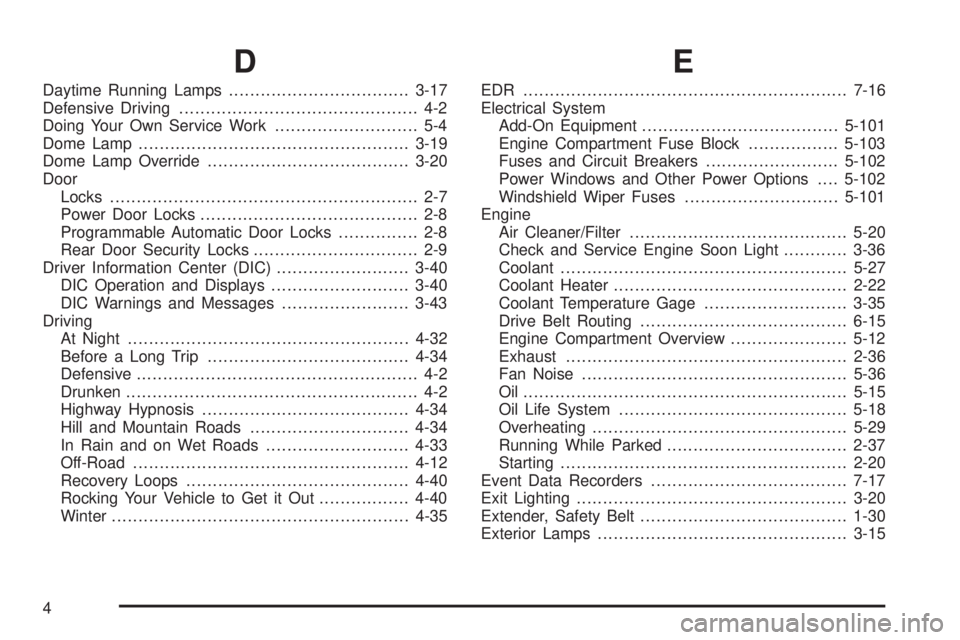
D
Daytime Running Lamps..................................3-17
Defensive Driving............................................. 4-2
Doing Your Own Service Work........................... 5-4
Dome Lamp...................................................3-19
Dome Lamp Override......................................3-20
Door
Locks.......................................................... 2-7
Power Door Locks......................................... 2-8
Programmable Automatic Door Locks............... 2-8
Rear Door Security Locks............................... 2-9
Driver Information Center (DIC).........................3-40
DIC Operation and Displays..........................3-40
DIC Warnings and Messages........................3-43
Driving
At Night.....................................................4-32
Before a Long Trip......................................4-34
Defensive..................................................... 4-2
Drunken....................................................... 4-2
Highway Hypnosis.......................................4-34
Hill and Mountain Roads..............................4-34
In Rain and on Wet Roads...........................4-33
Off-Road....................................................4-12
Recovery Loops..........................................4-40
Rocking Your Vehicle to Get it Out.................4-40
Winter........................................................4-35
E
EDR .............................................................7-16
Electrical System
Add-On Equipment.....................................5-101
Engine Compartment Fuse Block.................5-103
Fuses and Circuit Breakers.........................5-102
Power Windows and Other Power Options....5-102
Windshield Wiper Fuses.............................5-101
Engine
Air Cleaner/Filter.........................................5-20
Check and Service Engine Soon Light............3-36
Coolant......................................................5-27
Coolant Heater............................................2-22
Coolant Temperature Gage...........................3-35
Drive Belt Routing.......................................6-15
Engine Compartment Overview......................5-12
Exhaust.....................................................2-36
Fan Noise..................................................5-36
Oil .............................................................5-15
Oil Life System...........................................5-18
Overheating................................................5-29
Running While Parked..................................2-37
Starting......................................................2-20
Event Data Recorders.....................................7-17
Exit Lighting...................................................3-20
Extender, Safety Belt.......................................1-30
Exterior Lamps...............................................3-15
4