air condition HUMMER H3 2008 Owner's Manual
[x] Cancel search | Manufacturer: HUMMER, Model Year: 2008, Model line: H3, Model: HUMMER H3 2008Pages: 416, PDF Size: 5.66 MB
Page 298 of 416
Brake Wear
Your vehicle has disc brakes. Disc brake pads have
built-in wear indicators that make a high-pitched warning
sound when the brake pads are worn and new pads
are needed. The sound can come and go or be heard all
the time your vehicle is moving, except when you are
pushing on the brake pedal rmly.
{CAUTION:
The brake wear warning sound means that
soon the brakes will not work well. That could
lead to an accident. When you hear the brake
wear warning sound, have your vehicle
serviced.
Notice:Continuing to drive with worn-out brake
pads could result in costly brake repair.
Some driving conditions or climates can cause a brake
squeal when the brakes are rst applied or lightly
applied. This does not mean something is wrong with
the brakes.Properly torqued wheel nuts are necessary to help
prevent brake pulsation. When tires are rotated, inspect
brake pads for wear and evenly tighten wheel nuts in
the proper sequence to torque specications in
Capacities and Specifications on page 5-107.
Brake linings should always be replaced as complete
axle sets.
Brake Pedal Travel
See your dealer/retailer if the brake pedal does not
return to normal height, or if there is a rapid increase in
pedal travel. This could be a sign that brake service
might be required.
Brake Adjustment
Every time you make a brake stop, the disc brakes
adjust for wear.
5-40
Page 317 of 416
(D) Construction Code:A letter code is used to
indicate the type of ply construction in the tire.
The letter R means radial ply construction;
the letter D means diagonal or bias ply
construction; and the letter B means belted-bias
ply construction.
(E) Rim Diameter
:Diameter of the wheel in
inches.
(F) Service Description
:The service description
indicates the load range and speed rating of a
tire. The load index can range from 1 to 279.
Speed ratings range from A to Z.
Tire Terminology and Denitions
Air Pressure:The amount of air inside the
tire pressing outward on each square inch of the
tire. Air pressure is expressed in pounds per
square inch (psi) or kilopascal (kPa).
Accessory Weight
:This means the combined
weight of optional accessories. Some examples of
optional accessories are, automatic transmission,
power steering, power brakes, power windows,
power seats, and air conditioning.
Aspect Ratio
:The relationship of a tire’s height
to its width.Belt
:A rubber coated layer of cords that is
located between the plies and the tread. Cords
may be made from steel or other reinforcing
materials.
Bead
:The tire bead contains steel wires wrapped
by steel cords that hold the tire onto the rim.
Bias Ply Tire
:A pneumatic tire in which the plies
are laid at alternate angles less than 90 degrees
to the centerline of the tread.
Cold Tire Pressure
:The amount of air pressure in
a tire, measured in pounds per square inch (psi) or
kilopascals (kPa) before a tire has built up heat
from driving. SeeInflation - Tire Pressure on
page 5-62.
Curb Weight
:The weight of a motor vehicle with
standard and optional equipment including the
maximum capacity of fuel, oil, and coolant,
but without passengers and cargo.
DOT Markings
:A code molded into the sidewall
of a tire signifying that the tire is in compliance
with the U.S. Department of Transportation (DOT)
motor vehicle safety standards. The DOT code
includes the Tire Identication Number (TIN),
an alphanumeric designator which can also identify
the tire manufacturer, production plant, brand,
and date of production.
5-59
Page 323 of 416
Tire Pressure Monitor Operation
The Tire Pressure Monitor System (TPMS) is designed
to warn the driver when a low tire pressure condition
exists. TPMS sensors are mounted onto each tire
and wheel assembly on your vehicle, excluding the
spare tire. The TPMS sensors monitor the air pressure
in your vehicle’s tires and transmit the tire pressure
readings to a receiver located in the vehicle.
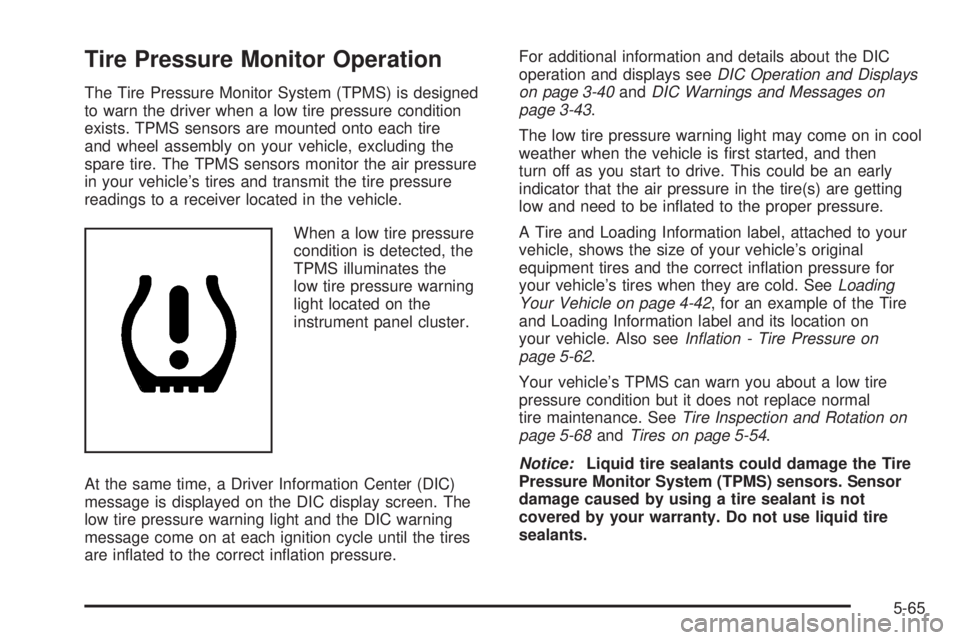
When a low tire pressure
condition is detected, the
TPMS illuminates the
low tire pressure warning
light located on the
instrument panel cluster.
At the same time, a Driver Information Center (DIC)
message is displayed on the DIC display screen. The
low tire pressure warning light and the DIC warning
message come on at each ignition cycle until the tires
are inated to the correct ination pressure.For additional information and details about the DIC
operation and displays seeDIC Operation and Displays
on page 3-40andDIC Warnings and Messages on
page 3-43.
The low tire pressure warning light may come on in cool
weather when the vehicle is rst started, and then
turn off as you start to drive. This could be an early
indicator that the air pressure in the tire(s) are getting
low and need to be inated to the proper pressure.
A Tire and Loading Information label, attached to your
vehicle, shows the size of your vehicle’s original
equipment tires and the correct ination pressure for
your vehicle’s tires when they are cold. SeeLoading
Your Vehicle on page 4-42, for an example of the Tire
and Loading Information label and its location on
your vehicle. Also seeInflation - Tire Pressure on
page 5-62.
Your vehicle’s TPMS can warn you about a low tire
pressure condition but it does not replace normal
tire maintenance. SeeTire Inspection and Rotation on
page 5-68andTires on page 5-54.
Notice:Liquid tire sealants could damage the Tire
Pressure Monitor System (TPMS) sensors. Sensor
damage caused by using a tire sealant is not
covered by your warranty. Do not use liquid tire
sealants.
5-65
Page 328 of 416
When It Is Time for New Tires
Various factors, such as maintenance, temperatures,
driving speeds, vehicle loading, and road conditions,
inuence when you need new tires.
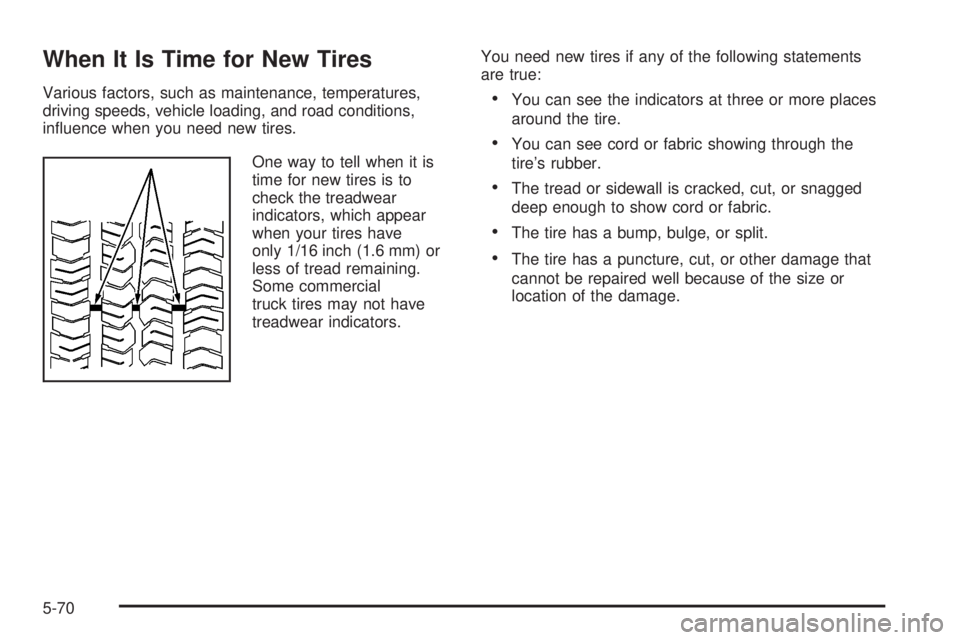
One way to tell when it is
time for new tires is to
check the treadwear
indicators, which appear
when your tires have
only 1/16 inch (1.6 mm) or
less of tread remaining.
Some commercial
truck tires may not have
treadwear indicators.You need new tires if any of the following statements
are true:You can see the indicators at three or more places
around the tire.
You can see cord or fabric showing through the
tire’s rubber.
The tread or sidewall is cracked, cut, or snagged
deep enough to show cord or fabric.
The tire has a bump, bulge, or split.
The tire has a puncture, cut, or other damage that
cannot be repaired well because of the size or
location of the damage.
5-70
Page 333 of 416
Temperature – A, B, C
The temperature grades are A (the highest), B,
and C, representing the tire’s resistance to
the generation of heat and its ability to dissipate
heat when tested under controlled conditions on a
specied indoor laboratory test wheel. Sustained
high temperature can cause the material of the tire
to degenerate and reduce tire life, and excessive
temperature can lead to sudden tire failure.
The grade C corresponds to a level of performance
which all passenger car tires must meet under
the Federal Motor Vehicle Safety Standard
No. 109. Grades B and A represent higher levels
of performance on the laboratory test wheel
than the minimum required by law.
Warning
:The temperature grade for this tire
is established for a tire that is properly inated
and not overloaded. Excessive speed,
underination, or excessive loading, either
separately or in combination, can cause heat
buildup and possible tire failure.
Wheel Alignment and Tire Balance
The tires and wheels on your vehicle were aligned
and balanced carefully at the factory to give you the
longest tire life and best overall performance.
Adjustments to wheel alignment and tire balancing will
not be necessary on a regular basis. However, if
you notice unusual tire wear or your vehicle pulling to
one side or the other, the alignment might need to
be checked. If you notice your vehicle vibrating when
driving on a smooth road, the tires and wheels
might need to be rebalanced. See your dealer/retailer
for proper diagnosis.
Wheel Replacement
Replace any wheel that is bent, cracked, or badly rusted
or corroded. If wheel nuts keep coming loose, the
wheel, wheel bolts, and wheel nuts should be replaced.
If the wheel leaks air, replace it (except some
aluminum wheels, which can sometimes be repaired).
See your dealer/retailer if any of these conditions exist.
Your dealer/retailer will know the kind of wheel you need.
5-75
Page 355 of 416
Windshield, Backglass, and Wiper
Blades
Clean the outside of the windshield and backglass with
glass cleaner.
Clean the rubber blades using a lint free cloth or paper
towel soaked with windshield washer uid or a mild
detergent. Wash the windshield thoroughly when you
clean the blades. Bugs, road grime, sap and a buildup of
vehicle wash/wax treatments may cause wiper streaking.
Replace the wiper blades if they are worn or damaged.
Wipers can be damaged by:
Extreme dusty conditions
Sand and salt
Heat and sun
Snow and ice, without proper removal
Aluminum or Chrome-Plated Wheels
and Trim
Your vehicle may have either aluminum or
chrome-plated wheels.
Keep the wheels clean using a soft clean cloth with mild
soap and water. Rinse with clean water. After rinsing
thoroughly, dry with a soft clean towel. A wax may then
be applied.Notice:Chrome wheels and other chrome trim may
be damaged if you do not wash your vehicle after
driving on roads that have been sprayed with
magnesium, calcium or sodium chloride. These
chlorides are used on roads for conditions such as
ice and dust. Always wash your vehicle’s chrome
with soap and water after exposure.
Notice:If you use strong soaps, chemicals,
abrasive polishes, cleaners, brushes, or cleaners
that contain acid on aluminum or chrome-plated
wheels, you could damage the surface of the
wheel(s). The repairs would not be covered by your
warranty. Use only approved cleaners on aluminum
or chrome-plated wheels.
The surface of these wheels is similar to the painted
surface of your vehicle. Do not use strong soaps,
chemicals, abrasive polishes, abrasive cleaners,
cleaners with acid, or abrasive cleaning brushes on
them because you could damage the surface. Do not
use chrome polish on aluminum wheels.
5-97
Page 357 of 416
At least every spring, ush these materials from the
underbody with plain water. Clean any areas where mud
and debris can collect. Dirt packed in close areas of
the frame should be loosened before being ushed.
Your dealer/retailer or an underbody car washing system
can do this for you.
Chemical Paint Spotting
Some weather and atmospheric conditions can create a
chemical fallout. Airborne pollutants can fall upon and
attack painted surfaces on the vehicle. This damage can
take two forms: blotchy, ring-shaped discolorations,
and small, irregular dark spots etched into the
paint surface.
Although no defect in the paint job causes this, we will
repair, at no charge to the owner, the surfaces of
new vehicles damaged by this fallout condition within
12 months or 12,000 miles (20 000 km) of purchase,
whichever occurs rst.
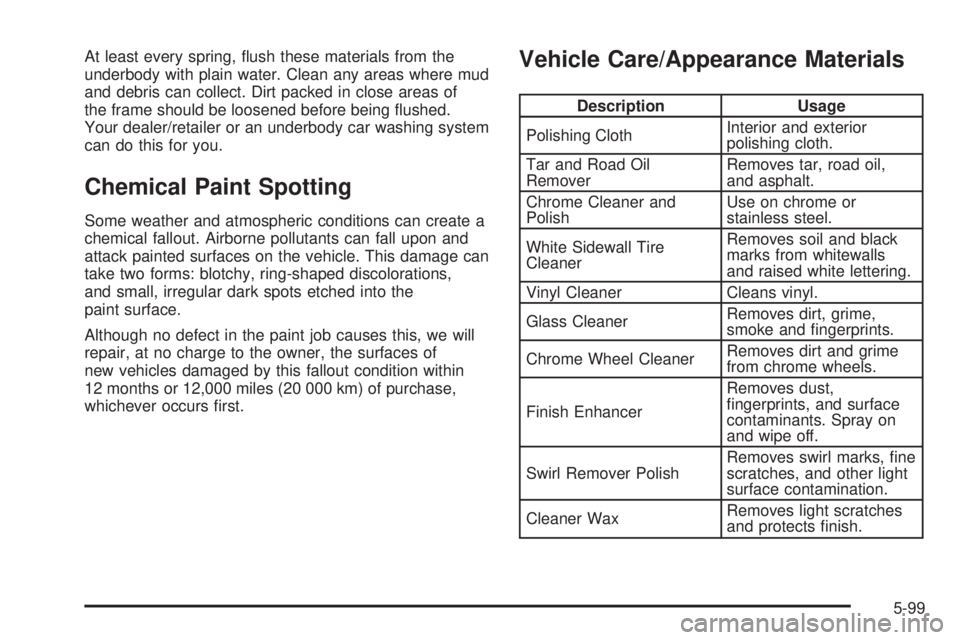
Vehicle Care/Appearance Materials
Description Usage
Polishing ClothInterior and exterior
polishing cloth.
Tar and Road Oil
RemoverRemoves tar, road oil,
and asphalt.
Chrome Cleaner and
PolishUse on chrome or
stainless steel.
White Sidewall Tire
CleanerRemoves soil and black
marks from whitewalls
and raised white lettering.
Vinyl Cleaner Cleans vinyl.
Glass CleanerRemoves dirt, grime,
smoke and ngerprints.
Chrome Wheel CleanerRemoves dirt and grime
from chrome wheels.
Finish EnhancerRemoves dust,
ngerprints, and surface
contaminants. Spray on
and wipe off.
Swirl Remover PolishRemoves swirl marks, ne
scratches, and other light
surface contamination.
Cleaner WaxRemoves light scratches
and protects nish.
5-99
Page 363 of 416

Fuse Usage
7 Regulated Voltage Control Power
8 Power Locks
9 Sunroof, Front Washer Pump
10 Accessories (SPO)
11 Air Compressor
12 Transfer Case Control Module
13Radio, Heating, Ventilation, Air
Conditioning Display
14 Body Control Module
15 Rear Wiper Motor
16 Rear Wiper Pump Switch
17 Air Injection Reactor (AIR) Solenoid
18 Spare 6
19 Cluster
20 Rear Turn Signal, Hazard Signal
21 Powertrain Control Module 1
22Mass Air Flow Sensor, Purge
Solenoid
23 Injector
24 Fog Lamp
25 Powertrain Control Module B
26 Transmission Control Module (TCM)
27 Airbags
28 Back-up LampsFuse Usage
29 Antilock Brakes, StabiliTrak®
30 Rear Window Defogger
31 Canister Vent
32 Regulated Voltage Control VSense+
33 Ignition 1
34 Transmission
35 Cruise, Inside Rearview Mirror
36 Horn
37 Driver Side Rear Park Lamp
38 Amplier
39Reduced Intensity Low-Beam
Daytime Running Lamps
40 Passenger Side Headlamp
41 Driver Side Headlamp
42 Trailer Back-Up Lamp
43 Front Park Lamps
44 Air Injection Reactor (AIR) Solenoid
45 Auxiliary Power 2
46 Electronic Throttle Control
47 Oxygen Sensor
48 Air Conditioning Clutch
49 Passenger Side Rear Park Lamp
50 Spare
51 Auxiliary Power 1
5-105
Page 364 of 416
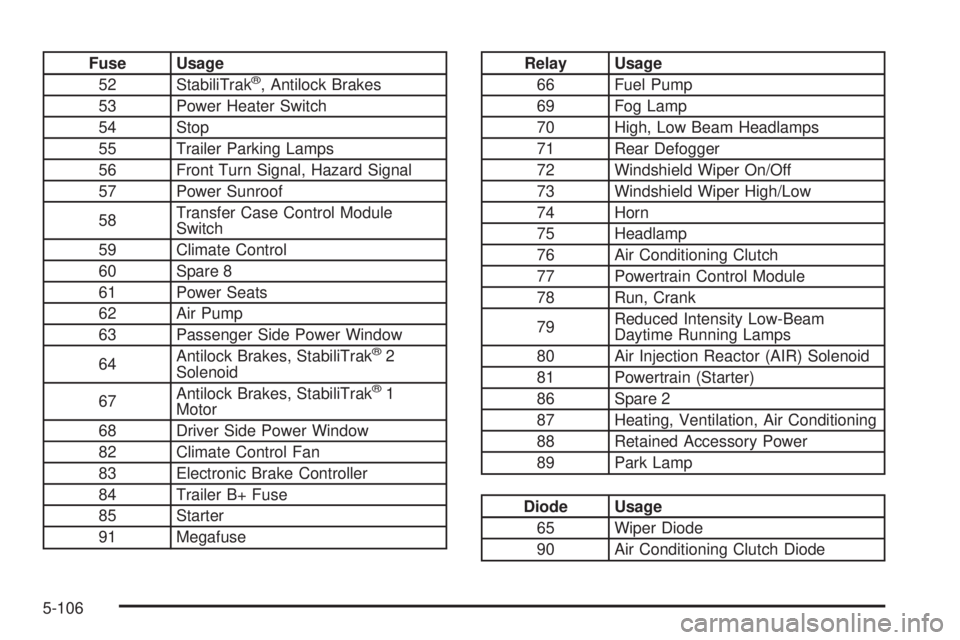
Fuse Usage
52 StabiliTrak®, Antilock Brakes
53 Power Heater Switch
54 Stop
55 Trailer Parking Lamps
56 Front Turn Signal, Hazard Signal
57 Power Sunroof
58Transfer Case Control Module
Switch
59 Climate Control
60 Spare 8
61 Power Seats
62 Air Pump
63 Passenger Side Power Window
64Antilock Brakes, StabiliTrak
®2
Solenoid
67Antilock Brakes, StabiliTrak
®1
Motor
68 Driver Side Power Window
82 Climate Control Fan
83 Electronic Brake Controller
84 Trailer B+ Fuse
85 Starter
91 Megafuse
Relay Usage
66 Fuel Pump
69 Fog Lamp
70 High, Low Beam Headlamps
71 Rear Defogger
72 Windshield Wiper On/Off
73 Windshield Wiper High/Low
74 Horn
75 Headlamp
76 Air Conditioning Clutch
77 Powertrain Control Module
78 Run, Crank
79Reduced Intensity Low-Beam
Daytime Running Lamps
80 Air Injection Reactor (AIR) Solenoid
81 Powertrain (Starter)
86 Spare 2
87 Heating, Ventilation, Air Conditioning
88 Retained Accessory Power
89 Park Lamp
Diode Usage
65 Wiper Diode
90 Air Conditioning Clutch Diode
5-106
Page 365 of 416

Capacities and Specications
The following approximate capacities are given in English and metric. Please refer toRecommended Fluids and
Lubricants on page 6-12for more information.
Capacities and Specications
ApplicationCapacities
English Metric
Air Conditioning Refrigerant R134aFor the air conditioning system refrigerant charge
amount, see the refrigerant caution label located
under the hood. See your dealer/retailer for more
information.
Cooling System
3.7L Engine 10.0 qt 9.5 L
5.3L Engine 14.3 qt 13.5 L
Engine Oil with Filter
3.7L and 5.3L Engines 6.0 qt 5.7 L
Fuel Tank 23.0 gal 87.1 L
Transfer Case 1.6 qt 1.5 L
5-107