brake light HUMMER H3 2008 Owner's Manual
[x] Cancel search | Manufacturer: HUMMER, Model Year: 2008, Model line: H3, Model: HUMMER H3 2008Pages: 416, PDF Size: 5.66 MB
Page 258 of 416
Trailer Brake Control Wiring Harness
The trailer brake control wiring harness is located
under the instrument panel to the right of the steering
column. The wires are taped to the harness that goes
to the courtesy light under the instrument panel.
The harness will contain the following wires:
Red Wire: AUX B+
Black Wire: Ground
Light Blue Wire: Brake Signal
Dark Blue Wire: Trailer Brakes
Trailer Recommendations
You must subtract your hitch loads from the Cargo
Weight Rating (CWR). CWR is the maximum weight
of the load your vehicle can carry. It doesn’t include the
weight of the people inside, but you can gure about
150 lbs. (68 kg) for each seat. The total cargo load
must not be more than your vehicles CWR.
Weigh your vehicle with your trailer attached, so that
you won’t go over the GVWR or GAWR. If you are using
a weight-distributing hitch, weigh the vehicle without
the spring bars in place.
You’ll get the best performance if you spread out the
weight of your load the right way, and if you choose the
correct hitch and trailer brakes.
For more information seeTowing a Trailer on page 4-50.
4-62
Page 298 of 416
Brake Wear
Your vehicle has disc brakes. Disc brake pads have
built-in wear indicators that make a high-pitched warning
sound when the brake pads are worn and new pads
are needed. The sound can come and go or be heard all
the time your vehicle is moving, except when you are
pushing on the brake pedal rmly.
{CAUTION:
The brake wear warning sound means that
soon the brakes will not work well. That could
lead to an accident. When you hear the brake
wear warning sound, have your vehicle
serviced.
Notice:Continuing to drive with worn-out brake
pads could result in costly brake repair.
Some driving conditions or climates can cause a brake
squeal when the brakes are rst applied or lightly
applied. This does not mean something is wrong with
the brakes.Properly torqued wheel nuts are necessary to help
prevent brake pulsation. When tires are rotated, inspect
brake pads for wear and evenly tighten wheel nuts in
the proper sequence to torque specications in
Capacities and Specifications on page 5-107.
Brake linings should always be replaced as complete
axle sets.
Brake Pedal Travel
See your dealer/retailer if the brake pedal does not
return to normal height, or if there is a rapid increase in
pedal travel. This could be a sign that brake service
might be required.
Brake Adjustment
Every time you make a brake stop, the disc brakes
adjust for wear.
5-40
Page 300 of 416
Jump Starting
If your vehicle’s battery has run down, you may want to
use another vehicle and some jumper cables to start your
vehicle. Be sure to use the following steps to do it safely.
{CAUTION:
Batteries can hurt you. They can be dangerous
because:
They contain acid that can burn you.
They contain gas that can explode or
ignite.
They contain enough electricity to
burn you.
If you do not follow these steps exactly, some
or all of these things can hurt you.
Notice:Ignoring these steps could result in costly
damage to your vehicle that would not be covered
by your warranty.
Trying to start your vehicle by pushing or pulling it
will not work, and it could damage your vehicle.
1. Check the other vehicle. It must have a 12-volt
battery with a negative ground system.Notice:If the other vehicle’s system is not a 12-volt
system with a negative ground, both vehicles can
be damaged. Only use vehicles with 12-volt systems
with negative grounds to jump start your vehicle.
2. Get the vehicles close enough so the jumper cables
can reach, but be sure the vehicles are not touching
each other. If they are, it could cause a ground
connection you do not want. You would not be able
to start your vehicle, and the bad grounding
could damage the electrical systems.
To avoid the possibility of the vehicles rolling, set
the parking brake rmly on both vehicles involved
in the jump start procedure. Put an automatic
transmission in PARK (P) or a manual transmission
in NEUTRAL before setting the parking brake.
If you have a four-wheel-drive vehicle, be sure the
transfer case is not in NEUTRAL.
Notice:If you leave your radio or other accessories
on during the jump starting procedure, they could
be damaged. The repairs would not be covered
by your warranty. Always turn off your radio and
other accessories when jump starting your vehicle.
3. Turn off the ignition on both vehicles. Unplug
unnecessary accessories plugged into the cigarette
lighter or the accessory power outlets. Turn off
the radio and all lamps that are not needed. This
will avoid sparks and help save both batteries. And
it could save the radio!
5-42
Page 325 of 416
TPMS Sensor Matching Process
Each TPMS sensor has a unique identication code.
Any time you replace one or more of the TPMS sensors
or rotate your vehicle’s tires, the identication codes
need to be matched to the new tire/wheel position.
The sensors are matched to the tire/wheel positions in
the following order: driver side front tire, passenger
side front tire, passenger side rear tire, and driver side
rear tire using a TPMS diagnostic tool. See your
dealer/retailer for service.
The TPMS sensors can also be matched to each
tire/wheel position by increasing or decreasing the tire’s
air pressure. If increasing the tire’s air pressure, do
not exceed the maximum ination pressure indicated on
the tire’s sidewall. To let air-pressure out of a tire you
can use the pointed end of the valve cap, a pencil-style
air pressure gage, or a key.
You have one minute to match the rst tire/wheel
position, and ve minutes overall, to match all four
tire/wheel positions. If it takes longer than one minute,
to match the rst tire and wheel, or more than
ve minutes to match all four tire and wheel positions,
the matching process stops and you need to start over.The TPMS sensor matching procedure is outlined
below:
1. Set the parking brake.
2. Turn the ignition switch to ON/RUN with the
engine off.
3. Turn the exterior lamp switch from AUTO to OFF
four times within three seconds. A double horn
chirp will sound and the TPMS low tire warning light
starts ashing. The double horn chirp and ashing
TPMS warning light indicates the TPMS matching
process has started. The TPMS warning light
should continue ashing throughout the matching
procedure. The LOW TIRE message displays on the
Driver Information Center (DIC).
4. Start with the driver side front tire.
5. Remove the valve cap from the valve cap stem.
Activate the TPMS sensor by increasing or
decreasing the tire’s air pressure for 10 seconds,
then stop and listen for a single horn chirp.
The single horn chirp should sound within
15 seconds, conrming that the sensor identication
code has been matched to this tire and wheel
position. If you do not hear the conrming single
horn chirp, turn the ignition switch to LOCK and start
over beginning with Step 2.
5-67
Page 403 of 416

A
Accessories and Modications............................ 5-3
Adding Equipment to Your Airbag-Equipped
Vehicle.......................................................1-68
Additives, Fuel................................................. 5-6
Add-On Electrical Equipment...........................5-101
Air Cleaner/Filter, Engine.................................5-20
Air Conditioning..............................................3-22
Airbag
Passenger Status Indicator...........................3-30
Readiness Light..........................................3-29
Airbag System................................................1-54
What Will You See After an Airbag Inates?....1-61
When Should an Airbag Inate?....................1-59
Where Are the Airbags?...............................1-57
Airbag Systems
Adding Equipment to Your Airbag-Equipped
Vehicle...................................................1-68
How Does an Airbag Restrain?......................1-60
Passenger Sensing System...........................1-62
Servicing Your Airbag-Equipped Vehicle..........1-67
What Makes an Airbag Inate?......................1-60
Antenna, Fixed Mast.......................................3-62
Antenna, XM™ Satellite Radio Antenna System . . . 3-62
Antilock Brake System (ABS)............................. 4-4
Antilock Brake, System Warning Light................3-34Appearance Care
Aluminum or Chrome-Plated Wheels..............5-97
Care of Safety Belts....................................5-94
Chemical Paint Spotting...............................5-99
Cleaning Exterior Lamps/Lenses....................5-95
Fabric/Carpet..............................................5-93
Finish Care.................................................5-96
Finish Damage............................................5-98
Instrument Panel, Vinyl, and
Other Plastic Surfaces..............................5-94
Interior Cleaning..........................................5-91
Leather......................................................5-93
Sheet Metal Damage...................................5-98
Tires..........................................................5-98
Underbody Maintenance...............................
5-98
Vehicle Care/Appearance Materials................5-99
Washing Your Vehicle...................................5-95
Weatherstrips..............................................5-94
Windshield, Backglass, and Wiper Blades.......5-97
Appointments, Scheduling Service....................... 7-9
Ashtray.........................................................3-22
Assist Steps...................................................4-31
Audio System.................................................3-48
Fixed Mast Antenna.....................................3-62
Navigation/Radio System,
see Navigation Manual..............................3-61
Radio Reception..........................................3-61
1
Page 404 of 416
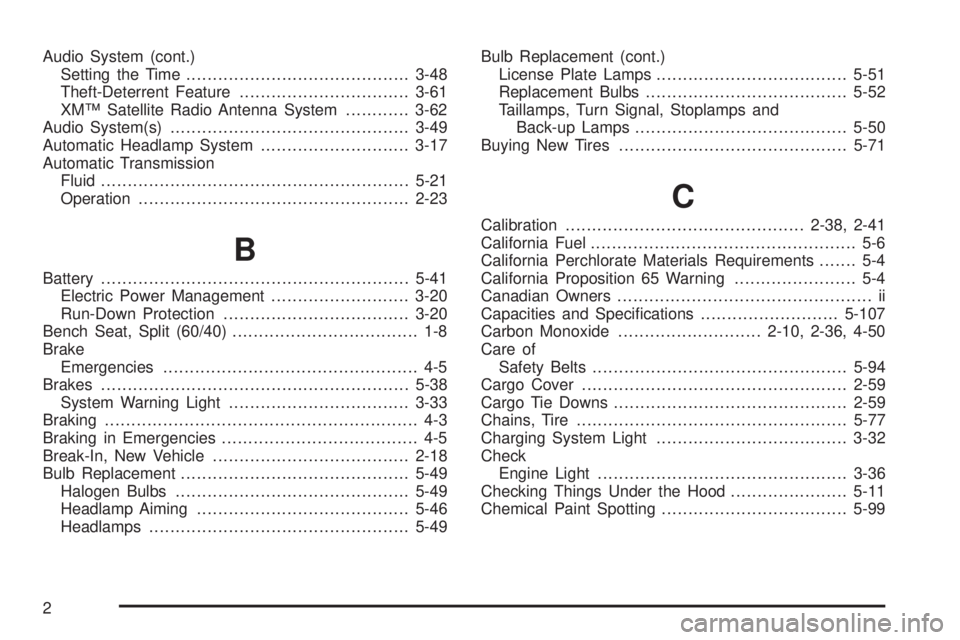
Audio System (cont.)
Setting the Time..........................................3-48
Theft-Deterrent Feature................................3-61
XM™ Satellite Radio Antenna System............3-62
Audio System(s).............................................3-49
Automatic Headlamp System............................3-17
Automatic Transmission
Fluid..........................................................5-21
Operation...................................................2-23
B
Battery..........................................................5-41
Electric Power Management..........................3-20
Run-Down Protection...................................3-20
Bench Seat, Split (60/40)................................... 1-8
Brake
Emergencies................................................ 4-5
Brakes..........................................................5-38
System Warning Light..................................3-33
Braking........................................................... 4-3
Braking in Emergencies..................................... 4-5
Break-In, New Vehicle.....................................2-18
Bulb Replacement...........................................5-49
Halogen Bulbs............................................5-49
Headlamp Aiming........................................5-46
Headlamps.................................................5-49Bulb Replacement (cont.)
License Plate Lamps....................................5-51
Replacement Bulbs......................................5-52
Taillamps, Turn Signal, Stoplamps and
Back-up Lamps........................................5-50
Buying New Tires...........................................5-71
C
Calibration.............................................2-38, 2-41
California Fuel.................................................. 5-6
California Perchlorate Materials Requirements....... 5-4
California Proposition 65 Warning....................... 5-4
Canadian Owners................................................ ii
Capacities and Specications..........................5-107
Carbon Monoxide...........................2-10, 2-36, 4-50
Care of
Safety Belts................................................5-94
Cargo Cover..................................................2-59
Cargo Tie Downs............................................2-59
Chains, Tire...................................................5-77
Charging System Light....................................3-32
Check
Engine Light...............................................3-36
Checking Things Under the Hood......................5-11
Chemical Paint Spotting...................................5-99
2
Page 409 of 416
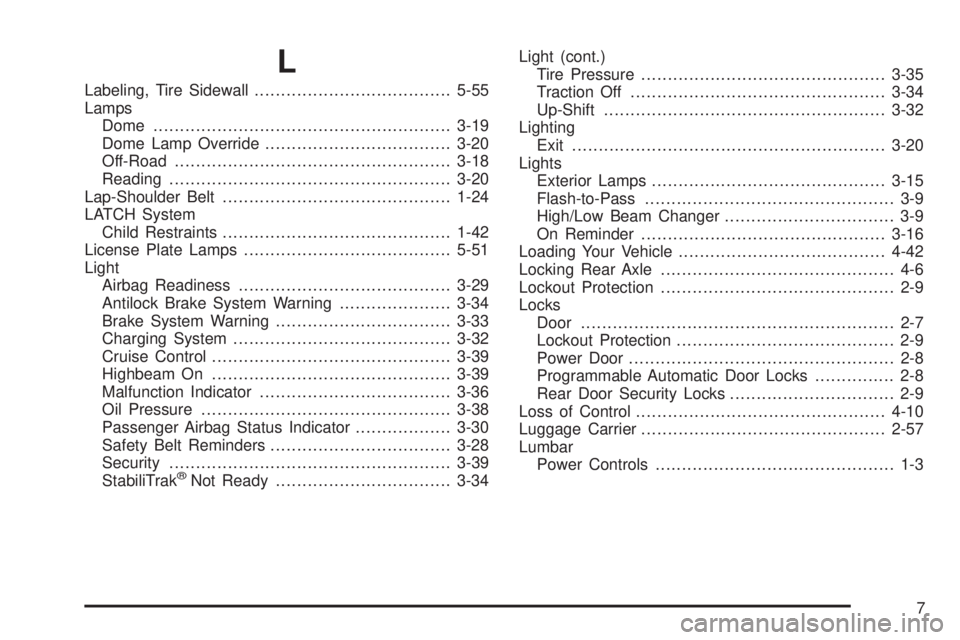
L
Labeling, Tire Sidewall.....................................5-55
Lamps
Dome........................................................3-19
Dome Lamp Override...................................3-20
Off-Road....................................................3-18
Reading.....................................................3-20
Lap-Shoulder Belt...........................................1-24
LATCH System
Child Restraints...........................................1-42
License Plate Lamps.......................................5-51
Light
Airbag Readiness........................................3-29
Antilock Brake System Warning.....................3-34
Brake System Warning.................................3-33
Charging System.........................................3-32
Cruise Control.............................................3-39
Highbeam On.............................................3-39
Malfunction Indicator....................................3-36
Oil Pressure...............................................3-38
Passenger Airbag Status Indicator..................3-30
Safety Belt Reminders..................................3-28
Security.....................................................3-39
StabiliTrak
®Not Ready.................................3-34Light (cont.)
Tire Pressure..............................................3-35
Traction Off................................................3-34
Up-Shift.....................................................3-32
Lighting
Exit...........................................................3-20
Lights
Exterior Lamps............................................3-15
Flash-to-Pass............................................... 3-9
High/Low Beam Changer................................ 3-9
On Reminder..............................................3-16
Loading Your Vehicle.......................................4-42
Locking Rear Axle............................................ 4-6
Lockout Protection............................................ 2-9
Locks
Door........................................................... 2-7
Lockout Protection......................................... 2-9
Power Door.................................................. 2-8
Programmable Automatic Door Locks............... 2-8
Rear Door Security Locks............................... 2-9
Loss of Control...............................................4-10
Luggage Carrier..............................................2-57
Lumbar
Power Controls............................................. 1-3
7
Page 411 of 416
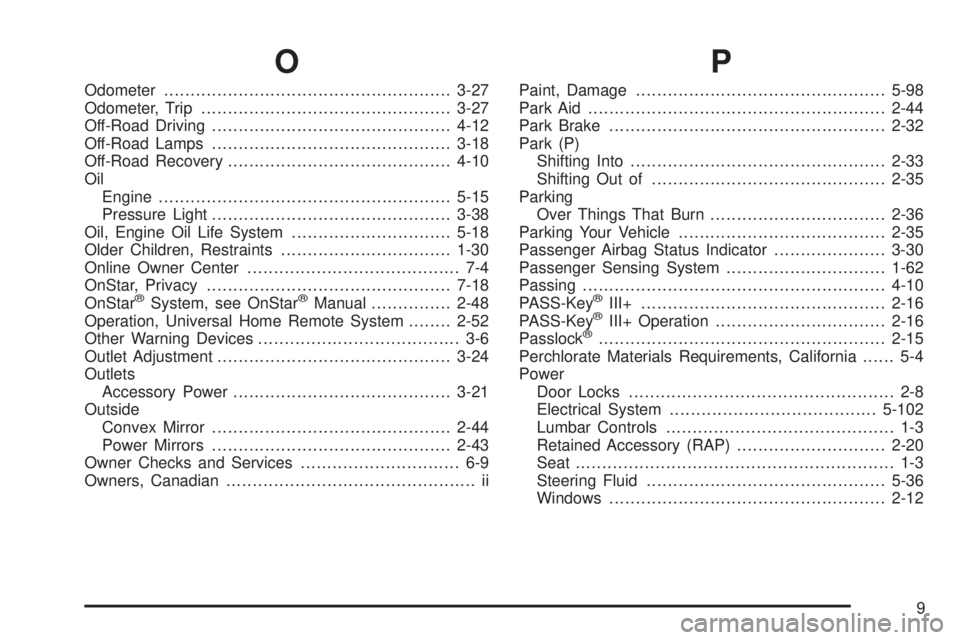
O
Odometer......................................................3-27
Odometer, Trip...............................................3-27
Off-Road Driving.............................................4-12
Off-Road Lamps.............................................3-18
Off-Road Recovery..........................................4-10
Oil
Engine.......................................................5-15
Pressure Light.............................................3-38
Oil, Engine Oil Life System..............................5-18
Older Children, Restraints................................1-30
Online Owner Center........................................ 7-4
OnStar, Privacy..............................................7-18
OnStar
®System, see OnStar®Manual...............2-48
Operation, Universal Home Remote System........2-52
Other Warning Devices...................................... 3-6
Outlet Adjustment............................................3-24
Outlets
Accessory Power.........................................3-21
Outside
Convex Mirror.............................................2-44
Power Mirrors.............................................2-43
Owner Checks and Services.............................. 6-9
Owners, Canadian............................................... ii
P
Paint, Damage...............................................5-98
Park Aid........................................................2-44
Park Brake....................................................2-32
Park (P)
Shifting Into................................................2-33
Shifting Out of............................................2-35
Parking
Over Things That Burn.................................2-36
Parking Your Vehicle.......................................2-35
Passenger Airbag Status Indicator.....................3-30
Passenger Sensing System..............................1-62
Passing.........................................................4-10
PASS-Key
®III+..............................................2-16
PASS-Key®III+ Operation................................2-16
Passlock®......................................................2-15
Perchlorate Materials Requirements, California...... 5-4
Power
Door Locks.................................................. 2-8
Electrical System.......................................5-102
Lumbar Controls........................................... 1-3
Retained Accessory (RAP)............................2-20
Seat............................................................ 1-3
Steering Fluid.............................................5-36
Windows....................................................2-12
9