transmission HUMMER H3 2008 Owner's Guide
[x] Cancel search | Manufacturer: HUMMER, Model Year: 2008, Model line: H3, Model: HUMMER H3 2008Pages: 416, PDF Size: 5.66 MB
Page 201 of 416
ABS can change the brake pressure faster than any
driver could. The computer is programmed to make the
most of available tire and road conditions. This can
help you steer around the obstacle while braking hard.
As you brake, the computer keeps receiving updates
on wheel speed and controls braking pressure
accordingly.
Remember: ABS does not change the time you need to
get your foot up to the brake pedal or always decrease
stopping distance. If you get too close to the vehicle
in front of you, you will not have time to apply the brakes
if that vehicle suddenly slows or stops. Always leave
enough room up ahead to stop, even though you
have ABS.
Using ABS
Do not pump the brakes. Just hold the brake pedal down
rmly and let antilock work for you. You might feel the
brakes vibrate or notice some noise, but this is normal.
Braking in Emergencies
With ABS, you can steer and brake at the same time.
In many emergencies, steering can help you more
than even the very best braking.
Traction Control System (TCS)
Your vehicle has a Traction Control System (TCS) that
limits wheel spin. This is especially useful in slippery road
conditions. The system operates only if it senses that any
of the wheels are spinning or beginning to lose traction.
When this happens, the system applies the brakes to limit
wheel spin and also reduces engine power. You may feel
or hear the system working, but this is normal.
The Traction Control System may operate on dry roads
under some conditions. When this happens, you may
notice a reduction in acceleration or a pumping sound.
This is normal and doesn’t mean there’s a problem with
your vehicle. Examples of these conditions include hard
acceleration in a turn, an abrupt upshift or downshift of
the transmission or driving on rough roads.
If your vehicle is in cruise control when the TCS begins
to limit wheel spin, the cruise control will automatically
disengage. When road conditions allow you to safely
use it again, you may re-engage the cruise control.
SeeCruise Control on page 3-11.
If your vehicle has a Driver information Center (DIC),
a TRACTION FAULT message will appear when a
Traction Control System or Anti-Lock Brake System
problem has been detected and the vehicle needs
service. SeeDIC Warnings and Messages on page 3-43
for more information.
4-5
Page 213 of 416
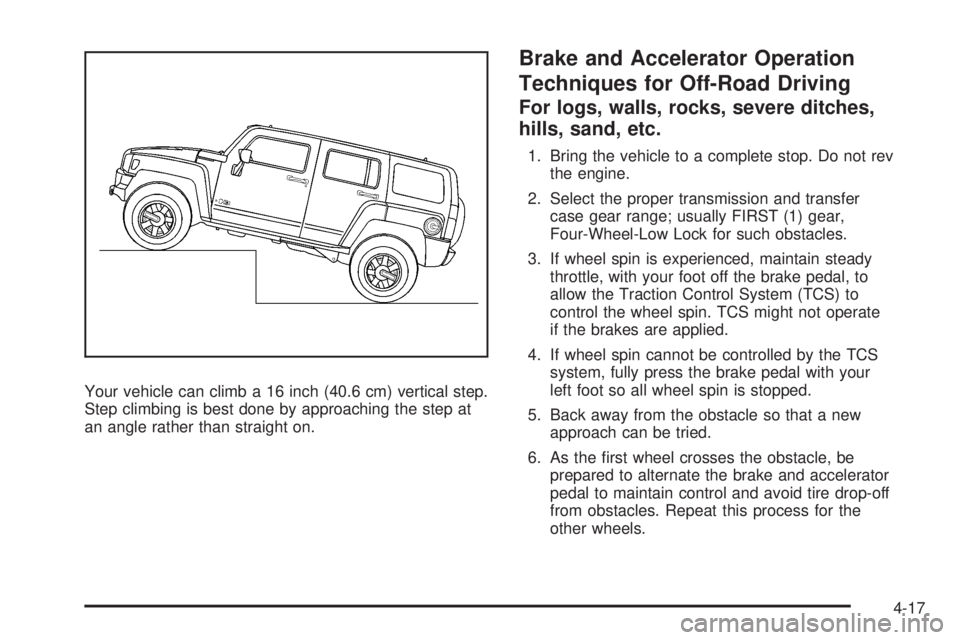
Your vehicle can climb a 16 inch (40.6 cm) vertical step.
Step climbing is best done by approaching the step at
an angle rather than straight on.
Brake and Accelerator Operation
Techniques for Off-Road Driving
For logs, walls, rocks, severe ditches,
hills, sand, etc.
1. Bring the vehicle to a complete stop. Do not rev
the engine.
2. Select the proper transmission and transfer
case gear range; usually FIRST (1) gear,
Four-Wheel-Low Lock for such obstacles.
3. If wheel spin is experienced, maintain steady
throttle, with your foot off the brake pedal, to
allow the Traction Control System (TCS) to
control the wheel spin. TCS might not operate
if the brakes are applied.
4. If wheel spin cannot be controlled by the TCS
system, fully press the brake pedal with your
left foot so all wheel spin is stopped.
5. Back away from the obstacle so that a new
approach can be tried.
6. As the rst wheel crosses the obstacle, be
prepared to alternate the brake and accelerator
pedal to maintain control and avoid tire drop-off
from obstacles. Repeat this process for the
other wheels.
4-17
Page 214 of 416
For mounds, washouts, loose up-hill
slopes, ditches, etc.
When wheel spin occurs as the vehicle is moving, the
driver may notice a slight shaking or shuddering of
the vehicle. This should be stopped as soon as possible
to prevent damage to vehicle components. This is the
indication that a loss of traction is occurring on this
terrain. The operator should:
1. Reduce speed and apply the brakes.
2. Assess the terrain properly and adjust
vehicle speed and gear ranges accordingly:
Four-Wheel High position for higher speeds and
Four-Wheel-Low Lock for more torque and
lower speeds. Transmission FIRST (1) gear is
generally recommended.
3. Apply slight pressure to the brake when the
shaking or shuddering sensation is felt, keeping
the vehicle moving in a controlled manner.
4. Be prepared to alternate between braking and
accelerating through the adverse terrain.
Getting Familiar with Off-Road Driving
It is a good idea to practice in an area that is safe
and close to home before you go into the wilderness.
Off-road driving does require some new and different
skills. Here is what we mean.
Tune your senses to different kinds of signals. Your
eyes, for example, need to constantly sweep the terrain
for unexpected obstacles. Your ears need to listen
for unusual tire or engine sounds. With your arms,
hands, feet, and body, you will need to respond to
vibrations and vehicle bounce.
Controlling your vehicle is the key to successful off-road
driving. One of the best ways to control your vehicle
is to control your speed. Here are some things to keep
in mind. At higher speeds:
You approach things faster and you have less time
to scan the terrain for obstacles.
You have less time to react.
You have more vehicle bounce when you drive
over obstacles.
You will need more distance for braking, especially
since you are on an unpaved surface.
4-18
Page 216 of 416
Because you will be on an unpaved surface, it is
especially important to avoid sudden acceleration,
sudden turns, or sudden braking.
In a way, off-road driving requires a different kind of
alertness from driving on paved roads and highways.
There are no road signs, posted speed limits, or signal
lights. You have to use your own good judgment
about what is safe and what is not.
Drinking and driving can be very dangerous on any
road. And this is certainly true for off-road driving.
At the very time you need special alertness and
driving skills, your reexes, perceptions, and judgment
can be affected by even a small amount of alcohol.
You could have a serious — or even fatal — accident
if you drink and drive or ride with a driver who has
been drinking. SeeDrunk Driving on page 4-2.Crossing Obstacles
Approach Angle — a Key to Mobility
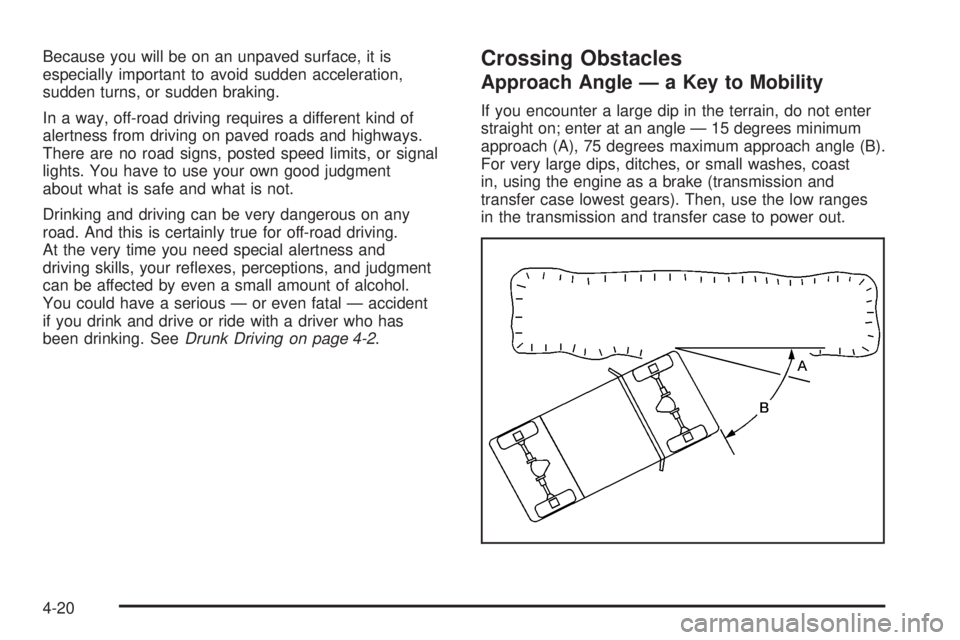
If you encounter a large dip in the terrain, do not enter
straight on; enter at an angle — 15 degrees minimum
approach (A), 75 degrees maximum approach angle (B).
For very large dips, ditches, or small washes, coast
in, using the engine as a brake (transmission and
transfer case lowest gears). Then, use the low ranges
in the transmission and transfer case to power out.
4-20
Page 217 of 416
Roll Your Tires Over Large Rocks
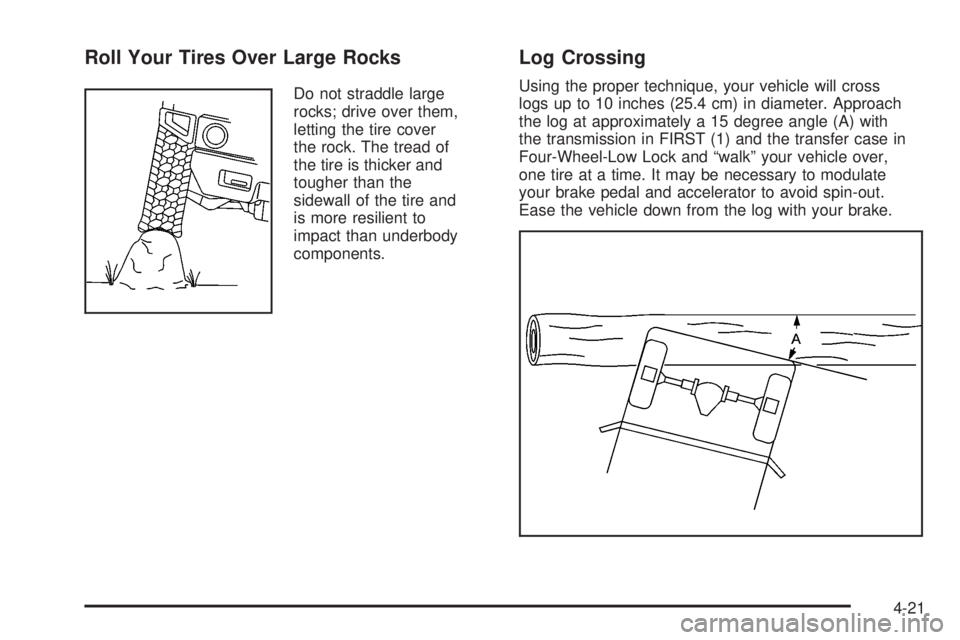
Do not straddle large
rocks; drive over them,
letting the tire cover
the rock. The tread of
the tire is thicker and
tougher than the
sidewall of the tire and
is more resilient to
impact than underbody
components.
Log Crossing
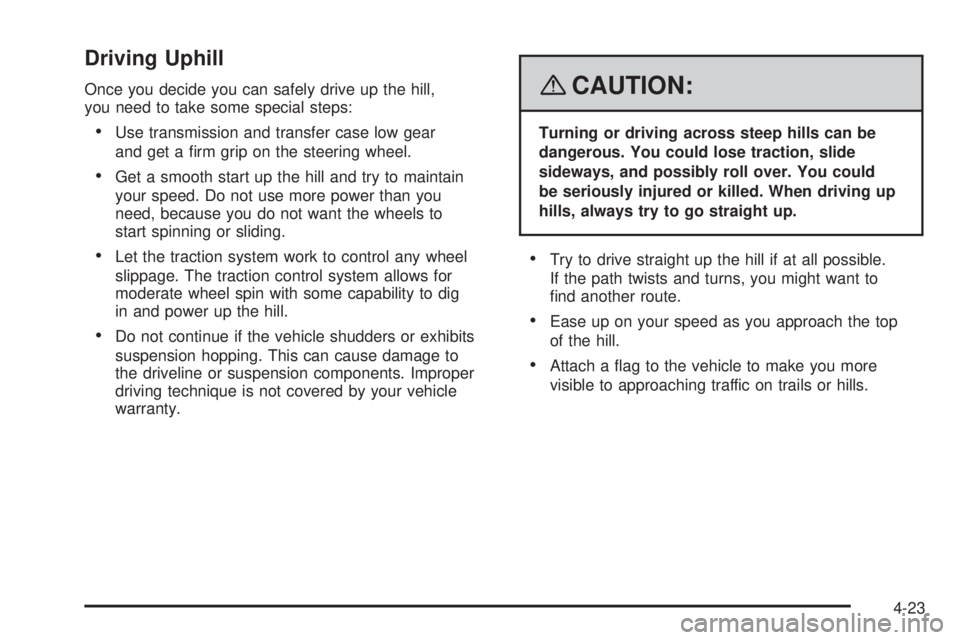
Using the proper technique, your vehicle will cross
logs up to 10 inches (25.4 cm) in diameter. Approach
the log at approximately a 15 degree angle (A) with
the transmission in FIRST (1) and the transfer case in
Four-Wheel-Low Lock and “walk” your vehicle over,
one tire at a time. It may be necessary to modulate
your brake pedal and accelerator to avoid spin-out.
Ease the vehicle down from the log with your brake.
4-21
Page 219 of 416
Driving Uphill
Once you decide you can safely drive up the hill,
you need to take some special steps:
Use transmission and transfer case low gear
and get a rm grip on the steering wheel.
Get a smooth start up the hill and try to maintain
your speed. Do not use more power than you
need, because you do not want the wheels to
start spinning or sliding.
Let the traction system work to control any wheel
slippage. The traction control system allows for
moderate wheel spin with some capability to dig
in and power up the hill.
Do not continue if the vehicle shudders or exhibits
suspension hopping. This can cause damage to
the driveline or suspension components. Improper
driving technique is not covered by your vehicle
warranty.
{CAUTION:
Turning or driving across steep hills can be
dangerous. You could lose traction, slide
sideways, and possibly roll over. You could
be seriously injured or killed. When driving up
hills, always try to go straight up.
Try to drive straight up the hill if at all possible.
If the path twists and turns, you might want to
nd another route.
Ease up on your speed as you approach the top
of the hill.
Attach a ag to the vehicle to make you more
visible to approaching traffic on trails or hills.
4-23
Page 220 of 416
Sound the horn as you approach the top of the
hill to let opposing traffic know you are there.
Use your headlamps even during the day.
They make your vehicle more visible to
oncoming traffic.
{CAUTION:
Driving to the top (crest) of a hill at full speed
can cause an accident. There could be a
drop-off, embankment, cliff, or even another
vehicle. You could be seriously injured or
killed. As you near the top of a hill, slow down
and stay alert.There are some things you should do if the vehicle stalls,
or is about to stall, and you cannot make it up the hill:
Push the brake pedal to stop the vehicle and keep
it from rolling backwards. Also, apply the parking
brake.
If your engine is still running, shift the transmission to
REVERSE (R), release the parking brake, and slowly
back down the hill in REVERSE (R).
If your engine has stopped running, you will need
to restart it. With the brake pedal pressed, apply
the parking brake. If you have an automatic
transmission, shift the transmission to PARK (P).
Restart the engine. Then, shift to REVERSE (R),
release the parking brake, and slowly back down
the hill as straight as possible in REVERSE (R).
As you are backing down the hill, put your left hand
on the steering wheel at the 12 o’clock position.
This way, you will be able to tell if your wheels are
straight and maneuver as you back down. It is best
that you back down the hill with your wheels straight
rather than in the left or right direction. Turning the
wheel too far to the left or right will increase the
possibility of a rollover.
4-24
Page 221 of 416
There are also some things you must not do if you stall,
or are about to stall, when going up a hill:
Never attempt to prevent a stall by shifting into
NEUTRAL (N) to rev-up the engine and regain
forward momentum. This will not work. Your vehicle
will roll backwards very quickly and you could go
out of control.
Instead, apply the regular brake to stop the
vehicle. Then apply the parking brake. Shift to
REVERSE (R), release the parking brake,
and slowly back straight down.
Never attempt to turn around if you are about to
stall when going up a hill. If the hill is steep
enough to stall your vehicle, it is steep enough to
cause you to roll over if you turn around. If you
cannot make it up the hill, you must back straight
down the hill.
If, after stalling, you try to back down the hill and decide
you just cannot do it, set the parking brake. If you
have an automatic transmission, shift to PARK (P).
Turn off the engine. Leave the vehicle and go get
some help. Exit on the uphill side and stay clear of
the path the vehicle would take if it rolled downhill.
Do not shift the transfer case to NEUTRAL when you
leave the vehicle. Leave it in some gear.
{CAUTION:
Shifting the transfer case to NEUTRAL
can cause your vehicle to roll even if the
transmission is in PARK (P), or, if you have a
manual transmission, even if you are in gear.
This is because the NEUTRAL position on the
transfer case overrides the transmission. You
or someone else could be injured. If you are
going to leave your vehicle, set the parking
brake and shift the transmission to PARK (P),
or, put the manual transmission in FIRST (1).
But do not shift the transfer case to
NEUTRAL. Leave the transfer case in the
Four-Wheel High, Four-Wheel-High Lock,
or Four-Wheel-Low Lock position.
4-25
Page 223 of 416
There some things not to do when driving down a hill.
These are important because, if you ignore them,
you could lose control and have a serious accident:
When driving downhill, avoid turns that take
you across the incline of the hill. A hill that is not
too steep to drive down may be too steep to
drive across. You could roll over if you do not
drive straight down.
Never go downhill with the transmission in
NEUTRAL (N). This is called “free-wheeling.”
Your brakes will have to do all the work and
could overheat and fade.
Your vehicle is much more likely to stall when going
uphill. But if it happens when going downhill:
1. Stop your vehicle by applying the regular brakes.
Apply the parking brake.
2. If you have an automatic transmission, shift to
PARK (P). While still braking, restart the engine.
3. Shift back to a low gear, release the parking brake,
and drive straight down.
4. If the engine will not start, get out and get help.
Driving Across an Incline
Sooner or later, an off-road trail will probably go
across the incline of a hill. If this happens, you have
to decide whether to try to drive across the incline.
Here are some things to consider:
{CAUTION:
Driving across an incline that is too steep will
make your vehicle roll over. You could be
seriously injured or killed. If you have any
doubt about the steepness of the incline, do
not drive across it. Find another route instead.
A hill that can be driven straight up or down may
be too steep to drive across. When you go straight
up or down a hill, the length of the wheel base — the
distance from the front wheels to the rear
wheels — reduces the likelihood the vehicle will
tumble end over end. But when you drive across an
incline, the much more narrow track width — the
distance between the left and right wheels — may
not prevent the vehicle from tilting and rolling over.
Also, driving across an incline puts more weight on
the downhill wheels. This could cause a downhill
slide or a rollover.
4-27
Page 230 of 416
Before Leaving on a Long Trip
To prepare your vehicle for a long trip, consider having
it serviced by your dealer/retailer before departing.
Things to check on your own include:
Windshield Washer Fluid:Reservoir full? Windows
clean — inside and outside?
Wiper Blades:In good shape?
Fuel, Engine Oil, Other Fluids:All levels checked?
Lamps:Do they all work and are lenses clean?
Tires:Are treads good? Are tires inated to
recommended pressure?
Weather and Maps:Safe to travel? Have up-to-date
maps?
Highway Hypnosis
Always be alert and pay attention to your surroundings
while driving. If you become tired or sleepy, nd a
safe place to park your vehicle and rest.
Other driving tips include:
Keep the vehicle well ventilated.
Keep interior temperature cool.
Keep your eyes moving — scan the road ahead
and to the sides.
Check the rearview mirror and vehicle instruments
often.
Hill and Mountain Roads
Driving on steep hills or through mountains is different
than driving on at or rolling terrain. Tips for driving
in these conditions include:
Keep your vehicle serviced and in good shape.
Check all uid levels and brakes, tires, cooling
system, and transmission.
Going down steep or long hills, shift to a
lower gear.
4-34