warning HUMMER H3 2008 Workshop Manual
[x] Cancel search | Manufacturer: HUMMER, Model Year: 2008, Model line: H3, Model: HUMMER H3 2008Pages: 416, PDF Size: 5.66 MB
Page 326 of 416
6. Proceed to the passenger side front tire, and repeat
the procedure in Step 5.
7. Proceed to the passenger side rear tire, and repeat
the procedure in Step 5.
8. Proceed to the driver side rear tire, and repeat the
procedure in Step 5.
9. After hearing the conrming horn chirp for the driver
side rear tire, check to see if the TPMS low tire
warning light and the DIC LOW TIRE messages
have turned off. If yes, the TPMS sensors have
been relearned. Turn the ignition switch to
LOCK/OFF.
If the low tire warning light and the SERV TPM
message on the DIC are on after completing Step 5
for the driver side rear tire, the sensor relearn
process has not been successful. Turn the ignition
switch to LOCK/OFF and repeat the matching
process beginning with Step 2.
10. Set all four tires to the recommended air pressure
level as indicated on the Tire and Loading
Information label.
11. Put the valve caps back on the valve stems.Tire Inspection and Rotation
We recommend that you regularly inspect your
vehicle’s tires, including the spare tire, for signs of
wear or damage. SeeWhen It Is Time for New
Tires on page 5-70for more information.
Tires should be rotated every 5,000 to 8,000 miles
(8 000 to 13 000 km). SeeScheduled Maintenance
on page 6-4.
The purpose of a regular tire rotation is to achieve
a uniform wear for all tires on the vehicle. This
will ensure that your vehicle continues to perform
most like it did when the tires were new.
Any time you notice unusual wear, rotate your
tires as soon as possible and check wheel
alignment. Also check for damaged tires or wheels.
SeeWhen It Is Time for New Tires on page 5-70
andWheel Replacement on page 5-75.
5-68
Page 330 of 416
Replacing less than a full set of tires can affect
the braking and handling performance of your
vehicle. SeeTire Inspection and Rotation
on page 5-68for information on proper tire
rotation.
{CAUTION:
Mixing tires could cause you to lose
control while driving. If you mix tires of
different sizes, brands, or types (radial
and bias-belted tires) the vehicle may not
handle properly, and you could have a
crash. Using tires of different sizes,
brands, or types may also cause damage
to your vehicle. Be sure to use the correct
size, brand, and type of tires on your
vehicle’s wheels.
{CAUTION:
If you use bias-ply tires on your vehicle,
the wheel rim anges could develop
cracks after many miles of driving. A tire
and/or wheel could fail suddenly, causing
a crash. Use only radial-ply tires with the
wheels on your vehicle.
If you must replace your vehicle’s tires with those
that do not have a TPC Spec number, make
sure they are the same size, load range, speed
rating, and construction type (radial and
bias-belted tires) as your vehicle’s original tires.
Vehicles equipped with a tire pressure monitoring
system may give an inaccurate low-pressure
warning if non-TPC spec rated tires are installed
on your vehicle. Non-TPC Spec rated tires
may give a low-pressure warning that is higher or
lower than the proper warning level you would
get with TPC Spec rated tires. SeeTire Pressure
Monitor System on page 5-63.
5-72
Page 332 of 416
Uniform Tire Quality Grading
Quality grades can be found where applicable on
the tire sidewall between tread shoulder and
maximum section width. For example:
Treadwear 200 Traction AA Temperature A
The following information relates to the system
developed by the United States National Highway
Traffic Safety Administration (NHTSA), which
grades tires by treadwear, traction, and
temperature performance. This applies only to
vehicles sold in the United States. The grades are
molded on the sidewalls of most passenger car
tires. The Uniform Tire Quality Grading (UTQG)
system does not apply to deep tread, winter-type
snow tires, space-saver, or temporary use
spare tires, tires with nominal rim diameters of
10 to 12 inches (25 to 30 cm), or to some
limited-production tires.
While the tires available on General Motors
passenger cars and light trucks may vary with
respect to these grades, they must also conform
to federal safety requirements and additional
General Motors Tire Performance Criteria (TPC)
standards.
Treadwear
The treadwear grade is a comparative rating
based on the wear rate of the tire when tested
under controlled conditions on a specied
government test course. For example, a tire
graded 150 would wear one and a half (1.5) times
as well on the government course as a tire
graded 100. The relative performance of tires
depends upon the actual conditions of their use,
however, and may depart signicantly from
the norm due to variations in driving habits, service
practices, and differences in road characteristics
and climate.
Traction – AA, A, B, C
The traction grades, from highest to lowest, are AA,
A, B, and C. Those grades represent the tire’s
ability to stop on wet pavement as measured under
controlled conditions on specied government test
surfaces of asphalt and concrete. A tire marked C
may have poor traction performance.
Warning
:The traction grade assigned to this
tire is based on straight-ahead braking
traction tests, and does not include
acceleration, cornering, hydroplaning,
or peak traction characteristics.
5-74
Page 333 of 416
Temperature – A, B, C
The temperature grades are A (the highest), B,
and C, representing the tire’s resistance to
the generation of heat and its ability to dissipate
heat when tested under controlled conditions on a
specied indoor laboratory test wheel. Sustained
high temperature can cause the material of the tire
to degenerate and reduce tire life, and excessive
temperature can lead to sudden tire failure.
The grade C corresponds to a level of performance
which all passenger car tires must meet under
the Federal Motor Vehicle Safety Standard
No. 109. Grades B and A represent higher levels
of performance on the laboratory test wheel
than the minimum required by law.
Warning
:The temperature grade for this tire
is established for a tire that is properly inated
and not overloaded. Excessive speed,
underination, or excessive loading, either
separately or in combination, can cause heat
buildup and possible tire failure.
Wheel Alignment and Tire Balance
The tires and wheels on your vehicle were aligned
and balanced carefully at the factory to give you the
longest tire life and best overall performance.
Adjustments to wheel alignment and tire balancing will
not be necessary on a regular basis. However, if
you notice unusual tire wear or your vehicle pulling to
one side or the other, the alignment might need to
be checked. If you notice your vehicle vibrating when
driving on a smooth road, the tires and wheels
might need to be rebalanced. See your dealer/retailer
for proper diagnosis.
Wheel Replacement
Replace any wheel that is bent, cracked, or badly rusted
or corroded. If wheel nuts keep coming loose, the
wheel, wheel bolts, and wheel nuts should be replaced.
If the wheel leaks air, replace it (except some
aluminum wheels, which can sometimes be repaired).
See your dealer/retailer if any of these conditions exist.
Your dealer/retailer will know the kind of wheel you need.
5-75
Page 337 of 416
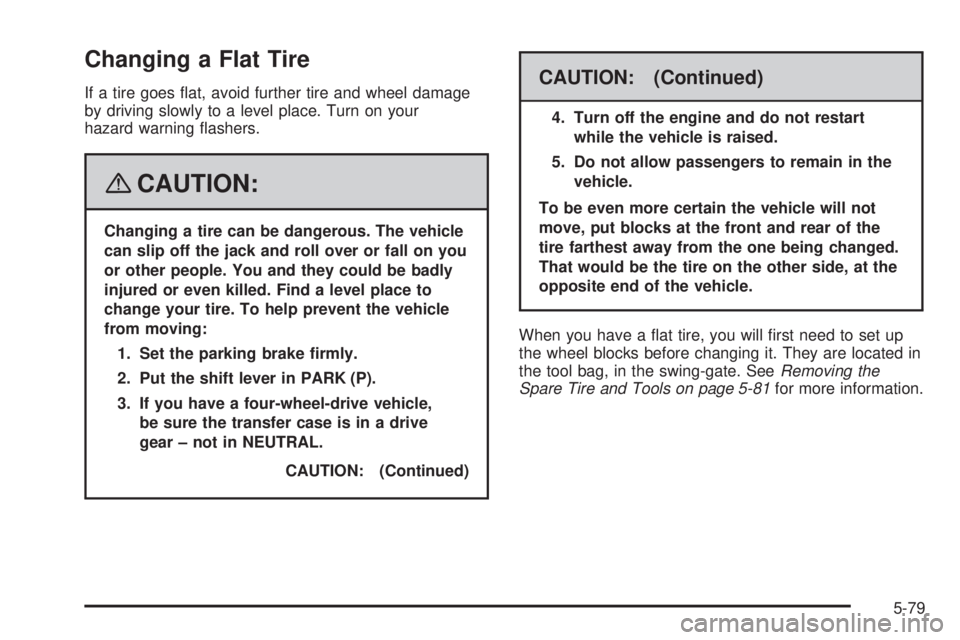
Changing a Flat Tire
If a tire goes at, avoid further tire and wheel damage
by driving slowly to a level place. Turn on your
hazard warning ashers.
{CAUTION:
Changing a tire can be dangerous. The vehicle
can slip off the jack and roll over or fall on you
or other people. You and they could be badly
injured or even killed. Find a level place to
change your tire. To help prevent the vehicle
from moving:
1. Set the parking brake rmly.
2. Put the shift lever in PARK (P).
3. If you have a four-wheel-drive vehicle,
be sure the transfer case is in a drive
gear – not in NEUTRAL.
CAUTION: (Continued)
CAUTION: (Continued)
4. Turn off the engine and do not restart
while the vehicle is raised.
5. Do not allow passengers to remain in the
vehicle.
To be even more certain the vehicle will not
move, put blocks at the front and rear of the
tire farthest away from the one being changed.
That would be the tire on the other side, at the
opposite end of the vehicle.
When you have a at tire, you will rst need to set up
the wheel blocks before changing it. They are located in
the tool bag, in the swing-gate. SeeRemoving the
Spare Tire and Tools on page 5-81for more information.
5-79
Page 370 of 416
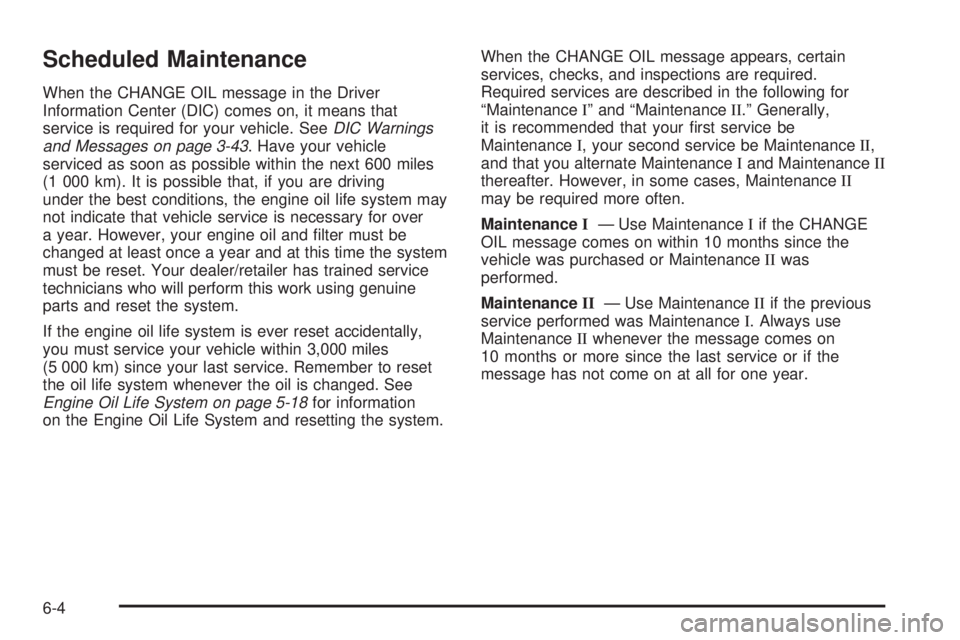
Scheduled Maintenance
When the CHANGE OIL message in the Driver
Information Center (DIC) comes on, it means that
service is required for your vehicle. SeeDIC Warnings
and Messages on page 3-43. Have your vehicle
serviced as soon as possible within the next 600 miles
(1 000 km). It is possible that, if you are driving
under the best conditions, the engine oil life system may
not indicate that vehicle service is necessary for over
a year. However, your engine oil and lter must be
changed at least once a year and at this time the system
must be reset. Your dealer/retailer has trained service
technicians who will perform this work using genuine
parts and reset the system.
If the engine oil life system is ever reset accidentally,
you must service your vehicle within 3,000 miles
(5 000 km) since your last service. Remember to reset
the oil life system whenever the oil is changed. See
Engine Oil Life System on page 5-18for information
on the Engine Oil Life System and resetting the system.When the CHANGE OIL message appears, certain
services, checks, and inspections are required.
Required services are described in the following for
“MaintenanceI” and “MaintenanceII.” Generally,
it is recommended that your rst service be
MaintenanceI, your second service be MaintenanceII,
and that you alternate MaintenanceIand MaintenanceII
thereafter. However, in some cases, MaintenanceII
may be required more often.
MaintenanceI— Use MaintenanceIif the CHANGE
OIL message comes on within 10 months since the
vehicle was purchased or MaintenanceIIwas
performed.
MaintenanceII— Use MaintenanceIIif the previous
service performed was MaintenanceI. Always use
MaintenanceIIwhenever the message comes on
10 months or more since the last service or if the
message has not come on at all for one year.
6-4
Page 403 of 416

A
Accessories and Modications............................ 5-3
Adding Equipment to Your Airbag-Equipped
Vehicle.......................................................1-68
Additives, Fuel................................................. 5-6
Add-On Electrical Equipment...........................5-101
Air Cleaner/Filter, Engine.................................5-20
Air Conditioning..............................................3-22
Airbag
Passenger Status Indicator...........................3-30
Readiness Light..........................................3-29
Airbag System................................................1-54
What Will You See After an Airbag Inates?....1-61
When Should an Airbag Inate?....................1-59
Where Are the Airbags?...............................1-57
Airbag Systems
Adding Equipment to Your Airbag-Equipped
Vehicle...................................................1-68
How Does an Airbag Restrain?......................1-60
Passenger Sensing System...........................1-62
Servicing Your Airbag-Equipped Vehicle..........1-67
What Makes an Airbag Inate?......................1-60
Antenna, Fixed Mast.......................................3-62
Antenna, XM™ Satellite Radio Antenna System . . . 3-62
Antilock Brake System (ABS)............................. 4-4
Antilock Brake, System Warning Light................3-34Appearance Care
Aluminum or Chrome-Plated Wheels..............5-97
Care of Safety Belts....................................5-94
Chemical Paint Spotting...............................5-99
Cleaning Exterior Lamps/Lenses....................5-95
Fabric/Carpet..............................................5-93
Finish Care.................................................5-96
Finish Damage............................................5-98
Instrument Panel, Vinyl, and
Other Plastic Surfaces..............................5-94
Interior Cleaning..........................................5-91
Leather......................................................5-93
Sheet Metal Damage...................................5-98
Tires..........................................................5-98
Underbody Maintenance...............................
5-98
Vehicle Care/Appearance Materials................5-99
Washing Your Vehicle...................................5-95
Weatherstrips..............................................5-94
Windshield, Backglass, and Wiper Blades.......5-97
Appointments, Scheduling Service....................... 7-9
Ashtray.........................................................3-22
Assist Steps...................................................4-31
Audio System.................................................3-48
Fixed Mast Antenna.....................................3-62
Navigation/Radio System,
see Navigation Manual..............................3-61
Radio Reception..........................................3-61
1
Page 404 of 416
Audio System (cont.)
Setting the Time..........................................3-48
Theft-Deterrent Feature................................3-61
XM™ Satellite Radio Antenna System............3-62
Audio System(s).............................................3-49
Automatic Headlamp System............................3-17
Automatic Transmission
Fluid..........................................................5-21
Operation...................................................2-23
B
Battery..........................................................5-41
Electric Power Management..........................3-20
Run-Down Protection...................................3-20
Bench Seat, Split (60/40)................................... 1-8
Brake
Emergencies................................................ 4-5
Brakes..........................................................5-38
System Warning Light..................................3-33
Braking........................................................... 4-3
Braking in Emergencies..................................... 4-5
Break-In, New Vehicle.....................................2-18
Bulb Replacement...........................................5-49
Halogen Bulbs............................................5-49
Headlamp Aiming........................................5-46
Headlamps.................................................5-49Bulb Replacement (cont.)
License Plate Lamps....................................5-51
Replacement Bulbs......................................5-52
Taillamps, Turn Signal, Stoplamps and
Back-up Lamps........................................5-50
Buying New Tires...........................................5-71
C
Calibration.............................................2-38, 2-41
California Fuel.................................................. 5-6
California Perchlorate Materials Requirements....... 5-4
California Proposition 65 Warning....................... 5-4
Canadian Owners................................................ ii
Capacities and Specications..........................5-107
Carbon Monoxide...........................2-10, 2-36, 4-50
Care of
Safety Belts................................................5-94
Cargo Cover..................................................2-59
Cargo Tie Downs............................................2-59
Chains, Tire...................................................5-77
Charging System Light....................................3-32
Check
Engine Light...............................................3-36
Checking Things Under the Hood......................5-11
Chemical Paint Spotting...................................5-99
2
Page 406 of 416
D
Daytime Running Lamps..................................3-17
Defensive Driving............................................. 4-2
Doing Your Own Service Work........................... 5-4
Dome Lamp...................................................3-19
Dome Lamp Override......................................3-20
Door
Locks.......................................................... 2-7
Power Door Locks......................................... 2-8
Programmable Automatic Door Locks............... 2-8
Rear Door Security Locks............................... 2-9
Driver Information Center (DIC).........................3-40
DIC Operation and Displays..........................3-40
DIC Warnings and Messages........................3-43
Driving
At Night.....................................................4-32
Before a Long Trip......................................4-34
Defensive..................................................... 4-2
Drunken....................................................... 4-2
Highway Hypnosis.......................................4-34
Hill and Mountain Roads..............................4-34
In Rain and on Wet Roads...........................4-33
Off-Road....................................................4-12
Recovery Loops..........................................4-40
Rocking Your Vehicle to Get it Out.................4-40
Winter........................................................4-35
E
EDR .............................................................7-16
Electrical System
Add-On Equipment.....................................5-101
Engine Compartment Fuse Block.................5-103
Fuses and Circuit Breakers.........................5-102
Power Windows and Other Power Options....5-102
Windshield Wiper Fuses.............................5-101
Engine
Air Cleaner/Filter.........................................5-20
Check and Service Engine Soon Light............3-36
Coolant......................................................5-27
Coolant Heater............................................2-22
Coolant Temperature Gage...........................3-35
Drive Belt Routing.......................................6-15
Engine Compartment Overview......................5-12
Exhaust.....................................................2-36
Fan Noise..................................................5-36
Oil .............................................................5-15
Oil Life System...........................................5-18
Overheating................................................5-29
Running While Parked..................................2-37
Starting......................................................2-20
Event Data Recorders.....................................7-17
Exit Lighting...................................................3-20
Extender, Safety Belt.......................................1-30
Exterior Lamps...............................................3-15
4
Page 407 of 416
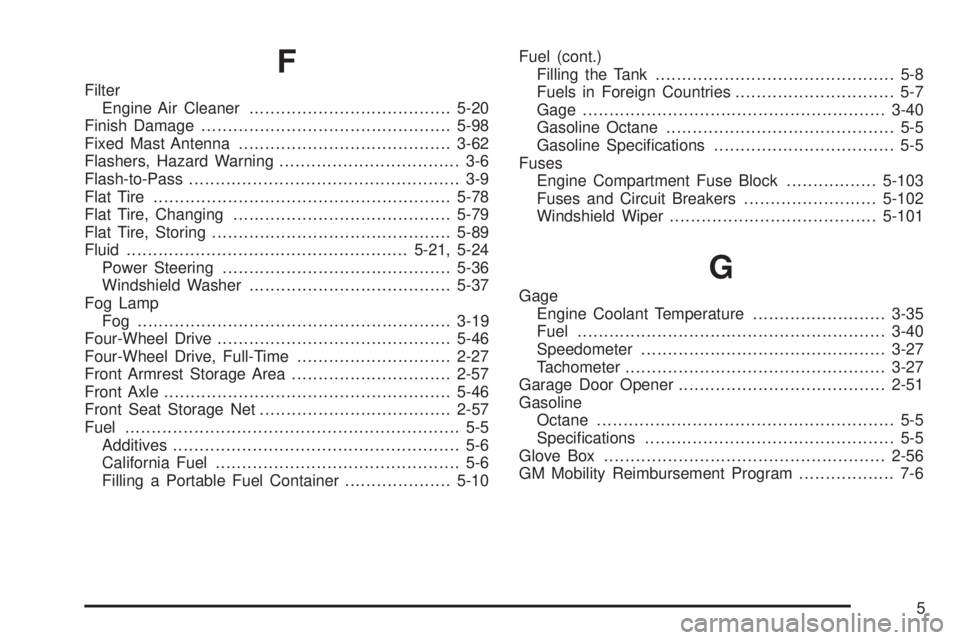
F
Filter
Engine Air Cleaner......................................5-20
Finish Damage...............................................5-98
Fixed Mast Antenna........................................3-62
Flashers, Hazard Warning.................................. 3-6
Flash-to-Pass................................................... 3-9
Flat Tire........................................................5-78
Flat Tire, Changing.........................................5-79
Flat Tire, Storing.............................................5-89
Fluid.....................................................5-21, 5-24
Power Steering...........................................5-36
Windshield Washer......................................5-37
Fog Lamp
Fog ...........................................................3-19
Four-Wheel Drive............................................5-46
Four-Wheel Drive, Full-Time.............................2-27
Front Armrest Storage Area..............................2-57
Front Axle......................................................5-46
Front Seat Storage Net....................................2-57
Fuel............................................................... 5-5
Additives...................................................... 5-6
California Fuel.............................................. 5-6
Filling a Portable Fuel Container....................5-10Fuel (cont.)
Filling the Tank............................................. 5-8
Fuels in Foreign Countries.............................. 5-7
Gage.........................................................3-40
Gasoline Octane........................................... 5-5
Gasoline Specications.................................. 5-5
Fuses
Engine Compartment Fuse Block.................5-103
Fuses and Circuit Breakers.........................5-102
Windshield Wiper.......................................5-101
G
Gage
Engine Coolant Temperature.........................3-35
Fuel..........................................................3-40
Speedometer..............................................3-27
Tachometer.................................................3-27
Garage Door Opener.......................................2-51
Gasoline
Octane........................................................ 5-5
Specications............................................... 5-5
Glove Box.....................................................2-56
GM Mobility Reimbursement Program.................. 7-6
5