engine HUMMER H3 2009 Owners Manual
[x] Cancel search | Manufacturer: HUMMER, Model Year: 2009, Model line: H3, Model: HUMMER H3 2009Pages: 382, PDF Size: 1.99 MB
Page 269 of 382
When parts of the braking system
are replaced — for example,
when the brake linings wear down
and new ones are installed — be
sure to get new approved
replacement parts. If this is not
done, the brakes might not work
properly. For example, if someone
puts in brake linings that are
wrong for the vehicle, the balance
between the front and rear brakes
can change — for the worse.
The braking performance expected
can change in many other ways
if the wrong replacement brake parts
are installed.Battery
This vehicle has a maintenance free
battery. When it is time for a new
battery, see your dealer/retailer
for one that has the replacement
number shown on the original
battery’s label. SeeEngine
Compartment Overview on
page 5-10for battery location.
Warning:Battery posts, terminals,
and related accessories contain
lead and lead compounds,
chemicals known to the State of
California to cause cancer and
reproductive harm. Wash hands
after handling.
Vehicle Storage
{CAUTION
Batteries have acid that can burn
you and gas that can explode.
You can be badly hurt if you
are not careful. SeeJump
Starting on page 5-34for tips
on working around a battery
without getting hurt.
Infrequent Usage: If the vehicle is
driven infrequently, remove the
black, negative (−) cable from the
battery. This helps keep the battery
from running down.
Extended Storage: For extended
storage of the vehicle, remove
the black, negative (−) cable from
the battery or use a battery
trickle charger. This helps maintain
the charge of the battery over
an extended period of time.
Service and Appearance Care 5-33
Page 271 of 382
Notice:If you leave the radio or
other accessories on during
the jump starting procedure, they
could be damaged. The repairs
would not be covered by the
warranty. Always turn off the
radio and other accessories when
jump starting the vehicle.
3. Turn off the ignition on both
vehicles. Unplug unnecessary
accessories plugged into
the cigarette lighter or the
accessory power outlets. Turn off
the radio and all lamps that
are not needed. This will avoid
sparks and help save both
batteries. And it could save
the radio!4. Open the hoods and locate
the batteries on both vehicles.
You will use the positive (+)
battery terminal and the remote
negative (−) jump starting
terminal to jump start your
vehicle. To access the
positive (+) battery terminal,
open the terminal cover.
SeeEngine Compartment
Overview on page 5-10for
more information on the
terminal locations.
{CAUTION
Using a match near a battery can
cause battery gas to explode.
People have been hurt doing this,
and some have been blinded. Use
a ashlight if you need more light.
(Continued)
CAUTION (Continued)
Be sure the batteries have
enough water. You do not need
to add water to the ACDelco
®
battery (or batteries) installed in
your new vehicle. But if a battery
has ller caps, be sure the right
amount of uid is there. If it is
low, add water to take care of that
rst. If you do not, explosive gas
could be present.
Battery uid contains acid that
can burn you. Do not get it on
you. If you accidentally get it in
your eyes or on your skin, ush
the place with water and get
medical help immediately.
Service and Appearance Care 5-35
Page 272 of 382
{CAUTION
Fans or other moving engine
parts can injure you badly. Keep
your hands away from moving
parts once the engine is running.
5. Check that the jumper cables
do not have loose or missing
insulation. If they do, you could
get a shock. The vehicles
could be damaged too.
Before you connect the cables,
here are some basic things
you should know. Positive (+) will
go to positive (+) or to a
remote positive (+) terminal if the
vehicle has one. Negative (−)
will go to a heavy, unpainted
metal engine part or to a remote
negative (−) terminal if the
vehicle has one.Do not connect positive (+) to
negative (−) or you will get
a short that would damage the
battery and maybe other
parts too. And do not connect
the negative (−) cable to
the negative (−) terminal on the
dead battery because this
can cause sparks.
6. Connect the red positive (+)
cable to the positive (+) terminal
of the dead battery. Use a
remote positive (+) terminal if the
vehicle has one.
7. Do not let the other end touch
metal. Connect it to the
positive (+) terminal of the
good battery. Use a remote
positive (+) terminal if the
vehicle has one.8. Now connect the black
negative (−) cable to the
negative (−) terminal of the
good battery. Use a remote
negative (−) terminal if the
vehicle has one.
Do not let the other end touch
anything until the next step.
The other end of the negative (−)
cable does not go to the dead
battery. It goes to a heavy,
unpainted metal engine part,
or to a remote negative (−)
terminal on the vehicle with
the dead battery.
9. Connect the other end of the
negative (−) cable at least
18 inches (45 cm) away from
the dead battery, but not
near engine parts that move.
The electrical connection is just
as good there, and the chance
of sparks getting back to the
battery is much less.
Your vehicle has a remote
negative (−) terminal, marked
GND (Ground), for this purpose.
5-36 Service and Appearance Care
Page 273 of 382
10. Now start the vehicle with the
good battery and run the
engine for a while.
11. Try to start the vehicle that had
the dead battery. If it will not
start after a few tries, it probably
needs service.
Notice:If the jumper cables are
connected or removed in the
wrong order, electrical shorting
may occur and damage the
vehicle. The repairs would not
be covered by your warranty.
Always connect and remove the
jumper cables in the correct
order, making sure that the cables
do not touch each other or
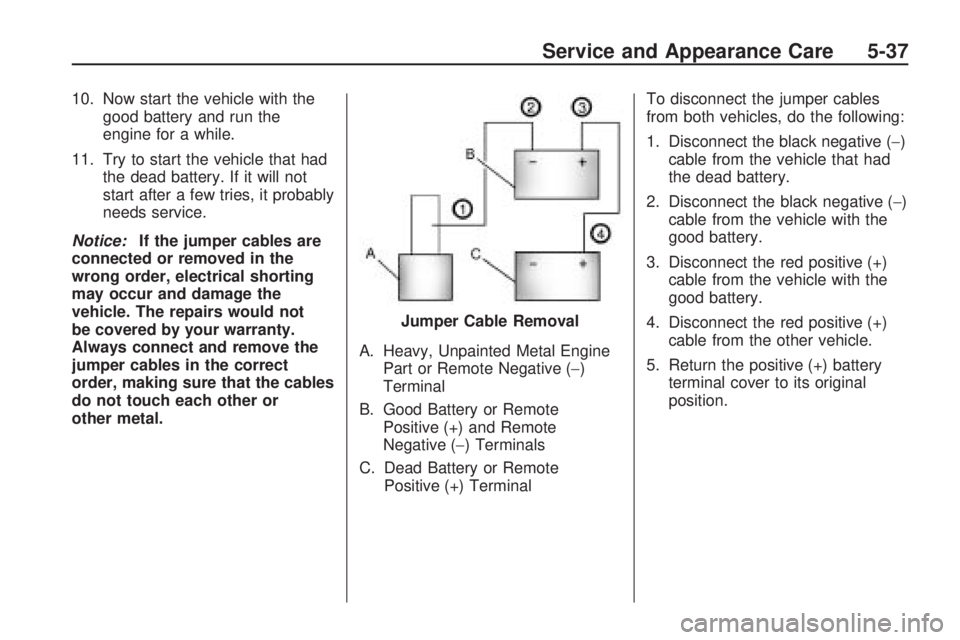
other metal.A. Heavy, Unpainted Metal Engine
Part or Remote Negative (−)
Terminal
B. Good Battery or Remote
Positive (+) and Remote
Negative (−) Terminals
C. Dead Battery or Remote
Positive (+) TerminalTo disconnect the jumper cables
from both vehicles, do the following:
1. Disconnect the black negative (−)
cable from the vehicle that had
the dead battery.
2. Disconnect the black negative (−)
cable from the vehicle with the
good battery.
3. Disconnect the red positive (+)
cable from the vehicle with the
good battery.
4. Disconnect the red positive (+)
cable from the other vehicle.
5. Return the positive (+) battery
terminal cover to its original
position. Jumper Cable Removal
Service and Appearance Care 5-37
Page 283 of 382
(D) DOT (Department of
Transportation):The
Department of Transportation
(DOT) code indicates that
the tire is in compliance
with the U.S. Department of
Transportation Motor Vehicle
Safety Standards.
(E) Tire Identication Number
(TIN)
:The letters and numbers
following DOT code are the
Tire Identication Number (TIN).
The TIN shows the manufacturer
and plant code, tire size, and
date the tire was manufactured.
The TIN is molded onto both
sides of the tire, although
only one side may have the date
of manufacture.
(F) Tire Ply Material
:The type
of cord and number of plies in the
sidewall and under the tread.
(G) Single Tire Maximum Load
:Maximum load that can be
carried and the maximum
pressure needed to support that
load when used as a single.For information on recommended
tire pressure seeInflation - Tire
Pressure on page 5-51and
Loading the Vehicle on
page 4-35.
Tire Size
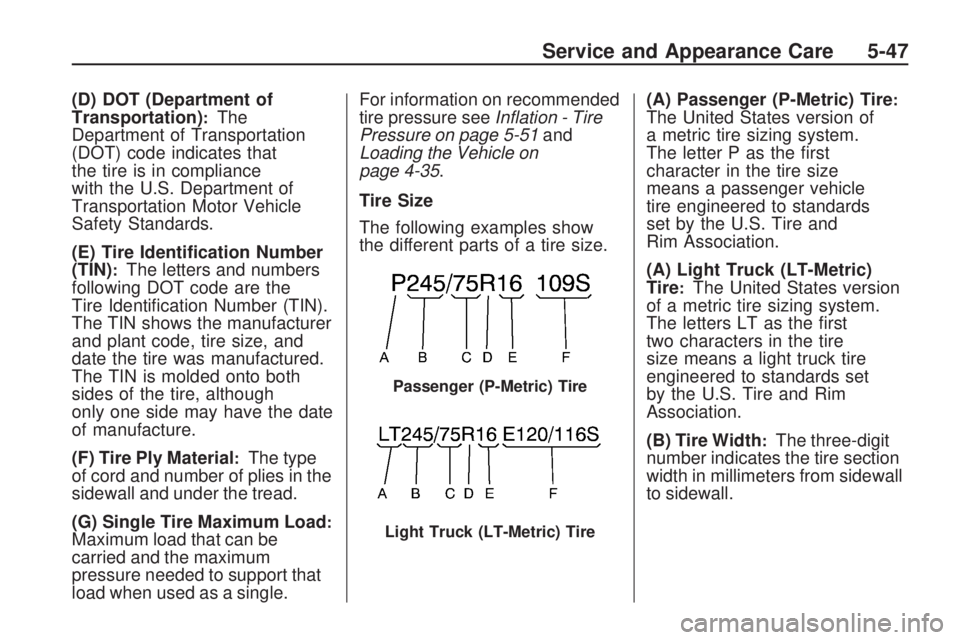
The following examples show
the different parts of a tire size.(A) Passenger (P-Metric) Tire
:The United States version of
a metric tire sizing system.
The letter P as the rst
character in the tire size
means a passenger vehicle
tire engineered to standards
set by the U.S. Tire and
Rim Association.
(A) Light Truck (LT-Metric)
Tire
:The United States version
of a metric tire sizing system.
The letters LT as the rst
two characters in the tire
size means a light truck tire
engineered to standards set
by the U.S. Tire and Rim
Association.
(B) Tire Width
:The three-digit
number indicates the tire section
width in millimeters from sidewall
to sidewall.
Passenger (P-Metric) Tire
Light Truck (LT-Metric) Tire
Service and Appearance Care 5-47
Page 292 of 382
TPMS Sensor Matching
Process
Each TPMS sensor has a unique
identication code. Any time
you replace one or more of the
TPMS sensors or rotate the
vehicle’s tires, the identication
codes need to be matched to the
new tire/wheel position. The sensors
are matched to the tire/wheel
positions in the following order:
driver side front tire, passenger side
front tire, passenger side rear
tire, and driver side rear tire using a
TPMS diagnostic tool. See your
dealer/retailer for service.
The TPMS sensors can also be
matched to each tire/wheel position
by increasing or decreasing the
tire’s air pressure. If increasing the
tire’s air pressure, do not exceed
the maximum ination pressure
indicated on the tire’s sidewall.
To let air-pressure out of a tire you
can use the pointed end of the
valve cap, a pencil-style air pressure
gage, or a key.You have one minute to match
the rst tire/wheel position,
and ve minutes overall, to match
all four tire/wheel positions. If it
takes longer than one minute, to
match the rst tire and wheel,
or more than ve minutes to match
all four tire and wheel positions,
the matching process stops and you
need to start over.
The TPMS sensor matching
procedure is outlined below:
1. Set the parking brake.
2. Turn the ignition switch to
ON/RUN with the engine off.
3. Turn the exterior lamp switch
from AUTO to OFF four times
within three seconds. A double
horn chirp will sound and
the TPMS low tire warning light
starts ashing. The double
horn chirp and ashing TPMS
warning light indicates the
TPMS matching process has
started. The TPMS warning
light should continue ashingthroughout the matching
procedure. The LOW TIRE
message displays on the Driver
Information Center (DIC).
4. Start with the driver side front tire.
5. Remove the valve cap from the
valve cap stem. Activate the
TPMS sensor by increasing or
decreasing the tire’s air pressure
for 10 seconds, then stop and
listen for a single horn chirp.
The single horn chirp should
sound within 15 seconds,
conrming that the sensor
identication code has been
matched to this tire and wheel
position. If you do not hear
the conrming single horn chirp,
turn the ignition switch to
LOCK and start over beginning
with Step 2.
6. Proceed to the passenger side
front tire, and repeat the
procedure in Step 5.
7. Proceed to the passenger side
rear tire, and repeat the
procedure in Step 5.
5-56 Service and Appearance Care
Page 303 of 382
CAUTION (Continued)
3. If you have a
four-wheel-drive vehicle,
be sure the transfer case
is in a drive gear – not in
N (Neutral).
4. Turn off the engine and do
not restart while the vehicle
is raised.
5. Do not allow passengers to
remain in the vehicle.
To be even more certain the
vehicle will not move, put blocks
at the front and rear of the tire
farthest away from the one being
changed. That would be the tire
on the other side, at the opposite
end of the vehicle.When the vehicle has a at tire,
the wheel blocks need to be set up
before changing it. The wheel
blocks are located in the tool bag in
the swing-gate for H3 models or
below the rear seat for H3T models.
SeeRemoving the Spare Tire
and Tools (H3) on page 5-68or
Removing the Spare Tire and
Tools (H3T) on page 5-69for
more information.
To use the wheel blocks, lift the
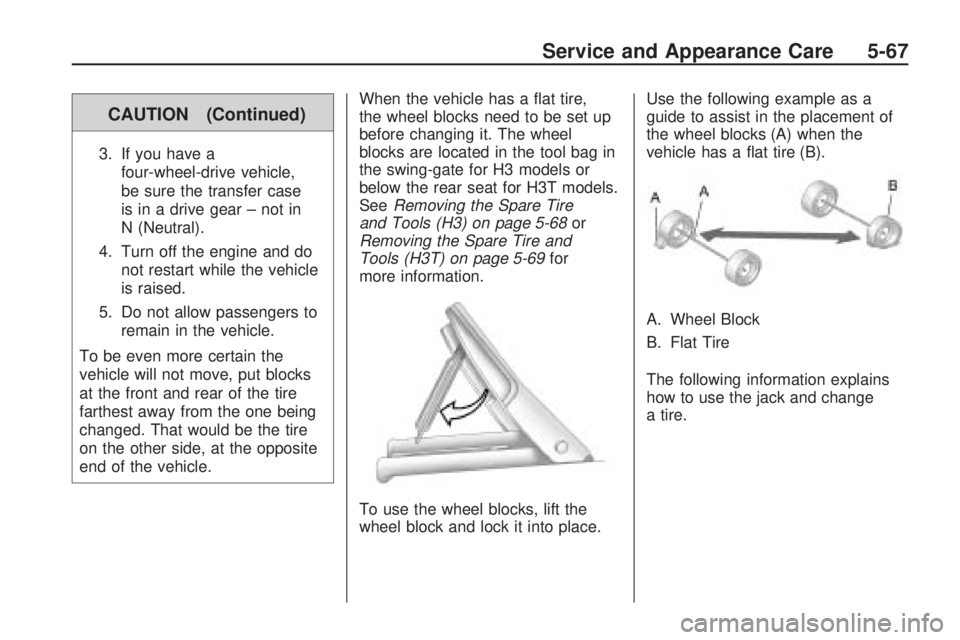
wheel block and lock it into place.Use the following example as a
guide to assist in the placement of
the wheel blocks (A) when the
vehicle has a at tire (B).
A. Wheel Block
B. Flat Tire
The following information explains
how to use the jack and change
a tire.
Service and Appearance Care 5-67
Page 326 of 382
Chemical Paint Spotting
Some weather and atmospheric
conditions can create a chemical
fallout. Airborne pollutants can
fall upon and attack painted surfaces
on the vehicle. This damage can
take two forms: blotchy, ring-shaped
discolorations, and small, irregular
dark spots etched into the paint
surface.
Although no defect in the paint job
causes this, we will repair, at no
charge to the owner, the surfaces
of new vehicles damaged by this
fallout condition within 12 months
or 12,000 miles (20 000 km) of
purchase, whichever occurs rst.
Vehicle Identication
Vehicle Identication
Number (VIN)
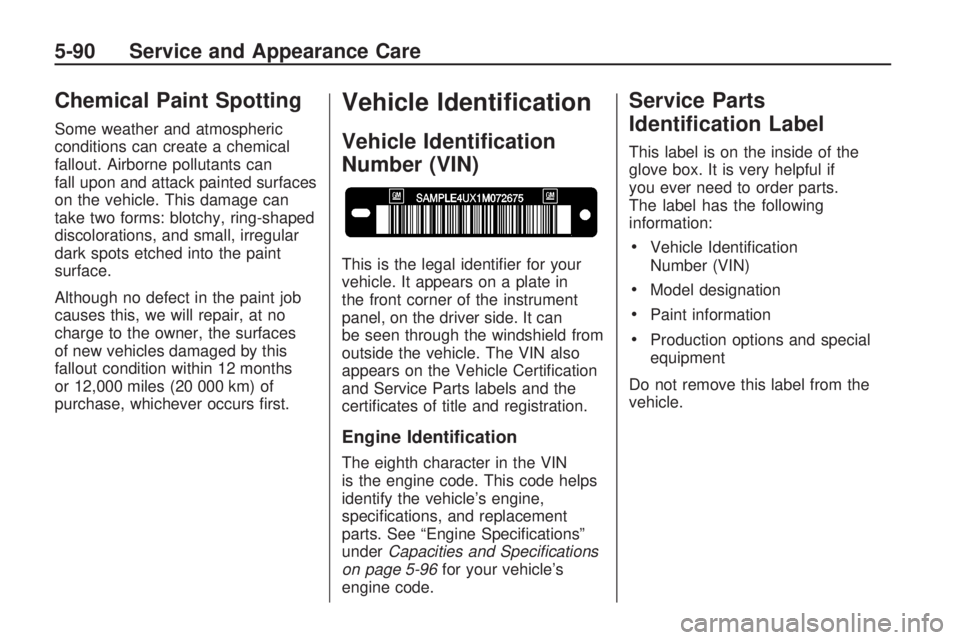
This is the legal identier for your
vehicle. It appears on a plate in
the front corner of the instrument
panel, on the driver side. It can
be seen through the windshield from
outside the vehicle. The VIN also
appears on the Vehicle Certication
and Service Parts labels and the
certicates of title and registration.
Engine Identication
The eighth character in the VIN
is the engine code. This code helps
identify the vehicle’s engine,
specications, and replacement
parts. See “Engine Specications”
underCapacities and Specifications
on page 5-96for your vehicle’s
engine code.
Service Parts
Identication Label
This label is on the inside of the
glove box. It is very helpful if
you ever need to order parts.
The label has the following
information:
Vehicle Identication
Number (VIN)
Model designation
Paint information
Production options and special
equipment
Do not remove this label from the
vehicle.
5-90 Service and Appearance Care
Page 328 of 382
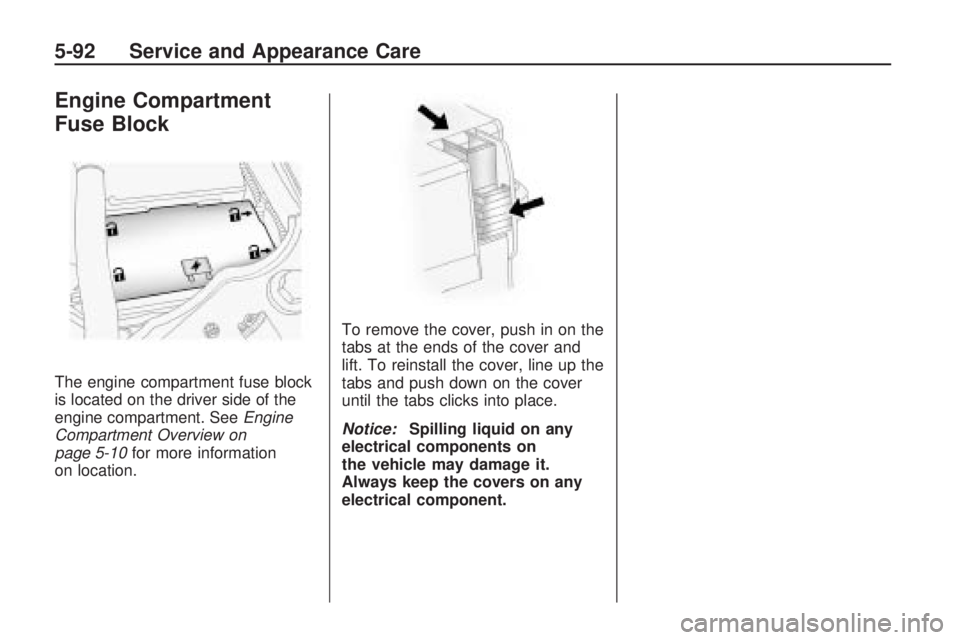
Engine Compartment
Fuse Block
The engine compartment fuse block
is located on the driver side of the
engine compartment. SeeEngine
Compartment Overview on
page 5-10for more information
on location.To remove the cover, push in on the
tabs at the ends of the cover and
lift. To reinstall the cover, line up the
tabs and push down on the cover
until the tabs clicks into place.
Notice:Spilling liquid on any
electrical components on
the vehicle may damage it.
Always keep the covers on any
electrical component.
5-92 Service and Appearance Care
Page 332 of 382
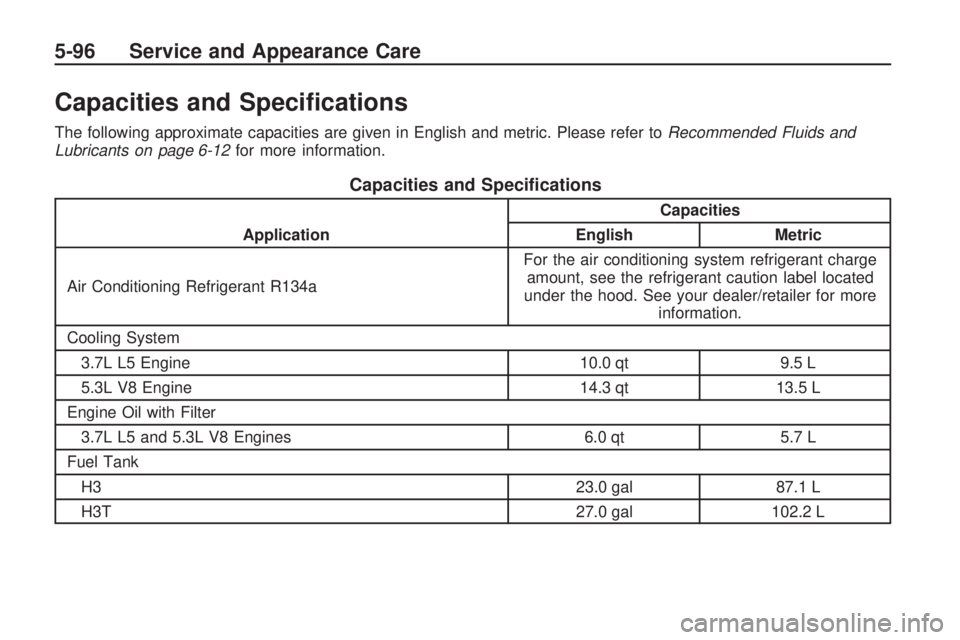
Capacities and Specications
The following approximate capacities are given in English and metric. Please refer toRecommended Fluids and
Lubricants on page 6-12 for more information.
Capacities and Specications
Application Capacities
English Metric
Air Conditioning Refrigerant R134a For the air conditioning system refrigerant charge
amount, see the refrigerant caution label located
under the hood. See your dealer/retailer for more information.
Cooling System 3.7L L5 Engine 10.0 qt9.5 L
5.3L V8 Engine 14.3 qt13.5 L
Engine Oil with Filter 3.7L L5 and 5.3L V8 Engines 6.0 qt5.7 L
Fuel Tank H3 23.0 gal87.1 L
H3T 27.0 gal102.2 L
5-96 Service and Appearance Care