battery HUMMER H3 2009 User Guide
[x] Cancel search | Manufacturer: HUMMER, Model Year: 2009, Model line: H3, Model: HUMMER H3 2009Pages: 382, PDF Size: 1.99 MB
Page 119 of 382
Instrument Panel
Instrument Panel
Overview
Instrument Panel
Overview...........................3-4
Hazard Warning Flashers. . .3-5
Horn...................................3-5
Tilt Wheel...........................3-6
Turn Signal/Multifunction
Lever................................3-6
Turn and Lane-Change
Signals.............................3-6
Headlamp High/
Low-Beam Changer..........3-7
Flash-to-Pass......................3-7
Windshield Wipers..............3-7
Windshield Washer.............3-8
Rear Window Wiper/
Washer.............................3-8
Cruise Control....................3-9
Exterior Lamps..................3-11
Headlamps on Reminder. . .3-13
Daytime Running
Lamps (DRL)..................3-13
Automatic Headlamp
System............................3-14
Off-Road Lamps................3-14
Fog Lamps.......................3-15
Instrument Panel
Brightness.......................3-15
Dome Lamp......................3-16
Dome Lamp Override........3-16
Exit Lighting......................3-16
Reading Lamps.................3-16
Electric Power
Management...................3-17
Battery Run-Down
Protection........................3-17
Accessory Power
Outlet(s)..........................3-18
Ashtray(s) and Cigarette
Lighter.............................3-18
Climate Controls
Climate Control System. . . .3-19
Outlet Adjustment.............3-21
Warning Lights, Gages,
and Indicators
Warning Lights, Gages,
and Indicators.................3-22
Instrument Panel Cluster. . .3-23
Speedometer and
Odometer........................3-24
Trip Odometer..................3-24
Tachometer.......................3-24
Safety Belt Reminders......3-24
Airbag Readiness Light.....3-25
Passenger Airbag Status
Indicator..........................3-26
Charging System Light......3-27
Up-Shift Light....................3-27
Brake System Warning
Light................................3-27
Antilock Brake System
(ABS) Warning Light.......3-28
StabiliTrak®/Traction
Control System (TCS)
Warning Light
..................3-29
Engine Coolant
Temperature Gage..........3-29
Tire Pressure Light...........3-30
Malfunction
Indicator Lamp................3-30
Instrument Panel 3-1
Page 135 of 382
Electric Power
Management
The vehicle has Electric Power
Management (EPM) that estimates
the battery’s temperature and
state of charge. It then adjusts the
voltage for best performance
and extended life of the battery.
When the battery’s state of charge
is low, the voltage is raised
slightly to quickly bring the charge
back up. When the state of charge is
high, the voltage is lowered
slightly to prevent overcharging. If
the vehicle has a voltmeter gage or
a voltage display on the Driver
Information Center (DIC), you may
see the voltage move up or
down. This is normal. If there is a
problem, an alert will be displayed.
The battery can be discharged
at idle if the electrical loads are very
high. This is true for all vehicles.
This is because the generator
(alternator) may not be spinning fastenough at idle to produce all the
power that is needed for very high
electrical loads.
A high electrical load occurs when
several of the following are on, such
as: headlamps, high beams, fog
lamps, rear window defogger,
climate control fan at high speed,
heated seats, engine cooling fans,
trailer loads, and loads plugged into
accessory power outlets.
EPM works to prevent excessive
discharge of the battery. It does this
by balancing the generator’s
output and the vehicle’s electrical
needs. It can increase engine
idle speed to generate more power,
whenever needed. It can temporarily
reduce the power demands of
some accessories.
Normally, these actions occur in
steps or levels, without being
noticeable. In rare cases at the
highest levels of corrective action,this action may be noticeable to the
driver. If so, a Driver Information
Center (DIC) message might be
displayed, such as BATTERY
SAVER ACTIVE, BATTERY
VOLTAGE LOW, or LOW BATTERY.
If this message is displayed, it is
recommended that the driver reduce
the electrical loads as much as
possible. SeeDIC Warnings and
Messages on page 3-37.
Battery Run-Down
Protection
This feature shuts off the dome
lamp if it is left on for more
than 20 minutes when the ignition is
in LOCK/OFF. This helps to
prevent the battery from being
drained.
Instrument Panel 3-17
Page 136 of 382
Accessory Power
Outlet(s)
The accessory power outlets can be
used to connect auxiliary electrical
equipment, such as a cellular phone.
There are two accessory power
outlets located under the climate
control system. There is also one
accessory power outlet located in the
rear cargo area (H3 model only). Pull
down the small cover to access the
accessory power outlet.
Notice:Leaving electrical
equipment on for extended
periods will drain the battery.
Always unplug electrical
equipment when not in use and
do not plug in equipment that
exceeds the maximum amperage
rating of 20 amperes.
Certain electrical accessories may
not be compatible with the
accessory power outlet and could
result in blown vehicle or adapter
fuses. If you experience a problem,see your dealer/retailer for additional
information on accessory power
outlets.
Notice:Adding any electrical
equipment to the vehicle can
damage it or keep other
components from working as
they should. The repairs would
not be covered by the vehicle
warranty. Do not use equipment
exceeding maximum amperage
rating of 20 amperes. Check with
your dealer/retailer before
adding electrical equipment.
When adding electrical equipment,
be sure to follow the proper
installation instructions included with
the equipment.
Notice:Improper use of the
power outlet can cause damage
not covered by the warranty.
Do not hang any type of
accessory or accessory bracket
from the plug because the
power outlets are designed for
accessory power plugs only.
Ashtray(s) and Cigarette
Lighter
For vehicles with a removable
ashtray, it can be placed into the
cupholder and be removed for
cleaning.
Notice:If papers, pins, or other
ammable items are put in
the ashtray, hot cigarettes or
other smoking materials could
ignite them and possibly damage
the vehicle. Never put ammable
items in the ashtray.
For vehicles with a lighter, push the
lighter down and it will pop up
when it is ready to be used.
Notice:Holding a cigarette
lighter in while it is heating does
not let the lighter back away from
the heating element when it is hot.
Damage from overheating can
occur to the lighter or heating
element, or a fuse could be blown.
Do not hold a cigarette lighter in
while it is heating.
3-18 Instrument Panel
Page 150 of 382
Make sure to fuel the vehicle
with quality fuel. Poor fuel
quality causes the engine not to
run as efficiently as designed
and may cause: stalling
after start-up, stalling when the
vehicle is changed into gear,
misring, hesitation on
acceleration, or stumbling on
acceleration. These conditions
might go away once the engine is
warmed up.
If one or more of these conditions
occurs, change the fuel brand
used. It will require at least
one full tank of the proper fuel to
turn the light off.
SeeGasoline Octane on
page 5-5.
If none of the above have made the
light turn off, your dealer/retailer
can check the vehicle. The
dealer/retailer has the proper test
equipment and diagnostic tools to x
any mechanical or electrical
problems that might have
developed.Emissions Inspection and
Maintenance Programs
Some state/provincial and local
governments have or might begin
programs to inspect the emission
control equipment on the vehicle.
Failure to pass this inspection could
prevent getting a vehicle
registration.
Here are some things to know to
help the vehicle pass an inspection:
The vehicle will not pass this
inspection if the check engine
light is on with the engine
running, or if the key is in the
ON/RUN and the light is not on.
The vehicle will not pass
this inspection if the OBD II
(on-board diagnostic) system
determines that critical emission
control systems have not
been completely diagnosed by
the system. The vehicle would be
considered not ready for
inspection. This can happen if
the battery has recently been
replaced or if the battery has rundown. The diagnostic system is
designed to evaluate critical
emission control systems during
normal driving. This can take
several days of routine driving. If
this has been done and the
vehicle still does not pass the
inspection for lack of OBD II
system readiness, your
dealer/retailer can prepare the
vehicle for inspection.
Oil Pressure Light
{CAUTION
Do not keep driving if the oil
pressure is low. The engine can
become so hot that it catches re.
Someone could be burned. Check
the oil as soon as possible and
have the vehicle serviced.
3-32 Instrument Panel
Page 158 of 382
SERV (Service) VEH (Vehicle)
This message displays if the
vehicle needs service. Have the
vehicle serviced by your
dealer/retailer as soon as possible.
SERVICE CHARG (Charge)
SYS (System)
This message displays if there is a
problem with the battery charging
system. Under certain conditions,
the battery warning light may
also turn on in the instrument panel
cluster. SeeCharging System
Light on page 3-27. The battery will
not be charging at an optimal
rate and the vehicle will lose the
ability to enter the fuel economy
mode. The vehicle is safe to drive,
however have the electrical
system checked by your
dealer/retailer. Press and release
the reset stem to acknowledge
the message and clear it from the
display.
SERVICE STAB (Stability)
SYS (System)
This message displays if there is a
problem with the StabiliTrak®
system. Have the vehicle serviced
by your dealer/retailer. See
StabiliTrak
®System on page 4-6for
more information.
STAB (Stability)
SYS (System) OFF
This message displays when the
StabiliTrak®system is turned
off. SeeStabiliTrak®System on
page 4-6for more information.
TRAC (Traction) OFF
This message along with the
traction off light displays when the
Traction Control System (TCS)
is turned off by pressing the TCS
button. SeeStabiliTrak
®/Traction
Control System (TCS) Warning Light
on page 3-29andTraction Control
System (TCS) on page 4-7for
more information.
TRACTION FAULT
This message displays if there is a
problem with the Traction Control
System (TCS). Check the TCS
as soon as possible and have the
vehicle serviced by your
dealer/retailer. SeeTraction Control
System (TCS) on page 4-7for
more information. Press and release
the reset stem to acknowledge
the message and clear it from the
display.
TURN SIGNAL
This message displays when the
turn signal is on for about 0.75 miles
(1.2 km) of travel. Press and
release the reset stem to
acknowledge the message and
clear it from the display.
3-40 Instrument Panel
Page 181 of 382
Cellular Phone Usage
Cellular phone usage may cause
interference with the vehicle’s radio.
This interference may occur when
making or receiving phone calls,
charging the phone’s battery,
or simply having the phone on. This
interference causes an increased
level of static while listening to
the radio. If static is received while
listening to the radio, unplug the
cellular phone and turn it off.
Fixed Mast Antenna
The xed mast antenna can
withstand most car washes without
being damaged as long as it is
securely attached to the base. If the
mast becomes slightly bent,
straighten it out by hand. If the mast
is badly bent, replace it.
Occasionally check to make sure
the antenna is tightened to its base.
If tightening is required, tighten
by hand. until fully seated plus one
quarter turn.
XM™ Satellite Radio
Antenna System
The XM Satellite Radio antenna is
located on the roof of the vehicle.
Keep the antenna clear of
obstructions for clear radio
reception.
If the vehicle has a sunroof, the
performance of the XM system may
be affected if the sunroof is open.
Instrument Panel 3-63
Page 191 of 382
2. Press the rear axle locking
button with the vehicle moving
less than 16 mph (26 km/h).
The light in the button stops ashing
and remains illuminated when the
rear axle is locked.
Notice:If you try to lock the axle
while the vehicle is stuck and
the tires are spinning, the
vehicle’s drivetrain could be
damaged. The repairs would not
be covered by the vehicle
warranty. Always lock the axle
before attempting situations
and/or navigating terrain which
could possibly cause the vehicle
to become stuck.
The locking rear axle will be
disengaged when the wheel speed
is greater than 40 mph (64 km/h),
if the vehicle’s battery is low and/or
the transfer case is shifted out of
4LO Lock mode.Notice:If the vehicle’s axle is
locked while driving on pavement,
the drivetrain could be damaged.
Repairs would not be covered
by the vehicle warranty. Do
not use the locking axle on
pavement. If four-wheel drive is
needed when traveling on
pavement, use only 4HI.
Locking Front Axle
For vehicles with this feature, the
locking front axle, used with
the locking rear axle, can give the
vehicle additional traction when
traveling in off-road situations such
as mud, snow, sand, steep hills
and uneven terrain.
The button used to turn the locking
front axle on or off is located on
the instrument panel.Before the front axle can be locked,
the rear axle must be locked.
To lock the front and rear axles:
1. Place the transfer case in
the 4LO Lock mode. This is the
only mode which allows the
front and rear axles to lock. See
Full-Time Four-Wheel Drive
on page 2-24for more
information regarding the transfer
case and 4LO Lock mode.
2. Press the rear axle locking
button with the vehicle moving
less than 16 mph (26 km/h).
3. Wait for the light in the button
to stop ashing and remain
illuminated to show that the rear
axle is locked.
4. Press the front axle locking
button with the vehicle stopped
or moving less than 16 mph
(26 km/h).
Driving Your Vehicle 4-9
Page 192 of 382
5. Wait for the light in the button
to stop ashing and remain
illuminated to show that the front
axle is locked.
Notice:If you try to lock the axle
while the vehicle is stuck and
the tires are spinning, the
vehicle’s drivetrain could be
damaged. The repairs would not
be covered by the vehicle
warranty. Always lock the axle
before attempting situations
and/or navigating terrain which
could possibly cause the vehicle
to become stuck.
Locking axles will be disengaged
when the wheel speed is greater
than 40 mph (64 km/h), if the
vehicle’s battery is low and/or the
transfer case is shifted out of
4LO Lock mode.Notice:If the vehicle’s axle is
locked while driving on pavement,
the drivetrain could be damaged.
Repairs would not be covered
by the vehicle warranty. Do
not use the locking axle on
pavement. If four-wheel drive is
needed when traveling on
pavement, use only 4HI.
Steering
Power Steering
If power steering assist is lost
because the engine stops or the
system is not functioning, the vehicle
can be steered but it will take
more effort.
Steering Tips
It is important to take curves at a
reasonable speed.
Traction in a curve depends on the
condition of the tires and the
road surface, the angle at which the
curve is banked, and vehicle
speed. While in a curve, speed is
the one factor that can be controlled.
If there is a need to reduce speed,
do it before entering the curve,
while the front wheels are straight.
Try to adjust the speed so you
can drive through the curve.
Maintain a reasonable, steady
speed. Wait to accelerate until out
of the curve, and then accelerate
gently into the straightaway.
4-10 Driving Your Vehicle
Page 215 of 382
Run the engine for short periods
only as needed to keep warm,
but be careful.
To save fuel, run the engine for
only short periods as needed to
warm the vehicle and then shut the
engine off and close the window
most of the way to save heat.
Repeat this until help arrives
but only when you feel really
uncomfortable from the cold. Moving
about to keep warm also helps.
If it takes some time for help to
arrive, now and then when you run
the engine, push the accelerator
pedal slightly so the engine
runs faster than the idle speed. This
keeps the battery charged to
restart the vehicle and to signal for
help with the headlamps. Do
this as little as possible to save fuel.If Your Vehicle is
Stuck in Sand, Mud,
Ice, or Snow
Slowly and cautiously spin the
wheels to free the vehicle when
stuck in sand, mud, ice, or snow.
SeeRocking Your Vehicle to Get It
Out on page 4-34.
If the vehicle has a traction system,
it can often help to free a stuck
vehicle. Refer to the vehicle’s
traction system in the Index. If stuck
too severely for the traction
system to free the vehicle, turn the
traction system off and use the
rocking method.
{CAUTION
If you let your vehicle’s tires spin
at high speed, they can explode,
and you or others could be
injured. The vehicle can overheat,
causing an engine compartment
re or other damage. Spin the
wheels as little as possible and
avoid going above 35 mph
(55 km/h) as shown on the
speedometer.
For information about using tire
chains on the vehicle, seeTire
Chains on page 5-65.
Driving Your Vehicle 4-33
Page 223 of 382
Use the following procedure to tow
the vehicle:
1. Put the transmission in P (Park)
for an automatic transmission or
in 1 (First) for a manual
transmission.
2. Turn the engine off, but leave the
ignition in ACC/ACCESSORY.
3. Firmly set the parking brake.
4. Securely attach the vehicle being
towed to the tow vehicle.
{CAUTION
Shifting a full-time
four-wheel-drive vehicle’s
transfer case into N (Neutral)
can cause the vehicle to roll
even if the automatic transmission
is in P (Park) or the manual
transmission is in any gear. You
or others could be injured. Make
sure the parking brake is rmly
set before the transfer case is
shifted to N (Neutral).5. Shift the transfer case to
N (Neutral). SeeFull-Time
Four-Wheel Drive on page 2-24
for the proper procedure to
select the N (Neutral) position for
the vehicle.
6. Release the parking brake only
after the vehicle being towed is
rmly attached to the tow vehicle.
7. Make sure the ignition is in
ACC/ACCESSORY.
When towing the vehicle for
extended periods of time, start the
vehicle as often as possible to
prevent battery drain. This should
only be done when the tow
vehicle is parked.
After towing, see “Shifting Out of
NEUTRAL” underFull-Time
Four-Wheel Drive on page 2-24.
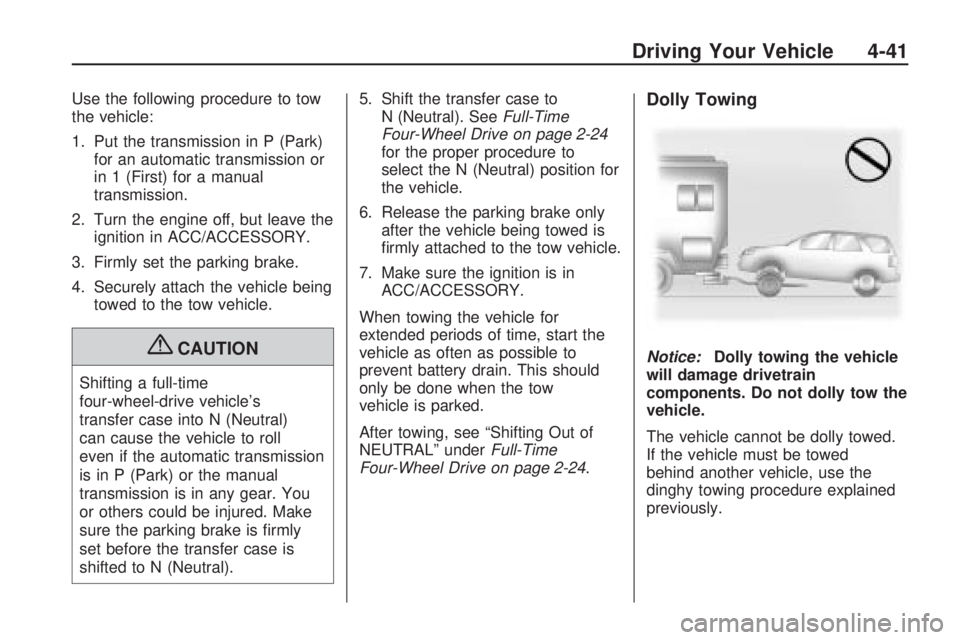
Dolly Towing
Notice:Dolly towing the vehicle
will damage drivetrain
components. Do not dolly tow the
vehicle.
The vehicle cannot be dolly towed.
If the vehicle must be towed
behind another vehicle, use the
dinghy towing procedure explained
previously.
Driving Your Vehicle 4-41