cruise control HUMMER H3 2009 User Guide
[x] Cancel search | Manufacturer: HUMMER, Model Year: 2009, Model line: H3, Model: HUMMER H3 2009Pages: 382, PDF Size: 1.99 MB
Page 188 of 382
Braking in Emergencies
ABS allows the driver to steer
and brake at the same time. In many
emergencies, steering can help
more than even the very best
braking.
Brake Assist
This vehicle has a Brake Assist
feature designed to assist the driver
in stopping or decreasing vehicle
speed in emergency driving
conditions. This feature uses the
stability system hydraulic brake
control module to supplement the
power brake system under
conditions where the driver has
quickly and forcefully applied
the brake pedal in an attempt to
quickly stop or slow down the
vehicle. The stability system
hydraulic brake control module
increases brake pressure at each
corner of the vehicle until the
ABS activates. Minor brake pedal
pulsations or pedal movement
during this time is normal and the
driver should continue to applythe brake pedal as the driving
situation dictates The Brake Assist
feature will automatically disengage
when the brake pedal is released
or brake pedal pressure is quickly
decreased.
StabiliTrak®System
The vehicle has a vehicle stability
enhancement system called
StabiliTrak. It is an advanced
computer controlled system that
assists the driver with directional
control of the vehicle in difficult
driving conditions.
StabiliTrak activates when the
computer senses a discrepancy
between the intended path and the
direction the vehicle is actually
traveling. StabiliTrak selectively
applies braking pressure at any one
of the vehicle’s brakes to assist
the driver with keeping the vehicle
on the intended path.
When the vehicle is started and
begins to move, the system
performs several diagnostic checksto insure there are no problems.
The system may be heard or
felt while it is working. This is normal
and does not mean there is a
problem with the vehicle.
If cruise control is being used when
StabiliTrak activates, the cruise
control automatically disengages.
The cruise control can be
re-engaged when road conditions
allow. SeeCruise Control on
page 3-9.
If there is a problem detected with
StabiliTrak, a SERVICE STAB
SYS message displays on the Driver
Information Center (DIC). See
DIC Warnings and Messages on
page 3-37for more information.
When this message is displayed, the
system is not working. Adjust your
driving accordingly.
StabiliTrak comes on automatically
whenever the vehicle is started
and resets itself at each ignition
cycle. However, when the transfer
case is placed in Four-Wheel-Low
Lock mode, StabiliTrak is
4-6 Driving Your Vehicle
Page 189 of 382
automatically disabled. See
Full-Time Four-Wheel Drive on
page 2-24for more information. It is
recommended to leave the system
on for normal driving conditions,
but it may be necessary to turn the
system off if the vehicle is stuck
in sand, mud, ice, or snow, and it is
necessary to “rock” the vehicle to
attempt to free it. SeeIf Your
Vehicle is Stuck in Sand, Mud, Ice,
or Snow on page 4-33.
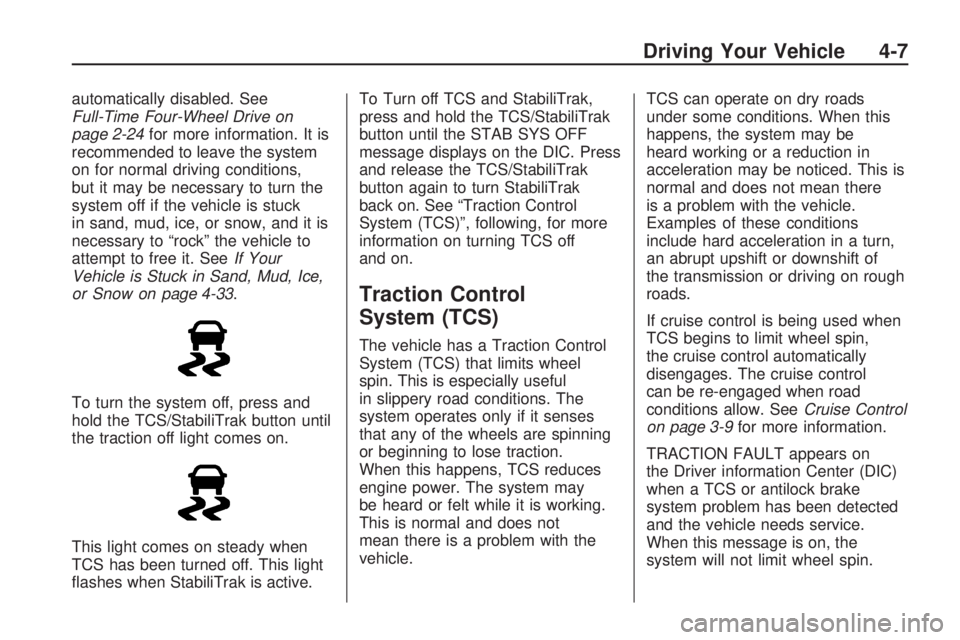
To turn the system off, press and
hold the TCS/StabiliTrak button until
the traction off light comes on.
This light comes on steady when
TCS has been turned off. This light
ashes when StabiliTrak is active.To Turn off TCS and StabiliTrak,
press and hold the TCS/StabiliTrak
button until the STAB SYS OFF
message displays on the DIC. Press
and release the TCS/StabiliTrak
button again to turn StabiliTrak
back on. See “Traction Control
System (TCS)”, following, for more
information on turning TCS off
and on.
Traction Control
System (TCS)
The vehicle has a Traction Control
System (TCS) that limits wheel
spin. This is especially useful
in slippery road conditions. The
system operates only if it senses
that any of the wheels are spinning
or beginning to lose traction.
When this happens, TCS reduces
engine power. The system may
be heard or felt while it is working.
This is normal and does not
mean there is a problem with the
vehicle.TCS can operate on dry roads
under some conditions. When this
happens, the system may be
heard working or a reduction in
acceleration may be noticed. This is
normal and does not mean there
is a problem with the vehicle.
Examples of these conditions
include hard acceleration in a turn,
an abrupt upshift or downshift of
the transmission or driving on rough
roads.
If cruise control is being used when
TCS begins to limit wheel spin,
the cruise control automatically
disengages. The cruise control
can be re-engaged when road
conditions allow. SeeCruise Control
on page 3-9for more information.
TRACTION FAULT appears on
the Driver information Center (DIC)
when a TCS or antilock brake
system problem has been detected
and the vehicle needs service.
When this message is on, the
system will not limit wheel spin.
Driving Your Vehicle 4-7
Page 211 of 382
Driving in Rain and on
Wet Roads
Rain and wet roads can reduce
vehicle traction and affect your
ability to stop and accelerate.
Always drive slower in these types
of driving conditions and avoid
driving through large puddles and
deep-standing or owing water.
{CAUTION
Wet brakes can cause crashes.
They might not work as well in a
quick stop and could cause
pulling to one side. You could
lose control of the vehicle.
After driving through a large
puddle of water or a car/vehicle
wash, lightly apply the brake
pedal until the brakes work
normally.
(Continued)
CAUTION (Continued)
Flowing or rushing water creates
strong forces. Driving through
owing water could cause your
vehicle to be carried away. If this
happens, you and other vehicle
occupants could drown. Do not
ignore police warnings and be
very cautious about trying to drive
through owing water.
Hydroplaning
Hydroplaning is dangerous. Water
can build up under your vehicle’s
tires so they actually ride on
the water. This can happen if the
road is wet enough and you
are going fast enough. When your
vehicle is hydroplaning, it has little or
no contact with the road.
There is no hard and fast rule about
hydroplaning. The best advice is
to slow down when the road is wet.
Other Rainy Weather Tips
Besides slowing down, other wet
weather driving tips include:
Allow extra following distance.
Pass with caution.
Keep windshield wiping
equipment in good shape.
Keep the windshield washer uid
reservoir lled.
Have good tires with proper tread
depth. SeeTires on page 5-44.
Turn off cruise control.
Driving Your Vehicle 4-29
Page 214 of 382
Allow greater following distance on
any slippery road and watch for
slippery spots. Icy patches
can occur on otherwise clear roads
in shaded areas. The surface of
a curve or an overpass can remain
icy when the surrounding roads
are clear. Avoid sudden steering
maneuvers and braking while on ice.
Turn off cruise control, if equipped,
on slippery surfaces.
Blizzard Conditions
Being stuck in snow can be in a
serious situation. Stay with the
vehicle unless there is help nearby.
If possible, use theRoadside
Service on page 7-6. To get help
and keep everyone in the vehicle
safe:
Turn on theHazard Warning
Flashers on page 3-5.
Tie a red cloth to an outside
mirror.
{CAUTION
Snow can trap engine exhaust
under the vehicle. This may cause
exhaust gases to get inside.
Engine exhaust contains carbon
monoxide (CO) which cannot be
seen or smelled. It can cause
unconsciousness and even death.
If the vehicle is stuck in the snow:
Clear away snow from
around the base of your
vehicle, especially any that is
blocking the exhaust pipe.
Check again from time to
time to be sure snow does
not collect there.
Open a window about two
inches (5 cm) on the side of
the vehicle that is away from
the wind to bring in fresh air.
Fully open the air outlets on
or under the instrument
panel.
(Continued)
CAUTION (Continued)
Adjust the Climate Control
system to a setting that
circulates the air inside the
vehicle and set the fan speed
to the highest setting. See
Climate Control System in the
Index.
For more information about
carbon monoxide, seeEngine
Exhaust on page 2-31.
Snow can trap exhaust gases
under your vehicle. This can
cause deadly CO (carbon
monoxide) gas to get inside. CO
could overcome you and kill you.
You cannot see it or smell it, so
you might not know it is in your
vehicle. Clear away snow from
around the base of your vehicle,
especially any that is blocking the
exhaust.
4-32 Driving Your Vehicle
Page 330 of 382
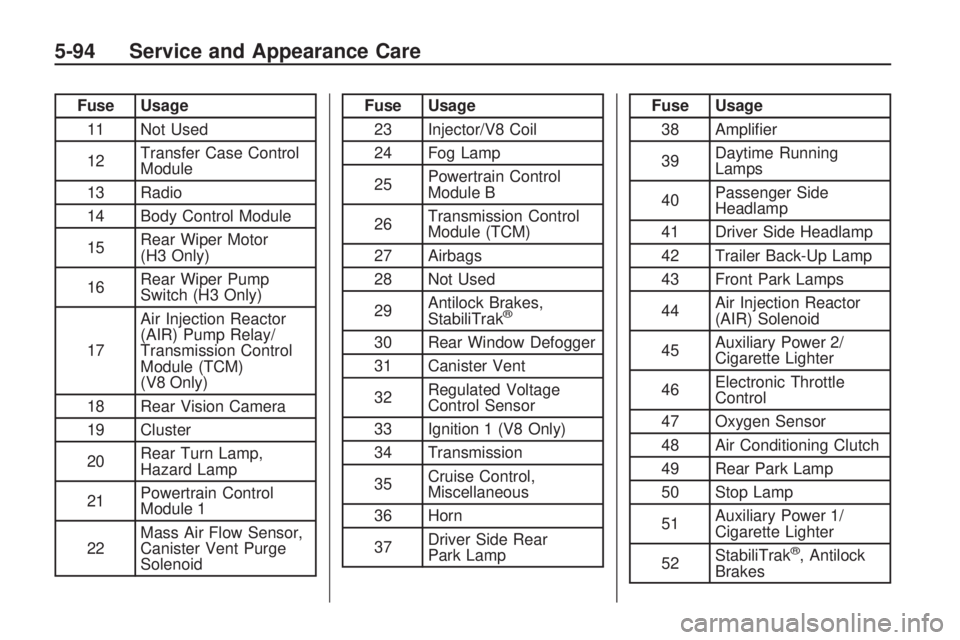
Fuse Usage
11 Not Used
12Transfer Case Control
Module
13 Radio
14 Body Control Module
15Rear Wiper Motor
(H3 Only)
16Rear Wiper Pump
Switch (H3 Only)
17Air Injection Reactor
(AIR) Pump Relay/
Transmission Control
Module (TCM)
(V8 Only)
18 Rear Vision Camera
19 Cluster
20Rear Turn Lamp,
Hazard Lamp
21Powertrain Control
Module 1
22Mass Air Flow Sensor,
Canister Vent Purge
SolenoidFuse Usage
23 Injector/V8 Coil
24 Fog Lamp
25Powertrain Control
Module B
26Transmission Control
Module (TCM)
27 Airbags
28 Not Used
29Antilock Brakes,
StabiliTrak
®
30 Rear Window Defogger
31 Canister Vent
32Regulated Voltage
Control Sensor
33 Ignition 1 (V8 Only)
34 Transmission
35Cruise Control,
Miscellaneous
36 Horn
37Driver Side Rear
Park Lamp
Fuse Usage
38 Amplier
39Daytime Running
Lamps
40Passenger Side
Headlamp
41 Driver Side Headlamp
42 Trailer Back-Up Lamp
43 Front Park Lamps
44Air Injection Reactor
(AIR) Solenoid
45Auxiliary Power 2/
Cigarette Lighter
46Electronic Throttle
Control
47 Oxygen Sensor
48 Air Conditioning Clutch
49 Rear Park Lamp
50 Stop Lamp
51Auxiliary Power 1/
Cigarette Lighter
52StabiliTrak
®, Antilock
Brakes
5-94 Service and Appearance Care
Page 373 of 382
Cleaning (cont.)
Finish Care......................5-86
Instrument Panel, Vinyl,
and Other Plastic
Surfaces......................5-85
Interior............................5-83
Leather...........................5-85
Tires...............................5-89
Underbody Maintenance....5-89
Washing Your Vehicle........5-86
Weatherstrips...................5-86
Windshield, Backglass, and
Wiper Blades................5-87
Climate Control System.........3-19
Outlet Adjustment.............3-21
Clock, Setting......................3-41
Clutch, Hydraulic..................5-21
Collision Damage Repair.......7-11
Compass............................2-34
Content Theft-Deterrent.........2-11
Control of a Vehicle............... 4-3
Convenience Net.................2-49
Coolant
Engine............................5-23
Engine Temperature Gage . . . 3-29
Cooling System...................5-22
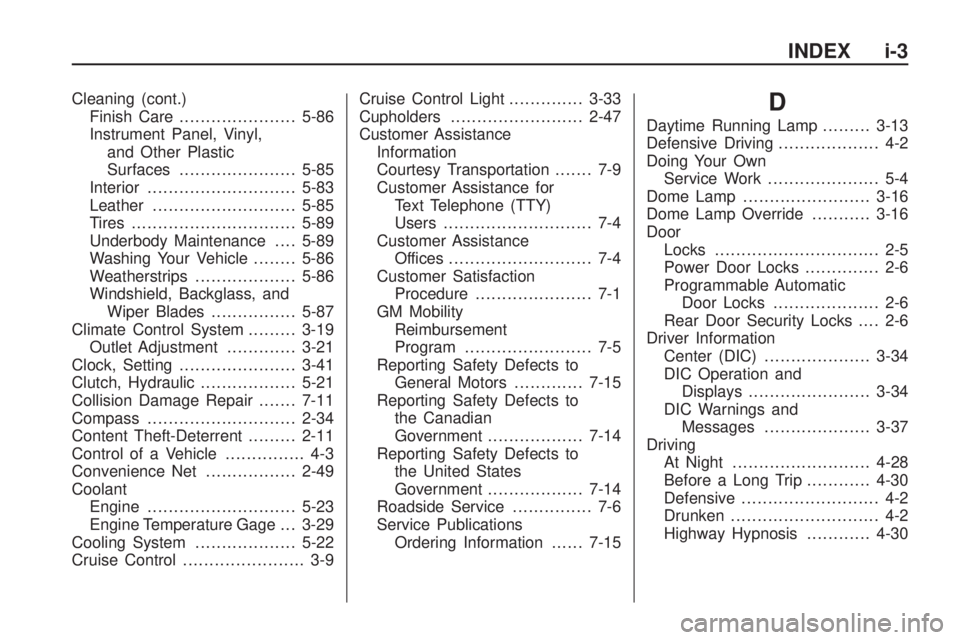
Cruise Control....................... 3-9Cruise Control Light..............3-33
Cupholders.........................2-47
Customer Assistance
Information
Courtesy Transportation....... 7-9
Customer Assistance for
Text Telephone (TTY)
Users............................ 7-4
Customer Assistance
Offices........................... 7-4
Customer Satisfaction
Procedure...................... 7-1
GM Mobility
Reimbursement
Program........................ 7-5
Reporting Safety Defects to
General Motors.............7-15
Reporting Safety Defects to
the Canadian
Government..................7-14
Reporting Safety Defects to
the United States
Government..................7-14
Roadside Service............... 7-6
Service Publications
Ordering Information......7-15
D
Daytime Running Lamp.........3-13
Defensive Driving................... 4-2
Doing Your Own
Service Work..................... 5-4
Dome Lamp ........................3-16
Dome Lamp Override...........3-16
Door
Locks............................... 2-5
Power Door Locks.............. 2-6
Programmable Automatic
Door Locks.................... 2-6
Rear Door Security Locks.... 2-6
Driver Information
Center (DIC)....................3-34
DIC Operation and
Displays.......................3-34
DIC Warnings and
Messages....................3-37
Driving
At Night..........................4-28
Before a Long Trip............4-30
Defensive.......................... 4-2
Drunken............................ 4-2
Highway Hypnosis............4-30
INDEX i-3
Page 376 of 382
J
Jump Starting......................5-34
K
Keyless Entry System............ 2-3
Keys.................................... 2-2
L
Labeling, Tire Sidewall..........5-45
Lamp
Malfunction Indicator.........3-30
Lamps
Dome .............................3-16
Dome Lamp Override........3-16
Off-Road .........................3-14
Reading..........................3-16
Lap-Shoulder Belt................1-20
LATCH System for Child
Restraints........................1-34
License Plate Lamps............5-43Light
Airbag Readiness.............3-25
Antilock Brake System
(ABS) Warning..............3-28
Brake System Warning......3-27
Charging System..............3-27
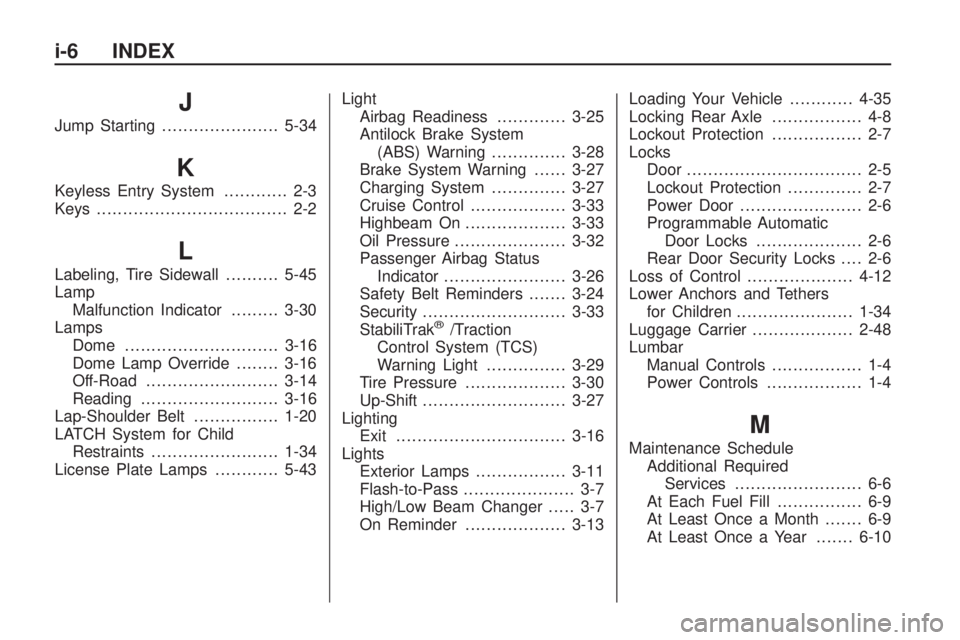
Cruise Control..................3-33
Highbeam On...................3-33
Oil Pressure.....................3-32
Passenger Airbag Status
Indicator.......................3-26
Safety Belt Reminders.......3-24
Security...........................3-33
StabiliTrak
®/Traction
Control System (TCS)
Warning Light...............3-29
Tire Pressure...................3-30
Up-Shift...........................3-27
Lighting
Exit................................3-16
Lights
Exterior Lamps.................3-11
Flash-to-Pass..................... 3-7
High/Low Beam Changer..... 3-7
On Reminder...................3-13Loading Your Vehicle............4-35
Locking Rear Axle................. 4-8
Lockout Protection................. 2-7
Locks
Door ................................. 2-5
Lockout Protection.............. 2-7
Power Door....................... 2-6
Programmable Automatic
Door Locks.................... 2-6
Rear Door Security Locks.... 2-6
Loss of Control....................4-12
Lower Anchors and Tethers
for Children......................1-34
Luggage Carrier...................2-48
Lumbar
Manual Controls................. 1-4
Power Controls.................. 1-4
M
Maintenance Schedule
Additional Required
Services........................ 6-6
At Each Fuel Fill................ 6-9
At Least Once a Month....... 6-9
At Least Once a Year.......6-10
i-6 INDEX