power steering HUMMER H3 2009 User Guide
[x] Cancel search | Manufacturer: HUMMER, Model Year: 2009, Model line: H3, Model: HUMMER H3 2009Pages: 382, PDF Size: 1.99 MB
Page 284 of 382
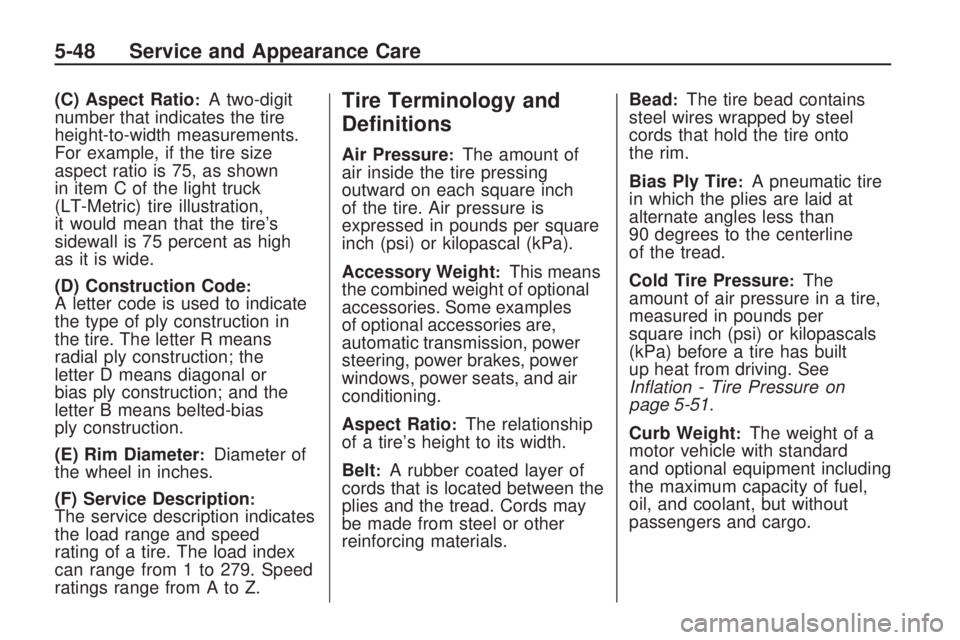
(C) Aspect Ratio:A two-digit
number that indicates the tire
height-to-width measurements.
For example, if the tire size
aspect ratio is 75, as shown
in item C of the light truck
(LT-Metric) tire illustration,
it would mean that the tire’s
sidewall is 75 percent as high
as it is wide.
(D) Construction Code
:A letter code is used to indicate
the type of ply construction in
the tire. The letter R means
radial ply construction; the
letter D means diagonal or
bias ply construction; and the
letter B means belted-bias
ply construction.
(E) Rim Diameter
:Diameter of
the wheel in inches.
(F) Service Description
:The service description indicates
the load range and speed
rating of a tire. The load index
can range from 1 to 279. Speed
ratings range from A to Z.
Tire Terminology and
Denitions
Air Pressure:The amount of
air inside the tire pressing
outward on each square inch
of the tire. Air pressure is
expressed in pounds per square
inch (psi) or kilopascal (kPa).
Accessory Weight
:This means
the combined weight of optional
accessories. Some examples
of optional accessories are,
automatic transmission, power
steering, power brakes, power
windows, power seats, and air
conditioning.
Aspect Ratio
:The relationship
of a tire’s height to its width.
Belt
:A rubber coated layer of
cords that is located between the
plies and the tread. Cords may
be made from steel or other
reinforcing materials.Bead
:The tire bead contains
steel wires wrapped by steel
cords that hold the tire onto
the rim.
Bias Ply Tire
:A pneumatic tire
in which the plies are laid at
alternate angles less than
90 degrees to the centerline
of the tread.
Cold Tire Pressure
:The
amount of air pressure in a tire,
measured in pounds per
square inch (psi) or kilopascals
(kPa) before a tire has built
up heat from driving. See
Inflation - Tire Pressure on
page 5-51.
Curb Weight
:The weight of a
motor vehicle with standard
and optional equipment including
the maximum capacity of fuel,
oil, and coolant, but without
passengers and cargo.
5-48 Service and Appearance Care
Page 341 of 382
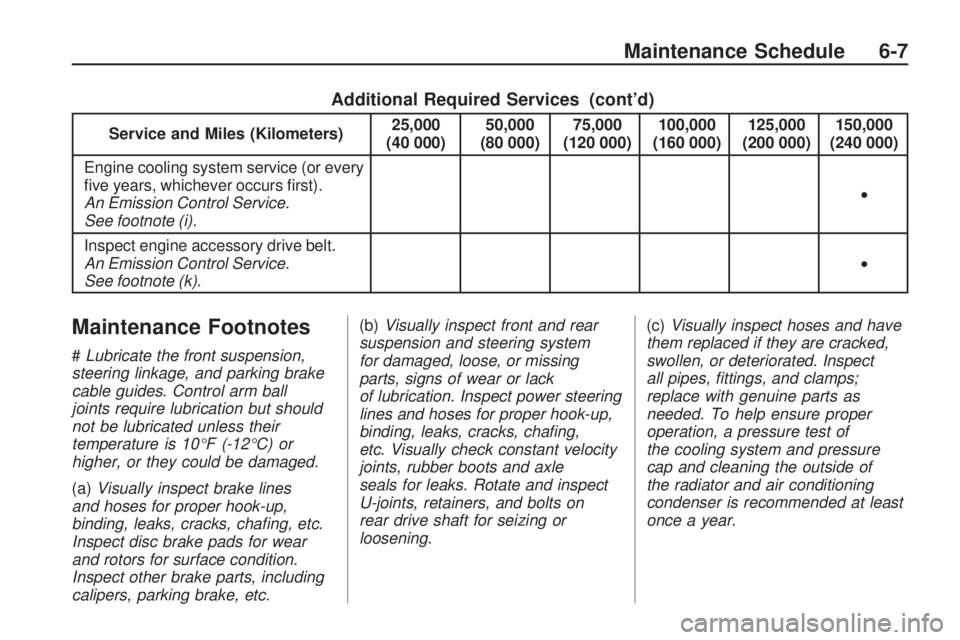
Additional Required Services (cont’d)
Service and Miles (Kilometers)25,000
(40 000) 50,000
(80 000) 75,000
(120 000) 100,000
(160 000) 125,000
(200 000) 150,000
(240 000)
Engine cooling system service (or every
ve years, whichever occurs rst).
An Emission Control Service.
See footnote (i). •
Inspect engine accessory drive belt.
An Emission Control Service.
See footnote (k). •
Maintenance Footnotes
#
Lubricate the front suspension,
steering linkage, and parking brake
cable guides. Control arm ball
joints require lubrication but should
not be lubricated unless their
temperature is 10°F (-12°C) or
higher, or they could be damaged.
(a) Visually inspect brake lines
and hoses for proper hook-up,
binding, leaks, cracks, chafing, etc.
Inspect disc brake pads for wear
and rotors for surface condition.
Inspect other brake parts, including
calipers, parking brake, etc. (b)
Visually inspect front and rear
suspension and steering system
for damaged, loose, or missing
parts, signs of wear or lack
of lubrication. Inspect power steering
lines and hoses for proper hook-up,
binding, leaks, cracks, chafing,
etc. Visually check constant velocity
joints, rubber boots and axle
seals for leaks. Rotate and inspect
U-joints, retainers, and bolts on
rear drive shaft for seizing or
loosening. (c)
Visually inspect hoses and have
them replaced if they are cracked,
swollen, or deteriorated. Inspect
all pipes, fittings, and clamps;
replace with genuine parts as
needed. To help ensure proper
operation, a pressure test of
the cooling system and pressure
cap and cleaning the outside of
the radiator and air conditioning
condenser is recommended at least
once a year.
Maintenance Schedule 6-7
Page 346 of 382
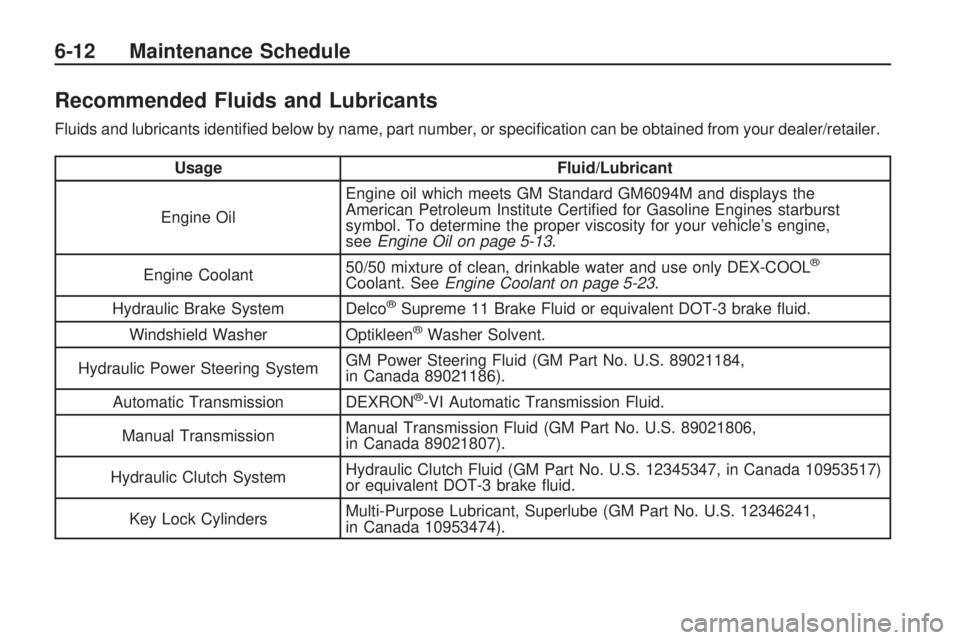
Recommended Fluids and Lubricants
Fluids and lubricants identied below by name, part number, or specication can be obtained from your dealer/retailer.
UsageFluid/Lubricant
Engine Oil Engine oil which meets GM Standard GM6094M and displays the
American Petroleum Institute Certied for Gasoline Engines starburst
symbol. To determine the proper viscosity for your vehicle’s engine,
see
Engine Oil on page 5-13 .
Engine Coolant 50/50 mixture of clean, drinkable water and use only DEX-COOL
®
Coolant. See
Engine Coolant on page 5-23 .
Hydraulic Brake System Delco
®Supreme 11 Brake Fluid or equivalent DOT-3 brake uid.
Windshield Washer Optikleen
®Washer Solvent.
Hydraulic Power Steering System GM Power Steering Fluid (GM Part No. U.S. 89021184,
in Canada 89021186).
Automatic Transmission DEXRON
®-VI Automatic Transmission Fluid.
Manual Transmission Manual Transmission Fluid (GM Part No. U.S. 89021806,
in Canada 89021807).
Hydraulic Clutch System Hydraulic Clutch Fluid (GM Part No. U.S. 12345347, in Canada 10953517)
or equivalent DOT-3 brake uid.
Key Lock Cylinders Multi-Purpose Lubricant, Superlube (GM Part No. U.S. 12346241,
in Canada 10953474).
6-12 Maintenance Schedule
Page 374 of 382
Driving (cont.)
Hill and Mountain Roads....4-30
In Rain and on
Wet Roads...................4-29
Off-Road .........................4-13
Recovery Loops...............4-34
Rocking Your Vehicle to
Get it Out ....................4-34
Winter.............................4-31
Driving for Better Fuel
Economy........................... 4-1
E
EDR ..................................7-16
Electrical System
Add-On Equipment............5-91
Engine Compartment Fuse
Block...........................5-92
Fuses and Circuit
Breakers......................5-91
Power Windows and Other
Power Options..............5-91
Windshield Wiper Fuses....5-91
Electronic Immobilizer
PASS-Key
®III+................2-13Electronic Immobilizer
Operation
PASS-Key
®III+................2-14
Engine
Air Cleaner/Filter...............5-17
Check and Service Engine
Soon Lamp..................3-30
Coolant...........................5-23
Coolant Heater.................2-19
Coolant
Temperature Gage.........3-29
Drive Belt Routing.............6-15
Engine Compartment
Overview......................5-10
Exhaust...........................2-31
Fan Noise.......................5-28
Oil ..................................5-13
Oil Life System.................5-15
Overheating.....................5-27
Starting...........................2-17
Event Data Recorders..........7-16
Exit Lighting........................3-16
Extender, Safety Belt............1-25
Exterior Lamps....................3-11
F
Filter
Engine Air Cleaner............5-17
Finish Damage....................5-89
Fixed Mast Antenna.............3-63
Flashers, Hazard Warning....... 3-5
Flash-to-Pass........................ 3-7
Flat Tire..............................5-66
Flat Tire, Changing...............5-66
Flat Tire, Storing..........5-78, 5-80
Fluid
Automatic Transmission.....5-18
Power Steering.................5-29
Windshield Washer...........5-30
Fog Lamp
Fog ................................3-15
Four-Wheel Drive.................5-38
Four-Wheel Drive,
Full-Time.........................2-24
Front Axle...........................5-39
Front Seat Storage Net.........2-47
Fuel..................................... 5-5
Additives........................... 5-6
California Fuel................... 5-5
Driving for Better
Economy....................... 4-1
i-4 INDEX
Page 378 of 382
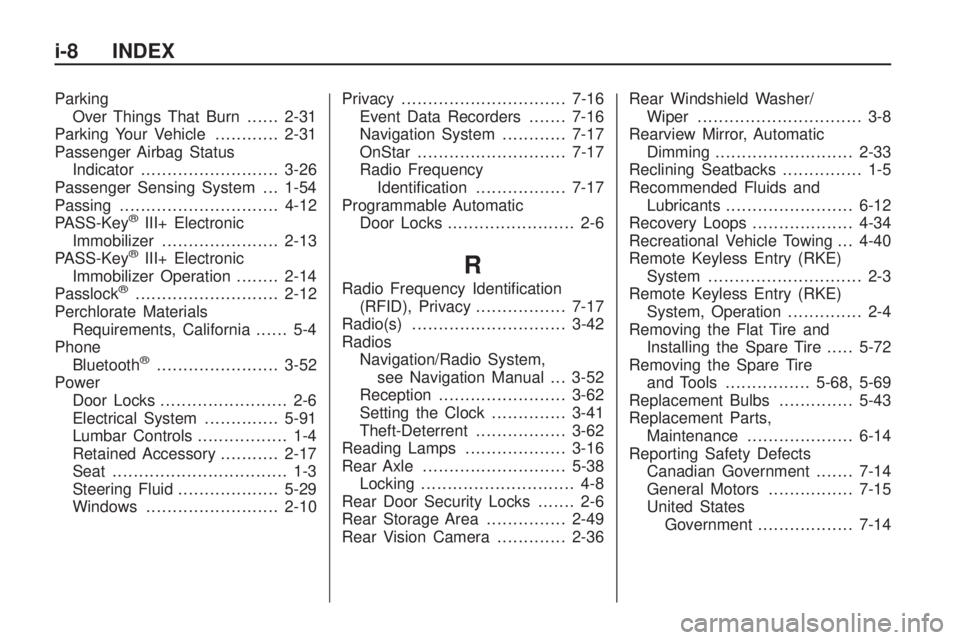
Parking
Over Things That Burn......2-31
Parking Your Vehicle............2-31
Passenger Airbag Status
Indicator..........................3-26
Passenger Sensing System . . . 1-54
Passing..............................4-12
PASS-Key
®III+ Electronic
Immobilizer......................2-13
PASS-Key
®III+ Electronic
Immobilizer Operation........2-14
Passlock
®...........................2-12
Perchlorate Materials
Requirements, California...... 5-4
Phone
Bluetooth
®.......................3-52
Power
Door Locks........................ 2-6
Electrical System..............5-91
Lumbar Controls................. 1-4
Retained Accessory...........2-17
Seat................................. 1-3
Steering Fluid...................5-29
Windows.........................2-10Privacy...............................7-16
Event Data Recorders.......7-16
Navigation System............7-17
OnStar............................7-17
Radio Frequency
Identication.................7-17
Programmable Automatic
Door Locks........................ 2-6
R
Radio Frequency Identication
(RFID), Privacy.................7-17
Radio(s).............................3-42
Radios
Navigation/Radio System,
see Navigation Manual . . . 3-52
Reception........................3-62
Setting the Clock..............3-41
Theft-Deterrent.................3-62
Reading Lamps...................3-16
Rear Axle...........................5-38
Locking............................. 4-8
Rear Door Security Locks....... 2-6
Rear Storage Area...............2-49
Rear Vision Camera.............2-36Rear Windshield Washer/
Wiper............................... 3-8
Rearview Mirror, Automatic
Dimming ..........................2-33
Reclining Seatbacks............... 1-5
Recommended Fluids and
Lubricants........................6-12
Recovery Loops...................4-34
Recreational Vehicle Towing . . . 4-40
Remote Keyless Entry (RKE)
System............................. 2-3
Remote Keyless Entry (RKE)
System, Operation.............. 2-4
Removing the Flat Tire and
Installing the Spare Tire.....5-72
Removing the Spare Tire
and Tools................5-68, 5-69
Replacement Bulbs..............5-43
Replacement Parts,
Maintenance....................6-14
Reporting Safety Defects
Canadian Government.......7-14
General Motors................7-15
United States
Government..................7-14
i-8 INDEX