automatic transmission HUMMER H3 2009 Owner's Manual
[x] Cancel search | Manufacturer: HUMMER, Model Year: 2009, Model line: H3, Model: HUMMER H3 2009Pages: 382, PDF Size: 1.99 MB
Page 204 of 382
Do not continue if the vehicle
shudders or exhibits suspension
hopping. This can cause
damage to the driveline or
suspension components.
Improper driving technique is not
covered by the vehicle warranty.
{CAUTION
Turning or driving across steep
hills can be dangerous. You could
lose traction, slide sideways, and
possibly roll over. You could be
seriously injured or killed. When
driving up hills, always try to go
straight up.
Try to drive straight up the hill if
at all possible. If the path twists
and turns, you might want to
nd another route.
Ease up on the speed as you
approach the top of the hill.
Attach a ag to the vehicle to be
more visible to approaching
traffic on trails or hills.
Sound the horn as you approach
the top of the hill to let opposing
traffic know you are there.
Use headlamps even during the
day to make the vehicle more
visible to oncoming traffic.
{CAUTION
Driving to the top (crest) of a hill
at full speed can cause an
accident. There could be a
drop-off, embankment, cliff, or
even another vehicle. You could
be seriously injured or killed. As
you near the top of a hill, slow
down and stay alert.If the vehicle stalls, or is about to
stall, and you cannot make it up
the hill:
Push the brake pedal to stop the
vehicle and keep it from rolling
backwards and apply the parking
brake.
If the engine is still running, shift
the transmission to R (Reverse),
release the parking brake,
and slowly back down the hill in
R (Reverse).
If the engine has stopped
running, you need to restart
it. With the brake pedal
pressed, apply the parking
brake. If the vehicle has an
automatic transmission, shift the
transmission to P (Park).
Restart the engine. Then, shift to
R (Reverse), release the
parking brake, and slowly back
down the hill as straight as
possible in R (Reverse).
4-22 Driving Your Vehicle
Page 205 of 382
While backing down the hill, put
your left hand on the steering
wheel at the 12 o’clock position
so you can tell if the wheels
are straight and can maneuver
as you back down. It is best
to back down the hill with
the wheels straight rather than
in the left or right direction.
Turning the wheel too far to the
left or right will increase the
possibility of a rollover.
Things not to do if the vehicle stalls,
or is about to stall, when going
up a hill:
Never attempt to prevent a stall
by shifting into N (Neutral) to
rev-up the engine and regain
forward momentum. This will
not work. The vehicle can
roll backward very quickly and
could go out of control.
Never try to turn around if about
to stall when going up a hill. If
the hill is steep enough to
stall the vehicle, it is steep
enough to cause it to roll over. If
you cannot make it up the hill,
back straight down the hill.
If, after stalling, you try to back
down the hill and decide you just
cannot do it, set the parking brake.
If the vehicle has an automatic
transmission, shift to P (Park). Turn
off the engine. Leave the vehicle
and go get some help. Exit on
the uphill side and stay clear of the
path the vehicle would take if it
rolled downhill. Do not shift
the transfer case to Neutral when
you leave the vehicle. Leave it
in some gear.{CAUTION
Shifting the transfer case to
Neutral can cause your vehicle to
roll even if the transmission is in
P (Park). This is because the
Neutral position on the transfer
case overrides the transmission.
You or someone else could be
injured. If you are going to leave
your vehicle, set the parking
brake and shift the transmission
to P (Park). But do not shift the
transfer case to Neutral.
Driving Your Vehicle 4-23
Page 206 of 382
Driving Downhill
When off-roading takes you
downhill, consider:
How steep is the downhill? Will I
be able to maintain vehicle
control?
What is the surface like?
Smooth? Rough? Slippery?
Hard-packed dirt? Gravel?
Are there hidden surface
obstacles? Ruts? Logs?
Boulders?
What is at the bottom of the hill?
Is there a hidden creek bank or
even a river bottom with large
rocks?
If you decide you can go down a hill
safely, try to keep the vehicle
headed straight down. Use a low
gear so engine drag can help
the brakes so they do not have to
do all the work. Descend slowly,
keeping the vehicle under control at
all times.
{CAUTION
Heavy braking when going down
a hill can cause your brakes to
overheat and fade. This could
cause loss of control and a
serious accident. Apply the brakes
lightly when descending a hill and
use a low gear to keep vehicle
speed under control.
Things not to do when driving down
a hill:
When driving downhill, avoid
turns that take you across
the incline of the hill. A hill that
is not too steep to drive down
might be too steep to drive
across. The vehicle could
roll over.
Never go downhill with the
transmission in N (Neutral), called
free-wheeling. The brakes will
have to do all the work and could
overheat and fade.Vehicles are much more likely to
stall when going uphill, but if it
happens when going downhill:
1. Stop the vehicle by applying the
regular brakes and apply the
parking brake.
2. With an automatic transmission,
shift to P (Park). While still
braking, restart the engine.
3. Shift back to a low gear, release
the parking brake, and drive
straight down.
4. If the engine will not start, get
out and get help.
4-24 Driving Your Vehicle
Page 223 of 382
Use the following procedure to tow
the vehicle:
1. Put the transmission in P (Park)
for an automatic transmission or
in 1 (First) for a manual
transmission.
2. Turn the engine off, but leave the
ignition in ACC/ACCESSORY.
3. Firmly set the parking brake.
4. Securely attach the vehicle being
towed to the tow vehicle.
{CAUTION
Shifting a full-time
four-wheel-drive vehicle’s
transfer case into N (Neutral)
can cause the vehicle to roll
even if the automatic transmission
is in P (Park) or the manual
transmission is in any gear. You
or others could be injured. Make
sure the parking brake is rmly
set before the transfer case is
shifted to N (Neutral).5. Shift the transfer case to
N (Neutral). SeeFull-Time
Four-Wheel Drive on page 2-24
for the proper procedure to
select the N (Neutral) position for
the vehicle.
6. Release the parking brake only
after the vehicle being towed is
rmly attached to the tow vehicle.
7. Make sure the ignition is in
ACC/ACCESSORY.
When towing the vehicle for
extended periods of time, start the
vehicle as often as possible to
prevent battery drain. This should
only be done when the tow
vehicle is parked.
After towing, see “Shifting Out of
NEUTRAL” underFull-Time
Four-Wheel Drive on page 2-24.
Dolly Towing
Notice:Dolly towing the vehicle
will damage drivetrain
components. Do not dolly tow the
vehicle.
The vehicle cannot be dolly towed.
If the vehicle must be towed
behind another vehicle, use the
dinghy towing procedure explained
previously.
Driving Your Vehicle 4-41
Page 225 of 382
Do not tow a trailer at all during
the rst 500 miles (800 km) the
new vehicle is driven. The
engine, axle or other parts could
be damaged.
Then, during the rst 500 miles
(800 km) that a trailer is towed,
do not drive over 50 mph
(80 km/h) and do not make starts
at full throttle. This helps the
engine and other parts of
the vehicle wear in at the
heavier loads.
Vehicles with an automatic
transmissions can tow in
D (Drive). Shift the transmission
to a lower gear if the
transmission shifts too often
under heavy loads and/or hilly
conditions. For vehicles with
a manual transmission, it is better
not to use the highest gear.
This vehicle has a Hill Start
Assist feature, which may
be useful when the vehicle is
stopped on a grade. SeeBraking
on page 4-3for more information.
Three important considerations have
to do with weight:
The weight of the trailer
The weight of the trailer tongue
The weight on the vehicle’s tires
Weight of the Trailer
How heavy can a trailer safely be?
It depends on how the rig is
used. For example, speed, altitude,
road grades, outside temperature
and how much the vehicle is used to
pull a trailer are all important. It
can depend on any special
equipment on the vehicle, and the
amount of tongue weight the vehicle
can carry. See “Weight of the
Trailer Tongue” later in this section
for more information.
Driving Your Vehicle 4-43
Page 226 of 382
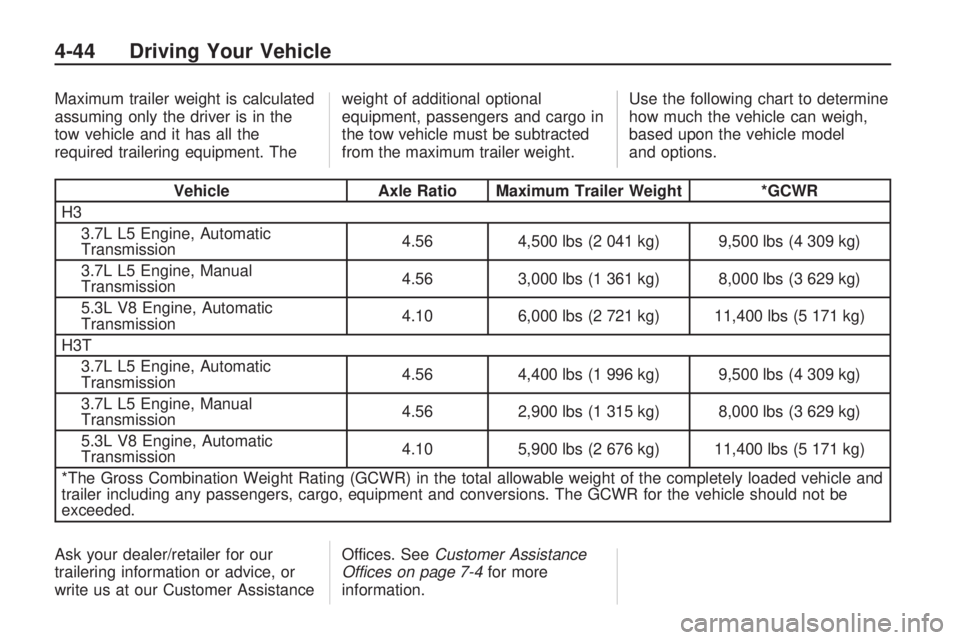
Maximum trailer weight is calculated
assuming only the driver is in the
tow vehicle and it has all the
required trailering equipment. Theweight of additional optional
equipment, passengers and cargo in
the tow vehicle must be subtracted
from the maximum trailer weight.Use the following chart to determine
how much the vehicle can weigh,
based upon the vehicle model
and options.
Vehicle
Axle Ratio Maximum Trailer Weight *GCWR
H3 3.7L L5 Engine, Automatic
Transmission 4.56
4,500 lbs (2 041 kg) 9,500 lbs (4 309 kg)
3.7L L5 Engine, Manual
Transmission 4.56
3,000 lbs (1 361 kg) 8,000 lbs (3 629 kg)
5.3L V8 Engine, Automatic
Transmission 4.10
6,000 lbs (2 721 kg) 11,400 lbs (5 171 kg)
H3T 3.7L L5 Engine, Automatic
Transmission 4.56
4,400 lbs (1 996 kg) 9,500 lbs (4 309 kg)
3.7L L5 Engine, Manual
Transmission 4.56
2,900 lbs (1 315 kg) 8,000 lbs (3 629 kg)
5.3L V8 Engine, Automatic
Transmission 4.10
5,900 lbs (2 676 kg) 11,400 lbs (5 171 kg)
*The Gross Combination Weight Rating (GCWR) in the total allowable weight of the completely loaded vehicle and
trailer including any passengers, cargo, equipment and conversions. The GCWR for the vehicle should not be
exceeded.
Ask your dealer/retailer for our
trailering information or advice, or
write us at our Customer Assistance Offices. See
Customer Assistance
Offices on page 7-4 for more
information.
4-44 Driving Your Vehicle
Page 231 of 382
Making Turns
Notice:Making very sharp turns
while trailering could cause
the trailer to come in contact with
the vehicle. The vehicle could
be damaged. Avoid making very
sharp turns while trailering.
When turning with a trailer, make
wider turns than normal. Do this
so the trailer won’t strike soft
shoulders, curbs, road signs, trees
or other objects. Avoid jerky or
sudden maneuvers. Signal well in
advance.
Turn Signals When Towing a
Trailer
The arrows on the instrument panel
ash whenever signaling a turn
or lane change. Properly hooked up,
the trailer lamps also ash, telling
other drivers the vehicle is turning,
changing lanes or stopping.When towing a trailer, the arrows
on the instrument panel ash
for turns even if the bulbs on the
trailer are burned out. For this
reason you may think other drivers
are seeing the signal when they
are not. It is important to check
occasionally to be sure the trailer
bulbs are still working.
Driving On Grades
Reduce speed and shift to a lower
gearbeforestarting down a long
or steep downgrade. If the
transmission is not shifted down, the
brakes might have to be used so
much that they would get hot and no
longer work well.
Vehicles with an automatic
transmission can tow in D (Drive).
Shift the transmission to a lower
gear if the transmission shifts
too often under heavy loads and/or
hilly conditions. For vehicles with
a manual transmission, it is
better not to use the highest gear.When towing at high altitude on
steep uphill grades, consider
the following: Engine coolant will
boil at a lower temperature than at
normal altitudes. If the engine is
turned off immediately after towing
at high altitude on steep uphill
grades, the vehicle may show signs
similar to engine overheating. To
avoid this, let the engine run
while parked, preferably on level
ground, with the automatic
transmission in P (Park) for a
few minutes before turning the
engine off. For vehicles with manual
transmissions, let the engine run
while parked, preferably on
level ground, with the transmission
out of gear and the parking
brake applied, for a few minutes
before turning the engine off. If the
overheat warning comes on,
seeEngine Overheating on
page 5-27.
Driving Your Vehicle 4-49
Page 232 of 382
Parking on Hills
{CAUTION
Parking the vehicle on a hill with
the trailer attached can be
dangerous. If something goes
wrong, the rig could start to move.
People can be injured, and both
the vehicle and the trailer can be
damaged. When possible, always
park the rig on a at surface.
If parking the rig on a hill:
1. Press the brake pedal, but do
not shift into P (Park) yet for
vehicles with an automatic
transmission, or into gear for
vehicles with a manual
transmission. Turn the wheels
into the curb if facing downhill or
into traffic if facing uphill.2. Have someone place chocks
under the trailer wheels.
3. When the wheel chocks are in
place, release the brake pedal
until the chocks absorb the load.
4. Reapply the brake pedal.
Then apply the parking brake and
shift into P (Park) for vehicles
with an automatic transmission or
into gear for vehicles with a
manual transmission.
5. Release the brake pedal.
Leaving After Parking on
a Hill
The vehicle has a Hill Start Assist
feature, which may be useful
when stopped on a grade. See
Braking on page 4-3for more
information.
1. Apply and hold the brake pedal
while you:
start the engine,
shift into a gear, and
release the parking brake.
2. Let up on the brake pedal.
3. Drive slowly until the trailer is
clear of the chocks.
4. Stop and have someone pick up
and store the chocks.
4-50 Driving Your Vehicle
Page 233 of 382
Maintenance When Trailer
Towing
The vehicle needs service more
often when pulling a trailer. See this
manual’s Maintenance Schedule
or Index for more information.
Things that are especially important
in trailer operation are automatic
transmission uid, engine oil,
axle lubricant, belts, cooling system
and brake system. It is a good
idea to inspect these before and
during the trip.
Check periodically to see that all
hitch nuts and bolts are tight.
Trailer Wiring Harness
Light-Duty Trailer Wiring Package
If the vehicle does not have a
trailer towing package, the chassis
harness will contain the following
blunt cut circuits:
Yellow: Left Stop/Turn Signal
Dark Green: Right Stop/Turn
Signal
White: Ground
Brown: Tail Lamps
To add a trailer towing wiring
package, have it installed by your
dealer/retailer or a qualied
service center. Also, seeAdd-On
Electrical Equipment on page 5-91
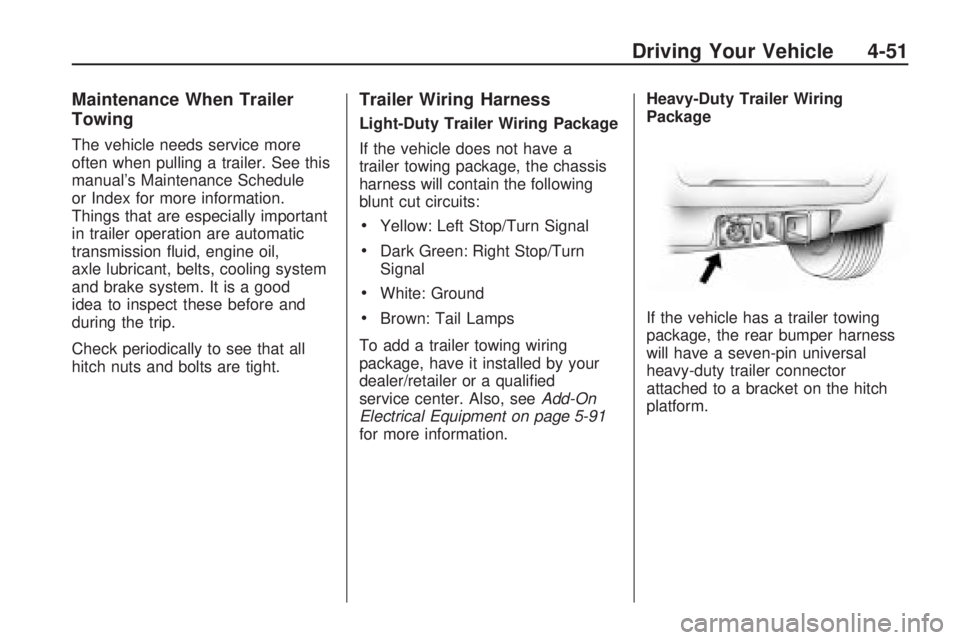
for more information.Heavy-Duty Trailer Wiring
Package
If the vehicle has a trailer towing
package, the rear bumper harness
will have a seven-pin universal
heavy-duty trailer connector
attached to a bracket on the hitch
platform.
Driving Your Vehicle 4-51
Page 237 of 382
Service and
Appearance Care
Service
Service...............................5-3
Accessories and
Modications.....................5-3
California Proposition
65 Warning.......................5-4
California Perchlorate
Materials Requirements.....5-4
Doing Your Own
Service Work....................5-4
Adding Equipment to the
Outside of the Vehicle........5-5
Fuel
Fuel....................................5-5
Gasoline Octane.................5-5
Gasoline Specications.......5-5
California Fuel....................5-5
Additives.............................5-6
Fuels in Foreign
Countries..........................5-7
Filling the Tank...................5-7
Filling a Portable Fuel
Container..........................5-8
Checking Things Under
the Hood
Checking Things Under
the Hood..........................5-9
Hood Release.....................5-9
Engine Compartment
Overview.........................5-10
Engine Oil.........................5-13
Engine Oil Life System.....5-15
Engine Air Cleaner/Filter. . .5-17
Automatic Transmission
Fluid................................5-18
Manual Transmission
Fluid................................5-20
Hydraulic Clutch................5-21
Cooling System.................5-22
Engine Coolant.................5-23
Engine Overheating...........5-27
Engine Fan Noise.............5-28
Power Steering Fluid.........5-29
Windshield Washer Fluid. . .5-30
Brakes..............................5-30
Battery..............................5-33
Jump Starting...................5-34
Rear Axle
Rear Axle.........................5-38
Four-Wheel Drive
Four-Wheel Drive..............5-38
Front Axle
Front Axle.........................5-39
Headlamp Aiming
Headlamp Aiming..............5-39
Bulb Replacement
Bulb Replacement.............5-41
Halogen Bulbs..................5-41
Headlamps........................5-41
Taillamps, Turn Signal,
Stoplamps and Back-up
Lamps (H3)
.....................5-42
Taillamps, Turn Signal,
Stoplamps and Back-up
Lamps (H3T)
...................5-42
License Plate Lamp..........5-43
Replacement Bulbs...........5-43
Service and Appearance Care 5-1