steering HUMMER H3 2009 Owner's Manual
[x] Cancel search | Manufacturer: HUMMER, Model Year: 2009, Model line: H3, Model: HUMMER H3 2009Pages: 382, PDF Size: 1.99 MB
Page 208 of 382
Stalling on an Incline
{CAUTION
Getting out on the downhill (low)
side of a vehicle stopped across
an incline is dangerous. If the
vehicle rolls over, you could be
crushed or killed. Always get out
on the uphill (high) side of the
vehicle and stay well clear of the
rollover path.
If the vehicle stalls when crossing
an incline, be sure you, and
any passengers, get out on the
uphill side, even if the door there is
harder to open. If you get out on
the downhill side and the vehicle
starts to roll over, you will be right in
its path.
If you have to walk down the slope,
stay out of the path the vehicle
will take if it does roll over.
Driving in Mud, Sand, Snow,
or Ice
When you drive in mud, snow, or
sand, the wheels do not get good
traction. Acceleration is not as quick,
turning is more difficult, and braking
distances are longer.
It is best to use a low gear when in
mud — the deeper the mud, the
lower the gear. In really deep mud,
keep the vehicle moving so it
does not get stuck.
When driving on sand, wheel
traction changes. On loosely packed
sand, such as on beaches or
sand dunes, the tires will tend to
sink into the sand. This affects
steering, accelerating, and braking.
Drive at a reduced speed and
avoid sharp turns or abrupt
maneuvers.Hard packed snow and ice offer the
worst tire traction. On these surfaces,
it is very easy to lose control. On wet
ice, for example, the traction is so
poor that you will have difficulty
accelerating. And, if the vehicle does
get moving, poor steering and
difficult braking can cause it to slide
out of control.
{CAUTION
Driving on frozen lakes, ponds, or
rivers can be dangerous.
Underwater springs, currents
under the ice, or sudden thaws
can weaken the ice. Your vehicle
could fall through the ice and you
and your passengers could
drown. Drive your vehicle on safe
surfaces only.
4-26 Driving Your Vehicle
Page 209 of 382
Driving in Water
{CAUTION
Driving through rushing water can
be dangerous. Deep water can
sweep your vehicle downstream
and you and your passengers
could drown. If it is only shallow
water, it can still wash away the
ground from under your tires, and
you could lose traction and roll
the vehicle over. Do not drive
through rushing water.
Heavy rain can mean ash ooding,
and ood waters demand extreme
caution.Find out how deep the water is
before driving through it. Do not
try it if it is deep enough to cover
the wheel hubs, axles, or exhaust
pipe — you probably will not get
through. Deep water can damage the
axle and other vehicle parts. The
vehicle is capable of depths up to
20 inches (50 cm). Know how to
judge whether the water is deeper
than this before proceeding into it.
If the water is not too deep, drive
slowly through it. At faster speeds,
water splashes on the ignition
system and the vehicle can stall.
Stalling can also occur if you get the
tailpipe under water. If the tailpipe
is under water, you will never
be able to start the engine. When
going through water, remember that
when the brakes get wet, it might
take longer to stop. SeeDriving
in Rain and on Wet Roads on
page 4-29.
After Off-Road Driving
Remove any brush or debris that
has collected on the underbody,
chassis, or under the hood. These
accumulations can be a re hazard.
After operation in mud or sand,
have the brake linings cleaned and
checked. These substances can
cause glazing and uneven braking.
Check the engine and oil coolers
for mud accumulation. Thoroughly
and carefully clean these devices to
allow proper cooling. Check the
body structure, steering, suspension,
wheels, tires, and exhaust system
for damage and check the fuel lines
and cooling system for any
leakage.
The vehicle requires more frequent
service due to off-road use.
Refer to the Maintenance Schedule
for additional information.
Driving Your Vehicle 4-27
Page 214 of 382
Allow greater following distance on
any slippery road and watch for
slippery spots. Icy patches
can occur on otherwise clear roads
in shaded areas. The surface of
a curve or an overpass can remain
icy when the surrounding roads
are clear. Avoid sudden steering
maneuvers and braking while on ice.
Turn off cruise control, if equipped,
on slippery surfaces.
Blizzard Conditions
Being stuck in snow can be in a
serious situation. Stay with the
vehicle unless there is help nearby.
If possible, use theRoadside
Service on page 7-6. To get help
and keep everyone in the vehicle
safe:
Turn on theHazard Warning
Flashers on page 3-5.
Tie a red cloth to an outside
mirror.
{CAUTION
Snow can trap engine exhaust
under the vehicle. This may cause
exhaust gases to get inside.
Engine exhaust contains carbon
monoxide (CO) which cannot be
seen or smelled. It can cause
unconsciousness and even death.
If the vehicle is stuck in the snow:
Clear away snow from
around the base of your
vehicle, especially any that is
blocking the exhaust pipe.
Check again from time to
time to be sure snow does
not collect there.
Open a window about two
inches (5 cm) on the side of
the vehicle that is away from
the wind to bring in fresh air.
Fully open the air outlets on
or under the instrument
panel.
(Continued)
CAUTION (Continued)
Adjust the Climate Control
system to a setting that
circulates the air inside the
vehicle and set the fan speed
to the highest setting. See
Climate Control System in the
Index.
For more information about
carbon monoxide, seeEngine
Exhaust on page 2-31.
Snow can trap exhaust gases
under your vehicle. This can
cause deadly CO (carbon
monoxide) gas to get inside. CO
could overcome you and kill you.
You cannot see it or smell it, so
you might not know it is in your
vehicle. Clear away snow from
around the base of your vehicle,
especially any that is blocking the
exhaust.
4-32 Driving Your Vehicle
Page 216 of 382
Rocking Your Vehicle to
Get It Out
Turn the steering wheel left and
right to clear the area around
the front wheels. The traction control
system activates when the system
senses that the wheels are spinning.
Turn off any traction or stability
system. With the wheels straight
ahead, shift back and forth between
R (Reverse) and a forward gear,
or with a manual transmission,
between 1 (First) or 2 (Second) and
R (Reverse), spinning the wheels
as little as possible. To prevent
transmission wear, wait until
the wheels stop spinning before
shifting gears. Release the
accelerator pedal while shifting, and
press lightly on the accelerator
pedal when the transmission is in
gear. Slowly spinning the wheels in
the forward and reverse directions
causes a rocking motion that
could free the vehicle. If that does
not get the vehicle out after a
few tries, it might need to be towed
out. The recovery loops can beused. If the vehicle does need to be
towed out, seeTowing Your
Vehicle on page 4-40.
Recovery Loops
{CAUTION
These loops, when used, are
under a lot of force. Keep people
away from the vicinity of the loops
and any chains or cables during
use. Always pull the vehicle
straight out. Never pull on the
loops at a sideways angle. The
loops could break off and you or
others could be injured from the
chain or cable snapping back.
Notice:Never use the recovery
loops to tow the vehicle. Your
vehicle could be damaged and it
would not be covered by
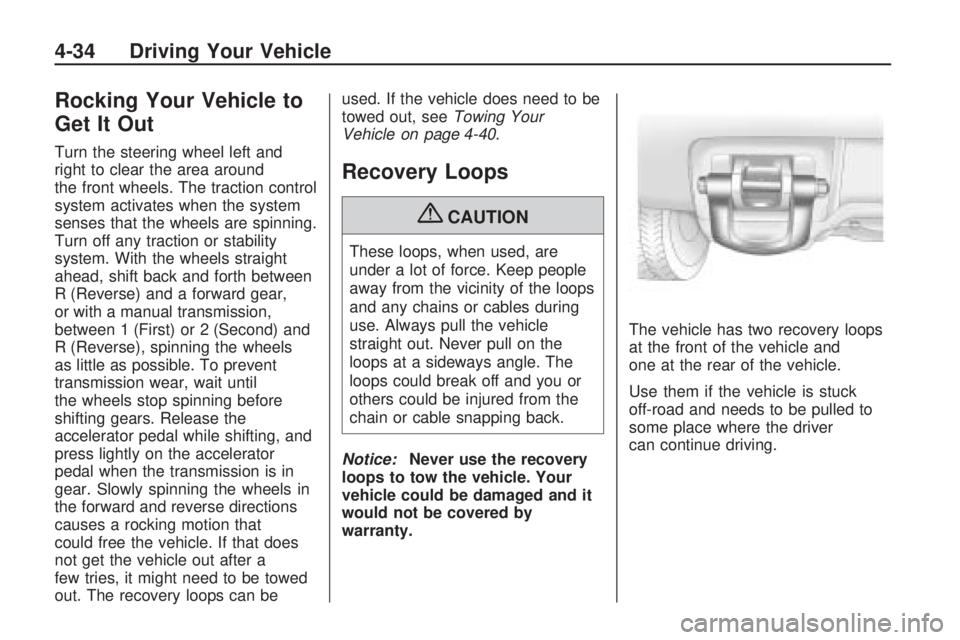
warranty.The vehicle has two recovery loops
at the front of the vehicle and
one at the rear of the vehicle.
Use them if the vehicle is stuck
off-road and needs to be pulled to
some place where the driver
can continue driving.
4-34 Driving Your Vehicle
Page 230 of 382
Safety Chains
Always attach chains between the
vehicle and the trailer. Cross
the safety chains under the tongue
of the trailer to help prevent the
tongue from contacting the road if it
becomes separated from the
hitch. Always leave just enough
slack so the rig can turn. Never
allow safety chains to drag on the
ground.
Trailer Brakes
A loaded trailer that weighs more
than 1,500 lbs (680 kg) needs
to have its own brake system that is
adequate for the weight of the
trailer. Be sure to read and follow
the instructions for the trailer brakes
so they are installed, adjusted
and maintained properly.
Driving with a Trailer
Towing a trailer requires a certain
amount of experience. Get to
know the rig before setting out for
the open road. Get acquainted
with the feel of handling and braking
with the added weight of the
trailer. And always keep in mind that
the vehicle you are driving is now
longer and not as responsive as the
vehicle is by itself.
Before starting, check all trailer hitch
parts and attachments, safety
chains, electrical connectors, lamps,
tires and mirror adjustments. If
the trailer has electric brakes, start
the vehicle and trailer moving
and then apply the trailer brake
controller by hand to be sure
the brakes are working. This checks
the electrical connection at the
same time.
During the trip, check occasionally
to be sure that the load is secure,
and that the lamps and any
trailer brakes are still working.
Following Distance
Stay at least twice as far behind
the vehicle ahead as you would
when driving the vehicle without a
trailer. This can help to avoid
situations that require heavy braking
and sudden turns.
Passing
More passing distance is needed
when towing a trailer. Because
the rig is longer, it is necessary to
go much farther beyond the
passed vehicle before returning to
the lane.
Backing Up
Hold the bottom of the steering
wheel with one hand. Then, to move
the trailer to the left, move that
hand to the left. To move the trailer
to the right, move your hand to
the right. Always back up slowly
and, if possible, have someone
guide you.
4-48 Driving Your Vehicle
Page 235 of 382
Trailer Brake Control Wiring
Harness
The trailer brake control wiring
harness is located under the
instrument panel to the right of the
steering column. The wires are
taped to the harness that goes to
the courtesy light under the
instrument panel. The harness has
the following wires:
Red Wire: AUX B+
Black Wire: Ground
Light Blue Wire: Brake Signal
Dark Blue Wire: Trailer Brakes
Trailer Recommendations
Subtract the hitch loads from the
Cargo Weight Rating (CWR). CWR
is the maximum weight of the
load the vehicle can carry. It does
not include the weight of the people
inside, but you can gure about
150 lbs. (68 kg) for each passenger.
The total cargo load must not be
more than the vehicles CWR.
Weigh the vehicle with the trailer
attached, so the GVWR or GAWR
are not exceeded. If using a
weight-distributing hitch, weigh the
vehicle without the spring bars
in place.
The best performance is obtained
by correctly spreading out the weight
of the load and choosing the
correct hitch and trailer brakes.
For more information seeTowing a
Trailer on page 4-42.
Driving Your Vehicle 4-53
Page 237 of 382
Service and
Appearance Care
Service
Service...............................5-3
Accessories and
Modications.....................5-3
California Proposition
65 Warning.......................5-4
California Perchlorate
Materials Requirements.....5-4
Doing Your Own
Service Work....................5-4
Adding Equipment to the
Outside of the Vehicle........5-5
Fuel
Fuel....................................5-5
Gasoline Octane.................5-5
Gasoline Specications.......5-5
California Fuel....................5-5
Additives.............................5-6
Fuels in Foreign
Countries..........................5-7
Filling the Tank...................5-7
Filling a Portable Fuel
Container..........................5-8
Checking Things Under
the Hood
Checking Things Under
the Hood..........................5-9
Hood Release.....................5-9
Engine Compartment
Overview.........................5-10
Engine Oil.........................5-13
Engine Oil Life System.....5-15
Engine Air Cleaner/Filter. . .5-17
Automatic Transmission
Fluid................................5-18
Manual Transmission
Fluid................................5-20
Hydraulic Clutch................5-21
Cooling System.................5-22
Engine Coolant.................5-23
Engine Overheating...........5-27
Engine Fan Noise.............5-28
Power Steering Fluid.........5-29
Windshield Washer Fluid. . .5-30
Brakes..............................5-30
Battery..............................5-33
Jump Starting...................5-34
Rear Axle
Rear Axle.........................5-38
Four-Wheel Drive
Four-Wheel Drive..............5-38
Front Axle
Front Axle.........................5-39
Headlamp Aiming
Headlamp Aiming..............5-39
Bulb Replacement
Bulb Replacement.............5-41
Halogen Bulbs..................5-41
Headlamps........................5-41
Taillamps, Turn Signal,
Stoplamps and Back-up
Lamps (H3)
.....................5-42
Taillamps, Turn Signal,
Stoplamps and Back-up
Lamps (H3T)
...................5-42
License Plate Lamp..........5-43
Replacement Bulbs...........5-43
Service and Appearance Care 5-1
Page 247 of 382
A. Windshield Washer Fluid
Reservoir. See “Adding Washer
Fluid” underWindshield
Washer Fluid on page 5-30.
B. Engine Coolant Recovery Tank.
SeeEngine Coolant on
page 5-23.
C.Engine Air Cleaner/Filter on
page 5-17.
D. Power Steering Fluid Reservoir.
SeePower Steering Fluid on
page 5-29.
E. Automatic Transmission Fluid
Dipstick (If Equipped). See
“Checking the Fluid Level”
underAutomatic Transmission
Fluid on page 5-18.
F. Engine Oil Fill Cap. See “When
to Add Engine Oil” under
Engine Oil on page 5-13.G. Radiator Pressure Cap.
SeeCooling System on
page 5-22.
H. Remote Negative (−) Terminal
(GND). SeeJump Starting on
page 5-34.
I. Engine Oil Dipstick. See
“Checking Engine Oil” under
Engine Oil on page 5-13.
J. Positive (+) Battery Terminal.
SeeJump Starting on
page 5-34.
K. Brake Fluid Reservoir.
See “Brake Fluid” under
Brakes on page 5-30.
L.Engine Compartment Fuse Block
on page 5-92.
M.Battery on page 5-33.
N. Hydraulic Clutch Fluid Reservoir
(If Equipped). SeeHydraulic
Clutch on page 5-21.
Service and Appearance Care 5-11
Page 249 of 382
A.Engine Air Cleaner/Filter on
page 5-17.
B. Air Filter Restriction Indicator
(If Equipped). SeeEngine Air
Cleaner/Filter on page 5-17.
C. Windshield Washer Fluid
Reservoir. See “Adding Washer
Fluid” underWindshield
Washer Fluid on page 5-30.
D. Engine Coolant Recovery Tank.
SeeEngine Coolant on
page 5-23.
E. Automatic Transmission
Fluid Dipstick (If Equipped).
See “Checking the Fluid Level”
underAutomatic Transmission
Fluid on page 5-18.
F. Engine Oil Dipstick. See
“Checking Engine Oil” under
Engine Oil on page 5-13.G. Engine Oil Fill Cap. See “When
to Add Engine Oil” underEngine
Oil on page 5-13.
H. Brake Fluid Reservoir.
See “Brake Fluid” underBrakes
on page 5-30.
I.Battery on page 5-33.
J. Power Steering Fluid Reservoir.
SeePower Steering Fluid on
page 5-29.
K.Engine Compartment Fuse Block
on page 5-92.
L. Radiator Pressure Cap.
SeeCooling System on
page 5-22.Engine Oil
Checking Engine Oil
It is a good idea to check the
engine oil every time you get fuel.
In order to get an accurate reading,
the oil must be warm and the
vehicle must be on level ground.
The engine oil dipstick handle
is a yellow loop. SeeEngine
Compartment Overview on
page 5-10for the location of the
engine oil dipstick.
1. Turn off the engine and give the
oil several minutes to drain back
into the oil pan. If you do not
do this, the oil dipstick might not
show the actual level.
2. Pull out the dipstick and clean it
with a paper towel or cloth,
then push it back in all the way.
Remove it again, keeping the
tip down, and check the level.
Service and Appearance Care 5-13
Page 265 of 382
Power Steering Fluid
SeeEngine Compartment Overview
on page 5-10for reservoir location.
When to Check Power
Steering Fluid
It is not necessary to regularly
check power steering uid unless a
leak in the system is suspected
or an unusual noise is heard. A uid
loss in this system could indicate
a problem. Have the system
inspected and repaired.
How to Check Power
Steering Fluid
1. Turn the key off and let the
engine compartment cool down.
2. Wipe the cap and the top of the
reservoir clean.
3. Unscrew the cap and wipe the
dipstick with a clean rag.
4. Replace the cap and completely
tighten it.
5. Then remove the cap again and
look at the uid level on the
dipstick.
The level should be between the
ADD and FULL marks. If necessary,
add only enough uid to bring the
level up to the proper range.
What to Use
To determine what kind of uid to
use, seeRecommended Fluids and
Lubricants on page 6-12. Always
use the proper uid.
Notice:Use of the incorrect uid
may damage the vehicle and
the damages may not be covered
by the vehicle’s warranty.
Always use the correct uid
listed inRecommended Fluids
and Lubricants on page 6-12.
Service and Appearance Care 5-29