seats HUMMER H3 2009 Repair Manual
[x] Cancel search | Manufacturer: HUMMER, Model Year: 2009, Model line: H3, Model: HUMMER H3 2009Pages: 382, PDF Size: 1.99 MB
Page 64 of 382
Restraint System
Check
Checking the Restraint
Systems
Safety Belts
Now and then, check the safety
belt reminder light, safety belts,
buckles, latch plates, retractors, and
anchorages are all working properly.
Look for any other loose or damaged
safety belt system parts that might
keep a safety belt system from doing
its job. See your dealer/retailer to
have it repaired. Torn or frayed
safety belts may not protect you in a
crash. They can rip apart under
impact forces. If a belt is torn or
frayed, get a new one right away.
Make sure the safety belt reminder
light is working. SeeSafety Belt
Reminders on page 3-24for more
information.Keep safety belts clean and dry.
SeeCare of Safety Belts on
page 5-85.
Airbags
The airbag system does not need
regularly scheduled maintenance
or replacement. Make sure the
airbag readiness light is working.
SeeAirbag Readiness Light
on page 3-25for more information.
Notice:If an airbag covering
is damaged, opened, or broken,
the airbag may not work properly.
Do not open or break the airbag
coverings. If there are any opened
or broken airbag covers, have
the airbag covering and/or airbag
module replaced. For the
location of the airbag modules,
seeWhat Makes an Airbag
Inflate? on page 1-52. See your
dealer/retailer for service.
Replacing Restraint
System Parts After a
Crash
{CAUTION
A crash can damage the
restraint systems in your vehicle.
A damaged restraint system may
not properly protect the person
using it, resulting in serious injury
or even death in a crash. To help
make sure your restraint systems
are working properly after a crash,
have them inspected and any
necessary replacements made
as soon as possible.
1-60 Seats and Restraint System
Page 65 of 382

If the vehicle has been in a crash, do
you need new safety belts or LATCH
system (if equipped) parts?
After a very minor crash, nothing
may be necessary. But the safety
belt assemblies that were used
during any crash may have been
stressed or damaged. See your
dealer/retailer to have the safety belt
assemblies inspected or replaced.
If the vehicle has the LATCH system
and it was being used during a
crash, you may need new LATCH
system parts.New parts and repairs may be
necessary even if the safety belt or
LATCH system (if equipped), was not
being used at the time of the crash.
If an airbag inates, you will need
to replace airbag system parts.
See the part on the airbag system
earlier in this section.
Have the safety belt pretensioners
checked if the vehicle has been in a
crash, if the airbag readiness light
stays on after the vehicle is started,
or while you are driving. SeeAirbag
Readiness Light on page 3-25.
Seats and Restraint System 1-61
Page 66 of 382

✍NOTES
1-62 Seats and Restraint System
Page 135 of 382
Electric Power
Management
The vehicle has Electric Power
Management (EPM) that estimates
the battery’s temperature and
state of charge. It then adjusts the
voltage for best performance
and extended life of the battery.
When the battery’s state of charge
is low, the voltage is raised
slightly to quickly bring the charge
back up. When the state of charge is
high, the voltage is lowered
slightly to prevent overcharging. If
the vehicle has a voltmeter gage or
a voltage display on the Driver
Information Center (DIC), you may
see the voltage move up or
down. This is normal. If there is a
problem, an alert will be displayed.
The battery can be discharged
at idle if the electrical loads are very
high. This is true for all vehicles.
This is because the generator
(alternator) may not be spinning fastenough at idle to produce all the
power that is needed for very high
electrical loads.
A high electrical load occurs when
several of the following are on, such
as: headlamps, high beams, fog
lamps, rear window defogger,
climate control fan at high speed,
heated seats, engine cooling fans,
trailer loads, and loads plugged into
accessory power outlets.
EPM works to prevent excessive
discharge of the battery. It does this
by balancing the generator’s
output and the vehicle’s electrical
needs. It can increase engine
idle speed to generate more power,
whenever needed. It can temporarily
reduce the power demands of
some accessories.
Normally, these actions occur in
steps or levels, without being
noticeable. In rare cases at the
highest levels of corrective action,this action may be noticeable to the
driver. If so, a Driver Information
Center (DIC) message might be
displayed, such as BATTERY
SAVER ACTIVE, BATTERY
VOLTAGE LOW, or LOW BATTERY.
If this message is displayed, it is
recommended that the driver reduce
the electrical loads as much as
possible. SeeDIC Warnings and
Messages on page 3-37.
Battery Run-Down
Protection
This feature shuts off the dome
lamp if it is left on for more
than 20 minutes when the ignition is
in LOCK/OFF. This helps to
prevent the battery from being
drained.
Instrument Panel 3-17
Page 139 of 382
Rear Window Defogger
The rear window defogger uses a
warming grid to remove fog or
frost from the rear window when the
key is in the ignition and turned
to ON/RUN.
=(Rear Defogger):Press to turn
the rear window defogger on or
off. After the button is rst pressed
the rear window defogger stays
on for about 15 minutes. If turned on
again, the defogger only runs for
about seven and one-half minutes.
Notice:Do not use anything
sharp on the inside of the rear
window. If you do, you could cut
or damage the warming grid, and
the repairs would not be covered
by the vehicle warranty. Do not
attach a temporary vehicle
license, tape, a decal or anything
similar to the defogger grid.
Outlet Adjustment
Use the air outlets located in the
center and on the side of the
instrument panel to direct the
airow.
This vehicle has air outlets that
allow you to adjust the direction and
amount of airow inside the
vehicle. Move the louvers up or
down to change the direction of the
airow. Use the thumbwheel
under the outlets to change the
direction of the airow from left
to right.Operation TipsUse the recirculation mode for
maximum air conditioning
performance.
Clear away any ice, snow or
leaves from the air inlets at
the base of the windshield that
may block the ow of air into the
vehicle.
Use of non-GM approved hood
deectors may adversely affect
the performance of the system.
Keep the path under the
front seats clear of objects to help
circulate the air inside of the
vehicle more effectively.
Instrument Panel 3-21
Page 221 of 382
Notice:Overloading your
vehicle may cause damage.
Repairs would not be covered
by your warranty. Do not
overload your vehicle.
If you put things inside your
vehicle – like suitcases, tools,
packages, or anything
else – they will go as fast as the
vehicle goes. If you have to
stop or turn quickly, or if there is
a crash, they will keep going.
{CAUTION
Things you put inside your
vehicle can strike and injure
people in a sudden stop or
turn, or in a crash.
Put things in the cargo
area of your vehicle. Try to
spread the weight evenly.
(Continued)
CAUTION (Continued)
Never stack heavier
things, like suitcases,
inside the vehicle so that
some of them are above
the tops of the seats.
Do not leave an
unsecured child restraint in
your vehicle.
When you carry something
inside the vehicle, secure
it whenever you can.
Do not leave a seat folded
down unless you need to.There is also important loading
information for off-road driving
in this manual. See
“Loading Your
Vehicle for Off-Road Driving”
underOff-Road Driving on
page 4-13.
Truck-Camper Loading
Information
Your vehicle was not designed
to carry a slide-in camper.
Driving Your Vehicle 4-39
Page 284 of 382
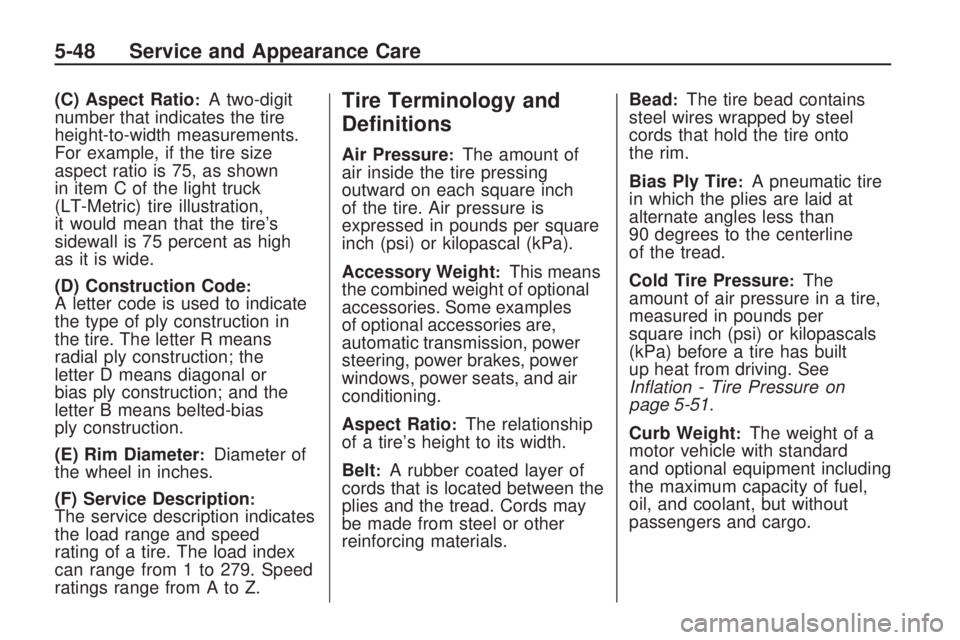
(C) Aspect Ratio:A two-digit
number that indicates the tire
height-to-width measurements.
For example, if the tire size
aspect ratio is 75, as shown
in item C of the light truck
(LT-Metric) tire illustration,
it would mean that the tire’s
sidewall is 75 percent as high
as it is wide.
(D) Construction Code
:A letter code is used to indicate
the type of ply construction in
the tire. The letter R means
radial ply construction; the
letter D means diagonal or
bias ply construction; and the
letter B means belted-bias
ply construction.
(E) Rim Diameter
:Diameter of
the wheel in inches.
(F) Service Description
:The service description indicates
the load range and speed
rating of a tire. The load index
can range from 1 to 279. Speed
ratings range from A to Z.
Tire Terminology and
Denitions
Air Pressure:The amount of
air inside the tire pressing
outward on each square inch
of the tire. Air pressure is
expressed in pounds per square
inch (psi) or kilopascal (kPa).
Accessory Weight
:This means
the combined weight of optional
accessories. Some examples
of optional accessories are,
automatic transmission, power
steering, power brakes, power
windows, power seats, and air
conditioning.
Aspect Ratio
:The relationship
of a tire’s height to its width.
Belt
:A rubber coated layer of
cords that is located between the
plies and the tread. Cords may
be made from steel or other
reinforcing materials.Bead
:The tire bead contains
steel wires wrapped by steel
cords that hold the tire onto
the rim.
Bias Ply Tire
:A pneumatic tire
in which the plies are laid at
alternate angles less than
90 degrees to the centerline
of the tread.
Cold Tire Pressure
:The
amount of air pressure in a tire,
measured in pounds per
square inch (psi) or kilopascals
(kPa) before a tire has built
up heat from driving. See
Inflation - Tire Pressure on
page 5-51.
Curb Weight
:The weight of a
motor vehicle with standard
and optional equipment including
the maximum capacity of fuel,
oil, and coolant, but without
passengers and cargo.
5-48 Service and Appearance Care
Page 329 of 382
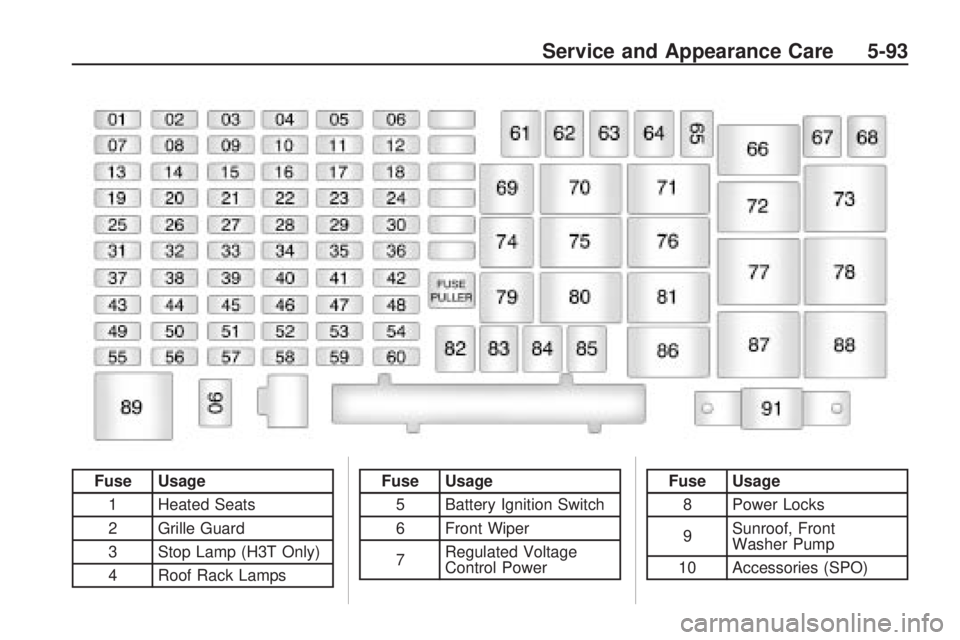
Fuse Usage1 Heated Seats
2 Grille Guard
3 Stop Lamp (H3T Only)
4 Roof Rack LampsFuse Usage5 Battery Ignition Switch
6 Front Wiper
7 Regulated Voltage
Control PowerFuse Usage
8 Power Locks
9 Sunroof, Front
Washer Pump
10 Accessories (SPO)
Service and Appearance Care 5-93
Page 331 of 382
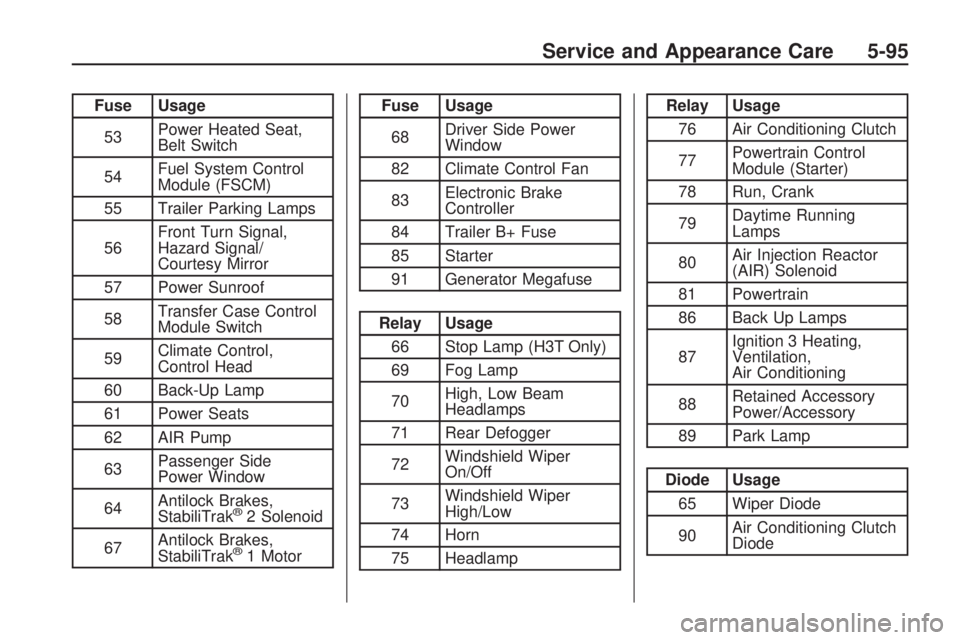
Fuse Usage
53Power Heated Seat,
Belt Switch
54Fuel System Control
Module (FSCM)
55 Trailer Parking Lamps
56Front Turn Signal,
Hazard Signal/
Courtesy Mirror
57 Power Sunroof
58Transfer Case Control
Module Switch
59Climate Control,
Control Head
60 Back-Up Lamp
61 Power Seats
62 AIR Pump
63Passenger Side
Power Window
64Antilock Brakes,
StabiliTrak
®2 Solenoid
67Antilock Brakes,
StabiliTrak
®1 Motor
Fuse Usage
68Driver Side Power
Window
82 Climate Control Fan
83Electronic Brake
Controller
84 Trailer B+ Fuse
85 Starter
91 Generator Megafuse
Relay Usage
66 Stop Lamp (H3T Only)
69 Fog Lamp
70High, Low Beam
Headlamps
71 Rear Defogger
72Windshield Wiper
On/Off
73Windshield Wiper
High/Low
74 Horn
75 Headlamp
Relay Usage
76 Air Conditioning Clutch
77Powertrain Control
Module (Starter)
78 Run, Crank
79Daytime Running
Lamps
80Air Injection Reactor
(AIR) Solenoid
81 Powertrain
86 Back Up Lamps
87Ignition 3 Heating,
Ventilation,
Air Conditioning
88Retained Accessory
Power/Accessory
89 Park Lamp
Diode Usage
65 Wiper Diode
90Air Conditioning Clutch
Diode
Service and Appearance Care 5-95
Page 375 of 382
Fuel (cont.)
Filling a Portable Fuel
Container....................... 5-8
Filling the Tank.................. 5-7
Fuels in Foreign Countries . . . 5-7
Gage ..............................3-33
Gasoline Octane................ 5-5
Gasoline Specications........ 5-5
Fuses
Engine Compartment
Fuse Block...................5-92
Fuses and Circuit
Breakers......................5-91
Windshield Wiper..............5-91
G
Gage
Engine Coolant
Temperature.................3-29
Fuel................................3-33
Speedometer...................3-24
Tachometer......................3-24
Garage Door Opener............2-42Gasoline
Octane............................. 5-5
Specications..................... 5-5
Glove Box...........................2-47
GM Mobility Reimbursement
Program............................ 7-5
H
Hazard Warning Flashers........ 3-5
Head Restraints..................... 1-2
Headlamp
Aiming ............................5-39
Headlamps..........................5-41
Bulb Replacement.............5-41
Daytime Running Lamp.....3-13
Exterior Lamps.................3-11
Flash-to-Pass..................... 3-7
Halogen Bulbs..................5-41
High/Low Beam Changer..... 3-7
On Reminder...................3-13
Heated Seats........................ 1-4
Heater................................3-19
Engine Coolant.................2-19
Highbeam On Light..............3-33Highway Hypnosis................4-30
Hill and Mountain Roads.......4-30
Hood
Checking Things Under....... 5-9
Release............................ 5-9
Horn .................................... 3-5
How to Wear Safety Belts
Properly..........................1-14
Hydraulic Clutch...................5-21
I
Ignition Positions..................2-16
Infants and Young Children,
Restraints........................1-28
Ination - Tire Pressure.........5-51
Instrument Panel
Brightness.......................3-15
Cluster............................3-23
Overview........................... 3-4
INDEX i-5