coolant level HUMMER H3 2009 Owners Manual
[x] Cancel search | Manufacturer: HUMMER, Model Year: 2009, Model line: H3, Model: HUMMER H3 2009Pages: 382, PDF Size: 1.99 MB
Page 156 of 382
CHANGE OIL
This message displays when the oil
needs to be changed. Check the
oil in the vehicle as soon as possible
and have the vehicle serviced by
your dealer/retailer. SeeEngine Oil
on page 5-13andScheduled
Maintenance on page 6-4for more
information. Press and release
the reset stem to acknowledge the
message and clear it from the
display.
DOORS
This message displays when one or
more of the doors is ajar. Check
all the doors on the vehicle to make
sure they are closed. The message
clears from the display after all
of the doors are closed.
ENG (Engine) HOT
This message displays when the
engine coolant temperature is
hot. Check the engine coolant
temperature gage. SeeEngine
Coolant Temperature Gage
on page 3-29. Have the vehicleserviced by your dealer/retailer as
soon as possible if you suspect
the engine is overheating. See
Engine Overheating on page 5-27
for more information.
FLUID
This message displays if the brake
uid is low. Check the brake
uid as soon as possible and have
the vehicle serviced by your
dealer/retailer. SeeBrakes on
page 5-30for more information.
Press and release the reset stem to
acknowledge the message and
clear it from the display.
FUEL CAP
This message displays if the
vehicle’s fuel cap is either off or
loose. Pull over as soon as possible
and check to see if the fuel cap is
secure. You may also see the check
engine light on the instrument
panel cluster. If the check engine
light does come on when the
fuel cap was loose, it may take a
few driving trips before the lightturns off. SeeMalfunction Indicator
Lamp on page 3-30for more
information if the light still remains
on. Press and release the reset
stem to acknowledge the message
and clear it from the display.
HSA (Hill Start Assist) ON
This message displays when the Hill
Start Assist is enabled. See
Braking on page 4-3for more
information.
LOW FUEL
This message displays if the level of
fuel in the vehicle is low. Also
check the fuel gage. SeeFuel Gage
on page 3-33for more information.
Rell the fuel tank as soon as
possible.
LOW TIRE
On vehicles with the Tire Pressure
Monitor System (TPMS), this
message displays if a low tire
pressure is detected in any of the
vehicle’s tires. Press and release the
reset stem to acknowledge the
3-38 Instrument Panel
Page 231 of 382
Making Turns
Notice:Making very sharp turns
while trailering could cause
the trailer to come in contact with
the vehicle. The vehicle could
be damaged. Avoid making very
sharp turns while trailering.
When turning with a trailer, make
wider turns than normal. Do this
so the trailer won’t strike soft
shoulders, curbs, road signs, trees
or other objects. Avoid jerky or
sudden maneuvers. Signal well in
advance.
Turn Signals When Towing a
Trailer
The arrows on the instrument panel
ash whenever signaling a turn
or lane change. Properly hooked up,
the trailer lamps also ash, telling
other drivers the vehicle is turning,
changing lanes or stopping.When towing a trailer, the arrows
on the instrument panel ash
for turns even if the bulbs on the
trailer are burned out. For this
reason you may think other drivers
are seeing the signal when they
are not. It is important to check
occasionally to be sure the trailer
bulbs are still working.
Driving On Grades
Reduce speed and shift to a lower
gearbeforestarting down a long
or steep downgrade. If the
transmission is not shifted down, the
brakes might have to be used so
much that they would get hot and no
longer work well.
Vehicles with an automatic
transmission can tow in D (Drive).
Shift the transmission to a lower
gear if the transmission shifts
too often under heavy loads and/or
hilly conditions. For vehicles with
a manual transmission, it is
better not to use the highest gear.When towing at high altitude on
steep uphill grades, consider
the following: Engine coolant will
boil at a lower temperature than at
normal altitudes. If the engine is
turned off immediately after towing
at high altitude on steep uphill
grades, the vehicle may show signs
similar to engine overheating. To
avoid this, let the engine run
while parked, preferably on level
ground, with the automatic
transmission in P (Park) for a
few minutes before turning the
engine off. For vehicles with manual
transmissions, let the engine run
while parked, preferably on
level ground, with the transmission
out of gear and the parking
brake applied, for a few minutes
before turning the engine off. If the
overheat warning comes on,
seeEngine Overheating on
page 5-27.
Driving Your Vehicle 4-49
Page 247 of 382
A. Windshield Washer Fluid
Reservoir. See “Adding Washer
Fluid” underWindshield
Washer Fluid on page 5-30.
B. Engine Coolant Recovery Tank.
SeeEngine Coolant on
page 5-23.
C.Engine Air Cleaner/Filter on
page 5-17.
D. Power Steering Fluid Reservoir.
SeePower Steering Fluid on
page 5-29.
E. Automatic Transmission Fluid
Dipstick (If Equipped). See
“Checking the Fluid Level”
underAutomatic Transmission
Fluid on page 5-18.
F. Engine Oil Fill Cap. See “When
to Add Engine Oil” under
Engine Oil on page 5-13.G. Radiator Pressure Cap.
SeeCooling System on
page 5-22.
H. Remote Negative (−) Terminal
(GND). SeeJump Starting on
page 5-34.
I. Engine Oil Dipstick. See
“Checking Engine Oil” under
Engine Oil on page 5-13.
J. Positive (+) Battery Terminal.
SeeJump Starting on
page 5-34.
K. Brake Fluid Reservoir.
See “Brake Fluid” under
Brakes on page 5-30.
L.Engine Compartment Fuse Block
on page 5-92.
M.Battery on page 5-33.
N. Hydraulic Clutch Fluid Reservoir
(If Equipped). SeeHydraulic
Clutch on page 5-21.
Service and Appearance Care 5-11
Page 249 of 382
A.Engine Air Cleaner/Filter on
page 5-17.
B. Air Filter Restriction Indicator
(If Equipped). SeeEngine Air
Cleaner/Filter on page 5-17.
C. Windshield Washer Fluid
Reservoir. See “Adding Washer
Fluid” underWindshield
Washer Fluid on page 5-30.
D. Engine Coolant Recovery Tank.
SeeEngine Coolant on
page 5-23.
E. Automatic Transmission
Fluid Dipstick (If Equipped).
See “Checking the Fluid Level”
underAutomatic Transmission
Fluid on page 5-18.
F. Engine Oil Dipstick. See
“Checking Engine Oil” under
Engine Oil on page 5-13.G. Engine Oil Fill Cap. See “When
to Add Engine Oil” underEngine
Oil on page 5-13.
H. Brake Fluid Reservoir.
See “Brake Fluid” underBrakes
on page 5-30.
I.Battery on page 5-33.
J. Power Steering Fluid Reservoir.
SeePower Steering Fluid on
page 5-29.
K.Engine Compartment Fuse Block
on page 5-92.
L. Radiator Pressure Cap.
SeeCooling System on
page 5-22.Engine Oil
Checking Engine Oil
It is a good idea to check the
engine oil every time you get fuel.
In order to get an accurate reading,
the oil must be warm and the
vehicle must be on level ground.
The engine oil dipstick handle
is a yellow loop. SeeEngine
Compartment Overview on
page 5-10for the location of the
engine oil dipstick.
1. Turn off the engine and give the
oil several minutes to drain back
into the oil pan. If you do not
do this, the oil dipstick might not
show the actual level.
2. Pull out the dipstick and clean it
with a paper towel or cloth,
then push it back in all the way.
Remove it again, keeping the
tip down, and check the level.
Service and Appearance Care 5-13
Page 260 of 382
Checking Coolant
The vehicle must be on a level
surface when checking the
coolant level.
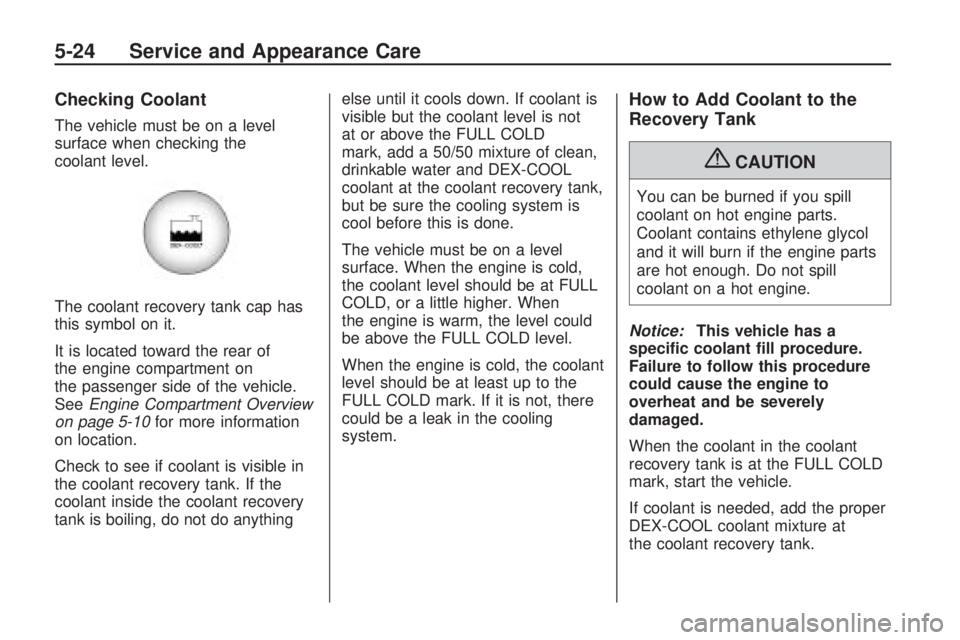
The coolant recovery tank cap has
this symbol on it.
It is located toward the rear of
the engine compartment on
the passenger side of the vehicle.
SeeEngine Compartment Overview
on page 5-10for more information
on location.
Check to see if coolant is visible in
the coolant recovery tank. If the
coolant inside the coolant recovery
tank is boiling, do not do anythingelse until it cools down. If coolant is
visible but the coolant level is not
at or above the FULL COLD
mark, add a 50/50 mixture of clean,
drinkable water and DEX-COOL
coolant at the coolant recovery tank,
but be sure the cooling system is
cool before this is done.
The vehicle must be on a level
surface. When the engine is cold,
the coolant level should be at FULL
COLD, or a little higher. When
the engine is warm, the level could
be above the FULL COLD level.
When the engine is cold, the coolant
level should be at least up to the
FULL COLD mark. If it is not, there
could be a leak in the cooling
system.
How to Add Coolant to the
Recovery Tank
{CAUTION
You can be burned if you spill
coolant on hot engine parts.
Coolant contains ethylene glycol
and it will burn if the engine parts
are hot enough. Do not spill
coolant on a hot engine.
Notice:This vehicle has a
specic coolant ll procedure.
Failure to follow this procedure
could cause the engine to
overheat and be severely
damaged.
When the coolant in the coolant
recovery tank is at the FULL COLD
mark, start the vehicle.
If coolant is needed, add the proper
DEX-COOL coolant mixture at
the coolant recovery tank.
5-24 Service and Appearance Care
Page 262 of 382
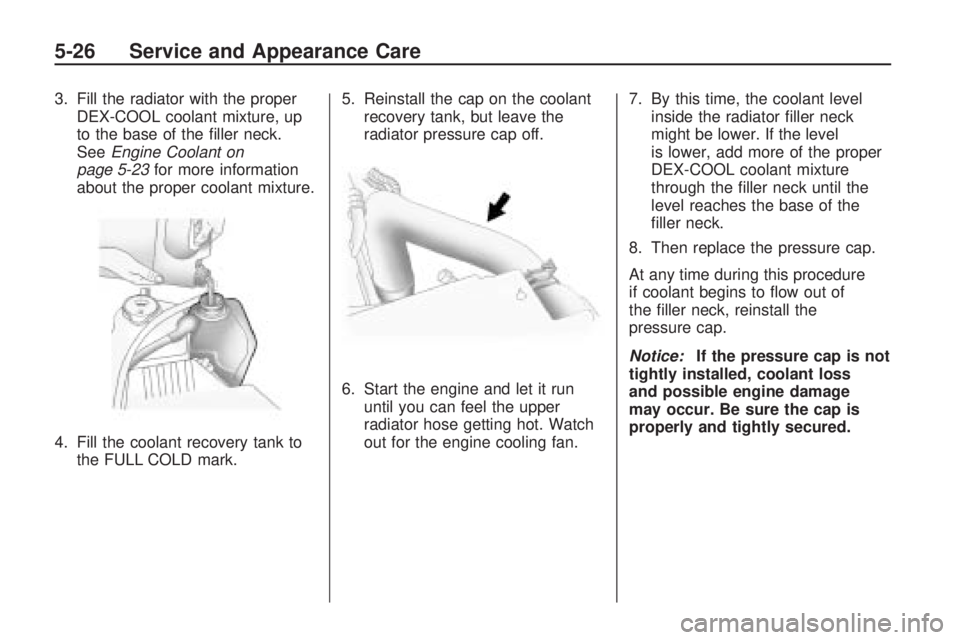
3. Fill the radiator with the proper
DEX-COOL coolant mixture, up
to the base of the ller neck.
SeeEngine Coolant on
page 5-23for more information
about the proper coolant mixture.
4. Fill the coolant recovery tank to
the FULL COLD mark.5. Reinstall the cap on the coolant
recovery tank, but leave the
radiator pressure cap off.
6. Start the engine and let it run
until you can feel the upper
radiator hose getting hot. Watch
out for the engine cooling fan.7. By this time, the coolant level
inside the radiator ller neck
might be lower. If the level
is lower, add more of the proper
DEX-COOL coolant mixture
through the ller neck until the
level reaches the base of the
ller neck.
8. Then replace the pressure cap.
At any time during this procedure
if coolant begins to ow out of
the ller neck, reinstall the
pressure cap.
Notice:If the pressure cap is not
tightly installed, coolant loss
and possible engine damage
may occur. Be sure the cap is
properly and tightly secured.
5-26 Service and Appearance Care
Page 263 of 382
Engine Overheating
The vehicle has an indicator to warn
of engine overheating.
A coolant temperature gage is
displayed on the instrument panel.
SeeEngine Coolant Temperature
Gage on page 3-29.
You may decide not to lift the hood
when this warning appears, but
instead get service help right away.
SeeRoadside Service on page 7-6.
If you do decide to lift the hood,
make sure the vehicle is parked on
a level surface.
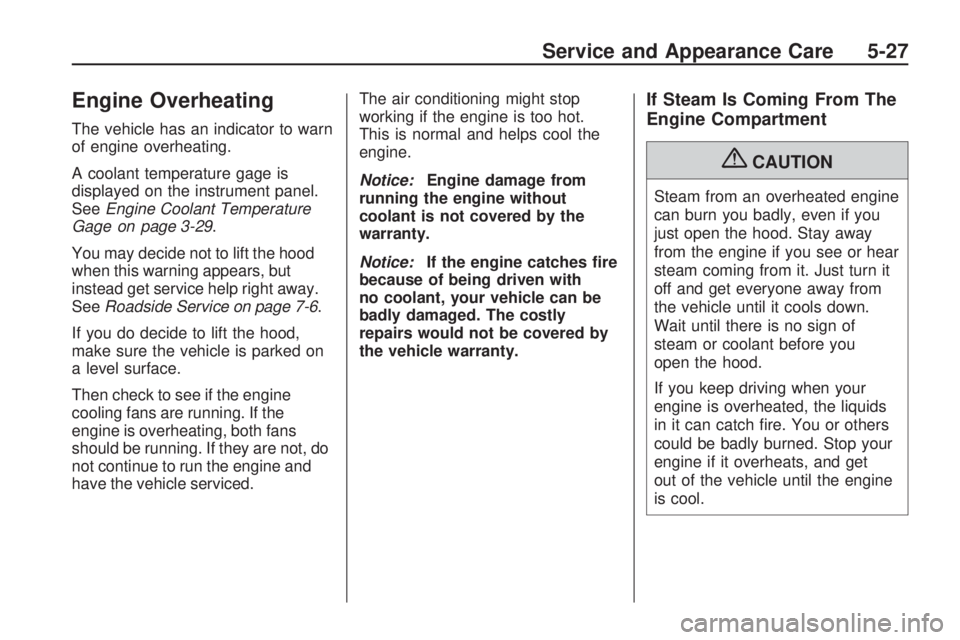
Then check to see if the engine
cooling fans are running. If the
engine is overheating, both fans
should be running. If they are not, do
not continue to run the engine and
have the vehicle serviced.The air conditioning might stop
working if the engine is too hot.
This is normal and helps cool the
engine.
Notice:Engine damage from
running the engine without
coolant is not covered by the
warranty.
Notice:If the engine catches re
because of being driven with
no coolant, your vehicle can be
badly damaged. The costly
repairs would not be covered by
the vehicle warranty.
If Steam Is Coming From The
Engine Compartment
{CAUTION
Steam from an overheated engine
can burn you badly, even if you
just open the hood. Stay away
from the engine if you see or hear
steam coming from it. Just turn it
off and get everyone away from
the vehicle until it cools down.
Wait until there is no sign of
steam or coolant before you
open the hood.
If you keep driving when your
engine is overheated, the liquids
in it can catch re. You or others
could be badly burned. Stop your
engine if it overheats, and get
out of the vehicle until the engine
is cool.
Service and Appearance Care 5-27
Page 266 of 382
Windshield Washer Fluid
What to Use
When windshield washer uid is
needed, be sure to read the
manufacturer’s instructions before
use. If operating the vehicle in
an area where the temperature may
fall below freezing, use a uid that
has sufficient protection against
freezing.
Adding Washer Fluid
Open the cap with the washer
symbol on it. Add washer uid until
the tank is full. SeeEngine
Compartment Overview on
page 5-10for reservoir location.Notice:
When using concentrated
washer uid, follow the
manufacturer’s instructions
for adding water.
Do not mix water with
ready-to-use washer uid.
Water can cause the solution
to freeze and damage your
washer uid tank and other
parts of the washer system.
Also, water does not clean as
well as washer uid.
Fill the washer uid tank only
three-quarters full when it is
very cold. This allows for uid
expansion if freezing occurs,
which could damage the tank if
it is completely full.
Do not use engine coolant
(antifreeze) in your windshield
washer. It can damage the
vehicle’s windshield washer
system and paint.
Brakes
Brake Fluid
The brake master cylinder reservoir
is lled with DOT-3 brake uid.
SeeEngine Compartment Overview
on page 5-10for the location of
the reservoir.
There are only two reasons why the
brake uid level in the reservoir
might go down:
The brake uid level goes down
because of normal brake lining
wear. When new linings are
installed, the uid level goes
back up.
A uid leak in the brake hydraulic
system can also cause a low uid
level. Have the brake hydraulic
system xed, since a leak means
that sooner or later the brakes will
not work well.
5-30 Service and Appearance Care
Page 339 of 382
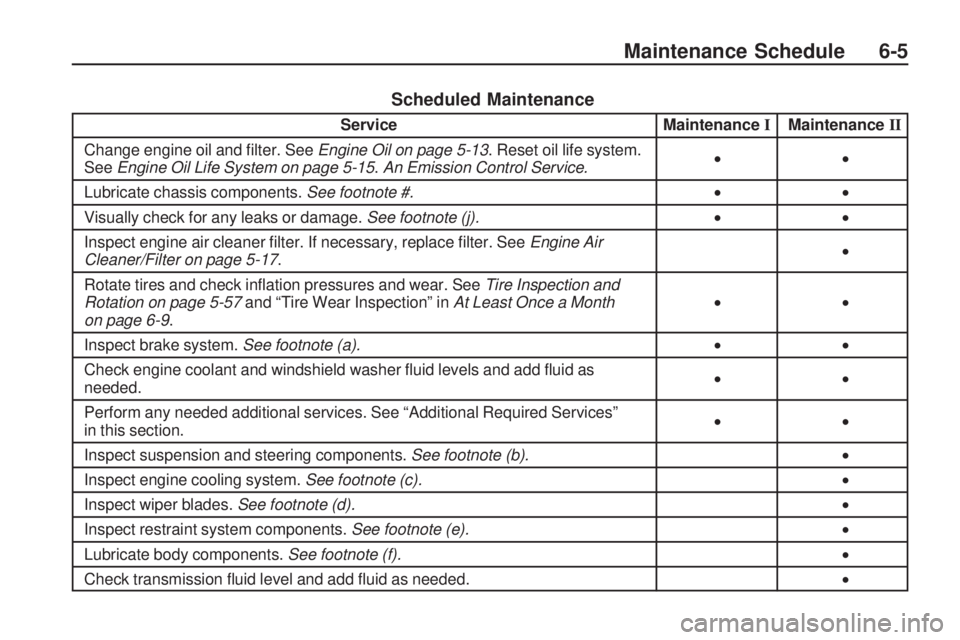
Scheduled Maintenance
ServiceMaintenanceIMaintenance II
Change engine oil and lter. See Engine Oil on page 5-13. Reset oil life system.
See Engine Oil Life System on page 5-15 .An Emission Control Service. ••
Lubricate chassis components. See footnote #. ••
Visually check for any leaks or damage. See footnote (j). ••
Inspect engine air cleaner lter. If necessary, replace lter. See Engine Air
Cleaner/Filter on page 5-17 . •
Rotate tires and check ination pressures and wear. See Tire Inspection and
Rotation on page 5-57 and “Tire Wear Inspection” in At Least Once a Month
on page 6-9. ••
Inspect brake system. See footnote (a). ••
Check engine coolant and windshield washer uid levels and add uid as
needed. ••
Perform any needed additional services. See “Additional Required Services”
in this section. ••
Inspect suspension and steering components. See footnote (b). •
Inspect engine cooling system. See footnote (c). •
Inspect wiper blades. See footnote (d). •
Inspect restraint system components. See footnote (e). •
Lubricate body components. See footnote (f). •
Check transmission uid level and add uid as needed. •
Maintenance Schedule 6-5
Page 342 of 382
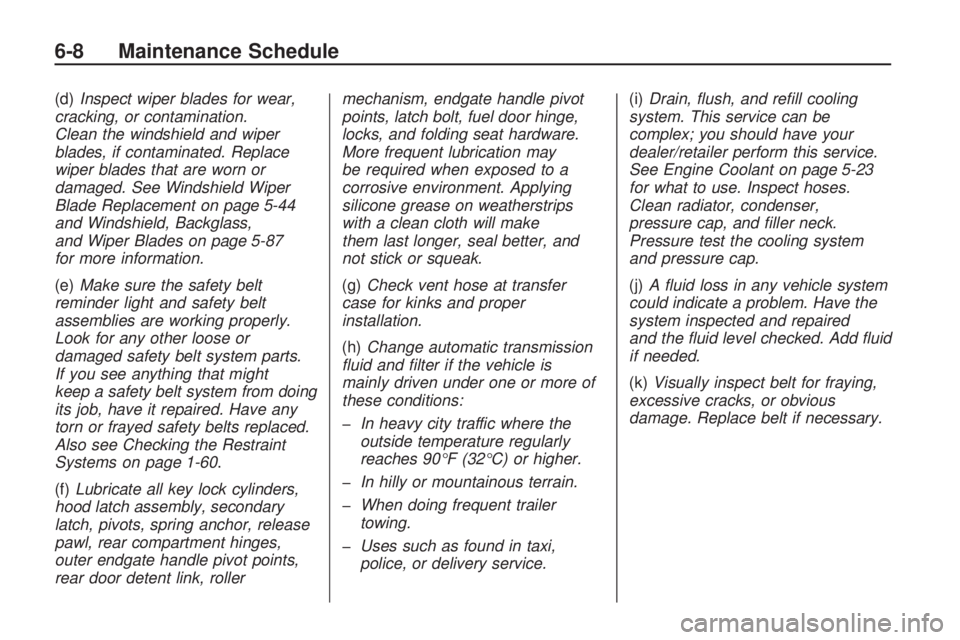
(d)Inspect wiper blades for wear,
cracking, or contamination.
Clean the windshield and wiper
blades, if contaminated. Replace
wiper blades that are worn or
damaged. See Windshield Wiper
Blade Replacement on page 5-44
and Windshield, Backglass,
and Wiper Blades on page 5-87
for more information.
(e)Make sure the safety belt
reminder light and safety belt
assemblies are working properly.
Look for any other loose or
damaged safety belt system parts.
If you see anything that might
keep a safety belt system from doing
its job, have it repaired. Have any
torn or frayed safety belts replaced.
Also see Checking the Restraint
Systems on page 1-60.
(f)Lubricate all key lock cylinders,
hood latch assembly, secondary
latch, pivots, spring anchor, release
pawl, rear compartment hinges,
outer endgate handle pivot points,
rear door detent link, rollermechanism, endgate handle pivot
points, latch bolt, fuel door hinge,
locks, and folding seat hardware.
More frequent lubrication may
be required when exposed to a
corrosive environment. Applying
silicone grease on weatherstrips
with a clean cloth will make
them last longer, seal better, and
not stick or squeak.
(g)Check vent hose at transfer
case for kinks and proper
installation.
(h)Change automatic transmission
fluid and filter if the vehicle is
mainly driven under one or more of
these conditions:
In heavy city traffic where the
outside temperature regularly
reaches 90°F (32°C) or higher.
In hilly or mountainous terrain.
When doing frequent trailer
towing.
Uses such as found in taxi,
police, or delivery service.(i)Drain, flush, and refill cooling
system. This service can be
complex; you should have your
dealer/retailer perform this service.
See Engine Coolant on page 5-23
for what to use. Inspect hoses.
Clean radiator, condenser,
pressure cap, and filler neck.
Pressure test the cooling system
and pressure cap.
(j)A fluid loss in any vehicle system
could indicate a problem. Have the
system inspected and repaired
and the fluid level checked. Add fluid
if needed.
(k)Visually inspect belt for fraying,
excessive cracks, or obvious
damage. Replace belt if necessary.
6-8 Maintenance Schedule