lock HUMMER H3 2010 Owners Manual
[x] Cancel search | Manufacturer: HUMMER, Model Year: 2010, Model line: H3, Model: HUMMER H3 2010Pages: 410, PDF Size: 2.24 MB
Page 287 of 410
Vehicle Care 10-21
{WARNING
Steam and scalding liquids from
a hot cooling system can blow
out and burn you badly. They
are under pressure, and if you
turn the surge tank pressure
cap—even a little —they can
come out at high speed. Never
turn the cap when the cooling
system, including the surge tank
pressure cap, is hot. Wait for the
cooling system and surge tank
pressure cap to cool if you ever
have to turn the pressure cap.
If coolant is needed, add the proper
mixture directly to the radiator, but
be sure the cooling system is cool
before this is done.
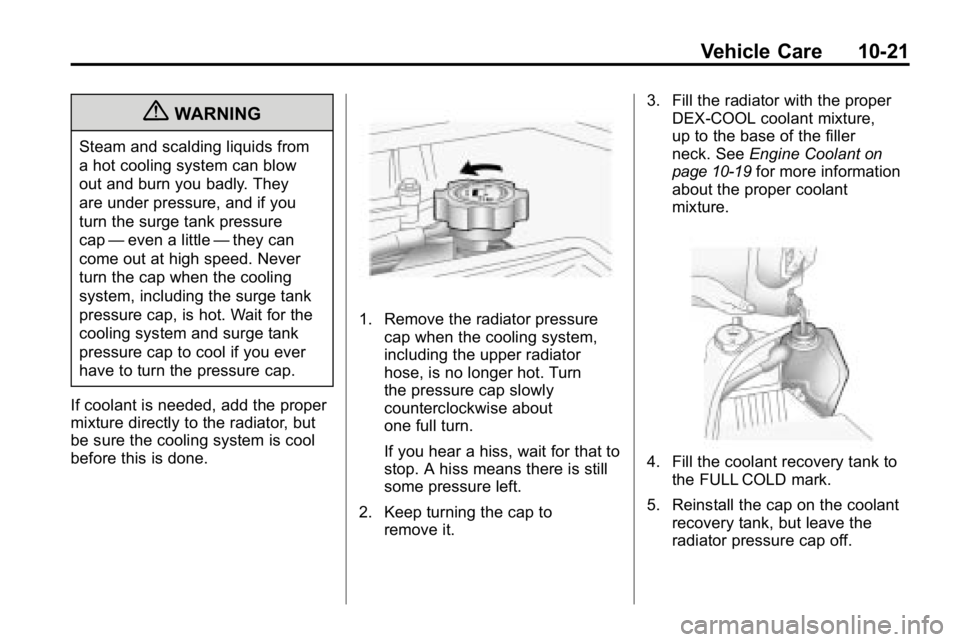
1. Remove the radiator pressure cap when the cooling system,
including the upper radiator
hose, is no longer hot. Turn
the pressure cap slowly
counterclockwise about
one full turn.
If you hear a hiss, wait for that to
stop. A hiss means there is still
some pressure left.
2. Keep turning the cap to remove it. 3. Fill the radiator with the proper
DEX‐COOL coolant mixture,
up to the base of the filler
neck. See Engine Coolant
on
page 10‑19for more information
about the proper coolant
mixture.
4. Fill the coolant recovery tank to
the FULL COLD mark.
5. Reinstall the cap on the coolant recovery tank, but leave the
radiator pressure cap off.
Page 296 of 410

10-30 Vehicle Care
Starter Switch Check
{WARNING
When you are doing this
inspection, the vehicle could
move suddenly. If the vehicle
moves, you or others could be
injured.
1. Before starting this check, be sure there is enough room
around the vehicle.
2. Firmly apply both the parking brake and the regular brake.
See Parking Brake
on
page 9‑51.
Do not use the accelerator
pedal, and be ready to turn off
the engine immediately if it
starts. 3. For automatic transmission
vehicles, try to start the engine
in each gear. The vehicle
should start only in P (Park) or
N (Neutral). If the vehicle starts
in any other position, contact
your dealer for service.
For manual transmission
vehicles, put the shift lever in
Neutral, push the clutch pedal
down halfway, and try to start
the engine. The vehicle should
start only when the clutch pedal
is pushed down all the way to
the floor. If the vehicle starts
when the clutch pedal is not
pushed all the way down,
contact your dealer for service.
Automatic Transmission
Shift Lock Control
System Check
{WARNING
When you are doing this
inspection, the vehicle could
move suddenly. If the vehicle
moves, you or others could be
injured.
1. Before starting this check, be sure there is enough room
around the vehicle. It should be
parked on a level surface.
2. Firmly apply the parking brake. See Parking Brake
on
page 9‑51.
Be ready to apply the regular
brake immediately if the vehicle
begins to move.
Page 297 of 410

Vehicle Care 10-31
3. With the engine off, turn theignition to ON/RUN, but do
not start the engine. Without
applying the regular brake, try
to move the shift lever out of
P (Park) with normal effort. If the
shift lever moves out of P (Park),
contact your dealer for service.
Ignition Transmission
Lock Check
While parked, and with the parking
brake set, try to turn the ignition to
LOCK/OFF in each shift lever
position.
.For automatic transmission
vehicles, the ignition should turn
to LOCK/OFF only when the
shift lever is in P (Park). The
ignition key should come out
only in LOCK/OFF.
.For manual transmission
vehicles, the ignition key should
come out only in LOCK/OFF.
Contact your dealer if service is
required.
Park Brake and P (Park)
Mechanism Check
{WARNING
When you are doing this check,
the vehicle could begin to move.
You or others could be injured
and property could be damaged.
Make sure there is room in front
of the vehicle in case it begins to
roll. Be ready to apply the regular
brake at once should the vehicle
begin to move. Park on a fairly steep hill, with the
vehicle facing downhill. Keeping
your foot on the regular brake, set
the parking brake.
.To check the parking brake's
holding ability: With the engine
running and the transmission in
N (Neutral), slowly remove foot
pressure from the regular brake
pedal. Do this until the vehicle is
held by the parking brake only.
.To check the P (Park)
mechanism's holding ability:
With the engine running, shift
to P (Park). Then release the
parking brake followed by the
regular brake.
Contact your dealer if service is
required.
Page 300 of 410
10-34 Vehicle Care
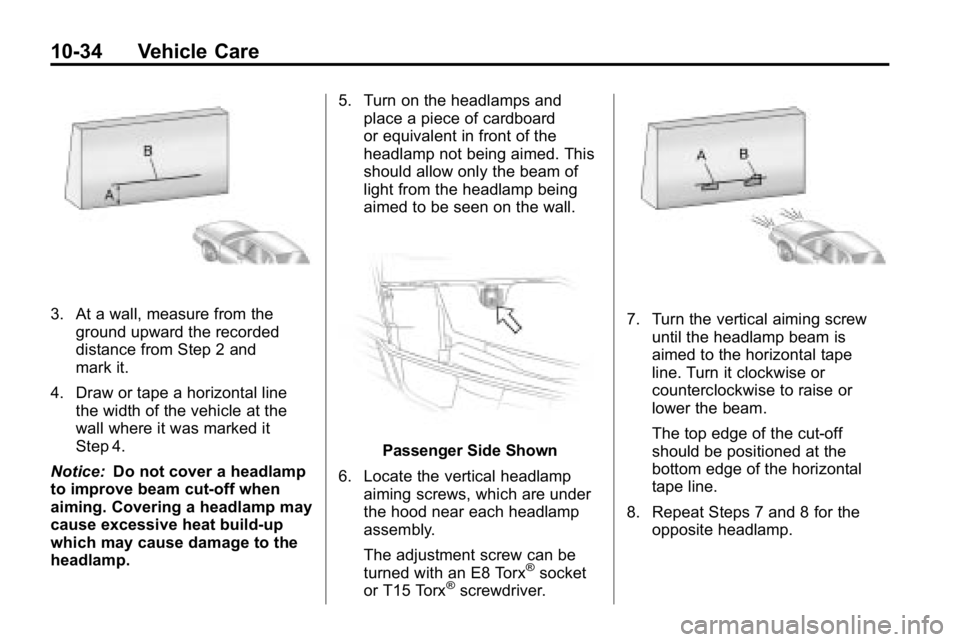
3. At a wall, measure from theground upward the recorded
distance from Step 2 and
mark it.
4. Draw or tape a horizontal line the width of the vehicle at the
wall where it was marked it
Step 4.
Notice: Do not cover a headlamp
to improve beam cut-off when
aiming. Covering a headlamp may
cause excessive heat build-up
which may cause damage to the
headlamp. 5. Turn on the headlamps and
place a piece of cardboard
or equivalent in front of the
headlamp not being aimed. This
should allow only the beam of
light from the headlamp being
aimed to be seen on the wall.
Passenger Side Shown
6. Locate the vertical headlamp aiming screws, which are under
the hood near each headlamp
assembly.
The adjustment screw can be
turned with an E8 Torx
®socket
or T15 Torx®screwdriver.
7. Turn the vertical aiming screw
until the headlamp beam is
aimed to the horizontal tape
line. Turn it clockwise or
counterclockwise to raise or
lower the beam.
The top edge of the cut-off
should be positioned at the
bottom edge of the horizontal
tape line.
8. Repeat Steps 7 and 8 for the opposite headlamp.
Page 301 of 410
Vehicle Care 10-35
Bulb Replacement
For the proper type of replacement
bulbs, seeReplacement Bulbson
page 10‑37.
For any bulb changing procedure
not listed in this section, contact
your dealer.
Halogen Bulbs
{WARNING
Halogen bulbs have pressurized
gas inside and can burst if you
drop or scratch the bulb. You or
others could be injured. Be sure
to read and follow the instructions
on the bulb package.
Headlamps
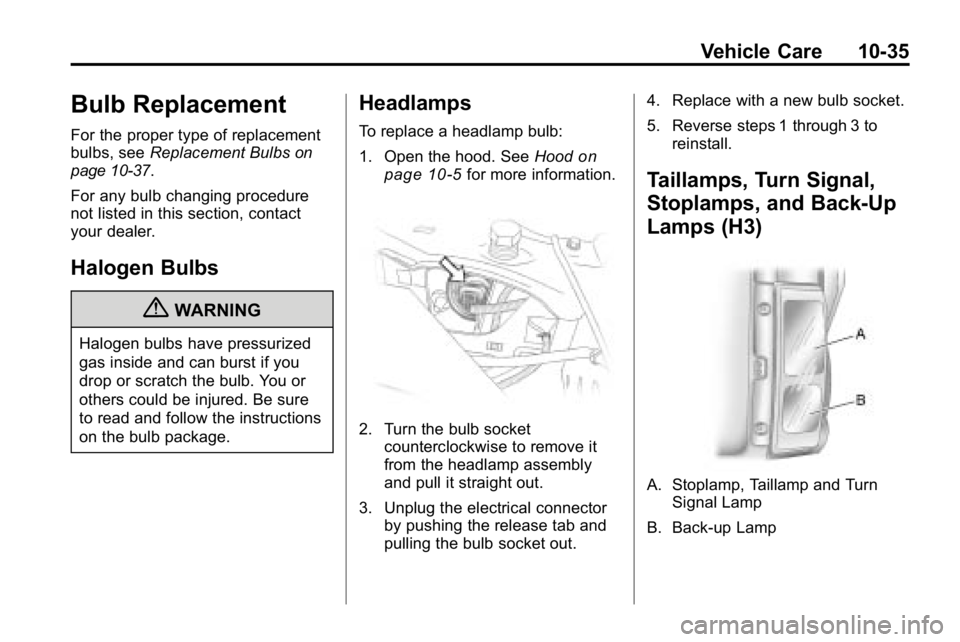
To replace a headlamp bulb:
1. Open the hood. See Hood
on
page 10‑5for more information.
2. Turn the bulb socket counterclockwise to remove it
from the headlamp assembly
and pull it straight out.
3. Unplug the electrical connector by pushing the release tab and
pulling the bulb socket out. 4. Replace with a new bulb socket.
5. Reverse steps 1 through 3 to
reinstall.
Taillamps, Turn Signal,
Stoplamps, and Back-Up
Lamps (H3)
A. Stoplamp, Taillamp and TurnSignal Lamp
B. Back-up Lamp
Page 302 of 410
10-36 Vehicle Care
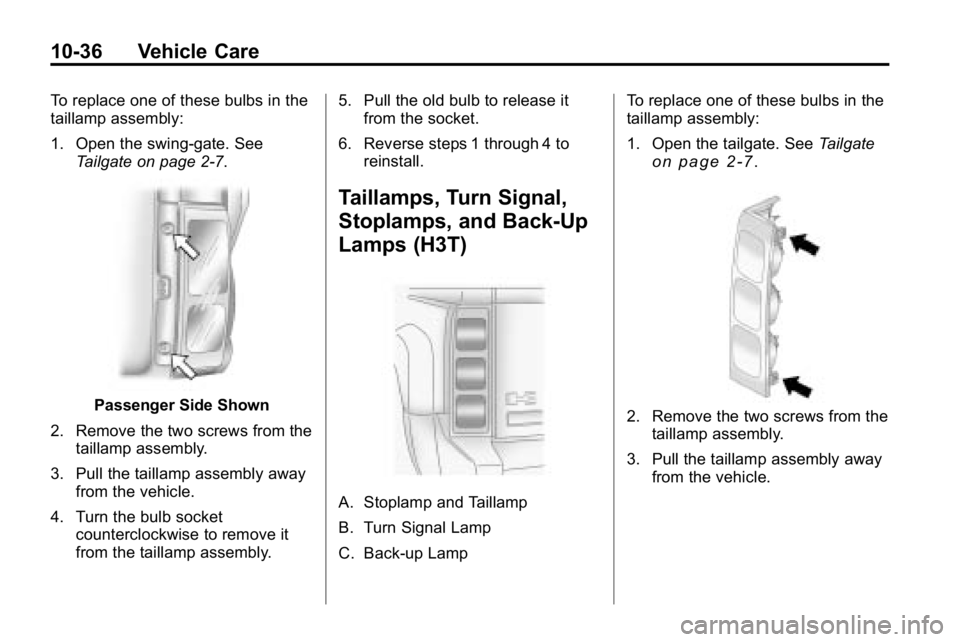
To replace one of these bulbs in the
taillamp assembly:
1. Open the swing-gate. SeeTailgate on page 2‑7.
Passenger Side Shown
2. Remove the two screws from the taillamp assembly.
3. Pull the taillamp assembly away from the vehicle.
4. Turn the bulb socket counterclockwise to remove it
from the taillamp assembly. 5. Pull the old bulb to release it
from the socket.
6. Reverse steps 1 through 4 to reinstall.
Taillamps, Turn Signal,
Stoplamps, and Back-Up
Lamps (H3T)
A. Stoplamp and Taillamp
B. Turn Signal Lamp
C. Back-up Lamp To replace one of these bulbs in the
taillamp assembly:
1. Open the tailgate. See
Tailgate
on page 2‑7.
2. Remove the two screws from the
taillamp assembly.
3. Pull the taillamp assembly away from the vehicle.
Page 303 of 410
Vehicle Care 10-37
4. Turn the bulb socketcounterclockwise to remove it
from the taillamp assembly.
5. Pull the old bulb to release it from the socket.
6. Turn the bulb socket clockwise to reinstall in the taillamp
assembly.
7. Reinstall the taillamp assembly making sure to line up the pins
with the vehicle.
8. Reinstall the two screws.License Plate Lamp
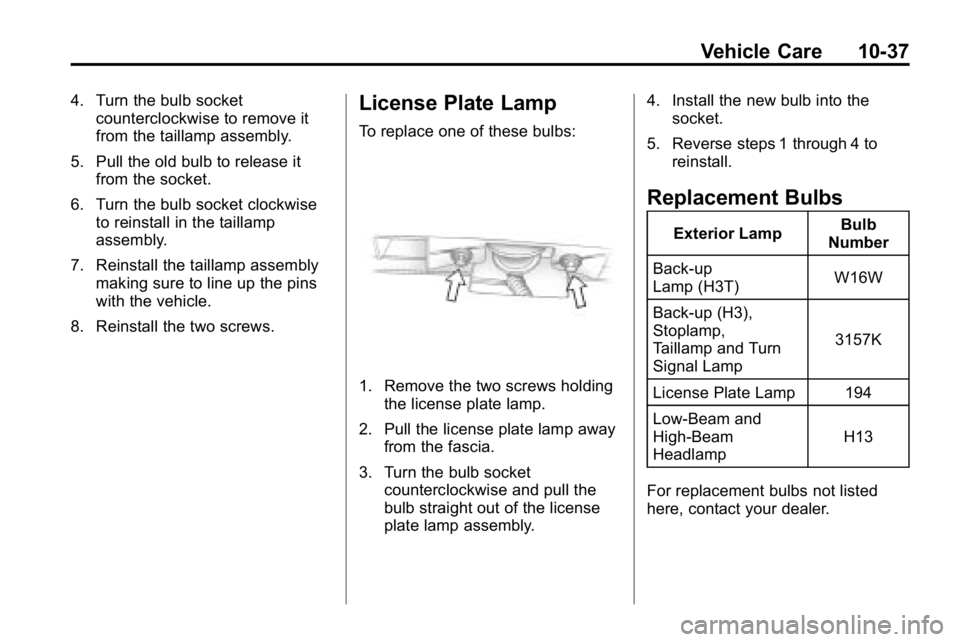
To replace one of these bulbs:
1. Remove the two screws holding the license plate lamp.
2. Pull the license plate lamp away from the fascia.
3. Turn the bulb socket counterclockwise and pull the
bulb straight out of the license
plate lamp assembly. 4. Install the new bulb into the
socket.
5. Reverse steps 1 through 4 to reinstall.
Replacement Bulbs
Exterior Lamp Bulb
Number
Back-up
Lamp (H3T) W16W
Back-up (H3),
Stoplamp,
Taillamp and Turn
Signal Lamp 3157K
License Plate Lamp 194
Low-Beam and
High-Beam
Headlamp H13
For replacement bulbs not listed
here, contact your dealer.
Page 305 of 410
Vehicle Care 10-39
Fuses and Circuit
Breakers
The wiring circuits in your vehicle
are protected from short circuits by
a combination of fuses and circuit
breakers. This greatly reduces the
chance of fires caused by electrical
problems.
Look at the silver-colored band
inside the fuse. If the band is broken
or melted, replace the fuse. Be sure
you replace a bad fuse with a new
one of the identical size and rating.
If you ever have a problem on the
road and do not have a spare fuse,
you can borrow one that has the
same amperage. Just pick some
feature of your vehicle that you can
get along without—like the radio
or cigarette lighter —and use its
fuse, if it is the correct amperage.
Replace it as soon as you can.
Engine Compartment
Fuse Block
The engine compartment fuse
block is located on the driver side
of the engine compartment. See
Engine Compartment Overview
on
page 10‑6for more information on
location.
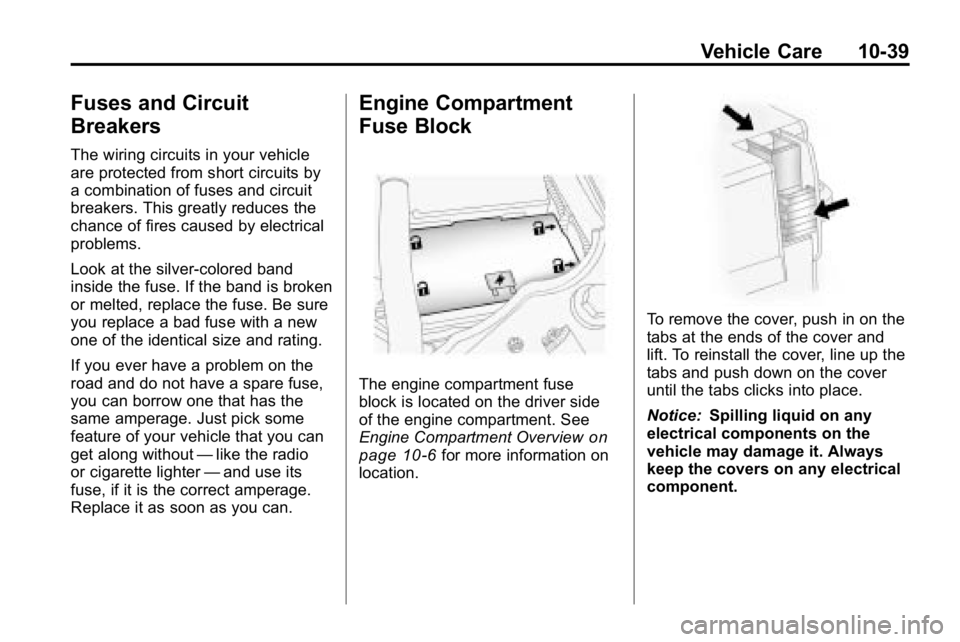
To remove the cover, push in on the
tabs at the ends of the cover and
lift. To reinstall the cover, line up the
tabs and push down on the cover
until the tabs clicks into place.
Notice: Spilling liquid on any
electrical components on the
vehicle may damage it. Always
keep the covers on any electrical
component.
Page 307 of 410

Vehicle Care 10-41
FuseUsage
1 Heated Seats
2 Grille Guard
3 Stop Lamp
(H3T Only)
4 Roof Rack Lamps
5 Battery Ignition
Switch
6 Front Wiper
7 Regulated Voltage
Control Power
8 Power Locks
9 Sunroof, Front
Washer Pump
10 Accessories (SPO) 11 Not Used
12 Transfer Case
Control Module
13 Radio
14 Body Control
Module Fuse
Usage
15 Rear Wiper Motor
(H3 Only)
16 Rear Wiper Pump
Switch (H3 Only)
17 Air Injection Reactor
(AIR) Pump Relay/
Transmission
Control Module
(TCM) (V8 Only)
18 Rear Vision Camera
19 Cluster
20 Rear Turn Lamp,
Hazard Lamp
21 Powertrain Control
Module 1
22 Mass Air Flow
Sensor, Canister
Vent Purge Solenoid
23 Injector/V8 Coil
24 Fog Lamp
25 Powertrain Control
Module B Fuse
Usage
26 Transmission
Control
Module (TCM)
27 Airbags
28 Not Used
29 Antilock Brake
System, StabiliTrak
®
30Rear Window
Defogger
31 Canister Vent
32 Regulated Voltage
Control Sensor
33 Ignition 1
34 Transmission
35 Cruise Control,
Miscellaneous
36 Horn
37 Driver Side Rear
Park Lamp
38 Amplifier
Page 308 of 410

10-42 Vehicle Care
FuseUsage
39 Daytime Running
Lamps
40 Passenger Side
Headlamp
41 Driver Side
Headlamp
42 Trailer
Back-Up Lamp
43 Front Park Lamps
44 Air Injection Reactor
(AIR) Solenoid
45 Auxiliary Power 2/
Cigarette Lighter
46 Electronic Throttle
Control
47 Oxygen Sensor
48 Air Conditioning
Clutch
49 Rear Park Lamp
50 Stop Lamp Fuse
Usage
51 Auxiliary Power 1/
Cigarette Lighter
52 StabiliTrak
®,
Antilock Brake
System
53 Power Heated Seat,
Belt Switch
54 Fuel System Control
Module (FSCM)
55 Trailer Parking
Lamps
56 Front Turn Signal,
Hazard Signal,
Courtesy Mirror
57 Power Sunroof
58 Transfer Case
Control Module
Switch
59 Climate Controls
Control Head
60 Back‐Up Lamp
61 Power Seats Fuse Usage
62 Air Injection Reactor
(AIR) Pump
63 Passenger Side
Power Window
64 Antilock Brake
System,
StabiliTrak
®2
Solenoid
67 Antilock Brake
System,
StabiliTrak
®1 Motor
68 Driver Side Power
Window
82 Climate Control Fan
83 Electronic Brake
Controller
84 Trailer B+ Fuse
85 Starter
91 Generator Megafuse