battery HUMMER H3 2010 Owner's Manual
[x] Cancel search | Manufacturer: HUMMER, Model Year: 2010, Model line: H3, Model: HUMMER H3 2010Pages: 410, PDF Size: 2.24 MB
Page 240 of 410
9-56 Driving and Operating
To lock the front and rear axles:
1. Place the transfer case in the4LO Lock mode. This is the
only mode which allows the
front and rear axles to lock.
See Four-Wheel Drive
on
page 9‑46for more information
regarding the transfer case and
4LO Lock mode.
2. Press the rear axle locking button with the vehicle moving
less than 16 mph (26 km/h).
3. Wait for the light in the button to stop flashing and remain
illuminated to show that the rear
axle is locked.
4. Press the front axle locking button with the vehicle stopped
or moving less than 26 km/h
(16 mph). 5. Wait for the light in the button
to stop flashing and remain
illuminated to show that the front
axle is locked.
Notice: If you try to lock the axle
while the vehicle is stuck and the
tires are spinning, the vehicle's
drivetrain could be damaged.
The repairs would not be covered
by the vehicle warranty. Always
lock the axle before attempting
situations and/or navigating
terrain which could possibly
cause the vehicle to become
stuck. Locking axles will be disengaged
when the wheel speed is greater
than 64 km/h (40 mph), if the
vehicle's battery is low and/or the
transfer case is shifted out of
4LO Lock mode.
Notice:
If the vehicle's axle
is locked while driving on
pavement, the drivetrain could be
damaged. Repairs would not be
covered by the vehicle warranty.
Do not use the locking axle on
pavement. If four-wheel drive is
needed when traveling on
pavement, use only 4HI.
Page 264 of 410
9-80 Driving and Operating
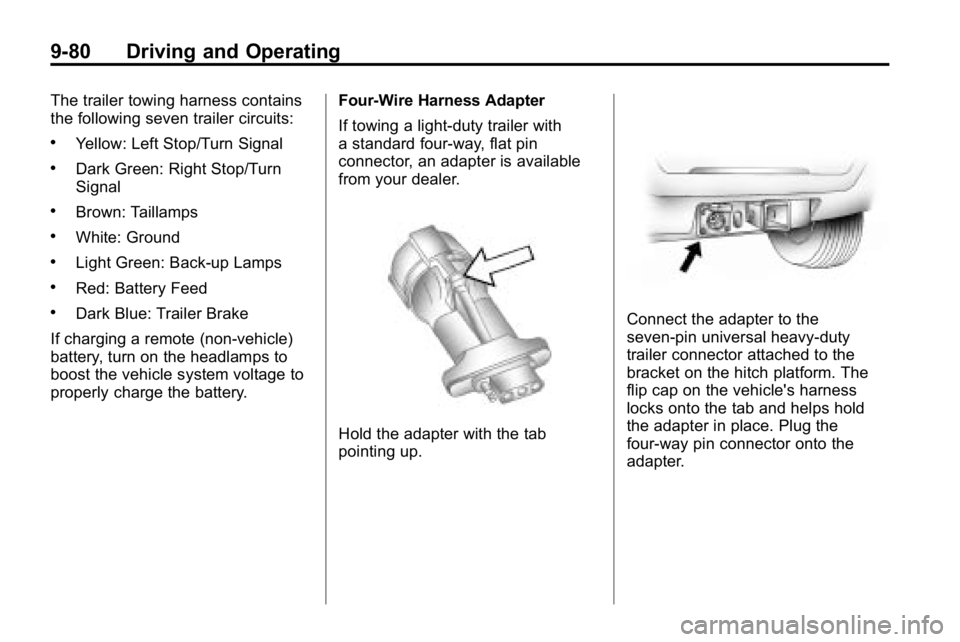
The trailer towing harness contains
the following seven trailer circuits:
.Yellow: Left Stop/Turn Signal
.Dark Green: Right Stop/Turn
Signal
.Brown: Taillamps
.White: Ground
.Light Green: Back-up Lamps
.Red: Battery Feed
.Dark Blue: Trailer Brake
If charging a remote (non‐vehicle)
battery, turn on the headlamps to
boost the vehicle system voltage to
properly charge the battery. Four-Wire Harness Adapter
If towing a light-duty trailer with
a standard four-way, flat pin
connector, an adapter is available
from your dealer.
Hold the adapter with the tab
pointing up.
Connect the adapter to the
seven‐pin universal heavy‐duty
trailer connector attached to the
bracket on the hitch platform. The
flip cap on the vehicle's harness
locks onto the tab and helps hold
the adapter in place. Plug the
four-way pin connector onto the
adapter.
Page 265 of 410
Driving and Operating 9-81
Trailer Brake Control Wiring
Harness
The trailer brake control wiring
harness is located under the
instrument panel to the right of the
steering column. The wires are
taped to the harness that goes
to the courtesy light under the
instrument panel. The harness
has the following wires:
.Red Wire: AUX B+
.Black Wire: Ground
.Light Blue Wire: Brake Signal
.Dark Blue Wire: Trailer Brakes
Trailer Recommendations
Subtract the hitch loads from the
Cargo Weight Rating (CWR). CWR
is the maximum weight of the load
the vehicle can carry. It does not
include the weight of the people
inside, but you can figure about
68 kg (150 lbs) for each passenger.
The total cargo load must not be
more than the vehicles CWR.
Weigh the vehicle with the trailer
attached, so the GVWR or GAWR
are not exceeded. If using a
weight-distributing hitch, weigh the
vehicle without the spring bars in
place.
The best performance is obtained
by correctly spreading out the
weight of the load and choosing the
correct hitch and trailer brakes.
For more information seeTrailer
Towing on page 9‑74.
Conversions and
Add-Ons
Add-On Electrical
Equipment
Notice: Do not add anything
electrical to the vehicle unless
you check with your dealer first.
Some electrical equipment can
damage the vehicle and the
damage would not be covered
by the vehicle's warranty. Some
add-on electrical equipment can
keep other components from
working as they should.
Add-on equipment can drain the
vehicle battery, even if the vehicle is
not operating.
The vehicle has an airbag system.
Before attempting to add anything
electrical to the vehicle, see
Servicing the Airbag-Equipped
Vehicle
on page 3‑40and Adding
Equipment to the Airbag-Equipped
Vehicle on page 3‑40.
Page 267 of 410
Vehicle Care 10-1
Vehicle Care
General Information
General Information . . . . . . . . . . 10-2
California Proposition65 Warning . . . . . . . . . . . . . . . . . 10-2
California Perchlorate Materials Requirements . . . . 10-3
Accessories and Modifications . . . . . . . . . . . . . . . 10-3
Vehicle Checks
Doing Your OwnService Work . . . . . . . . . . . . . . . 10-4
Hood . . . . . . . . . . . . . . . . . . . . . . . . 10-5
Engine Compartment Overview . . . . . . . . . . . . . . . . . . . 10-6
Engine Oil . . . . . . . . . . . . . . . . . . . 10-9
Engine Oil Life System . . . . . 10-11
Automatic Transmission Fluid . . . . . . . . . . . . . . . . . . . . . . 10-12
Manual Transmission Fluid . . . . . . . . . . . . . . . . . . . . . . 10-15 Hydraulic Clutch . . . . . . . . . . . . 10-16
Engine Air Cleaner/Filter . . . . 10-17
Cooling System . . . . . . . . . . . . 10-18
Engine Coolant . . . . . . . . . . . . . 10-19
Engine Overheating . . . . . . . . 10-22
Engine Fan . . . . . . . . . . . . . . . . . 10-24
Power Steering Fluid . . . . . . . 10-24
Washer Fluid . . . . . . . . . . . . . . . 10-25
Brakes . . . . . . . . . . . . . . . . . . . . . 10-26
Brake Fluid . . . . . . . . . . . . . . . . . 10-27
Battery . . . . . . . . . . . . . . . . . . . . . 10-28
Four-Wheel Drive . . . . . . . . . . . 10-29
Front Axle . . . . . . . . . . . . . . . . . . 10-29
Rear Axle . . . . . . . . . . . . . . . . . . 10-29
Starter Switch Check . . . . . . . 10-30
Automatic Transmission Shift
Lock Control System
Check . . . . . . . . . . . . . . . . . . . . . 10-30
Ignition Transmission Lock Check . . . . . . . . . . . . . . . . . . . . . 10-31
Park Brake and P (Park) Mechanism Check . . . . . . . . 10-31
Wiper Blade Replacement . . . . . . . . . . . . . . 10-32
Headlamp Aiming
Headlamp Aiming . . . . . . . . . . 10-33
Bulb Replacement
Bulb Replacement . . . . . . . . . . 10-35
Halogen Bulbs . . . . . . . . . . . . . . 10-35
Headlamps . . . . . . . . . . . . . . . . . 10-35
Taillamps, Turn Signal,Stoplamps, and Back-Up
Lamps (H3) . . . . . . . . . . . . . . . 10-35
Taillamps, Turn Signal, Stoplamps, and Back-Up
Lamps (H3T) . . . . . . . . . . . . . . 10-36
License Plate Lamp . . . . . . . . 10-37
Replacement Bulbs . . . . . . . . . 10-37
Electrical System
Electrical System Overload . . . . . . . . . . . . . . . . . . 10-38
Fuses and Circuit Breakers . . . . . . . . . . . . . . . . . . 10-39
Engine Compartment Fuse Block . . . . . . . . . . . . . . . . . . . . . 10-39
Page 273 of 410

Vehicle Care 10-7
A. Windshield Washer FluidReservoir. See “Adding Washer
Fluid” under Washer Fluid
on
page 10‑25.
B. Engine Coolant Recovery Tank. See Engine Coolant
on
page 10‑19.
C. Engine Air Cleaner/Filter
on
page 10‑17.
D. Power Steering Fluid Reservoir. See Power Steering Fluid
on
page 10‑24.
E. Automatic Transmission Fluid Dipstick (If Equipped). See
“Checking the Fluid Level” under
Automatic Transmission Fluid
on
page 10‑12.
F. Engine Oil Fill Cap. See “When
to Add Engine Oil” underEngine
Oil on page 10‑9. G. Radiator Pressure Cap. See
Cooling System on page 10‑18.
H. Remote Negative (−) Terminal (GND). See Jump Starting
on
page 10‑86.
I. Engine Oil Dipstick. See “Checking Engine Oil” under
Engine Oil on page 10‑9.
J. Positive (+) Battery Terminal. See Jump Starting
on
page 10‑86.
K. Brake Fluid Reservoir. See “Brake Fluid” under
Brakes on page 10‑26.
L. Engine Compartment Fuse
Block on page 10‑39.
M. Battery on page 10‑28.
N. Hydraulic Clutch Fluid Reservoir (If Equipped). See Hydraulic
Clutch on page 10‑16.
Page 275 of 410
Vehicle Care 10-9
A.Engine Air Cleaner/Filteron
page 10‑17.
B. Air Filter Restriction Indicator (If Equipped). See Engine Air
Cleaner/Filter
on page 10‑17.
C. Windshield Washer Fluid Reservoir. See “Adding Washer
Fluid” under Washer Fluid
on
page 10‑25.
D. Engine Coolant Recovery Tank. See Engine Coolant
on
page 10‑19.
E. Automatic Transmission Fluid Dipstick (If Equipped). See
“Checking the Fluid Level” under
Automatic Transmission Fluid
on
page 10‑12. F. Engine Oil Dipstick. See
“Checking Engine Oil” under
Engine Oil on page 10‑9.
G. Engine Oil Fill Cap. See “When
to Add Engine Oil” underEngine
Oil on page 10‑9.
H. Brake Fluid Reservoir. See “Brake Fluid” underBrakes
on
page 10‑26.
I. Battery on page 10‑28.
J. Power Steering Fluid Reservoir. See Power Steering Fluid
on
page 10‑24.
K. Engine Compartment Fuse
Block on page 10‑39.
L. Radiator Pressure Cap. See Cooling System on page 10‑18.
Engine Oil
Checking Engine Oil
It is a good idea to check the engine
oil level at each fuel fill. In order to
get an accurate reading, the oil
must be warm and the vehicle must
be on level ground.
The engine oil dipstick handle
is a yellow loop. See Engine
Compartment Overview
on
page 10‑6for the location of the
engine oil dipstick.
1. Turn off the engine and give the oil several minutes to drain back
into the oil pan. If this is not
done, the oil dipstick might not
show the actual level.
2. Pull out the dipstick and clean it with a paper towel or cloth,
then push it back in all the way.
Remove it again, keeping the tip
down, and check the level.
Page 294 of 410
10-28 Vehicle Care
What to Add
Use only new DOT 3 brake fluid
from a sealed container. See
Recommended Fluids and
Lubricants on page 11‑8.
Always clean the brake fluid
reservoir cap and the area around
the cap before removing it. This
helps keep dirt from entering the
reservoir.
{WARNING
With the wrong kind of fluid in
the brake hydraulic system, the
brakes might not work well. This
could cause a crash. Always use
the proper brake fluid.Notice:
.Using the wrong fluid
can badly damage brake
hydraulic system parts. For
example, just a few drops of
mineral-based oil, such as
engine oil, in the brake
hydraulic system can
damage brake hydraulic
system parts so badly that
they will have to be replaced.
Do not let someone put in
the wrong kind of fluid.
.If brake fluid is spilled
on the vehicle's painted
surfaces, the paint finish can
be damaged. Be careful not
to spill brake fluid on the
vehicle. If you do, wash it off
immediately.
Battery
Refer to the replacement number
shown on the original battery label
when a new battery is needed. See
Engine Compartment Overview
on
page 10‑6for battery location.
{DANGER
Battery posts, terminals, and
related accessories contain lead
and lead compounds, chemicals
known to the State of California to
cause cancer and reproductive
harm. Wash hands after handling.
Page 295 of 410
Vehicle Care 10-29
Vehicle Storage
{WARNING
Batteries have acid that can burn
you and gas that can explode.
You can be badly hurt if you are
not careful. SeeJump Starting
on
page 10‑86
for tips on working
around a battery without
getting hurt.
Infrequent Usage: Remove the
black, negative (−) cable from the
battery to keep the battery from
running down.
Extended Storage: Remove the
black, negative (−) cable from the
battery or use a battery trickle
charger.
Four-Wheel Drive
It is recommended that the
four-wheel drive transfer case fluid
be checked and filled by the dealer.
Front Axle
It is not necessary to regularly
check front axle fluid unless a leak
is suspected or an unusual noise is
heard. A fluid loss could indicate a
problem.
It is recommended that the front
axle fluid be checked and filled by
your dealer.
Rear Axle
When to Check and Change
Lubricant
It is not necessary to regularly
check rear axle fluid unless a leak is
suspected or an unusual noise is
heard. A fluid loss could indicate a
problem. Have it inspected and
repaired.
How to Check Lubricant
To get an accurate reading, the
vehicle should be on a level
surface.
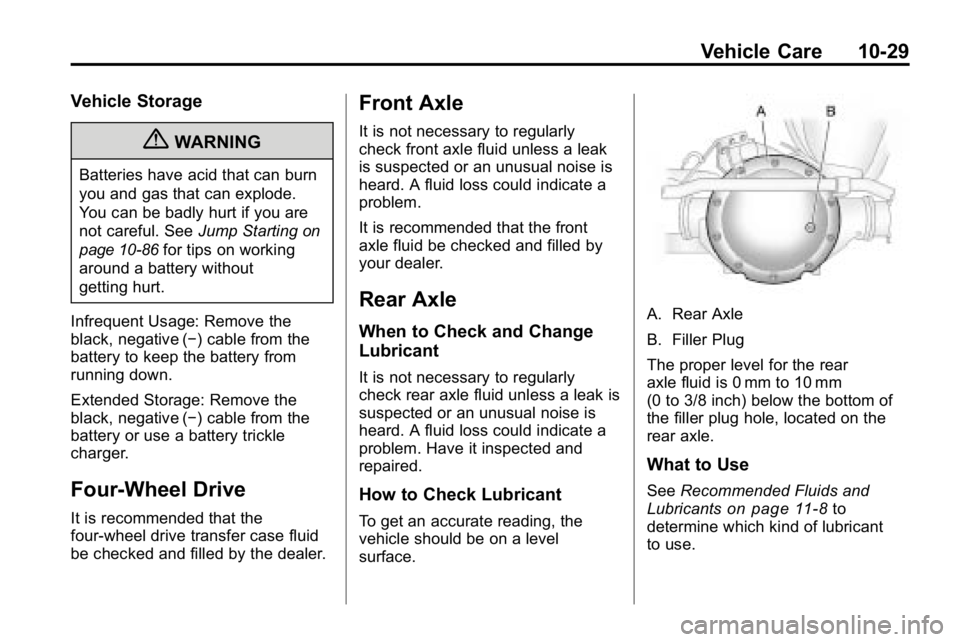
A. Rear Axle
B. Filler Plug
The proper level for the rear
axle fluid is 0 mm to 10 mm
(0 to 3/8 inch) below the bottom of
the filler plug hole, located on the
rear axle.
What to Use
See Recommended Fluids and
Lubricantson page 11‑8to
determine which kind of lubricant
to use.
Page 307 of 410

Vehicle Care 10-41
FuseUsage
1 Heated Seats
2 Grille Guard
3 Stop Lamp
(H3T Only)
4 Roof Rack Lamps
5 Battery Ignition
Switch
6 Front Wiper
7 Regulated Voltage
Control Power
8 Power Locks
9 Sunroof, Front
Washer Pump
10 Accessories (SPO) 11 Not Used
12 Transfer Case
Control Module
13 Radio
14 Body Control
Module Fuse
Usage
15 Rear Wiper Motor
(H3 Only)
16 Rear Wiper Pump
Switch (H3 Only)
17 Air Injection Reactor
(AIR) Pump Relay/
Transmission
Control Module
(TCM) (V8 Only)
18 Rear Vision Camera
19 Cluster
20 Rear Turn Lamp,
Hazard Lamp
21 Powertrain Control
Module 1
22 Mass Air Flow
Sensor, Canister
Vent Purge Solenoid
23 Injector/V8 Coil
24 Fog Lamp
25 Powertrain Control
Module B Fuse
Usage
26 Transmission
Control
Module (TCM)
27 Airbags
28 Not Used
29 Antilock Brake
System, StabiliTrak
®
30Rear Window
Defogger
31 Canister Vent
32 Regulated Voltage
Control Sensor
33 Ignition 1
34 Transmission
35 Cruise Control,
Miscellaneous
36 Horn
37 Driver Side Rear
Park Lamp
38 Amplifier
Page 352 of 410
10-86 Vehicle Care
After installing the spare tire on your
vehicle, you should stop as soon as
possible and make sure the spare is
correctly inflated.
The spare tire does not have a Tire
Pressure Monitor System sensor.
You may get a low pressure warning
light. SeeTire Pressure Monitor
Operation
on page 10‑53. Have the
damaged or flat road tire repaired or
replaced as soon as you can.
Do not mix tires and wheels of
different sizes, because they will
not fit. Keep your spare tire and its
wheel together.
Jump Starting
If the vehicle's battery has run
down, you may want to use another
vehicle and some jumper cables to
start your vehicle. Be sure to use
the following steps to do it safely.
{WARNING
Batteries can hurt you. They can
be dangerous because:
.They contain acid that can
burn you.
.They contain gas that can
explode or ignite.
.They contain enough
electricity to burn you.
If you do not follow these steps
exactly, some or all of these
things can hurt you. Notice:
Ignoring these steps
could result in costly damage to
the vehicle that would not be
covered by the warranty.
Trying to start the vehicle by
pushing or pulling it will not
work, and it could damage the
vehicle.
1. Check the other vehicle. It must
have a 12‐volt battery with a
negative ground system.
Notice: If the other vehicle's
system is not a 12-volt system
with a negative ground, both
vehicles can be damaged. Only
use vehicles with 12-volt systems
with negative grounds to jump
start your vehicle.
2. Get the vehicles close enough so the jumper cables can reach,
but be sure the vehicles are not
touching each other. If they
are, it could cause a ground
connection you do not want.