infotainment HUMMER H3 2010 Owner's Manual
[x] Cancel search | Manufacturer: HUMMER, Model Year: 2010, Model line: H3, Model: HUMMER H3 2010Pages: 410, PDF Size: 2.24 MB
Page 174 of 410
7-20 Infotainment System
3. Say the name tag to be deleted.The system responds with
“Would you like to delete,
.If the name tag is correct,
say “Yes” to delete the
name tag. The system
responds with “OK, deleting
the main menu.”
.If the name tag is incorrect,
say “No”. The system
responds with “No. OK, let's
try again, please say the
name tag.”
Using the Delete All Name Tags
Command
The delete all name tags command
deletes all stored phone book name
tags and route name tags for
OnStar (if present). To use the delete all name tags
command:
1. Press and release
g. The
system responds with “Ready”
followed by a tone.
2. Say “Delete all name tags”. The
system responds with “You are
about to delete all name tags
stored in your phone directory
and your route destination
directory. Are you sure you want
to do this? Please say yes
or no.”
.Say “Yes” to delete all
name tags.
.Say “No” to cancel the
function and return to the
main menu.
Making a Call
Calls can be made using the
following commands:
.Dial
.Digit Dial
.Call
.Re‐dial
Using the Dial Command
1. Press and release
g. The
system responds with “Ready”
followed by a tone.
2. Say “Dial”. The system responds
with “Dial using
“Number please” followed by
a tone.
Page 175 of 410

Infotainment System 7-21
3. Say the entire number withoutpausing.
.If the system recognizes
the number, it responds
with “OK, Dialing” and dials
the number.
.If the system does not
recognize the number, it
confirms the numbers
followed by a tone. If the
number is correct, say
“Yes”. The system responds
with “OK, Dialing” and dials
the number. If the number
is not correct, say “No”.
The system will ask for the
number to be re‐entered. Using the Digit Dial Command
1. Press and release
g. The
system responds with “Ready”
followed by a tone.
2. Say “Digit Dial”. The system
responds with “Digit dial using
first digit to dial” followed by
a tone.
3. Say the digits to be dialed one at a time. Following each digit, the
system will repeat back the digit
it heard followed by a tone. 4. Continue entering digits until the
number to be dialed is complete.
After the whole number has
been entered, say “Dial”. The
system responds with “OK,
Dialing” and dials the number.
.If an unwanted number is
recognized by the system,
say“Clear” at any time to
clear the last number.
.To hear all of the numbers
recognized by the system,
say “Verify” at any time and
the system will repeat them.
Page 176 of 410
7-22 Infotainment System
Using the Call Command
1. Press and release
g. The
system responds with “Ready”
followed by a tone.
2. Say “Call”. The system responds
with “Call using
Please say the name tag”
followed by a tone.
3. Say the name tag of the person to call.
.If the system clearly
recognizes the name tag it
responds with “OK, calling,
number.
.If the system is unsure
it recognizes the right
name tag, it confirms the
name tag followed by a
tone. If the name tag is
correct, say “Yes”. The system responds with
“OK, calling,
and dials the number. If the
name tag is not correct, say
“No”. The system will ask
for the name tag to be
re‐entered.
Once connected, the person called
will be heard through the audio
speakers.
Using the Re‐dial Command
1. Press and release
g. The
system responds with “Ready”
followed by a tone.
2. After the tone, say “Re‐dial”. The
system responds with “Re‐dial
using
the last number called from the
connected Bluetooth phone.
Once connected, the person called
will be heard through the audio
speakers.
Receiving a Call
When an incoming call is received,
the audio system mutes and a ring
tone is heard in the vehicle. Press
and release
gto answer the call.
Call Waiting
Call waiting must be supported on
the Bluetooth phone and enabled by
the wireless service carrier to work.
.Press and releasegto answer
an incoming call when another
call is active. The original call is
placed on hold.
.Press and releasegagain to
return to the original call.
.To ignore the incoming call,
continue with the original call
with no action.
Page 177 of 410
Infotainment System 7-23
Three‐Way Calling
Three‐Way Calling must be
supported on the Bluetooth phone
and enabled by the wireless service
carrier to work.
1. While on a call press andrelease
g. The system responds
with “Ready” followed by a tone.
2. Say “Three‐way call”. The
system responds with
“Three‐way call, please say
dial or call”.
3. Use the dial or call command to dial the number of the third party
to be called.
4. Once the call is connected, press
gto link all the callers
together.
Ending a Call
To end a call:
1. Press and release
g. The
system responds with “Ready”
followed by a tone.
2. Say “End Call”. The call is then
ended.
Muting a Call
During a call, all sounds from inside
the vehicle can be muted so that the
person on the other end of the call
cannot hear them.
To Mute a Call
1. Press and release
g. The
system responds with “Ready”
followed by a tone.
2. Say “Mute Call”. The system
responds with “Call muted”. To Cancel Mute
1. Press and release
g. The
system responds with “Ready”
followed by a tone.
2. After the tone, say “Mute Call”.
The system responds with
“Resuming call”.
Transferring a Call
Audio can be transferred between
the in‐vehicle Bluetooth system and
the cell phone.
To Transfer Audio to the Cell
Phone
During a call with the audio in the
vehicle:
1. Press and release
g. The
system responds with “Ready”
followed by a tone.
2. Say “Transfer Call.” The system
responds with “Transferring call”
and the audio will switch from
the vehicle to the cell phone.
Page 178 of 410
7-24 Infotainment System
To Transfer Audio to the In-Vehicle
Bluetooth System
The cellular phone must be paired
and connected with the Bluetooth
system before a call can be
transferred. The connection process
can take up to two minutes after the
key is turned to the ON/RUN or
ACC/ACCESSORY position.
During a call with the audio on the
cell phone, press
gfor more than
two seconds. The audio switches
from the cell phone to the vehicle.
Voice Pass-Thru
Voice Pass‐Thru allows access to
the voice recognition commands on
the cell phone. See the cell phone
manufacturers user guide to see if
the cell phone supports this feature. This feature can be used to verbally
access contacts stored in the cell
phone.
1. Press and release
g. The
system responds with “Ready”
followed by a tone.
2. Say “Bluetooth”. The system
responds with “Bluetooth ready”
followed by a tone.
3. Say “Voice”. The system
responds with “OK, accessing
.The cell phone's normal
prompt messages will go
through its cycle according
to the phone's operating
instructions.
Dual Tone Multi-Frequency
(DTMF) Tones
The in‐vehicle Bluetooth system can
send numbers and numbers stored
as name tags during a call. This is
used when calling a menu driven
phone system. Account numbers
can be programmed into the
phonebook for retrieval during menu
driven calls.
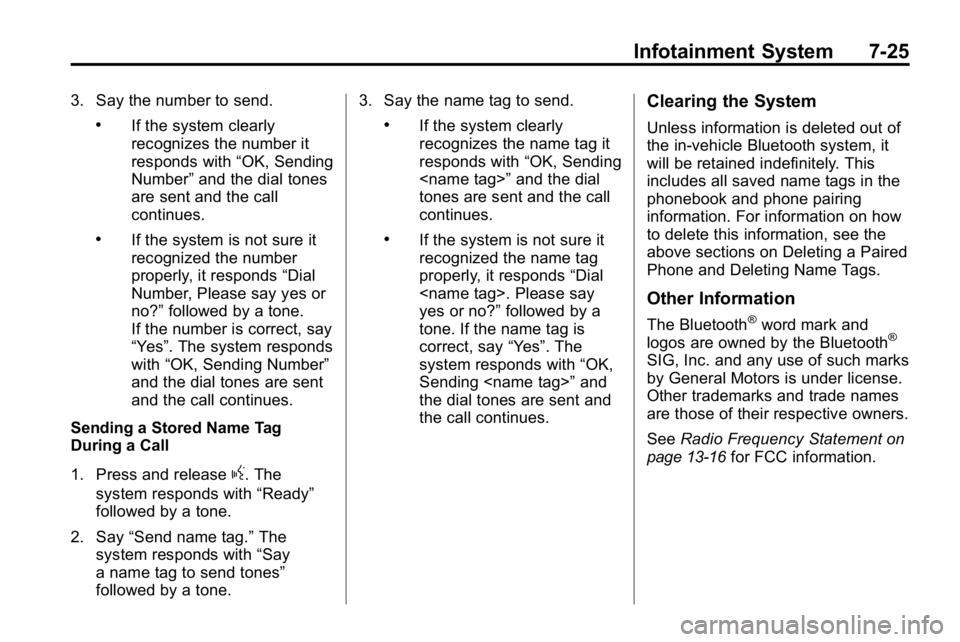
Sending a Number During a Call
1. Press and release
g. The
system responds with “Ready”
followed by a tone.
2. Say “Dial”. The system responds
with “Say a number to send
tones” followed by a tone.
Page 179 of 410
Infotainment System 7-25
3. Say the number to send.
.If the system clearly
recognizes the number it
responds with“OK, Sending
Number” and the dial tones
are sent and the call
continues.
.If the system is not sure it
recognized the number
properly, it responds “Dial
Number, Please say yes or
no?” followed by a tone.
If the number is correct, say
“Yes”. The system responds
with “OK, Sending Number”
and the dial tones are sent
and the call continues.
Sending a Stored Name Tag
During a Call
1. Press and release
g. The
system responds with “Ready”
followed by a tone.
2. Say “Send name tag.” The
system responds with “Say
a name tag to send tones”
followed by a tone. 3. Say the name tag to send.
.If the system clearly
recognizes the name tag it
responds with
“OK, Sending
tones are sent and the call
continues.
.If the system is not sure it
recognized the name tag
properly, it responds “Dial
yes or no?” followed by a
tone. If the name tag is
correct, say “Yes”. The
system responds with “OK,
Sending
the dial tones are sent and
the call continues.
Clearing the System
Unless information is deleted out of
the in‐vehicle Bluetooth system, it
will be retained indefinitely. This
includes all saved name tags in the
phonebook and phone pairing
information. For information on how
to delete this information, see the
above sections on Deleting a Paired
Phone and Deleting Name Tags.
Other Information
The Bluetooth®word mark and
logos are owned by the Bluetooth®
SIG, Inc. and any use of such marks
by General Motors is under license.
Other trademarks and trade names
are those of their respective owners.
See Radio Frequency Statement
on
page 13‑16for FCC information.
Page 180 of 410

7-26 Infotainment System
2NOTES
Page 405 of 410

INDEX i-7
Lower Anchors and Tethersfor Children (LATCH
SYSTEM) . . . . . . . . . . . . . . . . . . . . 3-51
Lumbar Adjustment . . . . . . . . . . . . . 3-4 Front Seats . . . . . . . . . . . . . . . . . . . . 3-4
M
MaintenanceRecords . . . . . . . . . . . . . . . . . . . . . 11-11
Maintenance Schedule Recommended Fluids andLubricants . . . . . . . . . . . . . . . . . . . 11-8
Scheduled Maintenance . . . . . . 11-2
Transfer Case Vent Filter . . . . . 9-46
Malfunction Indicator Lamp . . . . 5-12
Manual Transmission . . . . . . . . . . 9-44 Fluid . . . . . . . . . . . . . . . . . . . . . . . . 10-15
Messages
Battery Voltage andCharging . . . . . . . . . . . . . . . . . . . . 5-21
Brake System . . . . . . . . . . . . . . . . 5-22
Door Ajar . . . . . . . . . . . . . . . . . . . . . 5-22
Engine Cooling System . . . . . . . 5-23
Engine Oil . . . . . . . . . . . . . . . . . . . . 5-23
Engine Power . . . . . . . . . . . . . . . . 5-23
Fuel System . . . . . . . . . . . . . . . . . . 5-24 Messages (cont.)
Lamp . . . . . . . . . . . . . . . . . . . . . . . . . 5-24
Ride Control System . . . . . . . . . . 5-24
Service Vehicle . . . . . . . . . . . . . . . 5-25
Tire . . . . . . . . . . . . . . . . . . . . . . . . . . . 5-25
Transmission . . . . . . . . . . . . . . . . . 5-25
Vehicle . . . . . . . . . . . . . . . . . . . . . . . 5-21
Mirrors Automatic Dimming
Rearview . . . . . . . . . . . . . . . . . . . . 2-14
Convex . . . . . . . . . . . . . . . . . . . . . . . 2-13
Folding . . . . . . . . . . . . . . . . . . . . . . . 2-13
Power . . . . . . . . . . . . . . . . . . . . . . . . 2-13
Monitor System, Tire
Pressure . . . . . . . . . . . . . . . . . . . . 10-52
N
Navigation SystemVehicle Data Recordingand Privacy . . . . . . . . . . . . . . . 13-16
Net, Convenience . . . . . . . . . . . . . . 4-3
New Vehicle Break-In . . . . . . . . . . 9-33
O
Odometer . . . . . . . . . . . . . . . . . . . . . . . 5-8 Trip . . . . . . . . . . . . . . . . . . . . . . . . . . . . 5-8
Off-Road . . . . . . . . . . . . . . . . . . . . . . . 9-7 Driving . . . . . . . . . . . . . . . . . . . . . . . . . 9-7
Lamps . . . . . . . . . . . . . . . . . . . . . . . . . 6-6
Recovery . . . . . . . . . . . . . . . . . . . . . . 9-5
Oil Engine . . . . . . . . . . . . . . . . . . . . . . . . 10-9
Engine Oil Life System . . . . . .10-11
Messages . . . . . . . . . . . . . . . . . . . . 5-23
Pressure Light . . . . . . . . . . . . . . . . 5-17
Older Children, Restraints . . . . . 3-42
Online Owner Center . . . . . . . . . . 13-4
OnStar
®System . . . . . . . . . . . . . . . 1-19
Operation, Infotainment
System . . . . . . . . . . . . . . . . . . . . . . . . 7-2
Outlets Power . . . . . . . . . . . . . . . . . . . . . . . . . 5-5
Overheating, Engine . . . . . . . . . . 10-22