weight HUMMER H3 2010 Owner's Manual
[x] Cancel search | Manufacturer: HUMMER, Model Year: 2010, Model line: H3, Model: HUMMER H3 2010Pages: 410, PDF Size: 2.24 MB
Page 262 of 410
9-78 Driving and Operating
Total Weight on the Vehicle's
Tires
Inflate the vehicle's tires to the
upper limit for cold tires. These
numbers can be found on the
Certification label or seeVehicle
Load Limits
on page 9‑27. Do
not go over the GVW limit for the
vehicle, or the GAWR, including the
weight of the trailer tongue.
Towing Equipment
Hitches
It is important to have the correct
hitch equipment. Crosswinds, large
trucks going by and rough roads are
a few reasons why the right hitch is
needed. The rear bumper on the vehicle is
not intended for hitches. Do not
attach rental hitches or other
bumper-type hitches to it. Use only
a frame-mounted hitch that does not
attach to the bumper.
Will any holes be made in the body
of the vehicle when the trailer hitch
is installed? If there are, then be
sure to seal the holes when the
hitch is removed. If the holes are not
sealed, dirt, water, and deadly
carbon monoxide (CO) from the
exhaust may get into the vehicle.
See
Engine Exhaust on page 9‑40. Weight-Distributing Hitches and
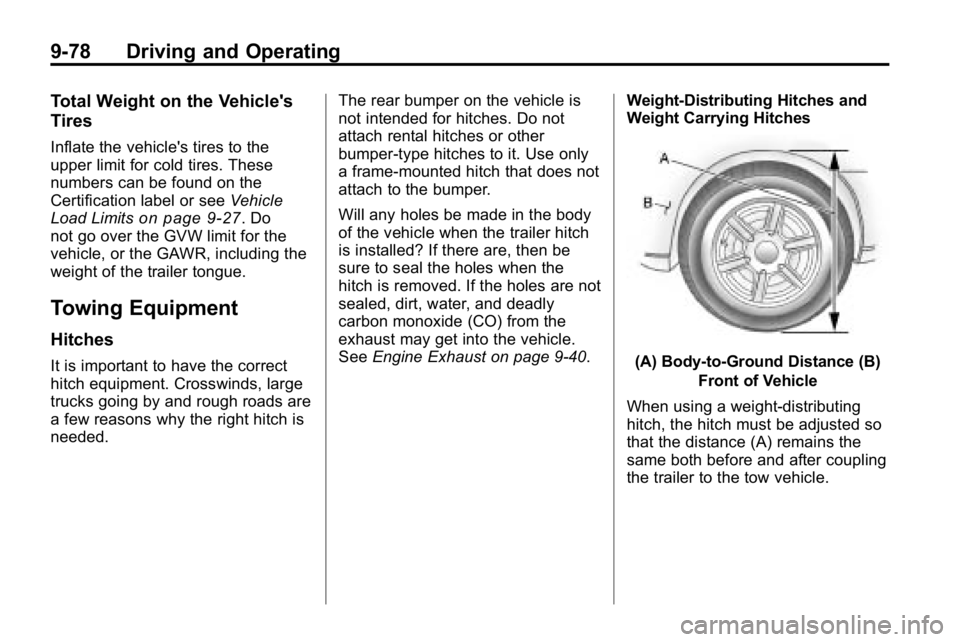
Weight Carrying Hitches(A) Body-to-Ground Distance (B)
Front of Vehicle
When using a weight-distributing
hitch, the hitch must be adjusted so
that the distance (A) remains the
same both before and after coupling
the trailer to the tow vehicle.
Page 263 of 410
Driving and Operating 9-79
Safety Chains
Always attach chains between the
vehicle and the trailer. Cross the
safety chains under the tongue
of the trailer to help prevent the
tongue from contacting the road if it
becomes separated from the hitch.
Always leave just enough slack so
the rig can turn. Never allow safety
chains to drag on the ground.
Trailer Brakes
A loaded trailer that weighs more
than 680 kg (1,500 lbs) needs to
have its own brake system that
is adequate for the weight of the
trailer. Be sure to read and follow
the instructions for the trailer brakes
so they are installed, adjusted and
maintained properly.
Trailer Wiring Harness
Light‐Duty Trailer Wiring Package
If the vehicle does not have a
trailer towing package, the chassis
harness will contain the following
blunt cut circuits:
.Yellow: Left Stop/Turn Signal
.Dark Green: Right Stop/Turn
Signal
.White: Ground
.Brown: Tail Lamps
To add a trailer towing wiring
package, have it installed by
your dealer or a qualified service
center. Also, see Add-On Electrical
Equipment
on page 9‑81for more
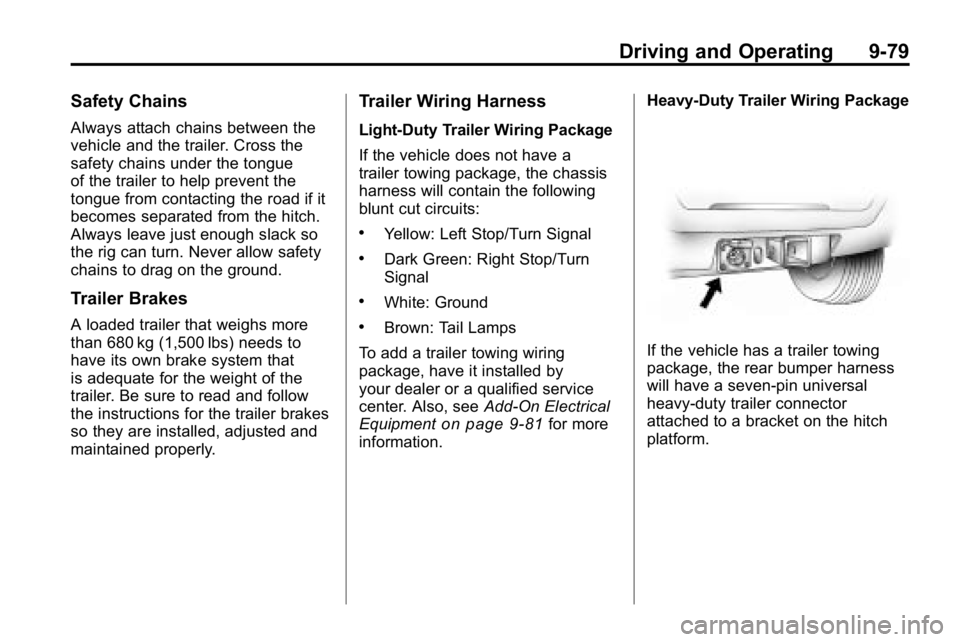
information. Heavy-Duty Trailer Wiring Package
If the vehicle has a trailer towing
package, the rear bumper harness
will have a seven‐pin universal
heavy‐duty trailer connector
attached to a bracket on the hitch
platform.
Page 265 of 410
Driving and Operating 9-81
Trailer Brake Control Wiring
Harness
The trailer brake control wiring
harness is located under the
instrument panel to the right of the
steering column. The wires are
taped to the harness that goes
to the courtesy light under the
instrument panel. The harness
has the following wires:
.Red Wire: AUX B+
.Black Wire: Ground
.Light Blue Wire: Brake Signal
.Dark Blue Wire: Trailer Brakes
Trailer Recommendations
Subtract the hitch loads from the
Cargo Weight Rating (CWR). CWR
is the maximum weight of the load
the vehicle can carry. It does not
include the weight of the people
inside, but you can figure about
68 kg (150 lbs) for each passenger.
The total cargo load must not be
more than the vehicles CWR.
Weigh the vehicle with the trailer
attached, so the GVWR or GAWR
are not exceeded. If using a
weight-distributing hitch, weigh the
vehicle without the spring bars in
place.
The best performance is obtained
by correctly spreading out the
weight of the load and choosing the
correct hitch and trailer brakes.
For more information seeTrailer
Towing on page 9‑74.
Conversions and
Add-Ons
Add-On Electrical
Equipment
Notice: Do not add anything
electrical to the vehicle unless
you check with your dealer first.
Some electrical equipment can
damage the vehicle and the
damage would not be covered
by the vehicle's warranty. Some
add-on electrical equipment can
keep other components from
working as they should.
Add-on equipment can drain the
vehicle battery, even if the vehicle is
not operating.
The vehicle has an airbag system.
Before attempting to add anything
electrical to the vehicle, see
Servicing the Airbag-Equipped
Vehicle
on page 3‑40and Adding
Equipment to the Airbag-Equipped
Vehicle on page 3‑40.
Page 314 of 410
10-48 Vehicle Care
(E) Rim Diameter:Diameter of
the wheel in inches.
(F) Load Range
:Load Range.
(G) Service Description
:The
service description indicates the
load index and speed rating of a
tire. If two numbers are given as
in the example, 120/116, then
this represents the load index for
single versus dual wheel usage
(single/dual). The speed rating is
the maximum speed a tire is
certified to carry a load.
Tire Terminology and
Definitions
Air Pressure:The amount
of air inside the tire pressing
outward on each square inch
of the tire. Air pressure is
expressed in psi (pounds per
square inch) or kPa (kilopascal). Accessory Weight
:This
means the combined weight
of optional accessories.
Some examples of optional
accessories are, automatic
transmission, power steering,
power brakes, power windows,
power seats, and air
conditioning.
Aspect Ratio
:The relationship
of a tire's height to its width.
Belt
:A rubber coated layer of
cords that is located between
the plies and the tread. Cords
may be made from steel or other
reinforcing materials.
Bead
:The tire bead contains
steel wires wrapped by steel
cords that hold the tire onto
the rim. Bias Ply Tire
:A pneumatic tire
in which the plies are laid at
alternate angles less than
90 degrees to the centerline of
the tread.
Cold Tire Pressure
:The
amount of air pressure in a tire,
measured in psi (pounds per
square inch) or kPa (kilopascal)
before a tire has built up heat
from driving. See Tire Pressure
on page 10‑51.
Curb Weight
:The weight of a
motor vehicle with standard and
optional equipment including
the maximum capacity of fuel,
oil, and coolant, but without
passengers and cargo.
Page 315 of 410

Vehicle Care 10-49
DOT Markings:A code
molded into the sidewall of a
tire signifying that the tire is
in compliance with the U.S.
Department of Transportation
(DOT) motor vehicle safety
standards. The DOT code
includes the Tire Identification
Number (TIN), an alphanumeric
designator which can also
identify the tire manufacturer,
production plant, brand, and
date of production.
GVWR
:Gross Vehicle Weight
Rating. See Vehicle Load Limits
on page 9‑27.
GAWR FRT
:Gross Axle
Weight Rating for the front axle.
See Vehicle Load Limits
on
page 9‑27
.
GAWR RR
:Gross Axle
Weight Rating for the rear axle.
See Vehicle Load Limits
on
page 9‑27
. Intended Outboard Sidewall
:
The side of an asymmetrical tire,
that must always face outward
when mounted on a vehicle.
Kilopascal (kPa)
:The metric
unit for air pressure.
Light Truck (LT‐Metric) Tire
:
A tire used on light duty trucks
and some multipurpose
passenger vehicles.
Load Index
:An assigned
number ranging from 1 to 279
that corresponds to the load
carrying capacity of a tire.
Maximum Inflation Pressure
:
The maximum air pressure to
which a cold tire can be inflated.
The maximum air pressure is
molded onto the sidewall.
Maximum Load Rating
:The
load rating for a tire at the
maximum permissible inflation
pressure for that tire. Maximum Loaded Vehicle
Weight
:The sum of curb
weight, accessory weight,
vehicle capacity weight, and
production options weight.
Normal Occupant Weight
:The
number of occupants a vehicle
is designed to seat multiplied by
68 kg (150 lbs). See Vehicle
Load Limits
on page 9‑27.
Occupant Distribution
:
Designated seating positions.
Outward Facing Sidewall
:The
side of an asymmetrical tire that
has a particular side that faces
outward when mounted on a
vehicle. The side of the tire that
contains a whitewall, bears
white lettering, or bears
manufacturer, brand, and/or
model name molding that is
higher or deeper than the same
moldings on the other sidewall
of the tire.
Page 316 of 410

10-50 Vehicle Care
Passenger (P-Metric) Tire:
A tire used on passenger cars
and some light duty trucks and
multipurpose vehicles.
Recommended Inflation
Pressure
:Vehicle
manufacturer's recommended
tire inflation pressure as shown
on the tire placard. See Tire
Pressure
on page 10‑51and
Vehicle Load Limits
on
page 9‑27
.
Radial Ply Tire
:A pneumatic
tire in which the ply cords that
extend to the beads are laid at
90 degrees to the centerline of
the tread.
Rim
:A metal support for a tire
and upon which the tire beads
are seated.
Sidewall
:The portion of a tire
between the tread and the bead. Speed Rating
:An
alphanumeric code assigned
to a tire indicating the maximum
speed at which a tire can
operate.
Traction
:The friction between
the tire and the road surface.
The amount of grip provided.
Tread
:The portion of a tire
that comes into contact with
the road.
Treadwear Indicators
:Narrow
bands, sometimes called wear
bars, that show across the tread
of a tire when only 1.6 mm
(1/16 inch) of tread remains.
See When It Is Time for New
Tires
on page 10‑58. UTQGS (Uniform Tire Quality
Grading Standards)
:A tire
information system that provides
consumers with ratings for a
tire's traction, temperature,
and treadwear. Ratings
are determined by tire
manufacturers using
government testing procedures.
The ratings are molded into
the sidewall of the tire. See
Uniform Tire Quality Grading
on
page 10‑61
.
Vehicle Capacity Weight
:
The number of designated
seating positions multiplied by
68 kg (150 lbs) plus the rated
cargo load. See Vehicle Load
Limits
on page 9‑27.
Vehicle Maximum Load on the
Tire
:Load on an individual tire
due to curb weight, accessory
weight, occupant weight, and
cargo weight.
Page 317 of 410
Vehicle Care 10-51
Vehicle Placard:A label
permanently attached to a
vehicle showing the vehicle's
capacity weight and the
original equipment tire size
and recommended inflation
pressure. See “Tire and Loading
Information Label” underVehicle
Load Limits
on page 9‑27.
Tire Pressure
Tires need the correct amount
of air pressure to operate
effectively.
Notice:Do not let anyone tell
you that under‐inflation or
over‐inflation is all right. It is
not. If your tires do not have
enough air (under‐inflation),
you can get the following:
.Too much flexing
.Too much heat
.Tire overloading
.Premature or
irregular wear
.Poor handling
.Reduced fuel economy
If your tires have too much air
(over‐inflation), you can get
the following:
.Unusual wear
.Poor handling
.Rough ride
.Needless damage from
road hazards
A vehicle specific Tire and
Loading Information label is
attached to your vehicle. This
label shows your vehicle's
original equipment tires and the
correct inflation pressures for
your tires when they are cold.
The recommended cold tire
inflation pressure, shown on the
label, is the minimum amount of air pressure needed to support
your vehicle's maximum load
carrying capacity.
For additional information
regarding how much weight
your vehicle can carry, and an
example of the Tire and Loading
Information label, see
Vehicle
Load Limits
on page 9‑27.
How you load your vehicle
affects vehicle handling and ride
comfort. Never load your vehicle
with more weight than it was
designed to carry.
When to Check
Check your tires once a month
or more. Also check the tire
pressure of the spare tire. If your
vehicle has a compact spare
tire, it should be at 60 psi
(420 kPa). See Full-Size Spare
Tire
on page 10‑85for additional
information.