ECU HUMMER H3 2010 Workshop Manual
[x] Cancel search | Manufacturer: HUMMER, Model Year: 2010, Model line: H3, Model: HUMMER H3 2010Pages: 410, PDF Size: 2.24 MB
Page 255 of 410

Driving and Operating 9-71
With the added weight, the engine,
transmission, wheel assemblies and
tires are forced to work harder and
under greater loads. The trailer also
adds wind resistance, increasing
the pulling requirements. For safe
trailering, correctly use the proper
trailering equipment.
The following information has
important trailering tips and rules
for your safety and that of your
passengers. Read this section
carefully before pulling a trailer.
Pulling A Trailer
Here are some important points:
.There are many laws, including
speed limit restrictions that apply
to trailering. Check for legal
requirements with state or
provincial police.
.Consider using a sway control.
See“Hitches” later in this
section.
.Do not tow a trailer at all during
the first 800 km (500 miles) the
new vehicle is driven. The
engine, axle or other parts could
be damaged.
.Then, during the first 800 km
(500 miles) that a trailer is
towed, do not drive over 80 km/h
(50 mph) and do not make starts
at full throttle. This helps the
engine and other parts of the
vehicle wear in at the heavier
loads.
.Vehicles with an automatic
transmission can tow in
D (Drive). Use a lower gear if
the transmission shifts too often.
For vehicles with a manual
transmission, it is better not to
use the highest gear.
.This vehicle has a Hill Start
Assist feature, which may be
useful when the vehicle is
stopped on a grade. See Hill
Start Assist (HSA)
on page 9‑52for more information.
.Do not drive faster than the
maximum posted speed for
trailers.
Driving with a Trailer
Towing a trailer requires experience.
Get familiar with handling and
braking with the added trailer
weight. The vehicle is now longer
and not as responsive as the
vehicle is by itself.
Check all trailer hitch parts and
attachments, safety chains,
electrical connectors, lamps, tires
and mirror adjustments. If the trailer
has electric brakes, start the vehicle
and trailer moving and then apply
the trailer brake controller by hand
to be sure the brakes are working.
During the trip, check occasionally
to be sure that the load is secure,
and the lamps and trailer brakes are
working properly.
Page 260 of 410
9-76 Driving and Operating
Ask your dealer for our trailering
information or advice, or write us at
our Customer Assistance Offices.
SeeCustomer Assistance Offices
on page 13‑3for more information.
Weight of the Trailer Tongue
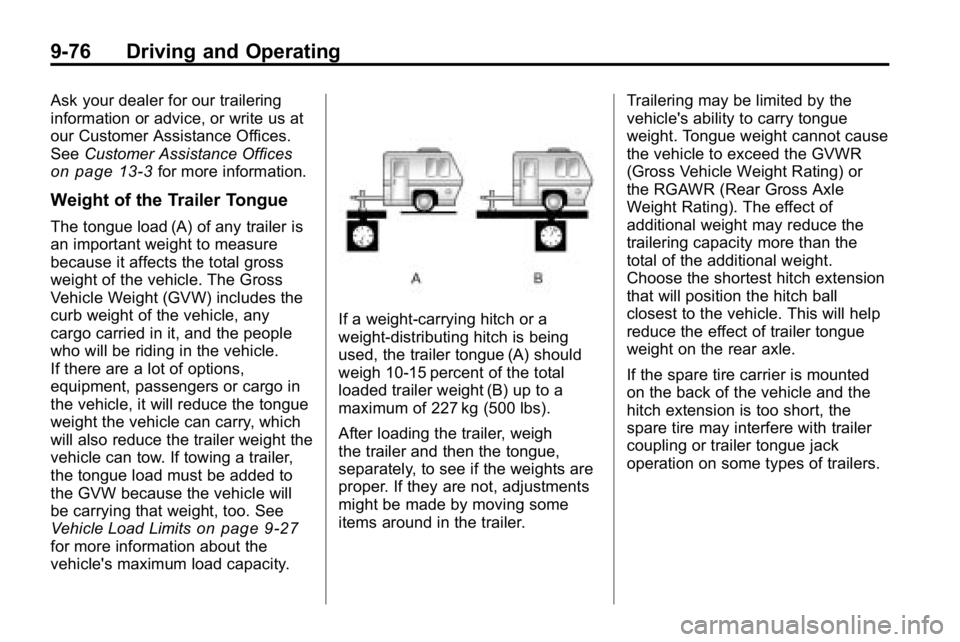
The tongue load (A) of any trailer is
an important weight to measure
because it affects the total gross
weight of the vehicle. The Gross
Vehicle Weight (GVW) includes the
curb weight of the vehicle, any
cargo carried in it, and the people
who will be riding in the vehicle.
If there are a lot of options,
equipment, passengers or cargo in
the vehicle, it will reduce the tongue
weight the vehicle can carry, which
will also reduce the trailer weight the
vehicle can tow. If towing a trailer,
the tongue load must be added to
the GVW because the vehicle will
be carrying that weight, too. See
Vehicle Load Limits
on page 9‑27for more information about the
vehicle's maximum load capacity.
If a weight-carrying hitch or a
weight-distributing hitch is being
used, the trailer tongue (A) should
weigh 10‐15 percent of the total
loaded trailer weight (B) up to a
maximum of 227 kg (500 lbs).
After loading the trailer, weigh
the trailer and then the tongue,
separately, to see if the weights are
proper. If they are not, adjustments
might be made by moving some
items around in the trailer. Trailering may be limited by the
vehicle's ability to carry tongue
weight. Tongue weight cannot cause
the vehicle to exceed the GVWR
(Gross Vehicle Weight Rating) or
the RGAWR (Rear Gross Axle
Weight Rating). The effect of
additional weight may reduce the
trailering capacity more than the
total of the additional weight.
Choose the shortest hitch extension
that will position the hitch ball
closest to the vehicle. This will help
reduce the effect of trailer tongue
weight on the rear axle.
If the spare tire carrier is mounted
on the back of the vehicle and the
hitch extension is too short, the
spare tire may interfere with trailer
coupling or trailer tongue jack
operation on some types of trailers.
Page 288 of 410

10-22 Vehicle Care
6. Start the engine and let it rununtil you can feel the upper
radiator hose getting hot. Watch
out for the engine cooling fan.
7. By this time, the coolant level inside the radiator filler neck
might be lower. If the level is
lower, add more of the proper
DEX‐COOL coolant mixture
through the filler neck until the
level reaches the base of the
filler neck.
8. Then replace the pressure cap. At any time during this procedure
if coolant begins to flow out of
the filler neck, reinstall the
pressure cap.
Notice:
If the pressure cap is not
tightly installed, coolant loss and
possible engine damage may
occur. Be sure the cap is properly
and tightly secured.
Engine Overheating
The vehicle has an indicator to warn
of engine overheating.
A coolant temperature gauge is
displayed on the instrument panel.
See Engine Coolant Temperature
Gauge on page 5‑9.
You may decide not to lift the
hood when this warning appears,
but instead get service help right
away. See Roadside Service
on
page 13‑5.
If you do decide to lift the hood,
make sure the vehicle is parked on
a level surface. Then check to see if the engine
cooling fans are running. If the
engine is overheating, both fans
should be running. If they are not,
do not continue to run the engine
and have the vehicle serviced.
The air conditioning might stop
working if the engine is too hot. This
is normal and helps cool the engine.
Notice:
Engine damage from
running the engine without
coolant is not covered by the
warranty.
Notice: If the engine catches
fire because of being driven
with no coolant, your vehicle can
be badly damaged. The costly
repairs would not be covered by
the vehicle warranty.
Page 298 of 410
10-32 Vehicle Care
Wiper Blade Replacement
Windshield wiper blades should be
inspected for wear and cracking.
SeeScheduled Maintenance
on
page 11‑2for more information.
Replacement blades come in
different types and are removed
in different ways. For proper type
and length, see Maintenance
Replacement Parts on page 11‑10. To replace the windshield wiper
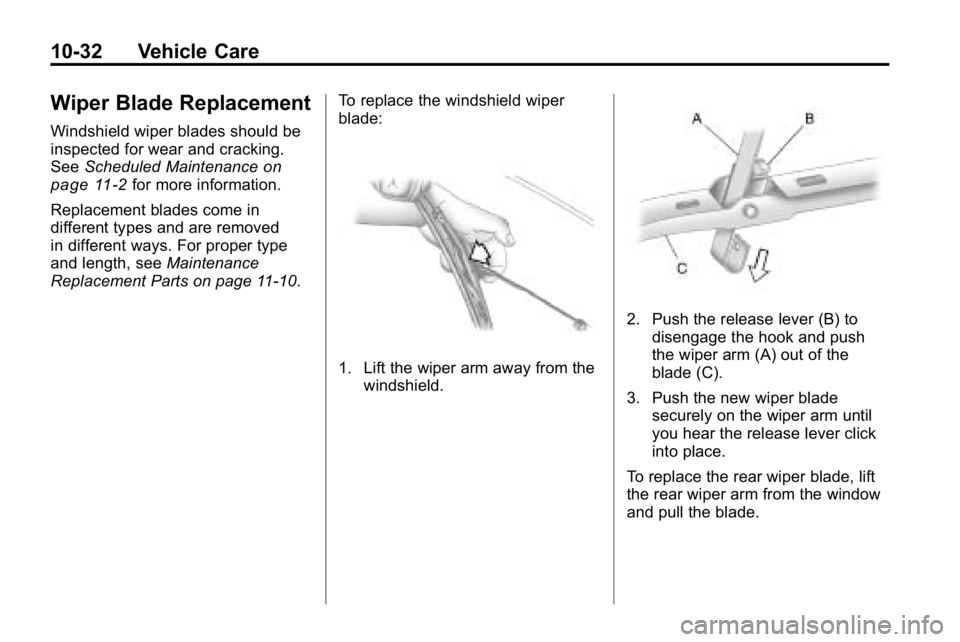
blade:
1. Lift the wiper arm away from the
windshield.
2. Push the release lever (B) to
disengage the hook and push
the wiper arm (A) out of the
blade (C).
3. Push the new wiper blade securely on the wiper arm until
you hear the release lever click
into place.
To replace the rear wiper blade, lift
the rear wiper arm from the window
and pull the blade.
Page 323 of 410
Vehicle Care 10-57
10. Set all four tires to therecommended air pressure
level as indicated on the Tire
and Loading Information label.
11. Put the valve caps back on the valve stems.
Tire Inspection
We recommend that you
regularly inspect your vehicle's
tires, including the spare tire,
if the vehicle has one, for
signs of wear or damage. See
When It Is Time for New Tires
on
page 10‑58
for more information.
Tire Rotation
Tires should be rotated every
5,000 to 8,000 miles (8 000 to
13 000 km). See Scheduled
Maintenance
on page 11‑2. The purpose of a regular tire
rotation is to achieve a uniform
wear for all tires on the vehicle.
This will ensure that the vehicle
continues to perform most like it
did when the tires were new.
The first rotation is the most
important. See
Scheduled
Maintenance
on page 11‑2.
Any time you notice unusual
wear, rotate the tires as soon
as possible and check wheel
alignment. Also check for
damaged tires or wheels.
See When It Is Time for New
Tires
on page 10‑58and Wheel
Replacement
on page 10‑63.
Make sure the spare tire is
stored securely. Push, pull and
then try to rotate or turn the tire.
If it moves, use the wheel
wrench/hoist shaft to tighten the
cable. See If a Tire Goes Flat
on
page 10‑64
.
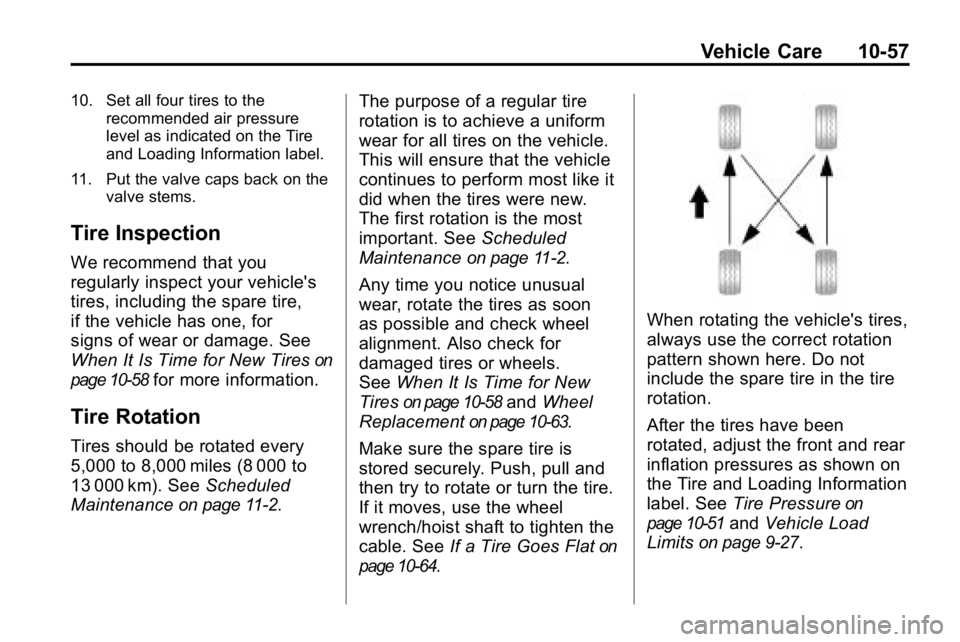
When rotating the vehicle's tires,
always use the correct rotation
pattern shown here. Do not
include the spare tire in the tire
rotation.
After the tires have been
rotated, adjust the front and rear
inflation pressures as shown on
the Tire and Loading Information
label. See Tire Pressure
on
page 10‑51
and Vehicle Load
Limits
on page 9‑27.
Page 330 of 410
10-64 Vehicle Care
Tire Chains
{WARNING
If your vehicle has LT285/75R16
or P265/65R18 size tires, do not
use tire chains. They can damage
your vehicle because there is not
enough clearance. Tire chains
used on a vehicle without the
proper amount of clearance can
cause damage to the brakes,
suspension, or other vehicle
parts. The area damaged by the
tire chains could cause you to
lose control of your vehicle and
you or others may be injured in a
crash.
Use another type of traction
device only if its manufacturer
recommends it for use on your
vehicle and tire size combination
and road conditions. Follow that
manufacturer's instructions.(Continued)
WARNING (Continued)
To help avoid damage to your
vehicle, drive slowly, readjust,
or remove the device if it is
contacting your vehicle, and do
not spin your vehicle's wheels.
If you do find traction devices that
will fit, install them on the rear
tires.
Notice: If your vehicle has a tire
size other than LT285/75R16 or
P265/65R18 use tire chains only
where legal and only when you
must. Use chains that are the
proper size for your tires. Install
them on the tires of the rear axle.
Do not use chains on the tires of
the front axle. Tighten them as
tightly as possible with the
ends securely fastened. Drive
slowly and follow the chain
manufacturer's instructions. If you can hear the chains
contacting your vehicle, stop
and retighten them. If the contact
continues, slow down until it
stops. Driving too fast or
spinning the wheels with chains
on will damage your vehicle.
If a Tire Goes Flat
It is unusual for a tire to blowout
while you are driving, especially if
you maintain your vehicle's tires
properly. If air goes out of a tire, it is
much more likely to leak out slowly.
But if you should ever have a
blowout, here are a few tips about
what to expect and what to do:
If a front tire fails, the flat tire
creates a drag that pulls the vehicle
toward that side. Take your foot off
the accelerator pedal and grip the
steering wheel firmly. Steer to
maintain lane position, and then
gently brake to a stop well out of the
traffic lane.
Page 332 of 410
10-66 Vehicle Care
SeeTire Changing (H3T)on
page 10‑66or Tire Changing (H3)on page 10‑75for more information.
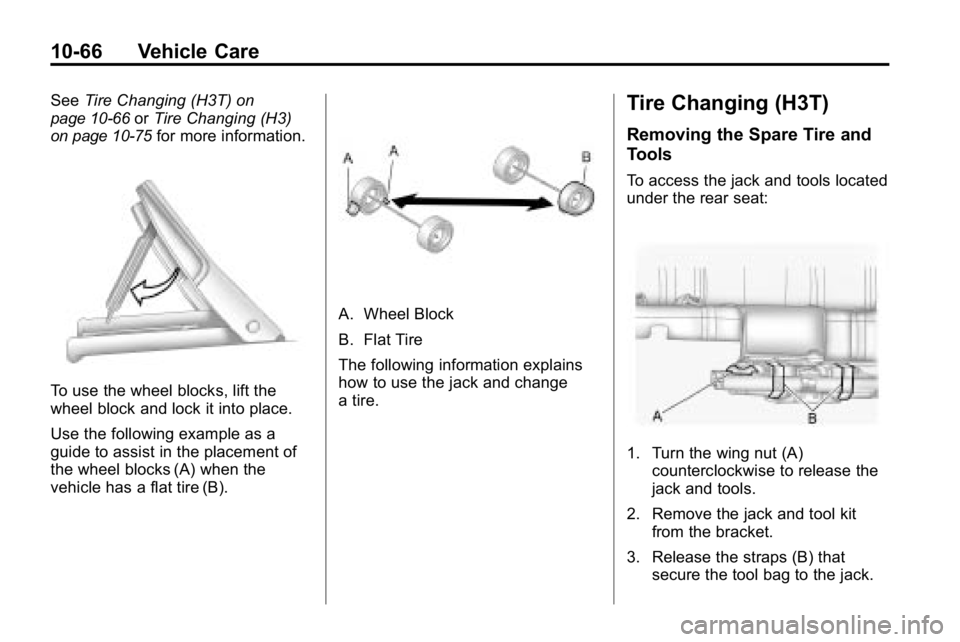
To use the wheel blocks, lift the
wheel block and lock it into place.
Use the following example as a
guide to assist in the placement of
the wheel blocks (A) when the
vehicle has a flat tire (B).
A. Wheel Block
B. Flat Tire
The following information explains
how to use the jack and change
a tire.
Tire Changing (H3T)
Removing the Spare Tire and
Tools
To access the jack and tools located
under the rear seat:
1. Turn the wing nut (A)
counterclockwise to release the
jack and tools.
2. Remove the jack and tool kit from the bracket.
3. Release the straps (B) that secure the tool bag to the jack.
Page 341 of 410
Vehicle Care 10-75
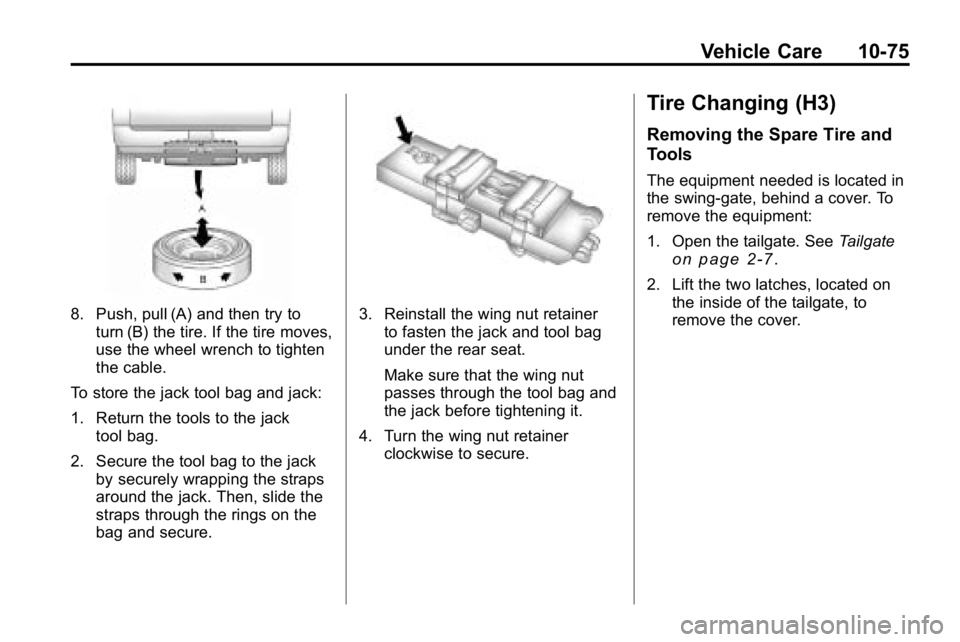
8. Push, pull (A) and then try toturn (B) the tire. If the tire moves,
use the wheel wrench to tighten
the cable.
To store the jack tool bag and jack:
1. Return the tools to the jack tool bag.
2. Secure the tool bag to the jack by securely wrapping the straps
around the jack. Then, slide the
straps through the rings on the
bag and secure.3. Reinstall the wing nut retainerto fasten the jack and tool bag
under the rear seat.
Make sure that the wing nut
passes through the tool bag and
the jack before tightening it.
4. Turn the wing nut retainer clockwise to secure.
Tire Changing (H3)
Removing the Spare Tire and
Tools
The equipment needed is located in
the swing-gate, behind a cover. To
remove the equipment:
1. Open the tailgate. See Tailgate
on page 2‑7.
2. Lift the two latches, located on the inside of the tailgate, to
remove the cover.
Page 342 of 410
10-76 Vehicle Care
3. Turn the wing nutcounterclockwise to release the
jack tool bag and jack and
remove them.
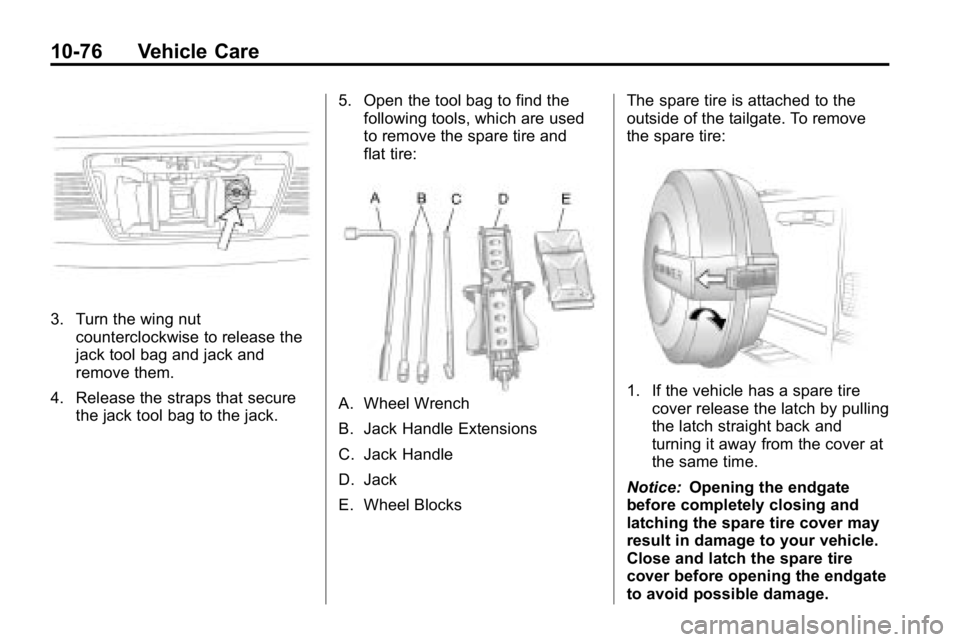
4. Release the straps that secure the jack tool bag to the jack. 5. Open the tool bag to find the
following tools, which are used
to remove the spare tire and
flat tire:
A. Wheel Wrench
B. Jack Handle Extensions
C. Jack Handle
D. Jack
E. Wheel Blocks The spare tire is attached to the
outside of the tailgate. To remove
the spare tire:1. If the vehicle has a spare tire
cover release the latch by pulling
the latch straight back and
turning it away from the cover at
the same time.
Notice: Opening the endgate
before completely closing and
latching the spare tire cover may
result in damage to your vehicle.
Close and latch the spare tire
cover before opening the endgate
to avoid possible damage.
Page 343 of 410
Vehicle Care 10-77
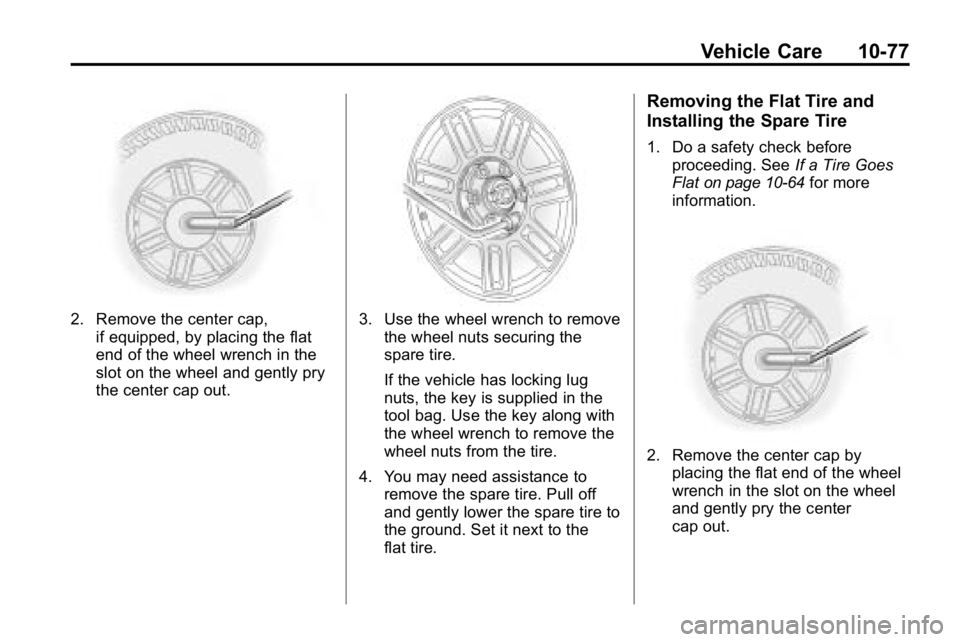
2. Remove the center cap,if equipped, by placing the flat
end of the wheel wrench in the
slot on the wheel and gently pry
the center cap out.3. Use the wheel wrench to removethe wheel nuts securing the
spare tire.
If the vehicle has locking lug
nuts, the key is supplied in the
tool bag. Use the key along with
the wheel wrench to remove the
wheel nuts from the tire.
4. You may need assistance to remove the spare tire. Pull off
and gently lower the spare tire to
the ground. Set it next to the
flat tire.
Removing the Flat Tire and
Installing the Spare Tire
1. Do a safety check before
proceeding. See If a Tire Goes
Flat
on page 10‑64for more
information.
2. Remove the center cap by placing the flat end of the wheel
wrench in the slot on the wheel
and gently pry the center
cap out.